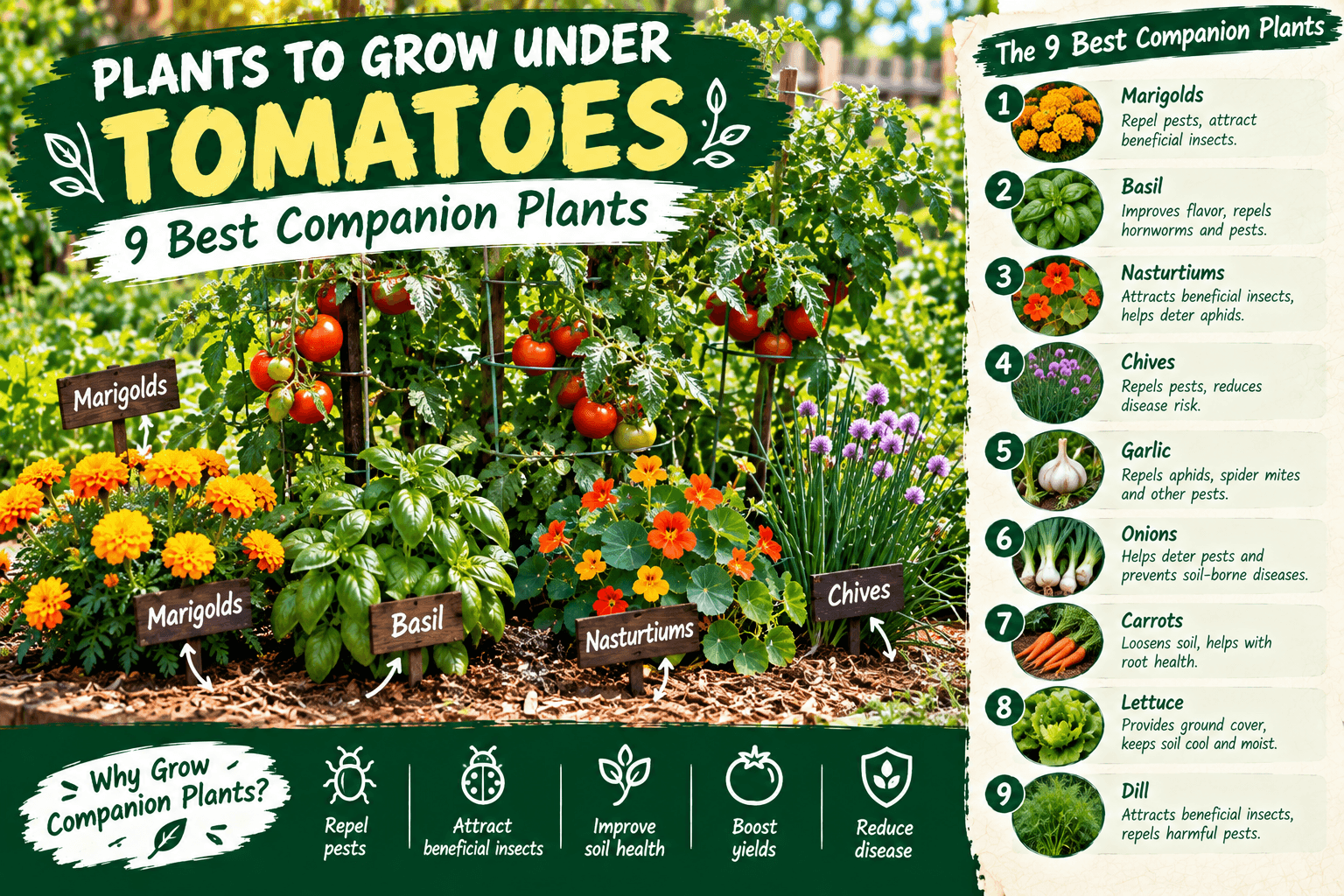
Plants to Grow Under Tomatoes: What Actually Works in My Garden
I Plants to Grow Under Tomatoes . used to think the ground under my tomato plants had to stay empty. Tomatoes get big, they drink a lot, and their roots spread everywhere. So for years I gave them the whole bed like they owned the place.
Then I started experimenting with plants to grow under tomatoes, and honestly, I wish I had tried it sooner.
Some plants helped cover bare soil. Others brought in bees and tiny helpful bugs. A few gave me another harvest from the same little patch of dirt.
Not everything worked, though. I crowded one tomato bed so badly that it looked like a green jungle by July. I could barely find the tomatoes, never mind pick them.
So, lemme show you what I plant under tomatoes now, what I avoid, and how I keep the whole bed from turning into a mess.
Why Grow Anything Under Tomato Plants?
At first, companion planting sounded a little too perfect to me.
You know the kind of thing. Plant this flower and suddenly every bug disappears, your tomatoes double in size, and the garden practically waters itself.
Yeah… gardening doesn’t work like that.
Still, planting under tomatoes can be useful for very simple reasons.
For example, low-growing plants can shade the soil. Because of that, the ground may dry out a little slower during hot weather.
Flowers can also make the bed more inviting to pollinators and other useful insects.
Most importantly for my small backyard garden, I get more food from the same space.
- Less bare soil
- More herbs and salad greens
- More flowers for bees
- A little help with weeds
- Better use of a small backyard bed
That last one matters a lot if you’re doing urban homesteading or backyard farming. I don’t have endless rows of land. Every square foot has a job.
1. Basil Is Still My Favorite Plant to Grow Under Tomatoes
Basil Fits Nicely Between Tomato Plants
If I could choose only one plant to tuck around my tomatoes, I’d probably pick basil.
Part of that is practical. Basil likes warm weather, I use a ton of it in the kitchen, and it stays fairly manageable if I keep cutting it.
Also, tomatoes and basil end up together on my plate all summer anyway, so growing them side by side just makes sense around here.
One summer I planted way too much basil because I didn’t expect all the seeds to sprout.
Well, they did.
I had basil under tomatoes, beside peppers, near the compost pile, and somehow one plant even came up next to the chicken fence.
Instead of pulling it, I started cutting the tops every week. That kept the plants shorter and bushier.
As a result, they didn’t compete with the tomatoes as much for light.
2. Lettuce Works Great Before Summer Gets Too Hot
Lettuce under tomatoes surprised me.
Early in the season, tomato plants are still small, so the lettuce gets plenty of light. Later, as the tomatoes grow, their leaves give the lettuce some shade.
That can be handy when warm weather arrives.
However, lettuce won’t love deep summer heat forever. In my garden, it eventually bolts or gets bitter.
So I treat lettuce as an early crop.
I plant it, harvest it young, and let the tomatoes take over later.
Why I Like This Setup
It means I’m not staring at empty soil for six weeks while I wait for the tomatoes to become big plants.
Instead, I get a few bowls of salad first.
Then the tomatoes move into the spotlight.
That’s the kind of simple stacking I like in a backyard garden.
3. Marigolds Make the Tomato Bed Look Better Too
I’ll admit something.
I first planted marigolds because everybody kept telling me I had to put them near tomatoes.
I expected some kind of miracle.
No miracle happened.
I still saw bugs.
I still had to inspect leaves.
And yes, one tomato hornworm ate half a plant before I noticed the little monster.
Still, I kept the marigolds.
Why?
Because they’re easy, bright, and they bring more insect activity into the garden. Plus, they fill those ugly bare spots around the tomato bed.
They’re also tougher than some fancy flowers I’ve tried.
4. Parsley Is Easy to Tuck Into Empty Spots
Parsley is another good one, especially if you actually use it.
I don’t plant herbs just because some companion chart says I should. If nobody in the house eats the herb, that space could grow something more useful.
Fortunately, parsley gets used around here.
I add it to soups, potatoes, eggs, salads, and whatever else needs something green thrown on top.
It also handles a bit of shade better than some sun-loving herbs.
So once tomato plants get taller, parsley can still hang on underneath them.
Just don’t bury it deep in a dark jungle of leaves. It still needs light and air.
5. Green Onions Don’t Take Much Room
Green onions are one of those plants I squeeze into weird little spaces.
Tomato beds included.
They grow upright, so they don’t spread much across the soil. That makes them useful when room is tight.
I usually plant a few near the outer edge of the bed where I can reach them easily.
Then I pull what I need while cooking.
Simple.
They’re not going to turn a bad tomato bed into a perfect one. Still, they give me another crop without taking over.
6. Spinach Can Work Early in the Season
Spinach is a bit like lettuce in my garden.
I use it early.
Once the weather gets hot, spinach usually decides life is over and starts bolting.
Before that happens, though, it can grow nicely in the open soil between young tomato plants.
This works especially well if you plant tomatoes after the worst cold weather has passed but while spring is still mild.
By the time the tomatoes need more space, I’ve already eaten most of the spinach.
7. Calendula Has Earned a Place in My Garden
I planted calendula years ago because I wanted more flowers mixed into my vegetable beds.
Then it started reseeding itself.
Now it pops up where it feels like it.
Honestly, I don’t mind.
The flowers are bright, they attract insects, and the plants usually behave themselves if I thin them out.
I like a garden that looks alive, not like a military vegetable field with every plant standing in a perfect line.
Calendula gives the tomato patch that slightly wild homestead look I enjoy.
8. Carrots Can Fit Between Tomatoes, But Give Them Space
I’ve grown carrots near tomatoes with mixed results.
The good part is that carrots mostly use space below ground, while tomatoes are doing their big leafy thing above.
However, don’t expect huge perfect carrots if the bed is crowded.
Tomato roots can fill a lot of soil.
Because of that, I usually grow carrots around the outside of the tomato area instead of right at the base.
That gives both crops a little more room.
9. Nasturtiums Are Good for the Edges
Nasturtiums can spread, so I don’t put them directly under the center of my tomato plants.
Instead, I let them grow around the outside of the bed.
They soften the edges and add a lot of color.
Bees seem to enjoy them too.
One year, mine got so enthusiastic that the vines started crawling into the path.
I kept stepping on them while carrying chicken feed.
Not my smartest garden layout.
Now I guide them away from walkways before they become a problem.
10. Small Herbs Can Work, but Don’t Force It
Some herbs can share space with tomatoes, but I’m careful here.
I don’t plant every herb together just because I have an empty spot.
For example, a big rosemary plant can become woody and wide. That’s not something I want squeezed under a tomato vine.
Smaller herbs are easier.
Parsley and basil are usually my first choices.
Meanwhile, I keep bigger perennial herbs in their own area.
What I Don’t Like Growing Directly Under Tomatoes
This part matters just as much as the good companion plants.
Over the years, I’ve learned that more plants does not always mean a better garden.
Sometimes it just means more competition.
- Large spreading squash
- Pumpkins
- Big mature herbs
- Plants that block airflow
- Anything that makes watering and harvesting difficult
Squash is a good example.
I’ve tried squeezing squash near tomato plants because I thought the leaves would cover the soil.
They covered everything alright.
Soon I had vines going through tomato cages, over the path, and halfway toward the compost pile.
Never again.
Don’t Plant Right Against the Tomato Stem
This is probably the biggest mistake people make when choosing plants to grow under tomatoes.
They see empty soil and fill every inch.
I used to do that too.
Now I leave some open space around the main tomato stem.
That makes watering easier. It also improves airflow and gives me space to inspect the plant.
Tomatoes can develop problems fast when leaves stay damp and crowded.
So even though I like companion planting, I don’t build a jungle anymore.
My Simple Tomato Bed Layout
I don’t use a complicated permaculture chart or measure every leaf.
Here’s the simple setup that usually works for me.
- I plant the tomatoes first and give them proper spacing.
- Next, I add basil between some of the plants.
- I put lettuce or spinach in open areas early in the season.
- Then I use marigolds or calendula around the edges.
- I tuck parsley or green onions into spots that are still easy to reach.
- Finally, I mulch the soil that remains uncovered.
That’s it.
Nothing fancy.
As the tomatoes grow, I harvest the smaller plants and remove anything that starts causing crowding.
Watering Tomatoes and Their Companion Plants
Once several plants share one bed, watering needs a little more attention.
I water near the soil instead of spraying everything from above.
That way, tomato leaves stay drier.
Also, I water deeply rather than giving the bed a tiny splash every few hours.
Mulch helps a lot here.
I usually use dry leaves, straw, or whatever clean organic mulch I have around the homestead.
It keeps bare soil covered and slows down water loss.
Just keep mulch a little away from the main tomato stem.
Don’t Forget Compost
Tomatoes are hungry plants.
If you’re growing several crops in one bed, the soil needs to support all of them.
Before planting, I normally work finished compost into the bed.
Not fresh chicken manure. Learned that one the hard way years ago.
Fresh manure can be too strong, and it can create problems you don’t need.
Good finished compost is much easier to work with.
Then I watch the plants during the season instead of automatically throwing fertilizer at them every week.
What About Pests?
Companion plants can make a garden more diverse, but don’t expect them to act like a force field.
I still check tomato leaves.
I still look underneath them.
And I still deal with pests when they show up.
One summer, I was feeling pretty proud of my tomato bed because it had basil, flowers, onions, and mulch.
Then I found a hornworm almost the size of my finger chewing through the top of a plant.
So much for my perfect ecosystem.
The good news is that checking plants often lets you catch trouble early.
What Works Best in a Small Urban Garden?
If your backyard is tiny, keep things simple.
You don’t need ten companion plants around every tomato.
I’d start with basil and one low-growing crop such as lettuce.
Then add a few flowers around the edge if you have space.
Container gardeners can do something similar.
However, don’t pack a tomato and five other plants into one small pot. Containers dry out fast, and tomato roots need room.
In pots, less is usually better.
My Favorite Plants to Grow Under Tomatoes
If you just want the short version, these are the ones I use most often:
- Basil – useful in the kitchen and easy to keep trimmed
- Lettuce – good early crop before summer heat
- Spinach – another nice spring option
- Parsley – handles a little shade
- Green onions – don’t take much space
- Marigolds – easy color around the bed
- Calendula – cheerful flowers and easy to grow
- Nasturtiums – best along the outer edges
- Carrots – useful if they have enough root space
Plants to Grow Under Tomatoes FAQ
Can I plant basil directly under tomato plants?
Yes, but I still give it some room. I don’t plant basil right against the tomato stem. A little spacing makes watering, pruning, and harvesting much easier.
What can I plant under tomatoes for shade?
Lettuce and parsley have worked well for me once tomato plants get taller. However, they still need some light, so don’t bury them under a wall of leaves.
Can I grow vegetables under tomato plants?
Sure. I like lettuce, spinach, green onions, and sometimes carrots. The trick is to choose smaller crops and harvest them before the tomato bed gets too crowded.
Should I completely cover the soil under tomatoes?
No, I wouldn’t. I leave room around the tomato stem for airflow and watering. Then I use mulch for the rest of the bare soil.
What I Would Do If I Was Starting Again
If I had to start a tomato bed from scratch tomorrow, I wouldn’t try to make it look full on planting day.
That’s the mistake.
Tomatoes that look tiny in May can become huge by July.
So I would plant fewer companion plants and give everything room to grow.
I’d put basil nearby, grow a quick crop of lettuce or spinach, add a couple flowers around the edges, then mulch the rest.
Simple beats crowded.
Trust me, I learned the hard way.
Give Your Tomato Bed a Little Company
You don’t need to turn companion planting into some big science project.
Start with one or two plants to grow under tomatoes, see how they behave in your backyard, and change things next season.
That’s basically how I’ve learned most things in homesteading anyway. Try something, mess it up a little, fix it, then pretend you knew what you were doing the whole time.
If your tomato bed has an empty spot, plant a little basil or lettuce there and see what happens.
And if you’ve found a strange tomato companion that works great in your garden, I’d love to hear about it.
SEO Settings for WordPress
Focus Keyphrase: Plants to Grow Under Tomatoes
SEO Title: Plants to Grow Under Tomatoes: 9 Easy Companion Plants
Slug: plants-to-grow-under-tomatoes
Meta Description: Discover the best plants to grow under tomatoes, including basil, lettuce, marigolds, parsley, and more, plus simple companion planting tips from my backyard garden.
Excerpt: Wondering what to plant beneath your tomatoes? Here are the plants I’ve had the best luck growing under tomato plants, plus spacing, watering, and companion planting tips I learned from my own backyard garden.
Category: Backyard Farming
Related Keywords: tomato companion plants, what to plant under tomatoes, companion planting tomatoes, best plants for tomatoes, vegetables to grow with tomatoes, herbs to plant with tomatoes, tomato garden ideas
WordPress tip: If your Astra theme already shows the post title as an H1, remove the H1 from this HTML and use “Plants to Grow Under Tomatoes: What Actually Works in My Garden” as your normal WordPress post title. That avoids having two H1 headings on the same page.