A grapevine can grow into a tangled mass surprisingly quickly if you simply plant it beside a fence and let it go. A good trellis gives the vine a permanent framework, while annual training and pruning keep the fruiting wood, leaves, and grape clusters in useful positions.
The goal is not to make the vine look perfectly symmetrical. It is to create a strong trunk, support productive wood, let sunlight reach the canopy, and make pruning and harvesting manageable.
Quick answer
Train a young grapevine to one or two strong trunks, guide it to the fruiting wire, then develop horizontal canes or permanent cordons according to the training system suited to your grape variety. Prune every dormant season because grapes produce fruit on shoots that grow from buds on one-year-old wood.
Training and Pruning Are Not the Same Thing
These two terms are often mixed together in backyard grape guides.
Training determines the permanent shape of the grapevine and where trunks, cordons, or fruiting canes sit on the trellis.
Pruning removes growth each year and determines how much one-year-old fruiting wood remains for the next crop.
A well-built trellis cannot replace pruning, and careful pruning cannot compensate for a weak trellis.
Understanding the Main Parts of a Grapevine
- Trunk: the permanent upright woody stem.
- Cordon: a permanent horizontal extension of the trunk.
- Shoot: green growth produced during the current season.
- Cane: a shoot after it matures and becomes woody.
- Spur: a short section of one-year-old cane left with a few buds.
- Bud: the point that produces a new shoot, which may carry fruit clusters.
Knowing these terms makes grape pruning much easier to understand.
Why Grapes Need a Strong Trellis
A mature grapevine carries much more weight than the young plant you start with.
The structure eventually supports:
- Permanent woody trunks and cordons
- Long summer shoots
- Dense foliage
- Multiple grape clusters
- Additional load from rain and wind
Build the trellis for the mature vine rather than for a first-year seedling.
Start With Strong End Posts
The end posts carry much of the tension from the trellis wires.
University of Missouri Extension recommends substantial, properly braced wooden end posts for a traditional bilateral-cordon trellis, with the posts set deeply enough to resist wire tension and crop load.
Intermediate posts can generally be lighter because they mainly support the wire between the ends.
Do not copy the post dimensions in a photograph blindly. Soil type, row length, wind exposure, grape vigor, wire tension, and training system all affect how strong the trellis needs to be.
What Wire Should You Use?
Grapevine trellis wire needs to remain strong under long-term tension.
University of Missouri recommends smooth galvanized 10- or 11-gauge wire for its bilateral-cordon system. University of Minnesota similarly notes that fruiting wires are typically heavier than catch wires.
Light decorative wire that works for peas may not be appropriate for a permanent grapevine.
One Wire, Two Wires, or Several?
The number of wires depends on the training system.
| System | Typical Use |
|---|---|
| Single high wire | High-wire cordon and curtain-style systems. |
| Low fruiting wire + catch wires | Vertical shoot positioning and similar systems. |
| Two fruiting wires | Four-cane Kniffin and some divided-canopy systems. |
| Multiple wires | Systems that need additional shoot positioning or canopy division. |
More wires do not automatically mean a better system.
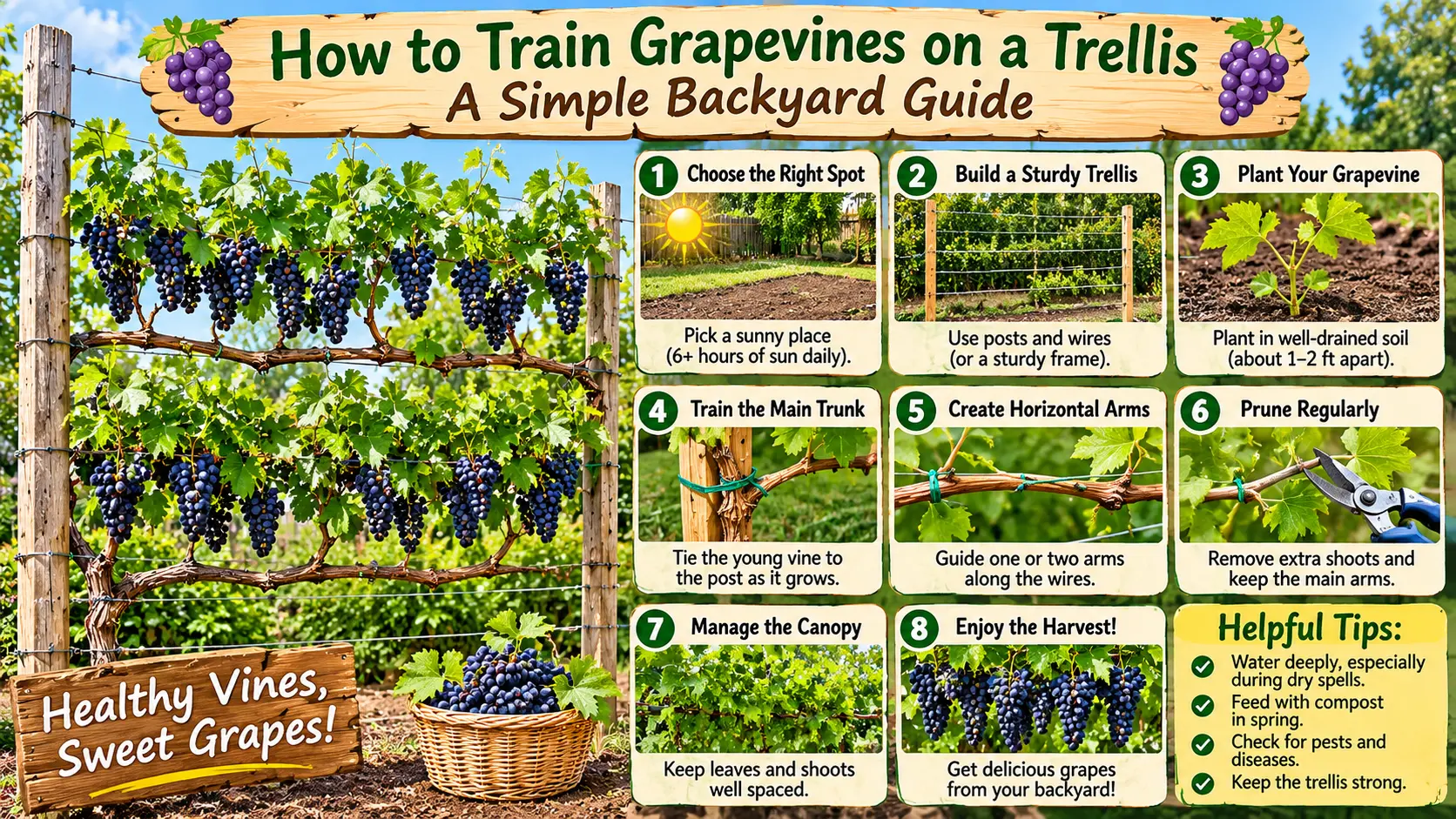
What Training System Does the Pinterest Image Show?
The image shows fruiting growth spread across more than one horizontal level.
It resembles a two-wire or divided system such as a four-cane Kniffin-style arrangement, but a photograph alone is not enough to identify the exact pruning and training system.
That distinction matters because a four-cane Kniffin system normally relies on annually renewed fruiting canes, while a bilateral cordon system keeps permanent horizontal cordons and is commonly spur-pruned.
Bilateral Cordon: A Good Backyard Starting Point
For many grape cultivars, the bilateral cordon is relatively easy to understand.
One trunk grows upward to the fruiting wire. At the top, two permanent arms extend in opposite directions along the wire.
Short fruiting spurs are then maintained along those permanent cordons.
University of Missouri describes this system as useful for many cultivars because it can provide good light penetration, make picking easier, and require relatively little tying once established.
But Not Every Grape Should Be Spur-Pruned
This is an important limitation.
Some cultivars produce better crops when longer one-year-old canes are retained rather than cutting everything into short spurs.
That is why you should identify the cultivar before choosing between:
- Spur pruning
- Cane pruning
- High-wire systems
- Low-wire systems
- Divided canopies
Penn State explains that spur pruning normally retains two to four buds on short sections of one-year-old wood, while cane pruning keeps longer sections with more buds.
Year 1: Build the Trunk, Not a Crop
The first season is mainly about establishing roots and a strong trunk.
A common approach is to:
- Select one strong shoot.
- Train it vertically toward the fruiting wire.
- Tie it loosely to a stake or training string.
- Remove competing growth as appropriate.
- Remove flowers or fruit so energy goes into establishment.
University of Missouri specifically recommends removing flowers during the first growing season to promote strong vine growth.
Year 2: Establish the Fruiting Structure
Once the trunk reaches the appropriate wire, the next goal is to create the horizontal structure required by your chosen system.
For a bilateral cordon, two healthy lateral shoots are trained in opposite directions along the fruiting wire.
University of Minnesota notes that young vines may establish trunks during year one or two and begin establishing fruiting wood during years two or three.
Do not force a weak vine to complete the full framework in one season.
Year 3: Begin Carrying a Crop Carefully
By the third season, a well-established vine may begin carrying a more meaningful crop.
That does not mean every shoot should be allowed to fruit heavily.
The vine still needs enough leaf area and healthy growth to finish establishing its permanent structure.
Why Dormant Pruning Is Essential
Grapes can produce a huge amount of wood in one summer.
If you avoid pruning because removing that much growth feels wrong, the vine eventually becomes crowded, shaded, difficult to harvest, and harder to manage.
Dormant pruning controls:
- The number of buds retained
- Where fruiting shoots will emerge
- Canopy density
- Potential crop load
- Light penetration
When Should You Prune Grapevines?
Pruning is normally done while vines are dormant.
University of Missouri recommends dormant pruning from late December through March in its region and notes that later winter pruning is often preferred because growers can better account for winter injury.
Exact timing depends on your climate, frost risk, and cultivar.
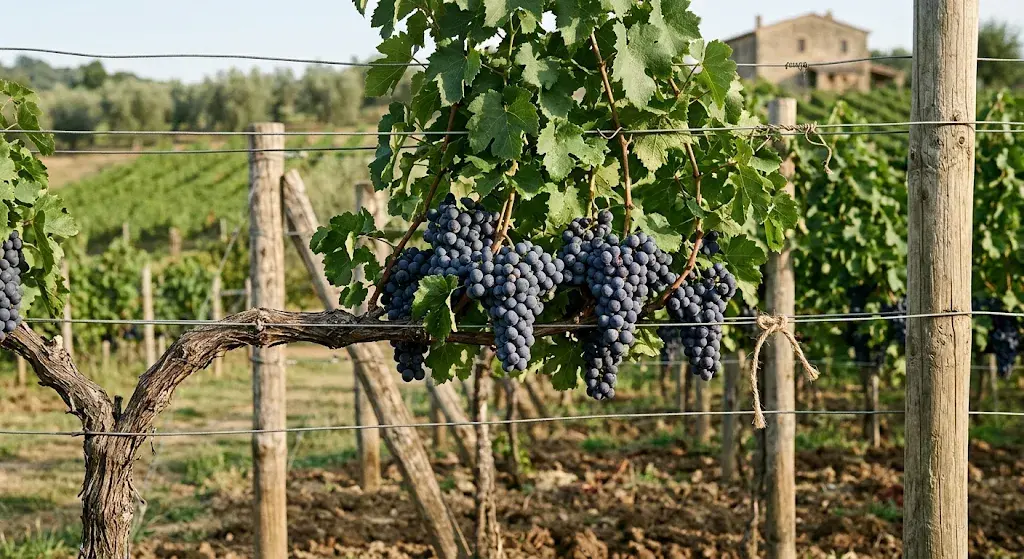
Spur Pruning Explained
With spur pruning, short pieces of one-year-old cane are retained along a permanent cordon.
Penn State explains that these spurs commonly retain only a few buds.
During spring, those buds grow into new shoots that carry the year’s grape clusters.
Cane Pruning Explained
Cane pruning keeps longer one-year-old canes rather than many short spurs.
Those canes are tied to the fruiting wire and replaced with new fruiting canes during future dormant pruning.
Systems such as the four-cane Kniffin are examples of training approaches commonly associated with cane pruning.
Do Not Wrap Permanent Wood Tightly Around the Wire
It can be tempting to twist a young cane repeatedly around the trellis wire to hold it in place.
Avoid tight wrapping.
As the wood expands, wire can become embedded or girdle the developing cordon.
Oregon State recommends only minimal wrapping when training replacement cordons and later unwrapping them so growth does not tighten around the wire.
Tie Vines Loosely
Use flexible ties or appropriate vineyard fasteners.
Ties should hold the cane or trunk in position without cutting into the bark as the vine thickens.
Check permanent ties periodically and replace any that begin constricting the wood.
Summer Shoot Management Matters Too
Winter pruning creates the framework, but the canopy still needs attention during the growing season.
Depending on the training system, summer work may include:
- Removing unwanted trunk shoots
- Thinning crowded shoots
- Positioning shoots upward or downward
- Tucking shoots between catch wires
- Removing damaged growth
The goal is an open, balanced canopy—not a wall of leaves packed tightly around fruit.
More Shoots Do Not Always Mean More Grapes
An overcrowded canopy can reduce light penetration and airflow.
Penn State’s current canopy-management guidance emphasizes maintaining appropriate shoot density and removing weak or crowded shoots where needed.
Exact shoot-density targets vary substantially among wine grapes, hybrids, and native grape cultivars, so do not copy one vineyard number onto every backyard vine.
Sunlight Around the Fruit Zone Matters
Training systems are designed partly to manage light.
Dense leaves above and below multiple fruiting wires can shade grape clusters and lower leaves.
Oregon State specifically notes that one disadvantage of four-cane Kniffin in some cool regions is shading from the upper canopy onto the lower canopy.
Should You Copy the Two-Level System in the Pinterest Image?
Not automatically.
A two-level system can increase canopy area, but it also makes training and pruning more complicated and can create shading between upper and lower fruiting zones.
For one or two backyard vines, a simpler single-fruiting-wire system may be easier to maintain unless your cultivar specifically benefits from another design.
Best first question: What grape cultivar are you growing? The correct pruning and training system should follow the cultivar’s fruiting habit and vigor—not a Pinterest photo.
What About Table Grapes?
Table grapes can be trained on several different systems depending on climate and cultivar.
Oregon State’s home table-grape guide discusses systems including vertical hedgerow, Scott Henry, and four-cane Kniffin.
The best system is therefore not determined simply by whether the grapes are eaten fresh or made into wine.
What About Grapes on a Fence?
A strong fence can sometimes function as part of a grape support system, but you still need a deliberate training plan.
Missouri Extension notes that fan systems can be useful for walls and fences.
Make sure the structure:
- Can carry mature vine weight
- Allows pruning access
- Does not trap the vine tightly against an inaccessible wall
- Provides room for airflow
What About a Grape Arbor or Pergola?
Grapes can also be trained over arbors and pergolas.
These systems can provide shade and fruit, but pruning is often less convenient because much of the canopy is overhead.
If your main goal is easy pruning and fruit production, a simple vertical trellis is often easier to manage.
A Simple Backyard Training Timeline
| Stage | Main Goal |
|---|---|
| Planting / Year 1 | Build roots and one strong trunk. |
| Year 2 | Establish cordons or future fruiting canes. |
| Year 3 | Complete the training framework and begin carrying a controlled crop. |
| Mature years | Dormant prune annually and manage shoots during summer. |
8 Common Grapevine Trellis Mistakes
1. Building a weak trellis
Mature vines, wet foliage, fruit, and wind place considerable load on wires and posts.
2. Choosing a training system before identifying the cultivar
Different cultivars may perform better with cane or spur pruning.
3. Allowing young vines to carry too much fruit
Early years should prioritize roots, trunk, and structural development.
4. Refusing to prune hard enough
Grapevines produce large amounts of annual wood and need regular dormant pruning.
5. Tying permanent wood too tightly
Tight wire or ties can constrict growing trunks and cordons.
6. Letting multiple tiers shade each other
Divided canopies require more careful shoot and light management.
7. Ignoring summer shoot management
Winter pruning alone does not guarantee an open, balanced canopy.
8. Copying vineyard spacing exactly into a tiny backyard
Spacing should account for cultivar vigor, trellis style, site, pruning system, and access.
Grapevine Trellis FAQ
Do grapevines need a trellis?
Most backyard grapevines benefit greatly from a permanent support because the trellis holds the woody framework, annual shoots, and fruit crop in manageable positions.
How many wires does a grape trellis need?
It depends on the training system. Some systems use one main fruiting wire, while others use additional catch wires or two fruiting levels.
What is the easiest grape training system?
A simple bilateral cordon is relatively easy to understand for cultivars suited to spur pruning, but the correct system depends on the grape variety and local growing conditions.
Should grapes be trained horizontally?
Many systems use horizontal fruiting canes or permanent cordons, but shoot direction varies. Some systems train new shoots upward, while others allow them to hang downward.
When do grapes begin producing?
A young vine may produce some fruit early, but Extension recommendations generally emphasize establishing the vine structure during the first two seasons and allowing a more meaningful crop in later years.
Should I cut grapevines back every year?
Yes. Annual dormant pruning is a core part of grape production because the next crop grows on shoots originating from buds on retained one-year-old wood.
Can I use barbed wire for a grape trellis?
Smooth galvanized vineyard-style wire is generally a better choice for training grapes. Extension trellis recommendations commonly specify smooth galvanized wire rather than barbed wire.
The Bottom Line
A productive grapevine starts with more than a strong set of wires.
The trellis needs to match the training system, and the training system needs to match the cultivar and growing conditions.
Build a strong support, establish the trunk before pushing for fruit, train healthy wood deliberately, and prune every dormant season.
The two-tier grapevine in the inspiration image is possible, but it is not automatically the best design for a backyard vine. For many gardeners, one well-managed fruiting zone is easier and more productive than a complicated multi-level trellis.
Sources
- University of Minnesota Extension — Trellises for Grapes
- University of Minnesota Extension — How to Train Young Grapevines
- University of Missouri Extension — Home Fruit Production: Grape Training Systems
- Penn State Extension — Grapevine Cane and Spur Pruning Fundamentals
- Oregon State University Extension — Growing Table Grapes