An off-grid earth oven can bake bread, pizza, vegetables, and other foods using wood instead of electricity—but the most important part of the oven is not the rustic clay exterior. It is the hidden relationship between the firebox, hot-gas path, baking chamber, chimney, insulation, and thermal mass.
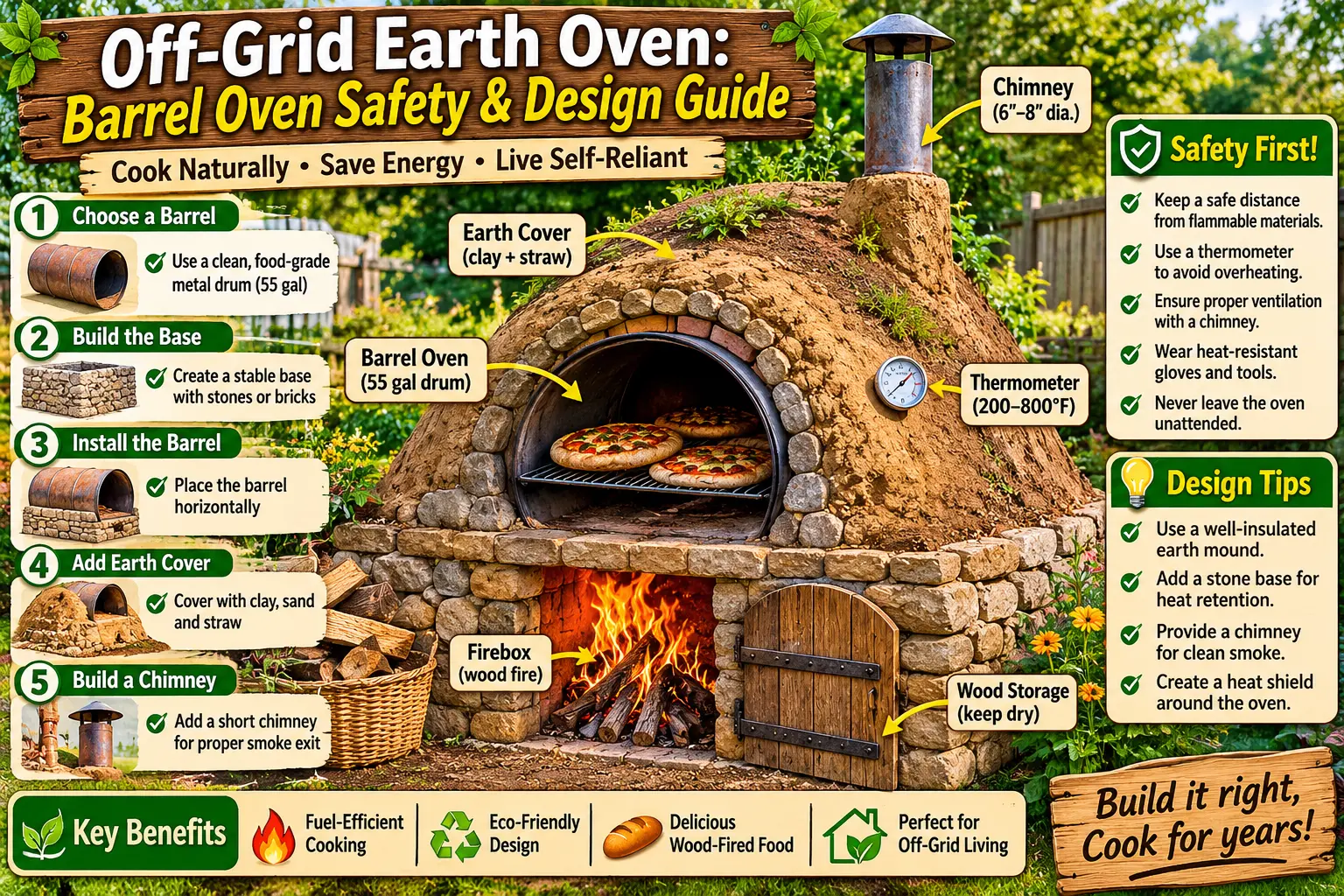
The Pinterest image shows a barrel-style indirect-fired oven: the food sits inside a metal baking chamber while hot combustion gases appear to travel around the outside of the barrel before exiting through a chimney.
That is different from a traditional direct-fired cob or masonry oven where the fire burns inside the same chamber that later holds the food.
Quick answer
The concept can work, but the Pinterest image should be treated as inspiration, not a build plan. A real wood-fired barrel oven needs a safe outdoor location, high-temperature materials, reliable chimney draft, controlled airflow, adequate insulation, thermal expansion allowance, a stable foundation, and a smoke path that cannot leak into the baking chamber.
What Is an Off-Grid Earth Oven?
An earth oven is an outdoor oven that uses mineral materials such as clay, sand, earth, brick, or stone to absorb and manage heat.
Some designs burn the fire directly inside the baking chamber. Others use a separate firebox and route hot gases around a cooking chamber.
The Pinterest design belongs closer to the second category.
How the Barrel-Style Concept Works
The basic concept shown in the image appears to use five elements:
- A wood-burning firebox
- A metal barrel used as the baking chamber
- A path for hot combustion gases around the barrel
- Earth or masonry thermal mass around the hot zone
- A chimney to carry smoke away
If properly designed, the barrel heats from the outside while food stays separated from the smoke stream.
1. The Baking Chamber Must Stay Separate From Smoke
The biggest advantage of an indirect-fired barrel oven is that smoke and flame do not need to pass directly over the food.
But that advantage only exists if the baking chamber is truly isolated from the combustion gases.
Any barrel, weld, door, flange, seam, or penetration that separates smoke from food must remain intact at high temperature. A decorative clay shell cannot compensate for a leaking metal cooking chamber.
2. Do Not Use an Unknown Salvaged Drum for Cooking
A reused steel drum may look ideal for this project, but its previous contents matter.
Avoid barrels that:
- Held fuels
- Held solvents
- Held pesticides
- Held industrial chemicals
- Have unknown interior coatings
- Have an unknown history
Heat can release residues and coating breakdown products that you do not want near food.
3. A Firebox Is More Than a Hole for Firewood
The image shows a low firebox below the barrel.
A real firebox needs to tolerate repeated high temperatures and direct flame without rapidly cracking, deforming, or exposing combustible materials.
Use materials intended for high-temperature masonry or stove applications rather than ordinary decorative block, random stone, painted metal, or untreated construction scraps inside the hottest zones.
4. Chimney Draft Controls the Whole System
The chimney is not just a smoke outlet.
It helps create the pressure difference that moves combustion air through the firebox and pulls hot gases through the oven.
Poor draft can lead to:
- Smoke spilling from the firebox
- Incomplete combustion
- Weak heat transfer
- Soot buildup
- Creosote accumulation
- Unstable oven temperatures
EPA guidance for wood-burning systems stresses that installation and venting quality directly affect both safety and emissions.
5. Do Not Try to Trap Every Bit of Heat
The Pinterest diagram emphasizes long heat flow around the barrel.
That sounds efficient, but a chimney still needs exhaust gases warm enough to maintain draft.
If a DIY design removes too much heat before gases reach the chimney, draft can become weaker and deposits can increase.
More heat capture is not automatically safer or more efficient.
6. Thermal Mass and Insulation Do Different Jobs
The image describes the surrounding earth as thermal mass.
That is only part of the thermal design.
| Layer | Main Job |
|---|---|
| Thermal mass | Absorbs and stores heat |
| Insulation | Slows heat loss |
| Weather layer | Protects earth materials from rain |
A massive oven with little insulation may absorb large amounts of heat but also require more fuel and longer firing before it becomes useful.
7. Wet Earth and High Heat Are a Bad Combination
Clay and earth construction can perform well around ovens when the material is appropriate and fully dried.
But trapped moisture expands rapidly when heated.
Newly built earthen sections should be dried gradually rather than exposed immediately to the hottest possible fire.
The same caution applies after prolonged rain if moisture has penetrated the oven body.
8. The Oven Needs a Real Foundation
An earth-and-masonry oven can become extremely heavy.
The foundation needs to account for:
- Oven mass
- Firebox mass
- Chimney mass
- Soil bearing capacity
- Drainage
- Freeze-thaw conditions where applicable
Building a heavy oven directly on soft garden soil can lead to uneven settling and cracking.
9. Keep the Oven Well Away From Combustibles
Wood-fired outdoor cooking equipment should be located where sparks, radiant heat, or chimney exhaust cannot ignite nearby structures or dry vegetation.
University of Minnesota advises outdoor grills to be used outdoors and kept at least 10 feet from buildings. A custom high-temperature wood-fired oven can require equal or greater caution depending on its design and local rules.
Check local fire and building requirements before choosing the site.
10. Do Not Build It Under a Low Roof
A sheltered outdoor kitchen can be convenient, but enclosing a wood-fired oven changes the ventilation and fire risk.
Wood combustion produces carbon monoxide and other combustion gases.
UMN notes that carbon monoxide is produced when wood and other fuels burn and that inadequate ventilation can allow dangerous gas levels to accumulate.
Use a DIY earth oven as outdoor equipment. Do not move it into a garage, shed, greenhouse, enclosed porch, or other semi-enclosed space simply because the weather is bad.
11. Burn Clean, Dry, Untreated Wood
Penn State recommends avoiding treated, stained, toxic, or rotten wood in wood-burning systems.
Do not burn:
- Painted lumber
- Pressure-treated lumber
- Plywood scraps with adhesives
- Particleboard
- Trash
- Plastics
- Unknown pallet wood
- Toxic plants such as poison ivy
Use clean, seasoned firewood appropriate for cooking fires.
12. The Oven Door Should Not Be Ordinary Wood Near Direct Flame
The Pinterest graphic labels a heavy wooden door beside the firebox.
That detail should not be copied literally without understanding the heat exposure.
Any component close to direct flame or hot exhaust needs to be made from, protected by, or separated with materials suitable for the temperatures involved.
13. The Metal Barrel Will Expand When Heated
Steel expands as it gets hot and contracts as it cools.
If a metal barrel is rigidly trapped inside a brittle earthen or masonry shell without allowance for movement, repeated heating cycles can contribute to cracking or deformation.
This is another reason the Pinterest cross-section should not be treated as a literal construction drawing.
14. You Need a Way to Inspect and Clean the Smoke Path
Any wood-burning system can accumulate ash, soot, and deposits.
If the smoke path is completely buried inside earth with no access points, maintenance becomes difficult.
EPA emphasizes regular chimney and vent inspection because cracks, blockages, and deposits can create fire and smoke hazards.
15. Do Not Guess the Cooking Temperature
One advantage of a metal baking chamber is that it can be fitted with an appropriate oven thermometer.
Wood-fire intensity alone does not tell you the temperature at the food.
Bread, pizza, roasting, and slow baking all need different heat conditions.
Barrel Oven vs. Traditional Cob Oven
| Feature | Barrel-Style Oven | Traditional Earth/Cob Oven |
|---|---|---|
| Food chamber | Metal chamber | Masonry or earthen chamber |
| Smoke around food | Can be separated in indirect designs | Often direct-fired before baking |
| Heat-up behavior | Metal responds relatively quickly | Thermal mass takes longer to heat |
| Thermal expansion | Important metal-design issue | Less metal movement |
| DIY complexity | High if smoke is routed around the barrel | Different but still requires careful thermal design |
What the Pinterest Image Gets Right
- Separates the firebox from the baking chamber.
- Uses thermal mass to store heat.
- Includes a chimney rather than allowing smoke to drift randomly.
- Uses wood as an off-grid heat source.
- Shows that heat needs a deliberate path around the oven.
What the Pinterest Image Leaves Out
| Visible Idea | Critical Hidden Detail |
|---|---|
| Metal barrel | Previous contents, coating, heat rating, expansion |
| Firebox | Refractory materials and airflow |
| Earth shell | Insulation, moisture protection, cracking |
| Heat arrows | Actual flue sizing and draft performance |
| Chimney | Height, clearances, inspection, cleanout |
| Outdoor location | Fire separation and local rules |
8 Mistakes to Avoid
1. Copying the diagram exactly
The graphic explains a concept, not a tested construction specification.
2. Using an unknown chemical drum
Unknown residues and coatings do not belong in a food-heating system.
3. Using ordinary wood inside high-heat zones
Combustible materials need appropriate separation from flame and exhaust.
4. Building before the earth has dried
Trapped moisture and rapid heating can damage an earthen structure.
5. Making the flue path too complicated
Too much resistance can weaken draft and increase smoke problems.
6. Burning treated or painted lumber
Burn only clean, appropriate firewood.
7. Building too close to a house or dry vegetation
Radiant heat, sparks, and chimney exhaust need safe separation.
8. Never inspecting the chimney
Soot, creosote, cracks, and blockages can create fire and smoke hazards.
Off-Grid Earth Oven FAQ
Can an earth oven bake bread?
Yes. Properly designed earth and masonry ovens have been used for bread and other baked foods for generations. The oven still needs predictable temperature control and safe construction.
Can you use a steel barrel as an oven?
A suitable metal chamber can be part of an outdoor oven design, but avoid unknown drums, incompatible coatings, and designs that expose food to combustion gases through leaks.
Does earth insulation keep the oven hot?
Dense earth mainly provides thermal mass. True insulation requires a low-conductivity layer that slows heat loss.
Can I use an earth oven inside a shed?
A DIY wood-fired earth oven should be treated as outdoor combustion equipment unless a professionally designed installation and applicable codes specifically allow otherwise. Wood combustion produces carbon monoxide and fire hazards.
Can I burn pallet wood?
Avoid unknown pallet wood. Use clean, known, untreated, seasoned firewood instead.
Is this the same as a rocket oven?
Not necessarily. Some barrel ovens use rocket-style combustion principles, but the Pinterest image alone does not establish that the firebox and flue geometry meet a proven rocket-oven design.
The Bottom Line
The off-grid earth oven shown in the Pinterest graphic is an interesting idea because it combines a wood fire, an indirect metal baking chamber, thermal mass, and a chimney without relying on electricity.
The concept is believable. The drawing is not a complete construction plan.
The safest way to approach a project like this is to start with a proven outdoor wood-fired oven design, then adapt the appearance—not invent the combustion system from a social-media diagram.
Firebox materials, chimney draft, clearances, thermal expansion, smoke isolation, foundation, weather protection, and inspection access all matter more than the rustic finish on the outside.
Planning a complete outdoor cooking area?
See FarmSolo’s DIY Outdoor Cooking Station guide for counters, workspace, storage, and practical backyard cooking layout ideas.
Prefer brick construction?
FarmSolo’s DIY Outdoor Brick Kitchen covers a different type of permanent backyard cooking space.
Sources
- U.S. Environmental Protection Agency — Wood-Burning Installation and Maintenance
- University of Minnesota Extension — Preparing Food Without Power
- Penn State Extension — Heating With Wood: An Introduction
- National Fire Protection Association — Cooking Fire Safety