An attached greenhouse with tropical plants, a small pond, and a garden path can feel like a private indoor jungle—but combining glass, warm air, plants, open water, and the wall of your house creates a much more demanding environment than an ordinary greenhouse.
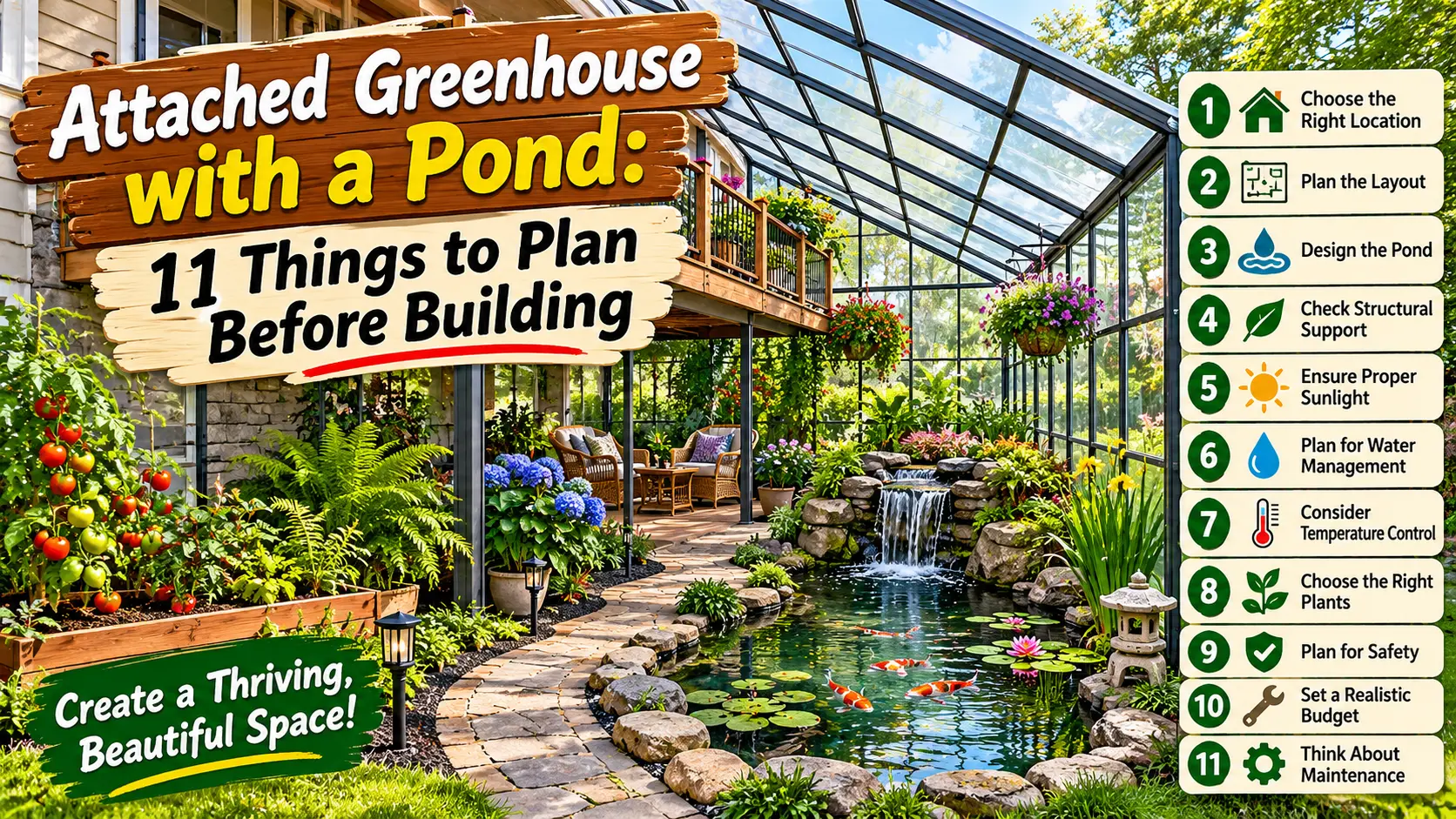
The Pinterest design is beautiful inspiration. It shows a glazed lean-to structure connected to a home, tropical foliage, orchids, a narrow pond with a waterfall, and an upper sitting area overlooking the plants.
What the illustration cannot show is the part that determines whether the space remains beautiful: waterproofing, ventilation, condensation control, drainage, greenhouse heating and cooling, pond filtration, electrical safety, and the structural connection to the house.
Quick answer
Treat an attached greenhouse with a pond as a moisture-controlled building, not simply a glass room full of plants. Start with the structure, waterproofing, drainage, ventilation, heating and cooling, then design the pond and planting around the environment you can realistically maintain.
What Is an Attached Greenhouse?
An attached greenhouse uses an existing building as part of its structure.
A common version is the lean-to greenhouse, which is built against one wall of a house, garage, workshop, or other permanent building.
This arrangement can provide:
- Easy access from the house
- Shared utility access
- Some protection from wind
- A solid wall that can contribute thermal mass
- A convenient place for year-round plant care
But sharing a wall also means greenhouse moisture and condensation must not be allowed to damage the house.
1. Start With the House Wall, Not the Plants
The first question should not be which orchids or banana plants you want.
The first question is whether the house wall, foundation, flashing, glazing connection, roof connection, and drainage can safely handle a warm humid space attached to them.
An attached greenhouse can create much higher moisture levels than the neighboring rooms inside the house.
Do not simply bolt greenhouse framing against existing siding. The junction between greenhouse and house needs appropriate structural attachment, flashing, water management, and air sealing for the actual building.
2. Humidity Is the Biggest Hidden Challenge
Plants release water vapor. Damp growing media releases water vapor. A pond releases water vapor. A waterfall increases evaporation even further.
That can be useful for humidity-loving tropical plants, but excess greenhouse humidity creates another problem: condensation.
Warm moist air contacting cold glazing, metal framing, masonry, or the wall of the house can turn into liquid water.
Persistent condensation can contribute to:
- Mold
- Wood decay
- Peeling finishes
- Corrosion
- Plant disease
- Water staining
- Hidden moisture inside wall assemblies
3. A Pond Does Not Replace Humidity Control
It is tempting to think of a greenhouse pond as a free natural humidifier.
Technically, open water does add moisture to the air.
But more humidity is not always better.
The greenhouse needs a balance between:
- Plant humidity requirements
- Temperature
- Air movement
- Ventilation
- Condensation prevention
- Disease control
Design the pond after you understand that balance rather than adding the largest water feature the floor can hold.
4. Ventilation Is Essential
A greenhouse can overheat on a bright day even when outdoor temperatures feel comfortable.
Ventilation has several jobs:
- Remove excess heat
- Remove moist air
- Reduce condensation
- Bring in fresh air
- Improve plant transpiration
- Reduce conditions favorable to some plant diseases
Possible systems include roof vents, side vents, intake openings, exhaust fans, and horizontal air-flow fans.
The correct setup depends on greenhouse size, glazing, climate, plant load, and heat gain.
5. Air Movement and Ventilation Are Not the Same Thing
A circulation fan moves existing greenhouse air around.
Ventilation replaces some greenhouse air with outside air.
A well-designed greenhouse may need both.
Air circulation helps prevent stagnant wet pockets behind dense tropical leaves and can make temperature and humidity more uniform throughout the space.
6. Plan Drainage Before Building the Pond
Every greenhouse needs a strategy for unwanted water.
With a pond, you also need to think about:
- Pond overflow
- Filter cleaning water
- Accidental spills
- Leaking plumbing
- Condensation dripping from glazing
- Water from irrigation
- Floor washing
A decorative floor that has nowhere to drain can become a serious problem when a pipe fitting fails.
Think like a wet room
Choose moisture-tolerant flooring, slope water where appropriate, and keep drainage routes accessible for maintenance.
7. The Pond Needs Its Own System
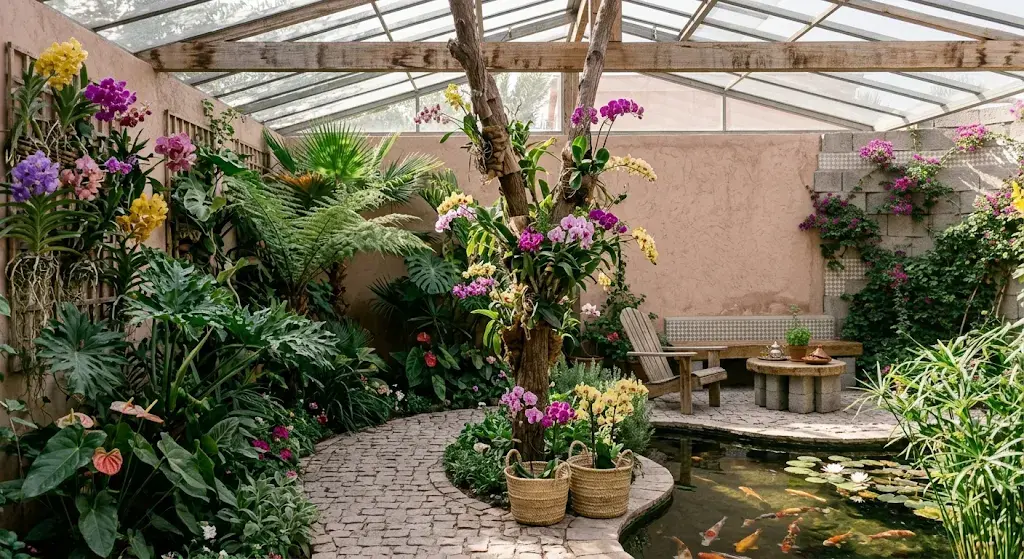
The pond in the illustration contains fish and a waterfall.
That should not be treated as a simple decorative tub filled with water.
A fish pond may need:
- Appropriate filtration
- Water circulation
- Aeration
- Safe pond depth and volume
- Water-quality monitoring
- Accessible maintenance equipment
- A safe overflow route
Do not add fish simply because the concept drawing shows koi.
A Pond Is Not Automatically Aquaponics
A greenhouse containing both plants and fish is not automatically an aquaponic system.
Aquaponics intentionally connects fish production with plant production through water circulation and biological filtration.
If the plants are simply growing in normal beds beside a decorative pond, it is still just a greenhouse with a pond.
Keep the systems separate unless you intentionally design and manage an aquaponic loop.
8. Water Can Provide Thermal Mass—but It Is Not Free Heat
A greenhouse pond contains a large mass of water.
Water can absorb heat when the greenhouse is warm and release some of it as temperatures fall.
That can help soften temperature swings.
Thermal mass stores energy; it does not create energy. After several cold or cloudy days, a pond cannot keep providing heat unless energy entered the system from sunlight or another heat source.
9. Heating and Cooling Need to Be Planned Together
A tropical greenhouse can need heat at night and cooling during a sunny afternoon on the same day.
Possible temperature-control tools include:
- Automatic roof vents
- Exhaust fans
- Circulation fans
- Shade cloth or exterior shading
- Heating systems designed for greenhouse use
- Thermostatic controls
- Humidity monitoring
Designing only for winter cold can leave you with an unusably hot greenhouse in spring and summer.
10. Do Not Choose Plants From the Illustration Alone
The concept image appears to include banana-like plants, orchids, bromeliad-type plants, ferns, and other tropical ornamentals.
Those plants do not all require identical conditions.
Before combining them, compare:
- Temperature range
- Humidity preference
- Light intensity
- Root-zone moisture
- Mature height and width
- Airflow needs
Create plant zones instead of trying to maintain one identical environment everywhere.
Use the Brightest Areas Wisely
Tall plants can quickly shade everything behind them.
Place plants according to mature size rather than their size when purchased.
A young banana plant beside the glazing may look perfect today and become a major shade source later.
11. Electrical Work Around Water Needs Extra Care
A greenhouse pond may use pumps, filters, lights, fans, heaters, controls, and irrigation equipment in an environment where floors can become wet.
This is not a good place for improvised extension cords or indoor-only electrical equipment.
Use equipment rated for the intended damp or wet location and follow applicable electrical requirements. Permanent wiring and circuits near water should be planned appropriately for the installation.
Waterfall pumps and decorative lights look simple after installation. The electrical protection behind them is not the part to improvise.
What About the Upper Balcony?
The illustration includes an elevated sitting platform connected to the house.
That transforms the idea from a simple greenhouse into a much more substantial building project.
An elevated occupied platform introduces:
- Structural loads
- Guard requirements
- Stair or access requirements
- Waterproofing
- Connections to the house
- Possible building permits
Treat it as building structure, not greenhouse shelving.
A Simpler Version for Most Backyards
You do not need the full two-story Pinterest design to create the same feeling.
A simpler version could use:
- A single-story attached lean-to greenhouse
- A waterproof floor with drainage
- A narrow central path
- A small raised or lined pond
- One modest recirculating waterfall
- Large tropical foliage at the back
- Lower plants near the path
- Hanging orchids or epiphytes where conditions suit them
- Automatic ventilation
- A small seating area rather than an upper balcony
That keeps the immersive garden feeling without adding another occupied structural level.
Attached vs. Freestanding Greenhouse
| Feature | Attached | Freestanding |
|---|---|---|
| House access | Excellent | Requires outdoor access |
| Moisture risk to house | Higher if poorly detailed | Separated from house |
| Utility access | Often convenient | May require longer runs |
| Orientation flexibility | Limited by house | More flexible |
| Pond leak consequences | Potentially more serious | Usually farther from living space |
What the Pinterest Design Gets Right
- Combines vertical and ground-level planting
- Uses water as a strong focal point
- Creates a clear walking path
- Uses tall plants to create an immersive environment
- Adds hanging plants without using floor space
- Uses glazing to bring light deep into the space
- Creates a place for people as well as plants
What the Illustration Leaves Out
| Visible Idea | Hidden Requirement |
|---|---|
| Glass roof | Wind, snow, drainage, flashing, overheating control |
| Tropical plants | Heating, humidity, light, airflow |
| Pond and waterfall | Waterproofing, filtration, overflow, electrical safety |
| Attached wall | Moisture protection and structural connection |
| Upper sitting area | Structural engineering, guards, waterproofing, permits |
8 Common Mistakes to Avoid
1. Adding a pond before designing ventilation
Open water increases the moisture load inside the greenhouse.
2. Treating the house wall like an outdoor greenhouse wall
Moisture entering a house wall can create hidden damage.
3. Designing for winter but forgetting summer
Large glazed spaces can overheat rapidly in strong sunlight.
4. Using a waterfall only for appearance
A waterfall increases evaporation, noise, electrical demand, and maintenance.
5. Adding fish without a pond-management plan
Fish increase filtration, oxygen, water-quality, and maintenance requirements.
6. Packing the greenhouse with tropical plants immediately
Plant for mature size and maintain enough airflow between leaves.
7. Forgetting floor drainage
Leaks and irrigation water need a safe route away from the house.
8. Copying the structural design from an illustration
A Pinterest drawing does not provide foundations, connection details, roof-load calculations, waterproofing, ventilation sizing, or electrical plans.
Attached Greenhouse With Pond FAQ
Can you put a pond inside a greenhouse?
Yes. A greenhouse can include an ornamental or functional pond, but you need to account for evaporation, humidity, structural weight, waterproofing, overflow, filtration, and maintenance.
Will a pond keep a greenhouse warm?
Water can act as thermal mass and reduce temperature swings, but it is not a heat source. The greenhouse still needs adequate solar gain, insulation, and supplemental heat where the climate requires it.
Does a greenhouse pond increase humidity?
Yes. Open water contributes moisture through evaporation, and moving water can increase evaporation further. Ventilation and air circulation must be designed accordingly.
Can orchids grow in a greenhouse with a pond?
Many orchids appreciate elevated humidity, but requirements differ greatly among orchid types. Temperature, light, airflow, and root-zone moisture are just as important as humidity.
Is an attached greenhouse better than a freestanding greenhouse?
An attached greenhouse can offer easier access and utility connections, while a freestanding greenhouse gives more flexibility in location and separates greenhouse moisture from the house. The better option depends on the site and goals.
Is a greenhouse pond the same as aquaponics?
No. Aquaponics deliberately circulates nutrient-rich fish water through a plant-growing and biological filtration system. A decorative pond beside conventional greenhouse plants is not aquaponics.
Do I need greenhouse fans if I have roof vents?
Possibly. Roof vents exchange air, while circulation fans move air inside the greenhouse. Large, densely planted, humid spaces often benefit from deliberate air circulation as well as ventilation.
The Bottom Line
An attached greenhouse with a pond can be an extraordinary backyard growing space, especially for tropical ornamentals and year-round garden enjoyment.
The Pinterest illustration gets the experience right: light, plants, moving water, a winding path, vertical planting, and a place to sit among the greenery.
The mistake would be designing the pond and plants first and treating ventilation, drainage, waterproofing, structure, and humidity as details to solve later.
Build the moisture-control system first. Then add the tropical garden around the environment the greenhouse can actually maintain.
Considering another greenhouse design?
See FarmSolo’s Underground Greenhouse: 9 Things to Know Before Building for a very different greenhouse approach built around earth sheltering, drainage, winter sun, and thermal mass.
Planning the whole property?
FarmSolo’s Permaculture Homestead Layout guide can help place greenhouse, water, garden, trees, paths, compost, and other permanent systems in the right order.
Sources
- University of Georgia Cooperative Extension — Hobby Greenhouses
- University of Georgia Cooperative Extension — Greenhouses: Heating, Cooling and Ventilation
- Penn State Extension — Assessing the Risk of Disease in Greenhouses
- University of Minnesota Extension — Controlling Moisture Problems in Your Home
- Penn State Extension — Humidity and Houseplants