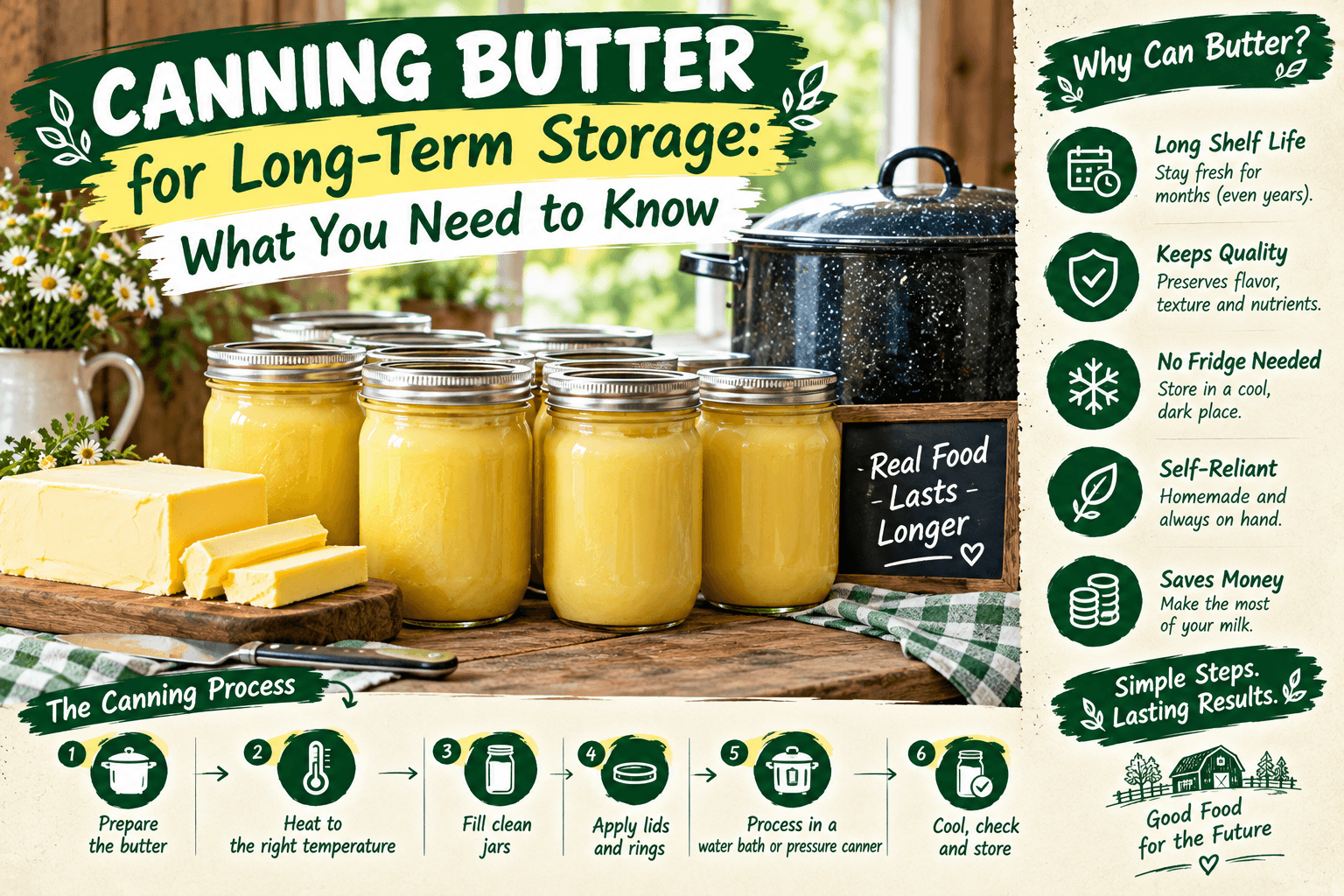
Canning Butter for Long-Term Storage: What I Learned the Hard Way
If you’ve spent any time around homesteading groups, you’ve probably seen people talking about canning butter for long-term storage.
The idea sounds pretty good. Buy butter when it’s cheap, melt it, put it into jars, seal the jars, and keep them in the pantry for months or even years.
I understand why people like the idea. I do too.
But there’s an important problem here. The popular homemade butter-in-a-jar method you see online is not a tested home-canning process. The National Center for Home Food Preservation does not recommend storing butter processed this way at room temperature.
So let me show you what I learned and what I do instead when I want butter stored for the long haul.
Why I Started Looking Into Canning Butter
Butter is one of those foods I don’t like running out of.
I use it for cooking, baking, toast, mashed potatoes, vegetables, and probably more things than I realize. When butter goes on sale, my first thought is usually, “How much freezer space do I have?”
That’s how I got interested in long-term butter storage.
Here’s the funny part. I originally thought storing butter in jars would be easy. I’ve canned tomatoes, pickles, fruit, and other foods over the years, so I figured butter couldn’t be that complicated.
Then I started looking into the actual food-safety side of it.
That’s when I realized something important: just because a jar seals doesn’t mean the food inside is safely canned.
Is Canning Butter Actually Safe?
This is the question that matters most.
The answer is that there is no research-tested home-canning process from the USDA/National Center for Home Food Preservation for butter that makes it shelf-stable at room temperature.
Butter is mostly fat, but it also contains water and other components. It is considered a low-acid food. The National Center for Home Food Preservation explains that butter and other low-acid foods can present concerns with Clostridium botulinum when stored in sealed containers without a validated process.
And this is where I think some online recipes get confusing.
You might see someone melt butter, pour it into hot jars, put lids on, and then say the jars are “canned.”
That isn’t the same thing as tested home canning.
A Sealed Jar Doesn’t Automatically Mean Canned
This was one of the biggest things I learned.
A lid can form a vacuum seal simply because hot food cools inside a jar. You might even hear the familiar little “pop” as the lid pulls down.
That doesn’t prove the food was processed safely.
The National Center for Home Food Preservation specifically explains that the common butter method circulating online is basically storing melted butter in jars rather than using a validated boiling-water or pressure-canning process.
Important: Don’t assume a tight lid means your butter is safe to store at room temperature. A good-looking seal cannot replace a tested processing method.
This is true with other foods, too. That’s why I don’t make up canning times when I can’t find a tested recipe.
What About Pressure Canning Butter?
You might be wondering about pressure canning.
That sounds like the obvious answer because pressure canning is used for many low-acid foods.
But home canning isn’t simply a matter of saying, “This food is low acid, so I’ll pressure-can it for a certain amount of time.”
Processing times have to be researched for the specific food, jar size, preparation, density, and other factors. The National Center for Home Food Preservation warns that home-canning processes need to be based on research rather than guessed or adapted from unrelated foods.
There is no tested butter pressure-canning recipe I can point you to from the USDA/NCHFP.
So I wouldn’t experiment with it.
What About Oven Canning Butter?
This one comes up a lot, too.
You’ll find instructions online telling people to heat jars in the oven, melt butter, fill the jars, and seal them.
I wouldn’t do it.
Oven canning isn’t a recommended home-canning method. The USDA’s National Agricultural Library notes that oven and open-kettle canning have been considered unsafe and unsuitable for modern home preservation.
There’s another problem with putting canning jars in a dry oven. Jar manufacturers don’t recommend using ordinary canning jars for this type of dry heating, and there is a risk of jar breakage.
For me, that’s enough reason to skip it.
So How Do I Store Butter for the Long Term?
This is where things get much easier.
You don’t need to turn every food into a shelf-stable canned product.
For butter, I prefer methods that actually match the food.
1. Freeze Regular Butter
This is probably the easiest option for most families.
When butter is on sale, buy what you can reasonably use and freeze it.
I like keeping some packages in the refrigerator for everyday use and putting the extra packages in the freezer.
The big advantage is that you aren’t trying to create a homemade shelf-stable butter product that hasn’t been tested.
My freezer trick: Keep a few packages together for normal use, then separate some smaller amounts so you don’t have to thaw a huge amount every time you need butter.
2. Buy Commercially Shelf-Stable Butter Products
If your goal is emergency food storage, another option is commercially produced shelf-stable butter products.
Commercial food manufacturers have equipment and research available that aren’t available to most home kitchens. Their processing methods can be tested for the specific product.
The National Center for Home Food Preservation notes that commercially canned butter products are available in some markets, including products sold in tins from other countries.
Just follow the storage instructions on the product you buy.
3. Consider Dry Butter for Emergency Storage
There are also dry butter products made specifically for longer storage.
These aren’t the same as taking normal butter and drying it yourself in a jar.
They’re commercially manufactured products designed for that purpose, so check the manufacturer’s storage directions, package date, and recommended shelf life.
For emergency food storage, this can make more sense than trying to turn ordinary butter into homemade canned butter.
What I Wouldn’t Do With Butter
After all the research I’ve done, here’s my short list.
- I wouldn’t put melted butter into jars and call it canned.
- I wouldn’t store homemade butter jars at room temperature for months.
- I wouldn’t invent a pressure-canning time.
- I wouldn’t use an oven-canning method.
- I wouldn’t trust a sealed lid as proof that the food is safe.
- I wouldn’t follow an old recipe just because it has been online for years.
That last one is important.
Old preservation recipes can be interesting, but food-safety recommendations change as researchers learn more. The National Center for Home Food Preservation regularly explains why older methods sometimes aren’t recommended anymore.
Can You Keep Butter in the Pantry?
For normal butter, I wouldn’t treat it as a pantry food.
Butter is a perishable dairy product, and refrigeration or freezing is the normal way to keep it for longer storage.
For emergency storage, use products specifically manufactured to be shelf stable rather than trying to make ordinary butter shelf stable at home.
That’s a little less exciting than having a row of golden butter jars sitting on a pantry shelf.
But boring and safe beats pretty and risky every single time.
How Much Butter Should You Store?
This depends on your household.
I don’t think you need to buy a ridiculous amount just because there’s a sale.
Start by looking at how much butter your family normally uses in a month.
For example, think about:
- How much butter you use for cooking.
- How much you use for baking.
- How much goes on bread or toast.
- How much you use during holidays.
- How much freezer space you actually have.
Then build your supply slowly.
There’s no prize for filling an entire freezer with butter and then discovering six months later that you can’t fit anything else in there.
My Simple Butter Storage System
These days I try to keep things simple.
I keep the amount we’re currently using in the refrigerator. Extra butter goes into the freezer. If I’m preparing an emergency food supply, I look at commercially shelf-stable options rather than trying to home-can butter.
That’s it.
No complicated equipment. No mystery processing times. No jars sitting around wondering if they’re actually safe.
And honestly, this is one of those homesteading lessons I wish I’d learned earlier.
Being self-sufficient doesn’t mean you have to make every single thing yourself.
Sometimes the smart move is buying the right product and storing it correctly.
What If You Already Made Canned Butter?
If you’ve already followed one of the homemade butter-in-a-jar methods you’ve seen online, don’t assume the jars are safe for room-temperature storage just because the lids sealed.
The safest approach is to follow current food-safety guidance and not treat those jars as a validated shelf-stable canned food.
If you’re unsure what to do with a specific batch, contact your local Extension office or another qualified food-safety resource before eating or storing it.
And please don’t taste questionable food to “see if it’s still good.” Foodborne hazards aren’t always something you can smell or taste.
My Biggest Lesson From This
I’ve learned that homesteading isn’t about proving you can preserve everything.
It’s about knowing what works, what doesn’t, and when to leave a certain job to a commercial food producer with the equipment and research to do it safely.
I love canning.
I love seeing jars of tomatoes, pickles, fruit, and other foods lined up in the pantry. There’s something really satisfying about it.
But butter is one food where I don’t try to get clever anymore.
I’ll freeze it.
I’ll buy a commercially shelf-stable product if I need one for emergency storage.
And I’ll save my canning jars for foods that have actually been tested for home canning.
Canning Butter for Long-Term Storage: FAQ
Can I can butter at home?
There is no USDA/NCHFP-tested home-canning process for making ordinary butter shelf stable at room temperature. The National Center for Home Food Preservation does not recommend the common melted-butter-in-jars method for long-term room-temperature storage.
Why do some canned butter jars seal?
A vacuum can form as hot butter and a jar cool down. However, a sealed lid does not prove that the food was safely processed. True home canning requires a validated process designed for the specific food.
What’s the best way to store butter long term?
For ordinary butter, freezing is a simple option. For emergency storage, you can also look for commercially manufactured shelf-stable or dry butter products and follow their package instructions.
Can I pressure-can butter?
Don’t make up a pressure-canning time for butter. There is no tested USDA/NCHFP process for home pressure canning ordinary butter, and canning times shouldn’t be guessed.
One Last Thing Before You Start
If you came here looking for a recipe for canning butter for long-term storage, I know this article probably wasn’t exactly what you expected.
But I’d rather tell you the truth than give you a nice-looking recipe that hasn’t been tested for safety.
There are plenty of great foods you can safely preserve at home. Butter just isn’t one where I think it’s worth taking the chance. Freeze your extra butter, look at commercially shelf-stable options for emergency storage, and keep your home-canning experiments focused on tested recipes.
Got a Butter Storage Question?
Have you been trying to build a long-term food storage plan? Tell me what you’re storing and what kind of space you have. There are usually a few simple ways to make a pantry or freezer work better without turning your kitchen into a food-preservation laboratory.