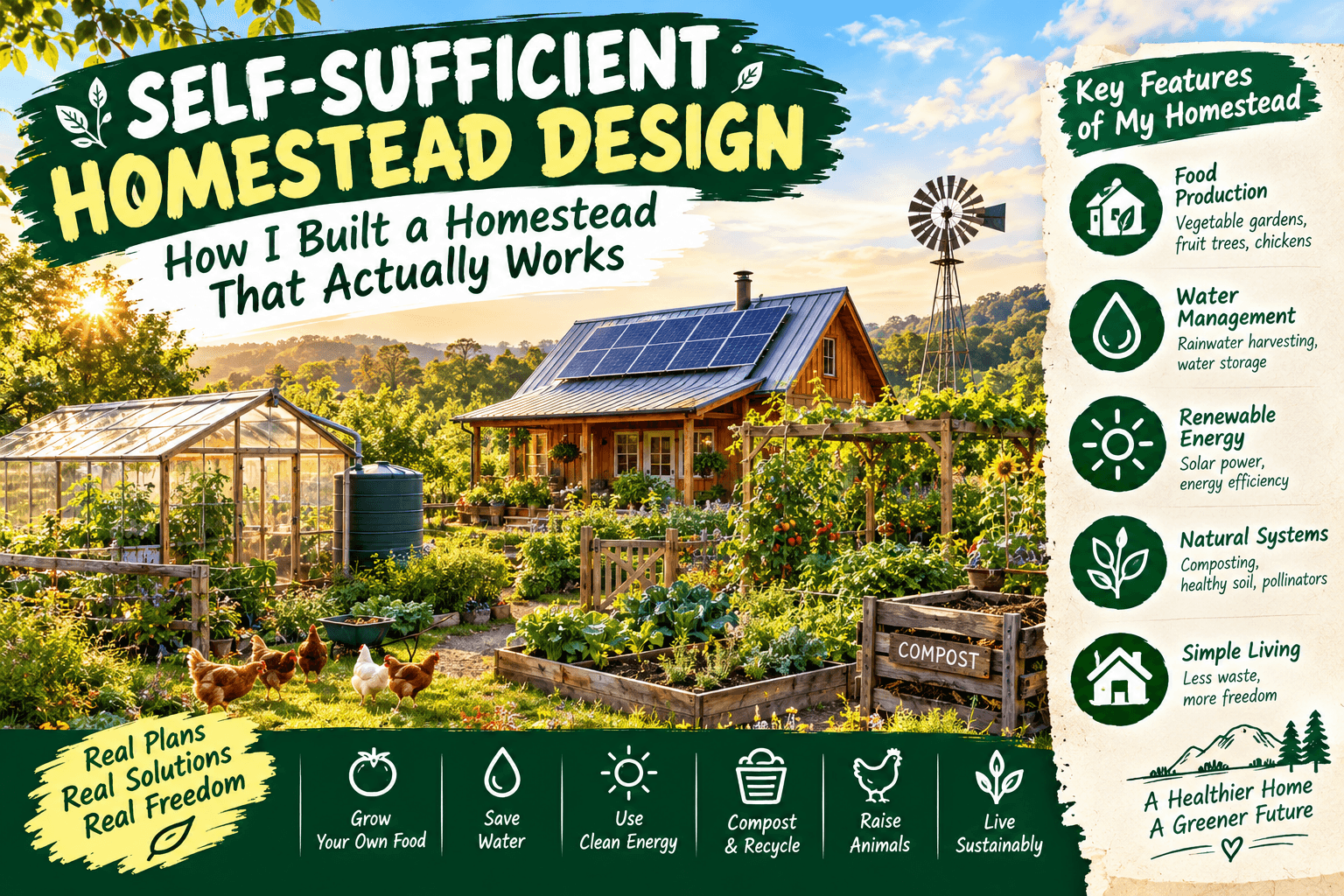
Self-Sufficient Homestead Design: How I Built a Homestead That Actually Works
Self-sufficient homestead design sounds like one of those big words you hear from people with 20 acres, three barns, solar panels everywhere, and enough chickens to start a poultry business.
That wasn’t me.
I started small, and honestly, I made plenty of dumb choices along the way. My first garden wasn’t planned very well. Watering everything became a pain. I put things where they looked nice instead of where they actually worked. Trust me, I learned the hard way.
After more than 10 years of working on my homestead, I’ve learned that a good design isn’t about having the biggest property. It’s about making the things you already have work together.
What Does Self-Sufficient Homestead Design Really Mean?
For me, self-sufficient homestead design means building a property where one part helps another part instead of everything working separately.
Your garden produces food. Food scraps go into compost. Compost helps feed the garden. Chickens provide eggs and manure. Rainwater can help with watering. Trees provide shade, fruit, mulch, and sometimes firewood.
That’s the basic idea.
You don’t have to do all of it on day one. In fact, I strongly recommend you don’t.
Start with the things that will make your everyday life easier. Then add more systems as you learn what your property needs.
One mistake I made: I tried adding too many projects in one summer. Garden, chickens, compost, new beds, fruit trees, and a little greenhouse. Sounds great, right?
It wasn’t.
I spent more time fixing things than enjoying the homestead. These days, I build one system, use it for a while, and then decide what should come next.
Start Your Homestead Design With the Land
Before you buy lumber, chickens, fruit trees, or solar equipment, walk around your property.
Seriously. Walk around it several times.
Pay attention to where the sun comes up and goes down. Notice where water collects after rain. Look at the windy spots. Check where the soil stays wet and where it dries out fast.
Also notice how you move around the property.
If you have to walk 100 yards every morning just to reach the chicken coop, you’re probably going to get tired of it. I know I did.
Here are the things I look at first:
- Where does the property get the most sunlight?
- Where is the easiest place to get water?
- Which areas stay dry?
- Which areas stay wet?
- Where does the wind usually come from?
- Where will you walk every day?
- Where can you grow food close to the house?
- Where can animals be kept without creating problems?
- Where can compost and garden waste go?
It sounds simple, but this little survey can save you a lot of money later.
Put the Garden Where You Will Actually Use It
This is one of my biggest lessons in homesteading.
A garden doesn’t have to be hidden at the far end of your property just because there’s more room there.
My most useful garden beds are the ones I can see and reach easily. When tomatoes need tying, I notice them. When something needs water, I see it. When a chicken gets into the wrong place, I don’t have to go hunting for the problem.
For a self-sufficient homestead design, I like putting frequently used crops close to the house.
Herbs, lettuce, tomatoes, peppers, green onions, and other things you harvest often should be easy to reach.
Things like potatoes, pumpkins, winter squash, and storage crops can have a little more distance.
My simple rule: The more often you use something, the closer it should be to your house.
Design for Water Before You Design for Pretty Gardens
Here’s something I wish I had understood earlier: water is one of the biggest jobs on a homestead.
Dragging a hose around every evening gets old very quickly.
That’s why water should be part of your homestead design from the beginning.
You might use rain barrels, storage tanks, swales, drip irrigation, or other water-saving systems depending on your property and local rules.
Even something as basic as directing rainwater from a roof toward a garden area can make a difference.
Just remember that collected rainwater isn’t automatically safe for drinking. For garden use, however, it can be very useful when handled properly.
I once put a garden bed in a spot that looked perfect in spring. A few months later, summer arrived and that area became bone dry. I was carrying buckets back and forth like some kind of garden punishment.
Never again.
Now I think about water before I decide where the garden goes.
Build Soil Instead of Constantly Buying Fertilizer
A self-sufficient homestead needs healthy soil.
You don’t need perfect soil on day one. You can build it slowly.
Compost is one of my favorite tools because it turns things that would normally become waste into something useful.
Kitchen scraps, leaves, grass clippings, garden waste, and other suitable materials can become compost over time.
Then that compost goes back into the garden.
That’s the kind of cycle I want on a homestead.
My basic compost routine
- Save suitable kitchen scraps.
- Add dry leaves and other brown material.
- Add garden waste when available.
- Keep the pile from getting too wet.
- Turn it occasionally if needed.
- Give it time to break down.
And don’t worry if your first compost pile looks terrible. Mine certainly did.
Where Should Chickens Go in a Self-Sufficient Homestead Design?
Chickens can fit really well into a self-sufficient homestead, but don’t put the coop wherever you have an empty corner.
Think about their daily routine.
You need to bring feed and water to them. You’ll collect eggs. You’ll clean the coop. You’ll deal with bedding and manure.
So make those jobs easy.
I also like having chickens reasonably close to garden areas, but not so close that they can destroy everything.
Learn from my mistake: chickens and young vegetable plants are not always good friends. A chicken can look at a freshly planted garden and apparently think, “Excellent. A salad bar.”
Good fencing matters.
Chicken manure can become useful compost material, too. Just make sure manure is properly managed and composted before using it around food crops.
Think About Food Storage, Not Just Growing Food
Growing food is only half the job.
What happens when you harvest 20 pounds of tomatoes at once?
You need a plan.
This is where canning, freezing, drying, fermenting, root cellaring, and other food preservation methods can become part of your homestead system.
I learned this after one summer when my garden seemed determined to produce every tomato on the same three days.
We ate tomatoes. We gave tomatoes away. Then we still had tomatoes.
Now I think about storage before planting huge amounts of a crop.
A better question to ask: “How much can I actually use or preserve?”
That question can save you from growing 50 zucchini plants when your family only wants three.
Use Trees and Perennial Plants to Do More Work
Annual vegetables are great, but perennial plants can make a homestead easier over time.
Fruit trees, berry bushes, herbs, asparagus, rhubarb, and other suitable perennial plants can return year after year once established.
They still need care, of course. Don’t believe anybody who tells you to plant a tree and forget about it.
But once established, perennial food plants can become an important part of your long-term food system.
I also like using plants for more than one purpose.
A fruit tree can give you food and shade. A hedge can provide privacy and habitat. Comfrey or other useful plants may help with mulch or compost systems depending on how you manage them.
Don’t Forget Energy in Your Homestead Plan
If you’re interested in off-grid living or simply want more independence, energy deserves a place in your design.
Solar panels are one option, but don’t jump into a huge system before understanding your actual energy use.
Start by looking at the things that use the most electricity.
Refrigerators, freezers, pumps, heaters, well systems, tools, and other equipment can add up quickly.
Sometimes the cheapest energy upgrade isn’t adding more solar. It might be reducing wasted energy first.
Good insulation, efficient appliances, timers, and smarter daily habits can all help.
Make Your Homestead Easy to Maintain
This part doesn’t get talked about enough.
Your homestead should not become a second full-time job unless that’s what you actually want.
I used to build things because they looked cool. Later, I realized every project needs maintenance.
More fences mean more fences to repair. More animals mean more daily work. More garden beds mean more watering, weeding, and harvesting.
So before adding something, ask yourself:
- How much daily work will this need?
- What happens when I’m sick?
- What happens when I go away for a few days?
- Can I repair it myself?
- Will I still want this five years from now?
Those questions have saved me from several projects I would’ve regretted.
A Simple Self-Sufficient Homestead Design for Beginners
If you’re starting from scratch, don’t try to build the whole dream homestead in one weekend.
Here’s how I’d do it now.
Year One: Get the Basics Right
Start with water, soil, a small vegetable garden, compost, and basic food storage.
Learn how your land behaves through the seasons.
Year Two: Add Useful Systems
Add fruit trees, berry plants, chickens, rainwater collection, better garden beds, or other projects that solve a real problem.
Year Three and Beyond: Improve the System
Now you can look at solar power, greenhouse growing, larger food storage, more animals, better irrigation, or other long-term projects.
The important thing is that every new project should make the whole homestead work better.
The Biggest Mistake? Trying to Copy Somebody Else’s Homestead
I’ve made this mistake more than once.
You see a beautiful homestead online and think, “I need that.”
Then you realize the person has different weather, different soil, more land, more money, more time, or completely different goals.
Your homestead needs to fit your life.
If you have a small urban backyard, use containers, vertical gardens, compact fruit trees, composting, and smart water use.
If you have several acres, you have different options.
There isn’t one perfect self-sufficient homestead design.
There is only a design that works well for your land, your budget, your climate, and your family.
My 5 Rules for a Homestead That Actually Works
- Start small. Build one useful system at a time.
- Put water first. Make watering easier before adding more plants.
- Grow what you eat. Don’t waste space on food nobody wants.
- Make systems work together. Compost, gardens, animals, water, and food storage should support each other.
- Leave room to change. Your first plan will probably change. Mine did.
Self-Sufficient Homestead Design FAQ
Can I create a self-sufficient homestead on a small property?
Absolutely. You won’t produce everything, but you can grow vegetables, herbs, fruit, keep suitable animals where legal, compost, preserve food, and reduce waste. Small-space homesteading is mostly about using your space wisely.
How much land do I need for a self-sufficient homestead?
There isn’t one magic number. Your goals matter more than the number of acres. A small backyard can provide a surprising amount of food, while a larger property gives you more options for animals, orchards, firewood, and larger gardens.
What should I build first?
I’d start with water, soil, and a small food garden. Those three things teach you a lot about your property without requiring a huge investment.
Build the Homestead You Can Actually Enjoy
The best part of self-sufficient homestead design isn’t having a perfect property that looks like a magazine photo.
It’s walking outside and knowing where your food comes from. It’s picking tomatoes for dinner, collecting fresh eggs, turning kitchen scraps into compost, saving seeds, or opening a jar of something you preserved months ago.
Some days your homestead will look amazing.
Other days a chicken will escape, a tomato plant will fall over, the compost will smell terrible, and you’ll wonder why you ever started this thing.
That’s normal.
Start small, pay attention to your land, and build systems that make your daily life easier. Over time, those little systems start working together. That’s when a self-sufficient homestead design really starts to feel like a homestead instead of just a collection of projects.
Got a Homestead Problem?
Tell me what you’re working with—small backyard, big property, chickens, garden, containers, off-grid plans, whatever. If you get stuck, ask. I’ve messed up plenty of things myself, and sometimes learning from somebody else’s mistake saves you a whole lot of trouble.