

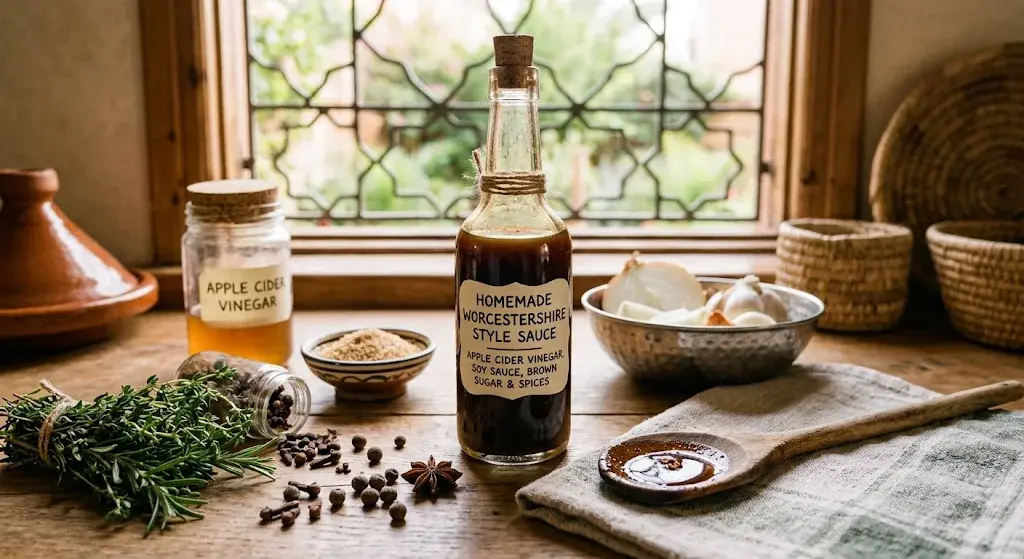
If you run out of Worcestershire sauce, you can make a quick savory substitute with ingredients you may already have in the pantry. Apple cider vinegar supplies acidity, soy sauce brings salt and umami, brown sugar rounds out the sharpness, and garlic, onion, lemon, and spices build a deeper flavor.
This version is best described as Worcestershire-style sauce. It is not an exact copy of traditional Worcestershire sauce, and it should be stored in the refrigerator rather than treated as a shelf-stable bottled condiment.
Quick answer
Simmer vinegar, soy sauce, water, brown sugar, lemon, garlic, onion, and spices briefly, cool the mixture, transfer it to a clean covered container, and refrigerate. Make small batches and do not store this homemade version in the pantry.
Is This Real Worcestershire Sauce?
Not exactly.
The original commercial Worcestershire sauce associated with Lea & Perrins includes ingredients such as vinegar, molasses, onions, anchovies, garlic, cloves, tamarind, sugar, and chili flavorings.
The manufacturer also describes its traditional sauce as undergoing a lengthy maturation process.
A 15-minute homemade version cannot reproduce that process exactly.
Think of this recipe as a quick Worcestershire substitute: tangy, salty, slightly sweet, savory, and useful in many of the same dishes.
Ingredients
- 1 cup apple cider vinegar
- 1/2 cup soy sauce
- 1/4 cup water
- 1/4 cup brown sugar
- 1 tablespoon fresh lemon juice
- 1 teaspoon garlic powder
- 1 teaspoon onion powder
- 1/4 teaspoon ground cinnamon
- 1/4 teaspoon freshly ground black pepper
- 1 teaspoon molasses, optional
- 1/2 teaspoon tamarind paste, optional
- Small pinch ground cloves, optional
Using garlic and onion powder instead of fresh chopped aromatics gives the sauce a smoother texture and makes straining optional.
Why I Would Change the Pinterest Recipe Slightly
The Pinterest graphic lists “minced garlic / powder” and “minced onion / powder.” Those options are not identical.
For a simple refrigerator condiment, powdered garlic and onion are easier because they:
- Disperse evenly
- Do not leave large pieces in the bottle
- Require no straining
- Give more predictable flavor from batch to batch
Fresh garlic and onion can still be used, but the finished sauce should be strained and treated as a short-lived refrigerated food.
1. Combine the Base Ingredients
Add the apple cider vinegar, soy sauce, water, and brown sugar to a small saucepan.
Whisk until the sugar begins dissolving.
2. Add the Seasonings
Add:
- Garlic powder
- Onion powder
- Cinnamon
- Black pepper
- Optional molasses
- Optional tamarind
- Optional tiny pinch of cloves
The molasses and tamarind are optional, but they move the flavor closer to the sweet-sour depth associated with traditional Worcestershire sauce.
3. Simmer Gently
Bring the mixture to a gentle simmer.
Cook for about 5–10 minutes, stirring occasionally.
You are not trying to reduce it into a thick syrup. Worcestershire-style sauce should remain thin enough to pour or shake from a bottle.
4. Add the Lemon Near the End
Stir in the fresh lemon juice toward the end of cooking or immediately after removing the saucepan from the heat.
Taste carefully once it is cool enough.
You should notice four main flavors:
- Sharp acidity
- Saltiness
- Moderate sweetness
- Warm savory spice
5. Cool Before Bottling
Let the sauce cool, then pour it into a clean covered bottle or jar.
If you used fresh minced garlic, onion, whole spices, or other solids, strain the sauce first if you want a smooth consistency.
6. Refrigerate the Homemade Sauce
This is not a shelf-stable canning recipe. A bottle, cork, Mason jar, or vacuum seal does not make an untested homemade sauce safe for room-temperature storage.
Keep the sauce refrigerated at 40°F (4°C) or below.
Because this is not a laboratory-tested preservation formula with an established shelf life, make small batches rather than preparing several months’ worth at once.
A conservative home-kitchen approach is to use the homemade sauce within about 3–4 days, especially when fresh aromatics are included.
Why Vinegar Does Not Automatically Make It Shelf-Stable
This is one of the most important lessons from viral sauce recipes.
A recipe may contain a lot of vinegar and still lack a validated shelf-stable preservation process.
Safe home canning depends on a research-tested combination of:
- Ingredient ratios
- Final acidity
- Product thickness
- Jar size
- Processing temperature
- Processing time
- Altitude adjustments when needed
We do not have that testing for this Pinterest formula, so refrigeration is the sensible approach.
Apple Cider Vinegar or White Vinegar?
| Vinegar | Flavor |
|---|---|
| Apple cider vinegar | Fruitier, slightly softer, warmer flavor |
| White vinegar | Sharper, cleaner acidity |
The Pinterest version uses apple cider vinegar, which works well for a quick homemade substitute.
Why Soy Sauce Works Here
Traditional Worcestershire sauce gets part of its savory depth from anchovies and fermentation.
Soy sauce provides a fast shortcut because it contributes:
- Salt
- Umami
- Fermented flavor
- Dark color
The finished product will taste different from traditional Worcestershire, but it can perform a similar job in many recipes.
Traditional vs. Quick Homemade Worcestershire-Style Sauce
| Feature | Traditional Style | Quick FarmSolo Version |
|---|---|---|
| Vinegar | Yes | Yes |
| Anchovies | Common in original style | No |
| Tamarind | Important traditional flavor | Optional |
| Molasses | Traditional ingredient | Optional |
| Soy sauce | Not in the classic U.S. Lea & Perrins ingredient list | Main umami shortcut |
| Preparation time | Extended maturation | Minutes |
How to Use Homemade Worcestershire-Style Sauce
A little goes a long way.
Try a teaspoon or two in:
- Beef marinades
- Burgers
- Meatloaf
- Gravy
- Stews
- Roasted mushrooms
- Beans
- Barbecue sauce
- Tomato-based sauces
- Salad dressings
- Bloody Mary-style drinks
Can You Make It Vegetarian?
This shortcut version already avoids anchovies if you use ordinary plant-based soy sauce and plant-based flavorings.
That makes it useful for cooks who want a fish-free Worcestershire-style substitute.
Always check packaged ingredient labels if you need the final sauce to meet a specific dietary requirement.
Can You Reduce the Sodium?
Soy sauce supplies much of the sodium in this recipe.
You can try a lower-sodium soy sauce, but taste the finished mixture before making additional changes because reducing salt alters the overall balance.
What the Pinterest Recipe Gets Right
- Vinegar provides the sharp acidic base.
- Soy sauce supplies quick umami.
- Brown sugar balances the acidity.
- Garlic and onion add savory flavor.
- Black pepper adds warmth.
- Cinnamon gives a subtle spice note.
What the Pinterest Graphic Leaves Out
| Missing Detail | Why It Matters |
|---|---|
| Storage instructions | Homemade sauce should not automatically be kept at room temperature. |
| Processing method | No tested home-canning process is supplied. |
| Traditional ingredients | Classic Worcestershire includes ingredients such as anchovy and tamarind. |
| Fresh vs. powdered garlic/onion | These options change texture and handling. |
| Shelf life | A homemade untested recipe does not inherit the shelf life of a commercial bottle. |
5 Mistakes to Avoid
1. Calling it shelf-stable because it contains vinegar
Acid alone does not replace a validated preservation process.
2. Storing it at room temperature in a decorative bottle
Keep this homemade version refrigerated.
3. Expecting it to taste exactly like Lea & Perrins
Traditional Worcestershire has different ingredients and a very different production process.
4. Using too much cinnamon
Cinnamon can quickly dominate a savory sauce. Keep the amount small.
5. Making a huge batch
Without a tested shelf life or canning process, small fresh batches are the better choice.
Homemade Worcestershire Sauce FAQ
Can Worcestershire sauce be made at home?
You can make a homemade sauce with a similar sweet, salty, acidic, and savory flavor profile. Quick recipes do not reproduce the traditional commercial maturation process exactly.
Does homemade Worcestershire sauce need refrigeration?
This recipe does. Keep it covered in the refrigerator at 40°F (4°C) or below.
Can I water-bath can this recipe?
No shelf-stable canning process is provided for this formula. Do not invent a processing time simply because the recipe contains vinegar.
Why does traditional Worcestershire contain anchovies?
Anchovies contribute salty fermented umami. This quick version uses soy sauce as an easier fish-free shortcut.
What does tamarind add?
Tamarind adds a distinctive fruity sourness and complexity that is strongly associated with classic Worcestershire flavor.
What can I substitute for Worcestershire sauce?
A mixture of soy sauce, vinegar, a little sweetener, and savory seasonings can work as a quick substitute in marinades, gravies, burgers, stews, and similar dishes.
The Bottom Line
The Pinterest recipe is a useful starting point, but it is better described as a quick homemade Worcestershire-style sauce than an exact homemade version of the traditional condiment.
Soy sauce provides fast umami, vinegar supplies acidity, brown sugar adds balance, and garlic, onion, pepper, cinnamon, molasses, and tamarind can build more complexity.
Make a small batch, keep it refrigerated, and do not treat a decorative bottle or sealed jar as proof that the sauce is shelf-stable.
Want more homemade sauces?
See FarmSolo’s 8 Homemade Dipping Sauces and 6 Homemade Stir-Fry Sauces for more easy refrigerator sauce ideas.
Sources
- Lea & Perrins / Kraft Heinz — The Original Worcestershire Sauce ingredients and product information
- University of Minnesota Extension — Home Food Safety and Refrigerated Homemade Sauces
- FoodSafety.gov — Cold Food Storage Guidance