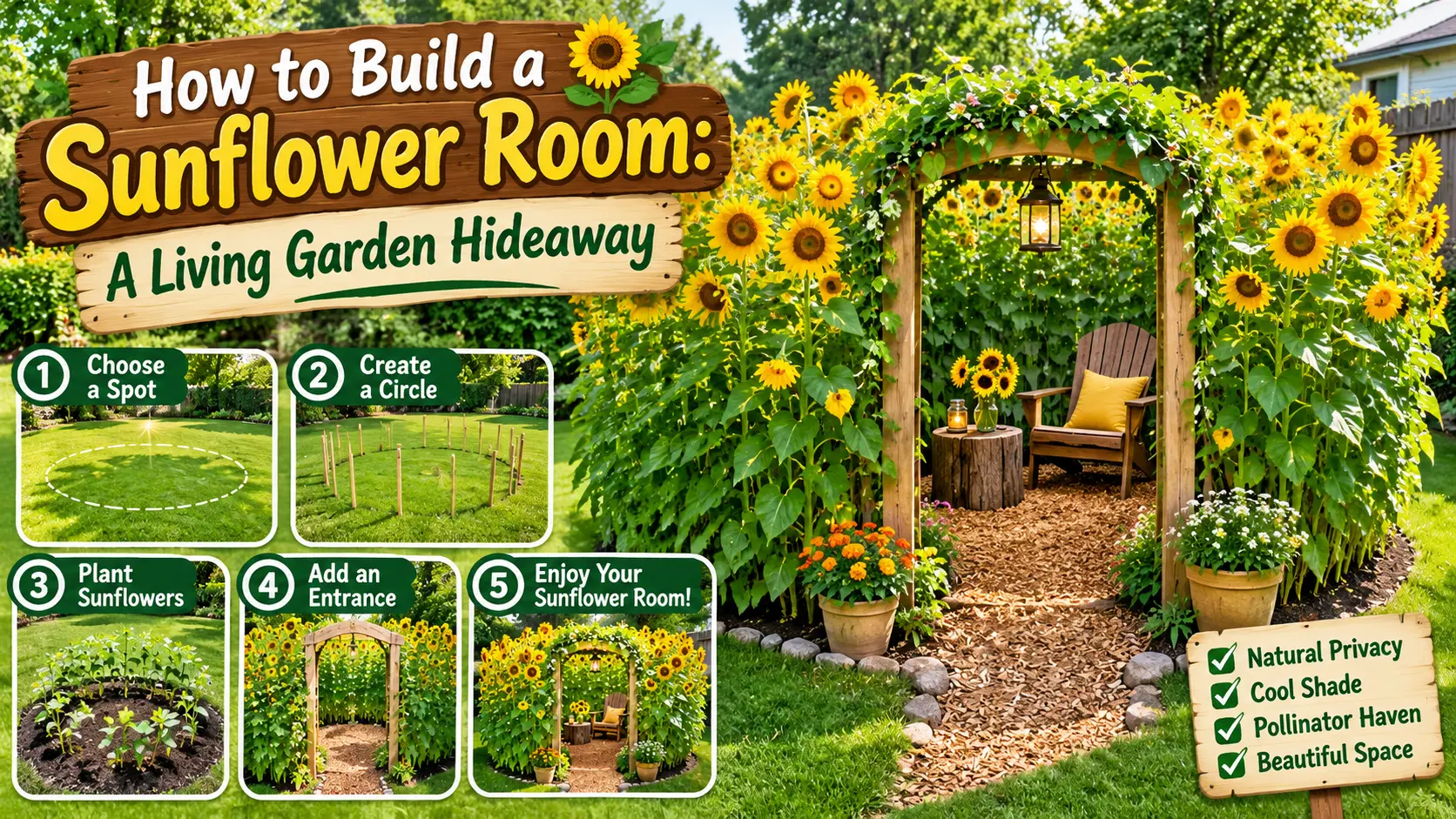
A sunflower room is one of the simplest ways to turn an ordinary patch of lawn into a living summer hideaway. Instead of planting sunflowers in a straight row, you grow them in a wide circle or oval, leave an opening for a doorway, and allow tall plants to form the walls.
By midsummer, the center can become a shaded sitting spot surrounded by green leaves, thick stems, yellow flowers, bees, butterflies, and eventually seed-eating birds.
The Pinterest idea is genuinely workable, but success depends on choosing tall sunflowers, giving them full sun, keeping the doorway open, supporting tall stems where wind is a problem, and avoiding overcrowding simply to get an instant wall.
Quick answer
Mark a large circle or oval in full sun, leave a doorway, plant tall sunflower varieties around the perimeter, and use two staggered rows if you want a denser living wall. Follow the cultivar’s seed-packet spacing, water during dry periods, control weeds while plants are young, and stake very tall varieties if the site is windy.
What Is a Sunflower Room?
A sunflower room—sometimes called a sunflower house or sunflower fort—is simply a ring of tall sunflowers planted around an open center.
You intentionally leave part of the circle unplanted to create a doorway.
As the sunflowers mature, their stems and large leaves create vertical walls while the center remains open enough for:
- A garden chair
- A small bench
- A child’s play space
- A reading spot
- A wildlife-watching area
- A summer photo backdrop
Does the Sunflower Room Idea Actually Work?
Yes, with the right varieties and site.
Illinois Extension specifically recommends planting two staggered rows of sunflowers when a gardener wants a dense wall and describes the result as a possible secret garden hideaway.
The main mistake is assuming every sunflower becomes a towering plant.
Some cultivars mature at only a foot or two tall, while others can reach 10, 12, or even 15 feet under suitable growing conditions.
1. Choose Tall Sunflowers
For a true walk-in sunflower room, choose cultivars bred for height rather than compact container sunflowers.
Examples listed by Illinois Extension include:
| Cultivar | Potential Height | Growth Habit |
|---|---|---|
| Lemon Queen | About 5–8 ft | Branching, multiple flowers |
| Treasure Mountain | Up to about 10 ft | Multiple flowers |
| Mammoth | About 9–12 ft | Large single flower |
| Kong | Up to about 14 ft | Very tall type |
| Pikes Peak | Up to about 15 ft | Large single flower |
Actual height varies with cultivar, soil, sunlight, water, weather, and growing season.
Branching or Single-Stem Sunflowers?
Both can work, but they create different rooms.
Branching varieties
These produce more side branches and flowers, creating a thicker, more colorful wall.
Single-stem varieties
These often produce one large flower head and a simpler upright silhouette.
For the lush Pinterest look, branching types can give the room a fuller appearance, while a mix of tall forms can add more texture.
2. Pick a Full-Sun Location
Sunflowers perform best in full sun and soil that is not waterlogged.
Avoid building the room underneath large shade trees just because the lawn underneath is empty.
Insufficient light can contribute to weaker, stretched stems and reduced flowering.
Tall plants are already vulnerable to wind, so a sunny location with some protection from severe prevailing winds is ideal.
3. Mark the Room Before Removing Grass
A garden hose or rope makes an easy temporary outline.
Create a circle or oval large enough for the intended use.
For a small sitting space, a diameter around 8–12 feet is a practical starting design range, although there is no horticultural rule requiring those dimensions.
Before digging:
- Put a chair in the center.
- Walk through the planned doorway.
- Check nearby irrigation.
- Watch where afternoon shade falls.
- Make sure the mature plants will not block a walkway or gate.
4. Leave a Real Doorway
Do not plant the full circle and expect to push through mature sunflower stems later.
Leave a permanent gap wide enough for comfortable entry.
Remember that mature leaves will extend into the opening, so the bare-soil gap can be wider than the doorway you ultimately want.
5. Use Two Staggered Rows for a Denser Wall
One of the best details in the Pinterest idea is the thick wall of stems and foliage.
Illinois Extension specifically suggests planting two staggered rows when the goal is a denser sunflower wall.
Instead of lining plants up directly behind one another, offset the second row so each plant grows between two plants in the first row.
Do not turn “dense” into overcrowded. Follow the spacing recommendations for the cultivar you actually buy. Proper airflow becomes increasingly important as the wall fills in.
6. Direct Sow the Seeds
Annual sunflowers are easy to establish by direct seeding once local conditions are suitable.
Follow the seed packet for:
- Planting depth
- Final spacing
- Expected germination time
- Days to flowering or maturity
If more seedlings emerge than needed, thin them rather than leaving every plant crowded together.
7. Keep Young Sunflowers Weed-Free
Mature sunflowers become imposing plants, but seedlings still have to compete with lawn grass and weeds.
Illinois Extension notes that weeds compete with young sunflowers for:
- Light
- Water
- Nutrients
Remove weeds carefully and use an appropriate organic mulch after seedlings are established if desired.
8. Water During Dry Weather
Sunflowers become reasonably drought tolerant once established, but drought tolerance does not mean they never need water.
Illinois Extension recommends watering when weather becomes dry.
Water the soil deeply rather than repeatedly misting only the surface.
Drip irrigation or a soaker hose can also keep foliage and flowers drier than overhead watering.
9. Plan for Wind Before the Plants Reach 10 Feet
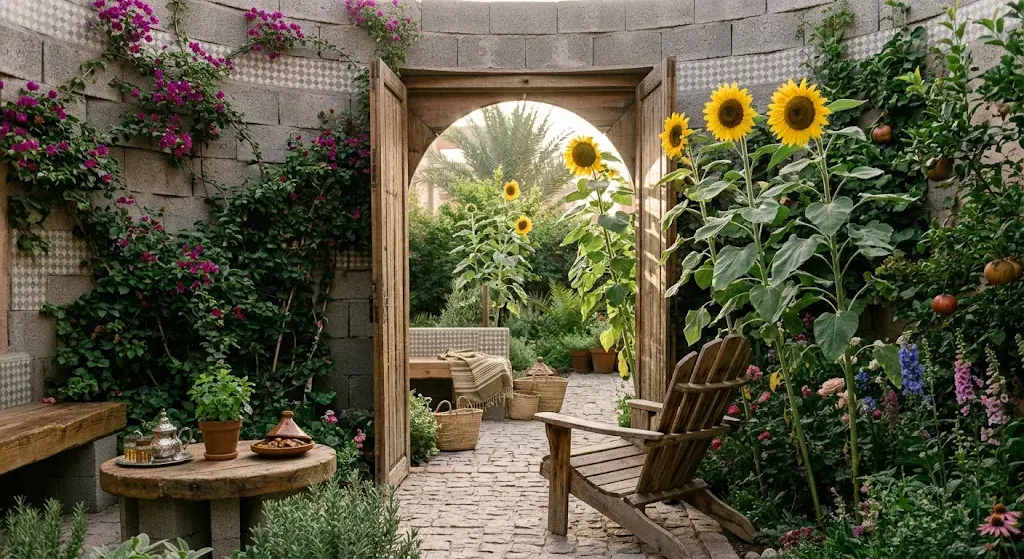
Tall sunflower varieties with large flower heads can be damaged by strong wind.
A plant that looks perfectly sturdy at three feet may become top-heavy later.
Good options include:
- Choosing a sheltered site
- Using sturdy individual stakes
- Running soft garden twine around groups of plants
- Using several horizontal support levels as the plants grow
Penn State notes that tall or heavy-flowered herbaceous plants can benefit from stakes or perimeter string supports, especially where rain or wind creates extra stress.
10. Keep the Support Outside the Walking Space
The inspiration image shows stakes and strings around the developing sunflower circle.
This can work, but avoid placing low horizontal strings across the doorway or across the interior where someone can trip over them.
As the plants get taller, move supports upward or add another level rather than leaving unnecessary low lines.
11. Think About Which Direction the Flowers Will Face
Young sunflowers are famous for following the sun, but that behavior changes as they mature.
Illinois Extension explains that mature sunflower flower heads generally settle facing east.
That means the flowers will not necessarily face inward toward your chair just because they form a circle.
If the appearance of the flower faces is important for photographs or views from a patio, consider east when positioning the room.
12. Expect Bees and Other Pollinators
A blooming sunflower wall is not just decoration.
Sunflowers attract pollinating insects, and Extension flower trials have recorded native bees and other beneficial insects visiting sunflower blooms.
That is valuable for the garden, but it also means the room will be an active wildlife space rather than an insect-free outdoor room.
13. Birds May Arrive When Seeds Mature
Later in the season, birds and squirrels often discover sunflower seed heads.
You can either:
- Leave heads for wildlife
- Harvest selected heads for seed
- Protect some heads if you want seed for yourself
If wildlife is part of the reason for building the room, leaving several mature heads standing can extend its value well beyond flowering.
14. Sunflowers Can Affect Nearby Plants
This is one detail most sunflower-room posts leave out.
Penn State identifies sunflowers as plants capable of allelopathy—producing compounds that may inhibit the growth or germination of some nearby plants.
That does not mean nothing can grow near sunflowers, but I would not build the sunflower circle directly through a valuable vegetable bed and assume every crop will respond well.
Best location: give the sunflower room its own ornamental or lawn area rather than squeezing it between sensitive vegetables.
15. What Should Go Inside the Room?
Keep the center simple.
Good options include:
- Wood chips
- A small garden chair
- A simple bench
- A few stepping stones
- A removable outdoor stool
Avoid installing something permanent before you know how much shade, leaf drop, and root growth the circle will produce.
A Simple Sunflower Room Layout
| Zone | What to Do |
|---|---|
| Outer wall | Tall sunflower cultivar |
| Second row | Stagger plants for extra density |
| Doorway | Leave permanently unplanted |
| Interior | Open ground, mulch, or simple seating |
| Wind support | Stakes and soft twine where needed |
When Will the Sunflower Room Be Ready?
Sunflowers are fast-growing annuals.
Many varieties reach maturity in roughly 70–100 days, although cultivar and growing conditions matter.
The room will start feeling enclosed before peak flowering because the leaves fill the walls first.
Can You Extend the Blooming Season?
Instead of sowing every seed on exactly the same day, you can experiment with more than one planting date where the local season is long enough.
Penn State notes that staggered sunflower planting dates can help extend the flowering period rather than relying on one short peak bloom.
For a room, keep the planting sequence simple so later seedlings are not completely shaded by much older plants.
What Happens at the End of the Season?
The living room is temporary.
Once the plants mature, you can:
- Harvest mature seed heads
- Leave some heads for birds
- Remove dead stems
- Compost healthy plant material where appropriate
- Prepare the circle for next year’s planting
Because sunflower residues can have allelopathic effects, avoid automatically using large amounts of fresh sunflower residue as mulch directly around sensitive plants.
What the Pinterest Idea Gets Right
- Uses a ring instead of a traditional straight flower bed.
- Leaves an intentional doorway.
- Uses tall plants to create living walls.
- Provides stakes and string while plants are young.
- Creates a useful open space rather than filling the entire circle.
What I Would Change
- Choose the cultivar before deciding the spacing.
- Use two staggered rows only if the seed-packet spacing still allows adequate airflow.
- Make the doorway wider than it looks necessary while plants are small.
- Add wind support early for very tall cultivars.
- Keep support strings away from the entrance.
- Give the sunflower room its own space rather than building it through a vegetable bed.
7 Sunflower Room Mistakes to Avoid
1. Buying dwarf sunflowers
Beautiful plants under three feet tall will not create the tall wall shown in the inspiration image.
2. Planting in shade
Sunflowers perform best with abundant direct sunlight.
3. Making the doorway too narrow
Mature leaves will occupy far more space than young seedlings.
4. Overcrowding the wall
Poor airflow can increase disease problems, including powdery mildew.
5. Ignoring wind until flowers form
Large flower heads make tall stems more top-heavy.
6. Expecting every flower to face the center
Mature annual sunflower heads generally orient toward the east.
7. Treating it like a permanent hedge
Annual sunflowers complete their life cycle in one growing season, so the room must be replanted each year.
Sunflower Room FAQ
Can you really make a room out of sunflowers?
Yes. Plant tall sunflower varieties in a circle or oval, leave a doorway, and use one or two rows to create the living wall.
What are the best sunflowers for a sunflower house?
Choose tall cultivars suited to your climate and growing season. Mammoth, Lemon Queen, Treasure Mountain, Kong, and Pikes Peak are examples of taller types listed by Extension sources.
How tall can sunflowers grow?
Cultivars vary enormously. Some stay under two feet while very tall types may reach 10–15 feet under suitable conditions.
How far apart should I plant them?
Use the spacing given for the exact cultivar on its seed packet. For a denser room, a second staggered row is better than simply cramming plants into one row.
Do giant sunflowers need stakes?
They may, especially in exposed locations or once large flower heads make the stems top-heavy. A sheltered site and early support reduce wind damage.
Do sunflowers come back every year?
Common annual sunflower varieties complete their life cycle in one season. A sunflower room made from annual varieties needs to be replanted each year.
Will the sunflower room attract bees?
Flowering sunflowers are attractive to pollinators, including native bees, so expect regular insect activity around the blooms.
The Bottom Line
A sunflower room is one Pinterest garden idea that can actually work very well.
The basic concept is simple: choose tall sunflowers, mark a sunny circle, leave a doorway, and create a dense living wall without overcrowding the plants.
The two details that make the biggest difference are choosing the correct tall cultivar and supporting the plants before summer wind becomes a problem.
Do that well, and a bare section of lawn can become a temporary living garden room, pollinator habitat, children’s hideaway, and late-season bird-feeding station all in the same growing season.
Sources
- University of Illinois Extension — How to Grow Sunflowers at Home
- University of Illinois Extension — Sunflower Cultivars and Mature Heights
- Penn State Extension — Supporting Herbaceous Plants in a Flower Garden
- Penn State Extension — Allelopathy in the Home Garden
- Penn State Extension — U-Pick Sunflowers: Planning a Profitable Farm Experience