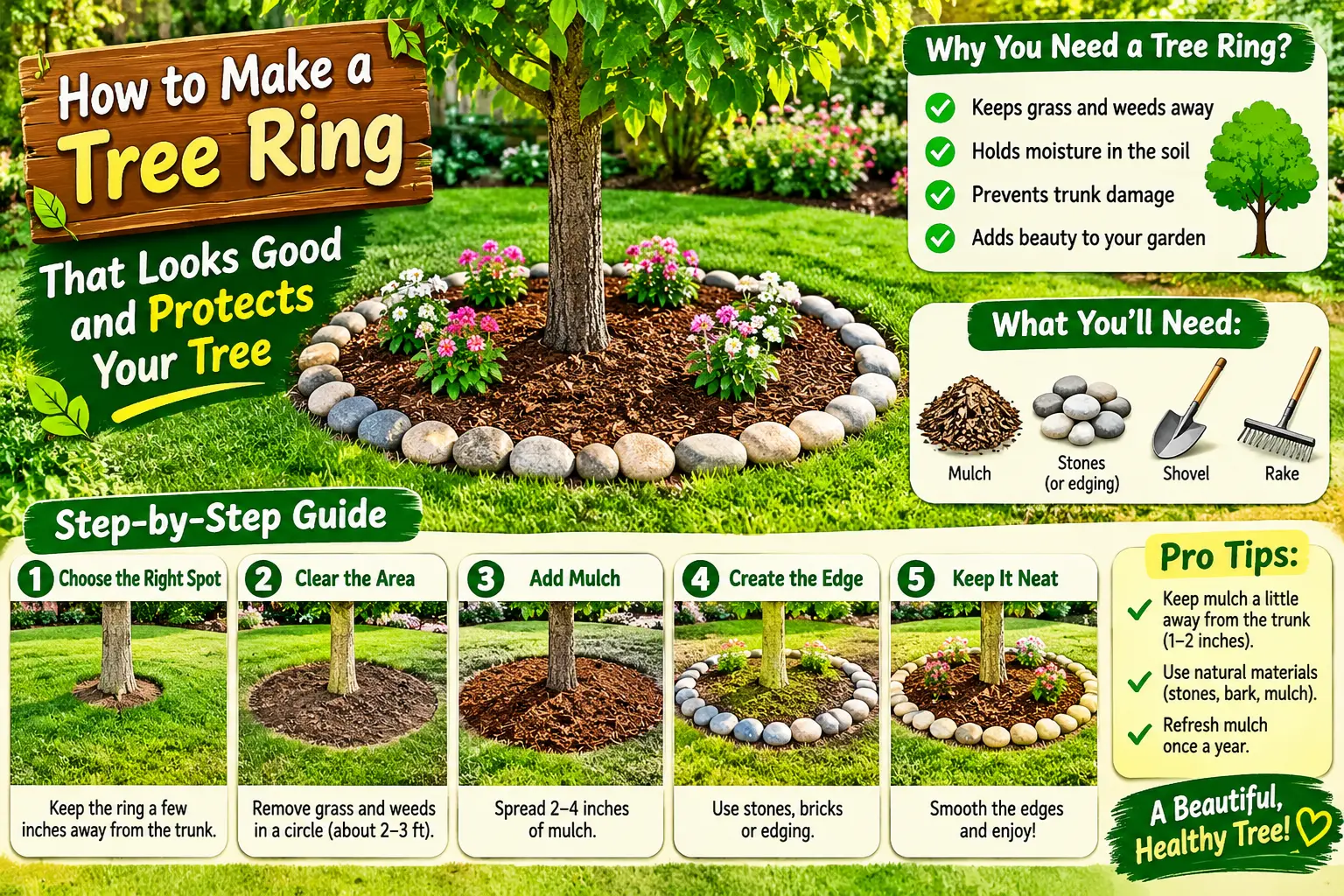
A clean circle around a tree can make an ordinary lawn look professionally landscaped—but the healthiest tree ring is more than a decorative border. It should reduce grass competition, protect the trunk from mowers, conserve soil moisture, and leave the tree’s root flare open to air.
The Pinterest design combines an organic mulch center with a ring of smooth decorative stones. That can work well when the stones stay near the outer edge and the mulch is kept away from the trunk.
Quick answer
Remove grass around the tree, expose the natural root flare, spread roughly 2–3 inches of organic mulch in a wide ring, and keep the mulch several inches away from the trunk. Decorative stones can be used around the outer edge, but avoid piling either stone or mulch against the bark.
Why Put a Ring Around a Tree?
A properly designed tree ring can do several useful jobs at once.
- Reduces competition from lawn grass
- Helps soil retain moisture
- Protects the trunk from lawn mowers and string trimmers
- Reduces soil compaction around the tree
- Moderates soil temperature
- Makes mowing around the tree easier
- Creates a cleaner landscape design
Organic mulch also slowly decomposes and contributes organic matter to the soil.
1. Find the Root Flare Before You Start
Look at the point where the trunk meets the soil.
A healthy tree normally widens near the bottom where the major roots begin spreading outward. This widening is called the root flare or trunk flare.
Do not bury it under mulch, soil, or decorative stones.
If the trunk looks like a telephone pole entering the soil with no visible widening, the tree may already be planted too deeply or the root flare may be buried. Do not simply add another layer of mulch on top.
2. Make the Ring Wide, Not Deep
One of the biggest landscaping mistakes is making a tiny, deep mulch circle immediately around the trunk.
Tree roots spread far beyond the trunk, so a wider mulched area is generally more useful than a deep mound.
For a young backyard tree, start with a ring several feet across if space allows. As the tree grows, the mulch area can expand outward.
3. Remove the Grass Carefully
Grass competes aggressively with young tree roots for water and nutrients.
Remove turf carefully rather than digging deeply around the tree.
Avoid chopping through visible roots or repeatedly cultivating the soil below the canopy.
4. Use Organic Mulch Over the Root Zone
Wood chips, shredded bark, pine needles, and similar organic materials are usually better for tree health than covering the entire root zone with gravel or river rock.
Organic mulch can:
- Reduce evaporation
- Moderate soil temperature
- Suppress weeds
- Reduce compaction
- Improve soil as it breaks down
How Deep Should Tree Mulch Be?
A layer around 2–3 inches deep is a useful target for many landscape trees.
Penn State generally recommends no more than about 2–4 inches, while University of Minnesota commonly recommends approximately 3 inches around newly planted trees.
More is not better.
5. Keep Mulch Away From the Trunk
The mulch should look more like a wide donut than a volcano.
Leave a visible gap around the trunk so bark stays dry and the root flare remains exposed.
Mulch piled directly against bark can keep it constantly damp and contribute to decay, disease, rodents, and girdling-root problems.
Avoid the “Mulch Volcano”
A mulch volcano is the common landscaping practice of piling mulch upward around the trunk like a cone.
It may look tidy, but it is the opposite of how healthy tree roots naturally grow.
Keep the center low and spread the material outward instead.
6. Can You Put River Rocks Around a Tree?
Yes, but use them mainly as a decorative feature rather than replacing all the organic mulch over the root zone.
River stones can make an attractive outer border because they:
- Create a crisp visual edge
- Do not decompose
- Help separate lawn from mulch
- Can reduce mulch spilling onto grass
However, stone does not improve the soil as it breaks down because it does not break down at all.
Mulch vs. River Rock Around Trees
| Feature | Organic Mulch | River Rock |
|---|---|---|
| Reduces evaporation | Yes | Can help somewhat |
| Adds organic matter | Yes | No |
| Needs replenishing | Eventually | Rarely |
| Decorative edging | Moderate | Excellent |
| Soil-building benefit | Yes | No |
7. Don’t Build a Raised Wall of Soil Around the Tree
A decorative tree ring should not become a raised planter that buries the trunk and existing root system under several inches of new soil.
Adding deep soil over established roots can change oxygen availability and moisture conditions.
Keep the original soil grade around the trunk unless a qualified tree professional recommends otherwise.
8. Water the Root Zone, Not the Trunk
Young trees need consistent moisture while their roots become established.
Apply water slowly over the root zone rather than constantly wetting the trunk.
Check the soil before watering again, especially in clay or poorly drained areas where overwatering is possible.
9. Don’t Add New Mulch Every Year Automatically
Old mulch does not disappear just because a new landscaping season begins.
Before adding another bag, check how much material remains.
If the existing layer is still deep enough, simply loosen or rake the surface instead of stacking new mulch on top.
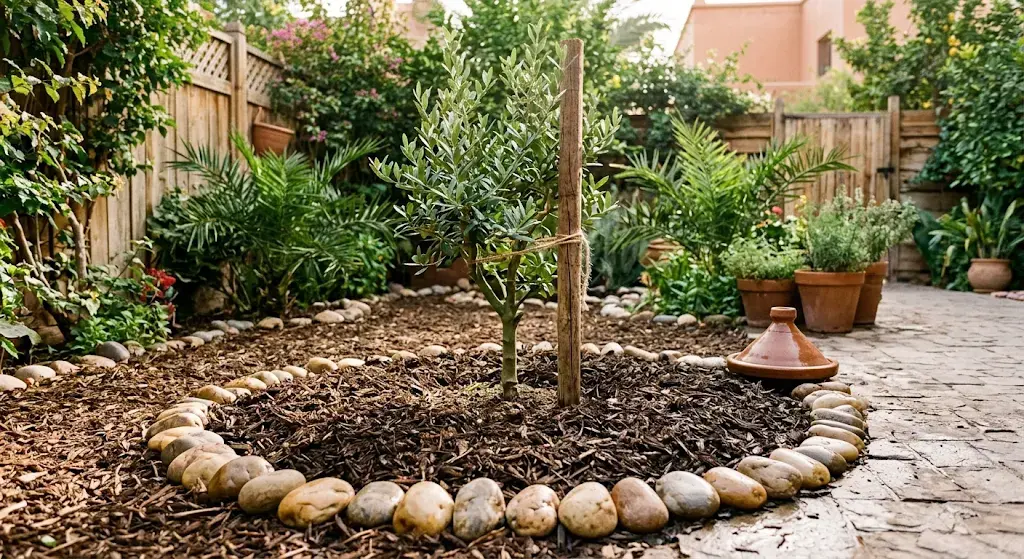
A Simple Tree Ring Layout
- Mark a wide circle around the tree.
- Carefully remove grass and weeds.
- Confirm that the root flare is visible.
- Leave the original soil grade intact.
- Spread 2–3 inches of organic mulch.
- Pull mulch away from the trunk.
- Add decorative river stones near the outside edge if desired.
- Make sure stones do not bury the flare or touch the trunk.
- Water slowly through the mulch into the root zone.
What the Pinterest Image Gets Right
The image has several good design ideas:
- A clean separation between lawn and tree
- Organic material in the main tree ring
- Decorative stones used mostly around the perimeter
- No grass growing directly against the trunk
- A simple shape that is easy to mow around
What I Would Change
I would make the mulch area wider as the tree grows and make sure the root flare remains clearly visible.
I would also keep a little more open space immediately around the trunk instead of allowing mulch to form a tight circle against the bark.
The river rock should remain decorative edging—not a deep layer covering most of the root zone.
6 Tree Ring Mistakes to Avoid
1. Piling mulch against the trunk
Keep the root flare visible and bark dry.
2. Making the mulch too deep
Deep mulch can reduce oxygen and create unwanted root growth.
3. Covering the root zone completely with rock
Organic mulch generally provides more benefits to tree soil.
4. Cutting roots to create a perfect circle
Do not sacrifice tree roots just to make a decorative border perfectly round.
5. Adding soil against the trunk
Avoid turning the tree ring into a raised bed that buries the trunk flare.
6. Adding another mulch layer every spring without checking depth
Measure what is already there first.
Tree Ring Landscaping FAQ
Is it good to put a mulch ring around a tree?
Yes. Proper organic mulch reduces grass competition, conserves moisture, protects against mower damage, and improves soil conditions.
How much mulch should go around a tree?
Around 2–3 inches works well in many landscapes. Avoid layers deeper than roughly 4 inches and use less where drainage is poor.
Should mulch touch the trunk?
No. Pull mulch back so the trunk and root flare remain visible and dry.
Are rocks good around trees?
They can work as decorative edging, but organic mulch generally gives more benefits to the soil and root zone.
How wide should a tree ring be?
Wider is generally better than deeper. Extend mulch several feet from a young tree where possible and enlarge the ring as the canopy grows.
Can I plant flowers inside the tree ring?
Be cautious. Digging repeatedly among tree roots and adding competing plants can disturb or compete with the tree. A simple organic mulch ring is usually the lowest-maintenance choice.
The Bottom Line
A tree ring can improve both the appearance of your yard and the growing conditions around a tree—but only when tree health comes before decoration.
Use organic mulch over the root zone, spread it wide, keep it shallow, and never pile it against the trunk.
If you like the Pinterest look, use smooth river stones as an outer decorative border while keeping the center primarily organic mulch.
The result can still look neat and intentional without sacrificing the health of the tree underneath it.
Sources
- Penn State Extension — Mulching Landscape Trees
- Penn State Extension — Visible Trunk Flares Are Critical to Tree Health
- University of Minnesota Extension — Watering Newly Planted Trees and Shrubs
- University of Minnesota Extension — Watering Established Trees and Shrubs