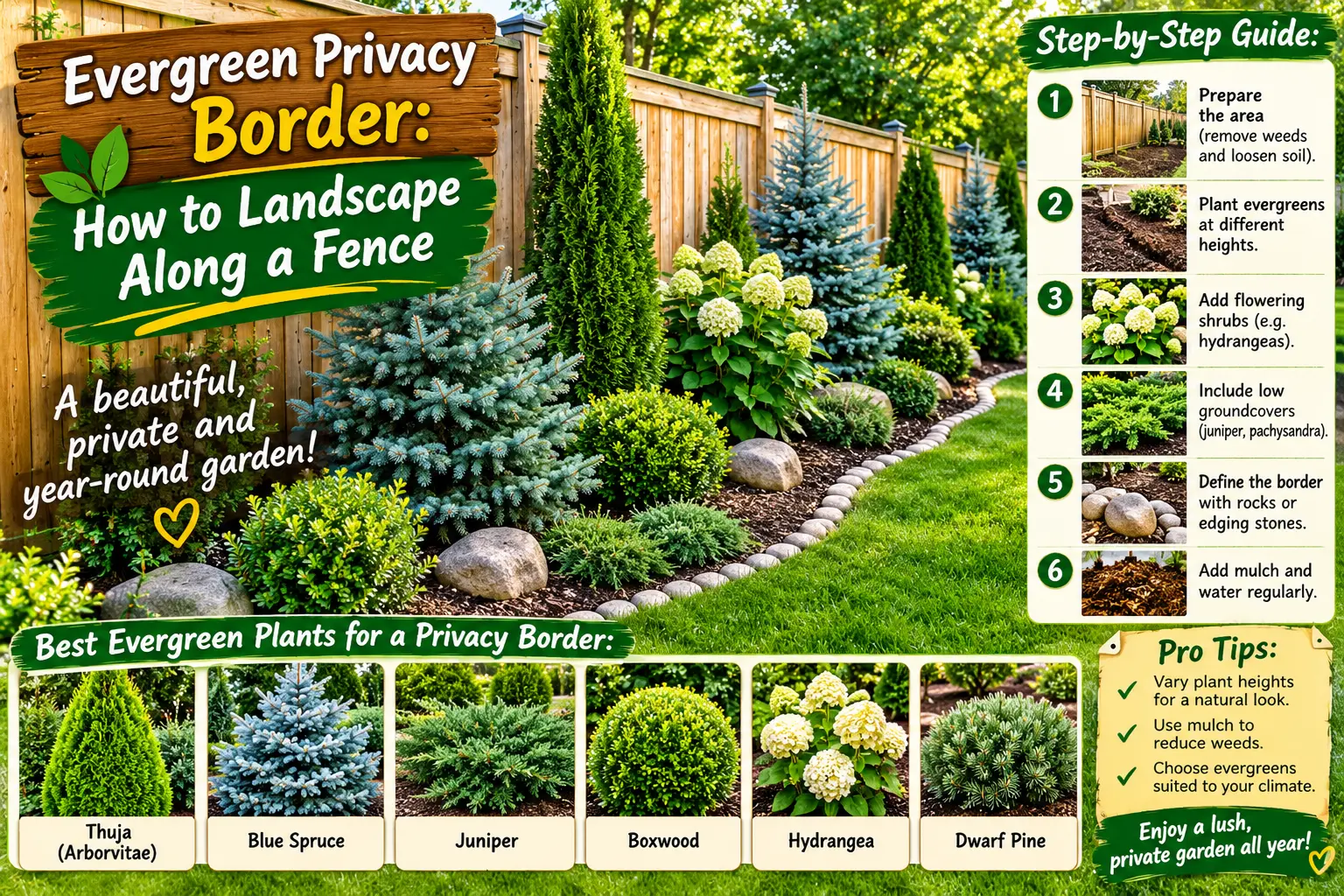
An evergreen border can turn a plain wooden fence into a layered garden that gives you privacy, year-round color, and a much softer backyard view. The best designs do not simply line up identical trees a few feet apart. They combine tall screening plants, medium shrubs, low evergreens, mulch, and a clean lawn edge while leaving enough space for every plant to reach its mature size.
That last point matters. A border can look slightly open during its first few years and still become beautifully full later. Plant everything too close together for an instant Pinterest look, and the same bed may become crowded, shaded, difficult to prune, and more vulnerable to stress as the plants mature.
Quick answer
Start with the mature width of your tallest evergreens, stagger different plants instead of building one solid row, place medium shrubs in front, finish with low plants and mulch, and leave room between the planting and the fence for growth and maintenance. Choose species for your climate and site rather than copying the exact plants in a photo.
Why an Evergreen Border Works So Well Along a Fence
A wooden privacy fence already creates a strong vertical line. Planting in front of it makes that line feel less harsh while adding another layer of screening.
A well-designed evergreen border can provide:
- More privacy above and around the fence
- Year-round green structure
- Wind protection
- Habitat and shelter for wildlife
- A cleaner transition between lawn and fence
- Color and texture during winter
- A background for flowers and seasonal plants
The strongest designs use several heights rather than one flat hedge.
What the Inspiration Image Is Doing Well
The border in the inspiration image uses a simple three-layer arrangement.
Back layer: tall evergreens
Narrow upright conifers and spruce-like trees create height and privacy.
Middle layer: medium shrubs
Rounded green, gold, and burgundy shrubs fill the visual gap between tall trees and the ground.
Front layer: compact evergreens
Small mounded shrubs give the border a finished edge without hiding the taller plants.
This layered approach creates depth even in a relatively narrow strip.
1. Decide What You Actually Need to Screen
Do not start by shopping for plants.
First stand in the areas where you spend time and identify the views you want to block.
You may need screening for:
- Second-story windows
- A neighboring patio
- A road
- A utility area
- A shed or garage
- An unattractive fence section
Sometimes one strategically placed tall evergreen does more useful screening than six trees planted everywhere.
2. Choose Plants for Mature Size, Not Nursery Size
A three-foot evergreen at the garden center may eventually become 10, 15, or even 30 feet wide depending on its species and cultivar.
Before buying anything, check the expected:
- Mature height
- Mature width
- Growth rate
- Sun requirements
- Soil preferences
- Cold or heat tolerance
- Drainage needs
FarmSolo rule: Never choose plant spacing by measuring the gaps in a Pinterest image. Space plants using the mature dimensions of the exact species or cultivar you are buying.
3. Mix Evergreen Shapes
Using only one shape can make a border look like a commercial hedge.
Mixing forms creates a more natural landscape.
| Plant Form | Best Role |
|---|---|
| Narrow columnar | Tall privacy where bed width is limited |
| Pyramidal conifer | Strong focal point and year-round structure |
| Rounded shrub | Middle layer and visual transition |
| Low mounding evergreen | Front edge and ground-level structure |
| Deciduous accent shrub | Flowers, berries, or seasonal color |
4. Do Not Plant One Species From End to End
A long row of identical evergreens can look clean when young, but it creates one important weakness: if a pest, disease, winter injury, drought, or soil problem affects that species, the entire privacy screen can suffer at once.
A mixed screen spreads that risk.
You might alternate or repeat groups of:
- Narrow conifers
- Broader conifers
- Evergreen shrubs
- Flowering deciduous shrubs
- Small ornamental trees
The result usually looks more natural than a single-species wall and gives you more seasonal interest.
5. Do Not Assume Blue Spruce Is Right for Every Yard
The blue-gray conifers in the inspiration image resemble spruce-type plants, but a photograph cannot confirm the exact species or cultivar.
More importantly, the plant that looks perfect in one climate may struggle in another.
Choose conifers that have a strong record in your region rather than buying purely for color.
Consider:
- Summer heat
- Winter cold
- Humidity
- Soil drainage
- Local pest pressure
- Available irrigation
6. Leave Space Between Plants and the Fence
Planting directly against the fence creates several future problems.
- Branches become crushed against boards.
- The fence becomes difficult to repair or stain.
- Airflow is reduced.
- Plants become one-sided.
- Pruning access becomes difficult.
Use the plant’s mature radius as a starting point when locating its center away from the fence, then account for any maintenance access you want to preserve.
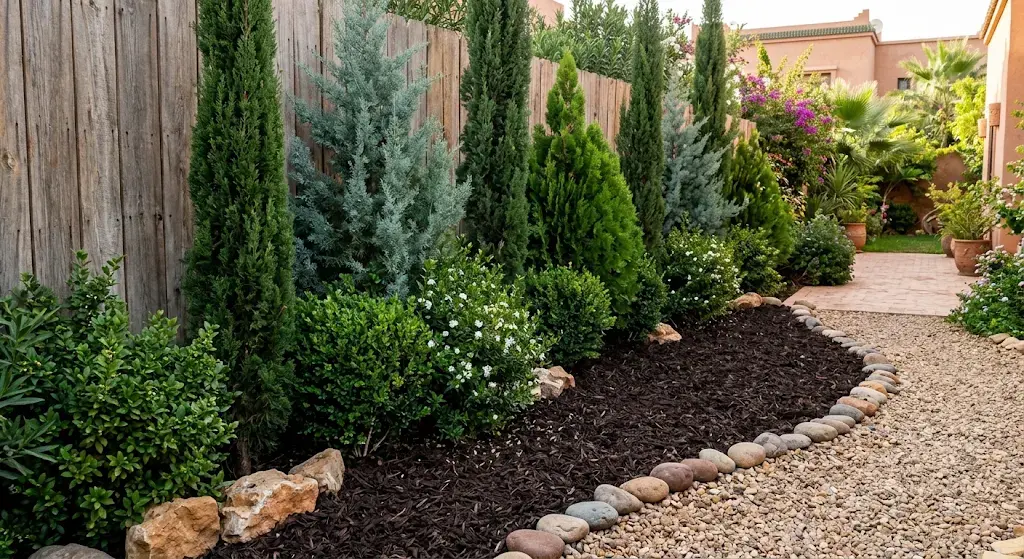
7. Stagger Plants Instead of Making a Perfect Row
The image works partly because the planting does not read as one rigid line.
Some shrubs sit closer to the lawn, while taller plants sit farther back.
That staggering creates:
- Better depth
- More natural spacing
- Room for different mature widths
- More interesting views from the lawn
Even in a narrow bed, moving a shrub forward by 12–24 inches can make the design look much less artificial.
8. Use Color Without Depending on Flowers
An evergreen border does not need to be one shade of green.
You can combine foliage with:
- Blue-gray needles
- Deep green foliage
- Golden-green shrubs
- Burgundy leaves
- Bright spring growth
Repeat each color in more than one location so the border feels connected rather than random.
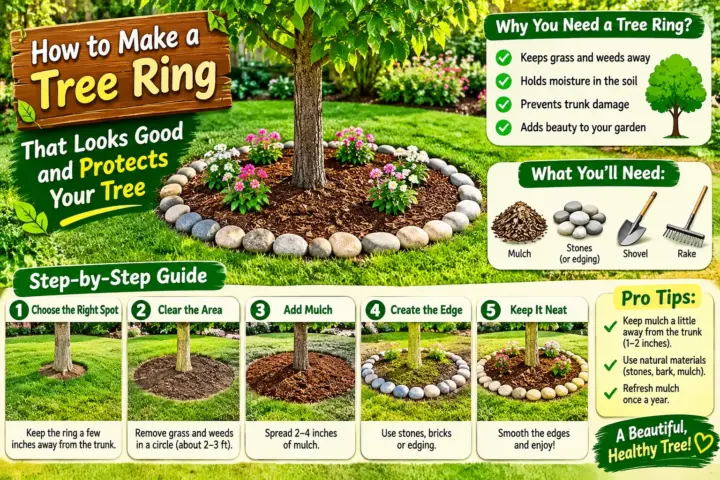
9. Use Organic Mulch Around the Shrubs
The dark mulch shown in the image is a practical choice as well as a visual one.
Organic mulch can help:
- Reduce weed growth
- Slow soil moisture loss
- Moderate soil temperatures
- Reduce mower damage
- Improve soil over time as it decomposes
A layer around 2–3 inches deep works well in many shrub beds.
Keep mulch away from trunks and shrub stems. Do not pile it against bark. Constant moisture around the stem can encourage decay and other problems.
10. The Stone Edge Is Decorative—Not the Important Part
The smooth stone border in the inspiration image creates a clean transition between mulch and lawn.
You can use:
- River stones
- Brick edging
- Metal landscape edging
- Stone pavers
- A simple cut lawn edge
Choose the edging based on maintenance and style. It does not need to be expensive to look intentional.
11. Curves Can Make a Long Fence Feel Less Harsh
A straight fence plus a perfectly straight planting bed can create a rigid corridor.
A gentle curved lawn edge breaks that line visually.
Keep curves broad and gradual rather than making many small waves that are difficult to mow around.
12. Check Drainage Before Planting Evergreens
A fence-line bed can collect water, especially if the yard slopes toward the fence or if soil was compacted during construction.
Before planting expensive conifers, check what happens after heavy rain.
If water sits for long periods, choose plants that tolerate those conditions or correct the underlying drainage problem before planting species that require well-drained soil.
13. Water New Evergreens Deeply While They Establish
Evergreens continue losing moisture through foliage even when they are not actively producing new growth.
Newly planted trees and shrubs need careful watering while roots spread into the surrounding soil.
Water deeply enough to moisten the root zone, then let soil conditions guide the next watering instead of following a rigid daily schedule.
Constantly saturated soil can be just as damaging as drought.
14. Do Not Depend on Heavy Pruning to Fix Bad Spacing
Many conifers look best when allowed to keep their natural form.
If a plant naturally grows 12 feet wide but you only have a four-foot planting space, repeated shearing is not a good long-term solution.
Choose a narrower cultivar from the beginning.
Some conifers also respond poorly when cut back into old bare wood, so aggressive size reduction can permanently damage their shape.
A Simple Layered Fence-Border Plan
| Layer | Purpose | Plant Type |
|---|---|---|
| Back | Privacy and height | Columnar evergreen or narrow conifer |
| Back / focal | Structure and contrast | Pyramidal conifer or small evergreen tree |
| Middle | Fill gaps and add color | Medium evergreen or deciduous shrub |
| Front | Soft edge | Low mounding evergreen or perennial |
| Ground | Weed control and clean finish | Organic mulch |
How to Lay Out the Bed Before Digging
- Measure the full fence section.
- Mark gates, utilities, irrigation, and drainage.
- Identify the views you need to screen.
- Choose the tall plants first.
- Write down each plant’s mature width.
- Mark plant centers on the ground.
- Add medium shrubs between or in front.
- Add low plants last.
- Stand back and check the layout from the house and patio.
- Only then begin digging.
What I Would Change From the Pinterest Design
The image looks excellent as inspiration, but I would make several adjustments before copying it into a real yard.
- Confirm every plant’s mature width.
- Increase gaps if necessary instead of chasing instant fullness.
- Use species proven for the local climate.
- Keep plants far enough from the fence for maintenance.
- Use several species rather than one vulnerable monoculture.
- Keep mulch away from trunks and stems.
7 Common Evergreen Privacy Border Mistakes
1. Planting for today’s size
Nursery plants grow. Use mature width when determining spacing.
2. Using only one species
A mixed border is generally more resilient and visually interesting.
3. Planting too close to the fence
Leave room for branches, airflow, and fence maintenance.
4. Ignoring drainage
A beautiful conifer can fail quickly in the wrong soil conditions.
5. Piling mulch around stems
Keep organic mulch several inches away from woody trunks and stems.
6. Choosing plants that require constant shearing
Choose cultivars whose natural mature size fits the available space.
7. Expecting instant privacy
A healthy permanent border often needs several growing seasons to fill in properly.
Evergreen Privacy Border FAQ
What are the best evergreens for privacy?
There is no single best species everywhere. Choose evergreen trees and shrubs that are adapted to your climate, soil, light, drainage, mature-space limits, and local pest pressures.
How far apart should privacy evergreens be planted?
Spacing depends on the mature width of the exact species or cultivar. Do not use one universal spacing number for arborvitae, spruce, juniper, pine, and other conifers.
Should evergreens touch when mature?
Some screening designs allow canopies to eventually overlap slightly, but severe crowding increases competition and makes maintenance more difficult. Plan intentionally rather than planting tightly for immediate privacy.
Can I plant evergreens directly against a wooden fence?
Leave enough room for the plant’s mature spread plus access to maintain the fence. Branches pressed permanently against boards can become distorted and make repairs difficult.
Is mulch good around evergreen shrubs?
Yes. Organic mulch helps conserve moisture, suppress weeds, moderate soil temperature, and improve soil as it decomposes. Keep it shallow and away from stems.
Should I use landscape fabric under the whole bed?
A well-maintained organic mulch layer can often manage weeds without permanently covering the soil with fabric. Fabric can also complicate future planting and eventually collect organic material on top where weeds can germinate anyway.
How do I make an evergreen border look less formal?
Mix heights, foliage colors, and plant forms; stagger plants forward and backward; use gentle curves; and repeat groups instead of planting every specimen at identical spacing.
The Bottom Line
A layered evergreen border is one of the best ways to soften a long privacy fence and create year-round backyard structure.
The Pinterest image gets the overall design idea right: tall evergreens in back, medium shrubs through the middle, compact plants along the edge, dark mulch, and a clean lawn border.
The part you should not copy is the apparent spacing or exact plant selection. Choose every plant for your own climate and give it enough room for its mature size.
A privacy border that looks slightly young in year one can become a far healthier and more attractive landscape in years five, ten, and beyond.
Sources
- University of Minnesota Extension — Selecting Trees and Shrubs for Windbreaks
- University of Illinois Extension — Build Privacy With Plants
- University of Minnesota Extension — Watering Newly Planted Trees and Shrubs
- University of Minnesota Extension — Pruning Trees and Shrubs
- Penn State Extension — Mulching Landscape Trees