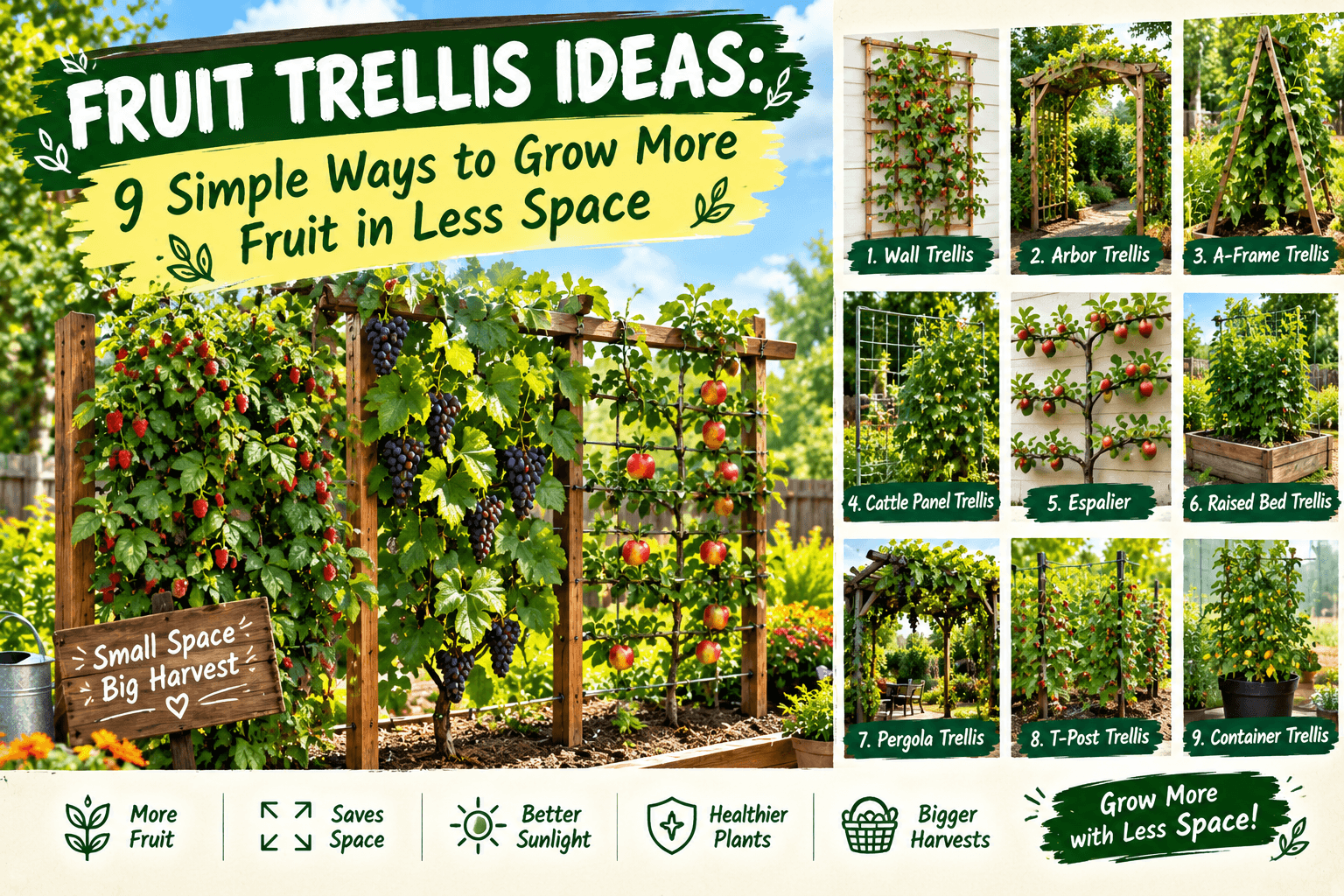
Fruit Trellis Ideas: 9 Simple Ways to Grow More Fruit in Less Space
My first fruit trellis was ugly.
I’m not gonna lie about that.
It was made from two old fence posts, some leftover wire, and a piece of wood that had been sitting behind my shed for who knows how long. I just wanted to get a climbing fruit plant off the ground.
It worked.
And that got me interested in fruit trellis ideas.
After that, I started trying different supports around the backyard. Some were cheap and worked great. Others looked good for about two weeks before leaning over like they had a bad back.
You’re gonna laugh at this, but one morning I found a young fruit vine lying across the chicken path. The chickens were having a wonderful breakfast before I figured out what happened.
So, I’ve learned a few things about growing fruit vertically.
If you’re working with a small backyard, patio, fence, or urban garden, a good trellis can help you grow fruit without giving up half your garden.
Lemme show you what has worked for me.
Why Use a Trellis for Fruit Plants?
Fruit plants can take up more room than you expect.
A small plant at the garden center can look harmless. Give it a couple seasons, though, and suddenly you’ve got branches going everywhere.
That’s where a trellis comes in.
Instead of letting vines and flexible branches spread across the ground, you guide them upward or along a support.
That can save space. It can also make harvesting easier.
Plus, getting fruit off the ground can help keep it away from mud, some pests, and foot traffic.
For my backyard homestead, the biggest benefit is simple: I can grow more in the same space.
1. A Simple Wire Trellis for Grapes
Grapes are one of the first fruit plants I think about when someone asks me about trellises.
They naturally want to climb.
You just need something strong enough to hold the vines and the fruit.
One of my favorite setups uses sturdy posts with horizontal wire running between them.
It doesn’t need to look fancy.
The important part is strength.
Grape vines get surprisingly heavy once they’re covered with leaves and fruit.
I learned this the annoying way. My first wire setup was too light. It looked fine in spring. By summer, the wire had sagged badly, and I was standing there trying to lift the whole thing back up without breaking the vines.
Now I use stronger posts and check the support before the growing season really gets going.
2. Fence Trellis for Small Fruit Plants
If you already have a strong fence, don’t ignore it.
A fence can become a ready-made support for certain fruit vines.
You can attach wire, netting, or sturdy horizontal supports to it.
This works especially well when you’re trying to save backyard space.
Instead of building a completely separate structure, you use something that’s already there.
Just make sure the fence can handle the extra weight.
A weak privacy fence and a heavy fruit vine aren’t exactly best friends.
One Thing to Watch
Leave enough room behind the plant for airflow and maintenance.
If everything is pressed tight against the fence, pruning and harvesting can become a pain.
I’ve done that before.
By the end of summer, I needed three hands just to find the fruit.
3. An Arch Trellis for a Backyard Garden
Now we’re getting into the fun stuff.
An arch trellis can look really nice while still being useful.
You can walk underneath it, which means the vertical structure doesn’t have to take up much extra ground space.
Depending on your climate and plant variety, climbing fruits such as grapes or certain berries can be trained along a strong arch.
I’ve also seen gardeners use arches to create a little entrance into a vegetable garden.
It gives the garden that old-fashioned homestead look.
4. A Wall-Mounted Fruit Trellis for Small Spaces
This is one of my favorite ideas for urban homesteading.
If you have a sunny wall, you already have part of the structure.
Attach sturdy supports to the wall and train suitable fruit plants across them.
This can work well when you don’t have room for a traditional orchard.
However, sunlight matters.
A beautiful trellis in deep shade isn’t going to magically produce a basket of fruit.
Watch the wall for a full day before you start drilling holes.
I made that mistake once with an herb shelf. The wall looked sunny in the morning. By afternoon, it was shaded.
Plants noticed.
I should have too.
5. A T-Shaped Trellis for Fruit Vines
A T-shaped support is simple but useful.
Imagine a strong post with a horizontal bar across the top.
You can run wires from the crossbar and train branches along them.
This style can be useful for grapes and other fruit plants that benefit from spreading their growth across a frame.
It also makes pruning easier because the branches are more organized.
That’s something I didn’t appreciate when I started.
A trellis isn’t only about holding the plant up.
It’s also about making your future work easier.
6. A Wooden Lattice Trellis for Berries
A wooden lattice is another option if you want something that looks a little more finished.
I’ve used lattice around parts of my garden because it blends into the backyard better than shiny metal does.
It can give climbing or semi-climbing plants something to lean against and can also help define a garden area.
Still, don’t assume every fruit plant needs to be tied tightly to the lattice.
Some plants need different training methods.
Check the growth habit of the exact variety you’re growing before you start tying branches everywhere.
7. DIY Cattle Panel Fruit Trellis
This is probably one of the strongest DIY options I’ve tried.
A cattle panel can make a big arch or a strong flat trellis.
It’s not the prettiest thing when you first install it.
But once vines cover it, you barely notice the metal.
The big advantage is strength.
These panels can handle a lot more weight than the little decorative garden trellises sold at some stores.
Here’s the funny part: I bought one thinking I’d use it for a quick garden project. Then I kept finding new uses for it. Garden arch? Yep. Support for vines? Yep. Temporary fence? Yep.
Homesteading has a funny way of turning one purchase into ten projects.
8. A Pergola-Style Fruit Trellis
If you’ve got more room and want something that feels like part garden, part outdoor living space, consider a pergola-style trellis.
Strong posts support a roof-like frame, and fruit vines can be trained over the top.
This can create shade while also giving you a productive garden feature.
Grapes are an obvious choice in areas where they grow well.
However, don’t build a huge structure before deciding what plant you’re growing.
The mature size of the plant should influence the size and strength of your trellis.
Otherwise, you’ll build the structure twice.
Ask me how I know.
9. A Simple String Trellis for Lightweight Fruit Vines
Not every plant needs a giant wooden structure.
For lighter vines, strong garden twine or similar support can sometimes work.
This is useful if you’re experimenting and don’t want to spend much money.
However, I don’t use flimsy string for heavy mature plants.
It may work in spring and fail when the plant becomes loaded with fruit.
Which Fruit Plants Can Use a Trellis?
This depends on the fruit and variety.
That’s important.
Not every fruit plant is naturally suited to climbing.
Some fruits grow on vines. Others grow on flexible canes or branches that can be trained against a support.
Grapes are an obvious example.
Some berry plants can also benefit from support.
There are even fruit trees that can be trained into flat shapes against a wall or support. That’s called espalier, and it’s something I’d like to experiment with more.
Before buying a plant, check its mature size and growth habit.
That five-minute bit of research can save you a whole lot of backyard frustration.
How I Build a Basic Fruit Trellis
If you’re new to this, don’t overthink it.
Here’s the basic process I use.
- Pick the fruit plant first. Know how large it can become.
- Choose the location. Look for enough sunlight and easy access.
- Build stronger than you think you need. Plants get heavy.
- Install the support early. Don’t wait until branches are tangled.
- Guide the plant gently. Use soft ties instead of cutting into young stems.
- Check the trellis during the season. Tighten wires and repair loose parts.
That’s really it.
The biggest thing is keeping up with the plant as it grows.
Use Soft Ties Instead of Regular Wire
This little detail can save your plants.
I’ve seen people tie branches with thin wire or very tight string.
As the branch grows, the tie can start cutting into it.
I prefer soft plant ties or strips of old cloth.
They’re gentle and easy to adjust.
And if the branch gets thicker, I loosen the tie.
Don’t tie everything down like you’re securing a package for shipping.
The plant still needs room to grow.
Don’t Forget Pruning and Training
A trellis won’t do all the work.
You still need to guide the plant.
When new growth starts going in the wrong direction, I gently move it toward the support.
Then I secure it loosely.
Later, I check again.
It’s a little like training a puppy.
You don’t teach it once and walk away.
You keep correcting small things before they become big problems.
What I Would Avoid When Building a Fruit Trellis
After several years of DIY garden projects, these are the mistakes I try not to repeat:
- Using weak posts for heavy vines
- Building in a shady location
- Putting the trellis too close to a walkway
- Using brittle or thin supports
- Waiting until the plant is tangled before training it
- Making the structure impossible to reach
The last one is huge.
If you can’t reach the fruit, you aren’t really saving yourself work.
You’re just moving the work higher up.
Fruit Trellis Ideas for Small Backyards
If your backyard is small, I would focus on vertical space.
A fence trellis can turn an unused wall into growing space.
An arch can create a garden walkway.
A strong narrow frame can fit along the side of a shed.
You can also use a wall-mounted structure where local rules and the wall itself allow it.
For urban homesteading, this is one of my favorite ways to squeeze more production from a small garden.
You’re not adding more ground.
You’re using the space above it.
What About Fruit Trellises in Containers?
Yes, it can work.
I’ve grown fruit plants in containers, but the container needs to be large enough for the particular plant.
You also need a stable trellis.
Here’s the problem: a small pot can tip over when a plant becomes tall and catches wind.
I learned that with a container that looked perfectly stable until a windy afternoon came along.
Down it went.
So if you’re growing fruit vertically in a container, think about the whole system.
Pot plus soil plus plant plus trellis should be stable.
My Favorite Cheap DIY Trellis Materials
I don’t believe you need to spend hundreds of dollars on a fruit support.
Look around first.
- Strong wooden posts
- Fence boards
- Garden wire
- Heavy-duty netting
- Cattle panels
- Old shelves
- Sturdy branches for lighter projects
- Soft plant ties
Just make sure reused materials are clean and safe for your garden.
I especially avoid unknown treated materials when I’m not sure what they are.
Fruit Trellis FAQ
What is the easiest fruit to grow on a trellis?
Grapes are one of the first fruits I’d consider because they naturally produce long vines. However, the best choice depends on your climate and the specific variety.
How strong should a fruit trellis be?
Stronger than you think. Mature vines can become heavy, especially after rain and when fruit develops. Use sturdy posts and supports that won’t bend easily.
Can I make a fruit trellis from a fence?
Yes, if the fence is strong enough. Add suitable wire or supports and make sure you can still reach the plant for pruning and harvesting.
Do fruit plants need to be tied to a trellis?
Many plants need some training and support. Use soft ties and don’t tie branches too tightly. Check them during the growing season as the plant gets larger.
What I’d Do If I Were Starting Again
If I was starting my backyard garden again today, I’d build the trellis before planting the fruit.
That’s the big lesson.
Don’t wait until the plant is six feet long and tangled around your tomatoes.
Choose the fruit first.
Then choose the location.
After that, build something strong enough to last several seasons.
I’d also keep the first project simple.
A couple of sturdy posts and horizontal wire can be more useful than an expensive decorative structure.
Once you understand how the plant grows, you can build something fancier later.
Start Small and Grow Upward
The best fruit trellis ideas aren’t always the most expensive ones.
Sometimes it’s a fence, a few posts, some wire, and a little patience.
Start with one plant. Watch how it grows. Guide it a little at a time.
That’s how I learned most of my backyard gardening tricks. I tried something, messed it up, fixed it, and tried again the next season.
And honestly, that’s part of the fun.
If you’re short on garden space, don’t immediately think you need more land. Look up. That empty fence, wall, or corner of the backyard might be your next growing space.
Got a fruit plant that’s getting out of control? Tell me about it. I’ve probably had the same problem.