Self Sufficient 1 Acre Homestead orchard, chickens, goats, greenhouse, compost When I first started thinking about a Self Sufficient 1 Acre Homestead, I had this picture in my head of a huge piece of land with a barn, cows, chickens, a giant garden, and probably a tractor sitting somewhere looking important.
Then I looked at land prices.
Yeah… that dream changed pretty quick.
The good news is, you don’t need 20 or 50 acres to build a productive homestead. With one acre, you can grow a surprising amount of food, keep a few animals, collect rainwater, compost kitchen scraps, grow fruit, and build a much more self-sufficient lifestyle.
I’ve spent more than 10 years learning what works and, more importantly, what doesn’t. If I were starting a self-sufficient 1-acre homestead from scratch today, I’d lay it out very differently than I did the first time.
The biggest lesson?
Don’t try to use every inch of land. Use every inch wisely.
Is One Acre Really Enough for a SSelf Sufficient 1 Acre Homestead
Heck yes… with a few limits.
One acre isn’t going to make you completely independent from the outside world. You’re probably not raising enough grain, hay, or livestock feed to support everything you eat.
But that’s not really the goal for most backyard homesteaders.
The goal is to produce more of your own:
- Vegetables
- Herbs
- Fruit
- Eggs
- Some meat
- Compost
- Herbs for medicine and cooking
- Firewood, depending on your location
- Rainwater for certain uses
- Preserved food
- Seeds for future crops
And you can do a lot with that.
I’ve found that a small piece of land can actually be easier to manage. You don’t spend half your Saturday walking around looking for a chicken that decided to disappear.
Trust me, I’ve been there.
Start With the House, Not the Garden
One mistake I see people make is putting the garden right in the prettiest part of the property.
Don’t.
Before planting anything, figure out where your house, driveway, utilities, water storage, paths, and animal areas are going.
Your house is the center of your daily life.
I like keeping frequently used areas close to it. The kitchen garden should be somewhere you can reach quickly. Same with herbs, chickens, compost, and water.
If you have to walk 200 feet to grab two tomatoes for dinner, eventually you’re gonna stop doing it.
That’s just human nature.
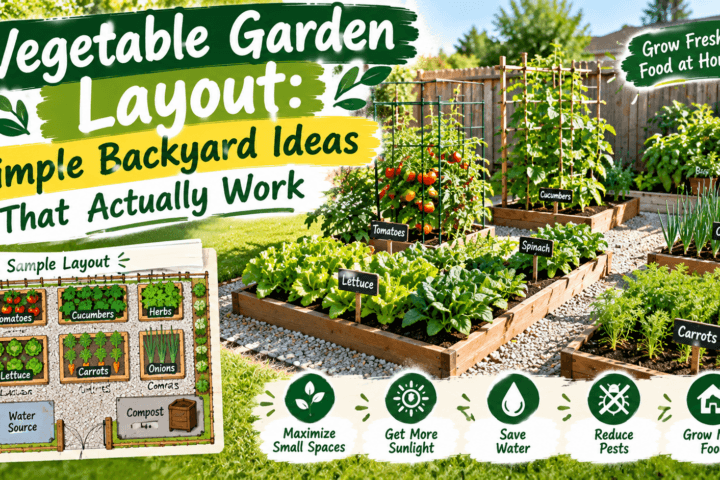
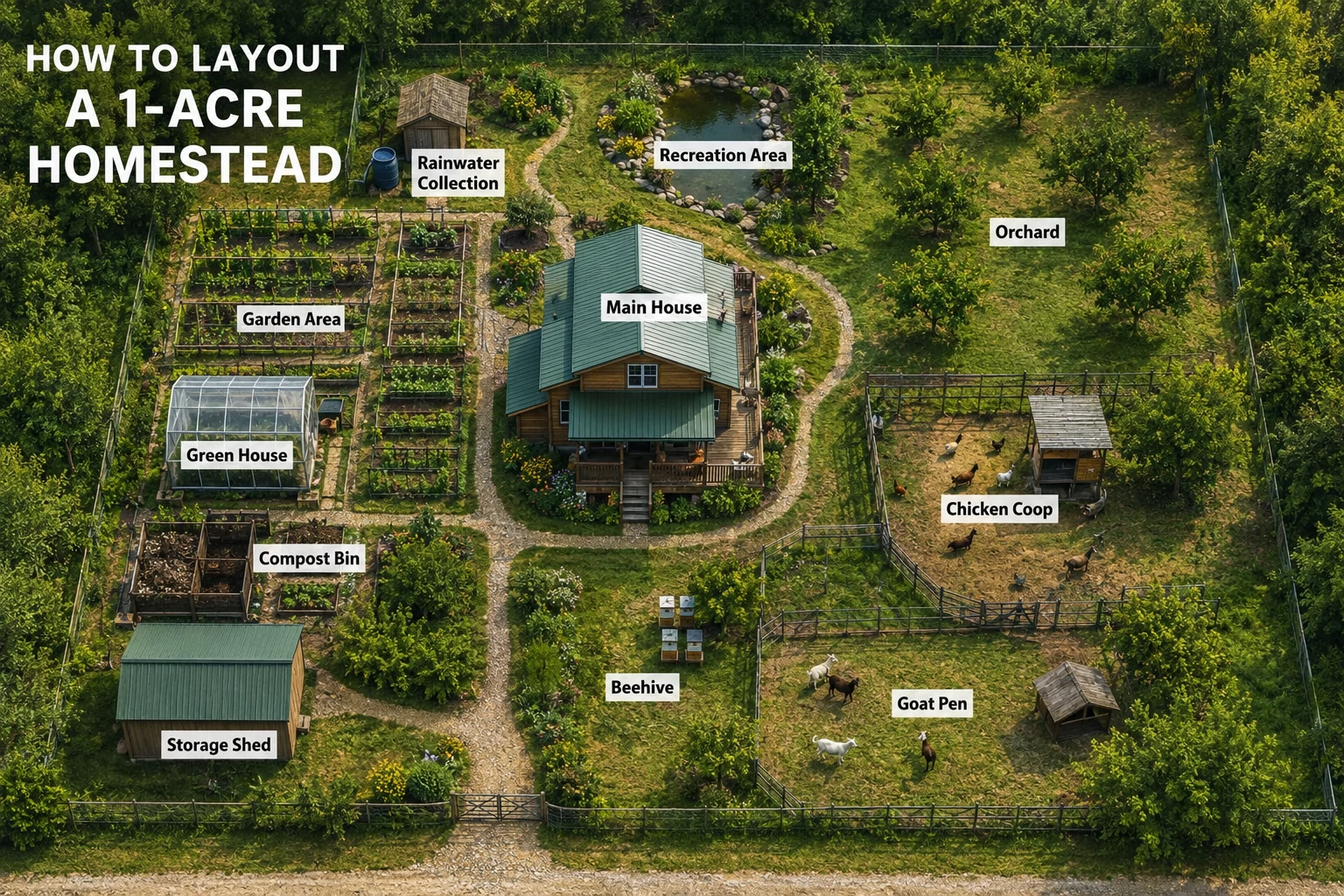
My basic 1-acre layout would look something like this:
Near the house:
- Kitchen garden
- Herbs
- Compost
- Chicken coop
- Small greenhouse
- Tool storage
Farther out:
- Orchard
- Larger vegetable beds
- Rainwater storage
- Chicken run
- Small livestock area
- Wood storage
Back or less-used areas:
- Fruit trees
- Perennial crops
- Wildlife-friendly plants
- Larger compost area
- Storage
The exact arrangement depends on your climate, slope, soil, sun, and local rules.
The Garden Should Be the Heart of Your Homestead
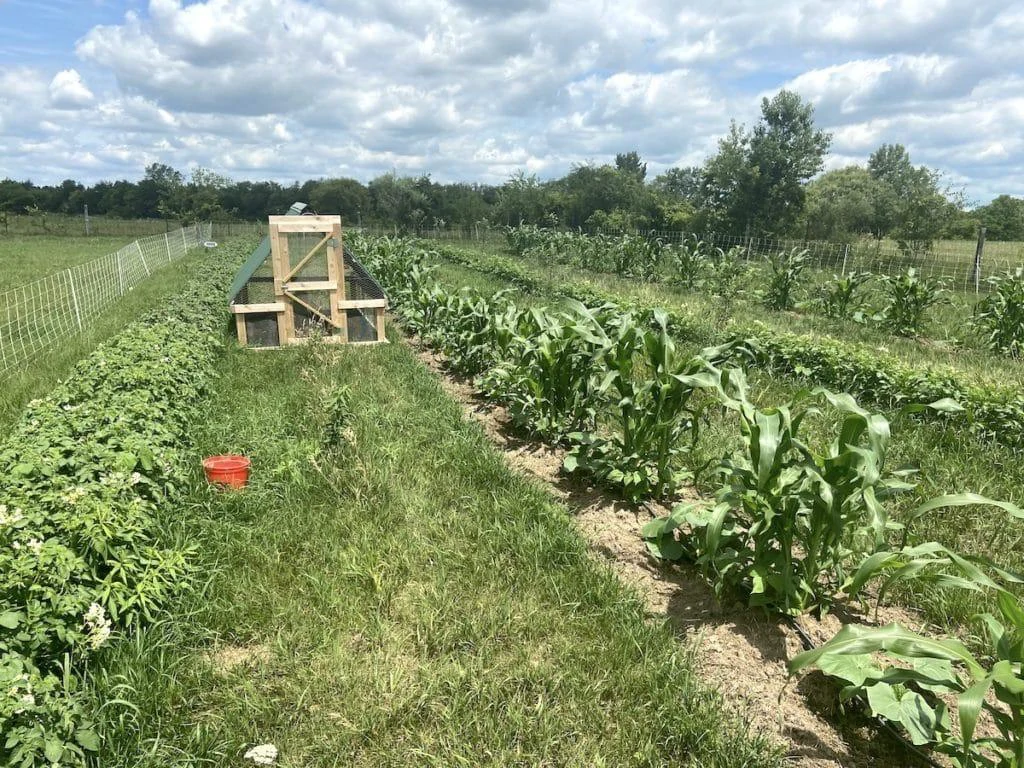
If you’re serious about becoming more self-sufficient, the vegetable garden is probably your best starting point.
But don’t make the mistake I made and plant everything you can think of.
My first big garden looked fantastic in May.
By August, it looked like a jungle had swallowed it.
I had zucchini coming out of my ears, weeds everywhere, and about 15 different vegetables that I barely ate.
Now I grow what we actually use.
For a one-acre homestead, I’d focus on productive crops such as:
- Tomatoes
- Potatoes
- Beans
- Peppers
- Cucumbers
- Carrots
- Onions
- Garlic
- Lettuce
- Kale
- Squash
- Beets
- Herbs
And I always leave room for succession planting.
Once one crop is finished, something else goes in.
That’s how you get more food from a small piece of land without making the garden enormous.
Put the Greenhouse Where You’ll Actually Use It
I love having a small greenhouse on a homestead.
It doesn’t need to be fancy.
Mine would be close to the garden because hauling trays, soil, compost, and water across the property gets old real fast.
A small greenhouse can help you:
- Start seedlings early
- Protect young plants
- Grow greens during colder months
- Extend the growing season
- Save seeds
- Experiment with crops
You don’t need a giant commercial greenhouse on one acre.
A simple DIY structure can be enough.
Just make sure you think about ventilation. My early greenhouse got so hot one afternoon that I nearly cooked an entire tray of seedlings.
That was an expensive lesson in opening windows.
Chickens Are Perfect for a Small Homestead
If your local laws allow them, chickens are one of the first animals I’d add.
They’re useful in several ways.
You get eggs, manure, entertainment, and they can help clean up certain garden scraps.
But there’s another reason I like chickens.
They make the homestead feel alive.
There’s something about walking outside in the morning with a cup of coffee while chickens are scratching around that just feels right.
For one acre, I wouldn’t go crazy with numbers.
A small flock is usually much easier to manage than 30 birds.
And build your coop securely.
Raccoons don’t care about your homesteading dreams.
They care about dinner.
What About Goats?
This is where I’d slow down.
A lot of people see a one-acre homestead picture and immediately think:
GOATS!
I understand. Goats are fun.
But goats need fencing, shelter, feed, minerals, and management. One acre doesn’t automatically mean you have enough forage to support them.
If you’re determined to keep goats, research your local conditions carefully and plan the fencing before buying the animals.
I learned this one the hard way.
A goat doesn’t see your fence as a fence.
It sees it as a puzzle.
And goats are surprisingly good puzzle solvers.
For many one-acre homesteaders, chickens, rabbits, or quail may be easier to manage than larger livestock.
Plant a Small Orchard Instead of Ten Different Trees
Fruit trees are one of my favorite long-term investments.
But don’t plant 40 trees because you saw a beautiful homestead orchard online.
Start small.
A few productive trees can give you years of food.
Depending on your climate, you might consider:
- Apples
- Pears
- Peaches
- Plums
- Cherries
- Figs
- Persimmons
Not every tree works everywhere, so choose varieties suited to your growing zone.
And remember, trees take time.
That’s actually one reason I like planting them early.
Every year you wait is another year without fruit.
I also like planting berries around the orchard. Raspberries, blackberries, strawberries, and similar crops can produce a lot without taking up much ground.
Compost Belongs Between the Garden and Kitchen
Don’t put your compost pile somewhere you’ll never visit.
That’s another mistake I made.
I once put mine way behind the garden because I thought it would look better.
Guess what happened?
I stopped using it.
Now I keep compost somewhere convenient.
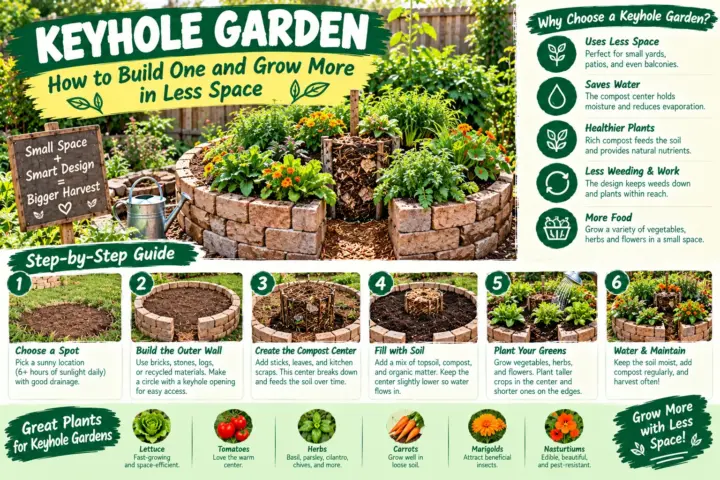
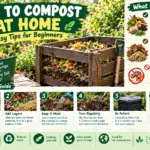
A good homestead compost system can turn kitchen scraps, leaves, weeds, and garden waste into something your soil actually needs.
I use a simple system rather than getting fancy.
Kitchen scraps go into a covered container.
Leaves and garden material go into the compost pile.
Every so often, I turn it.
That’s it.
You don’t need an expensive spinning compost machine unless you really want one.
Rainwater Collection Can Make a Big Difference
Water is one of the first things I’d plan when designing a self-sufficient 1-acre homestead.
Your roof is basically a giant water collection surface.
With the right setup and local regulations, rainwater can be collected and stored for appropriate non-potable uses such as irrigation.
I like using rainwater for the garden because it reduces how much water I need from the main supply.
You can collect water from gutters and send it into barrels or larger tanks.
But here’s the important part:
Plan your overflow.
The first rain barrel I installed overflowed right beside the house.
After a heavy storm, I had a miniature river running toward the foundation.
Not exactly the homestead feature I was going for.
Build Paths Before Everything Gets Overgrown
This sounds boring.
It’s not.
Good paths make a small homestead much easier to manage.
You want to be able to walk from:
House → garden → chickens → compost → orchard → storage
without fighting through weeds and mud.
I like simple gravel, wood chips, mulch, or other inexpensive materials depending on the area.
Keep the paths wide enough for a wheelbarrow.
You’ll thank me later.
Especially when you’re hauling 40 pounds of compost.
Solar Power Doesn’t Have to Run Everything
When people hear “self-sufficient homestead,” they sometimes imagine a massive solar setup covering every roof.
You don’t need to start there.
A small solar system can be useful for specific jobs:
- Lights
- Small pumps
- Charging batteries
- Cameras
- Electric fencing
- Emergency power
Start with the things that matter most.
Over time, you can expand.
That’s how I prefer doing almost everything on a homestead. Build a little, use it, find the problems, then improve it.
Food Storage Is Just as Important as Growing Food
Growing food is only half the job.
You also need to keep it.
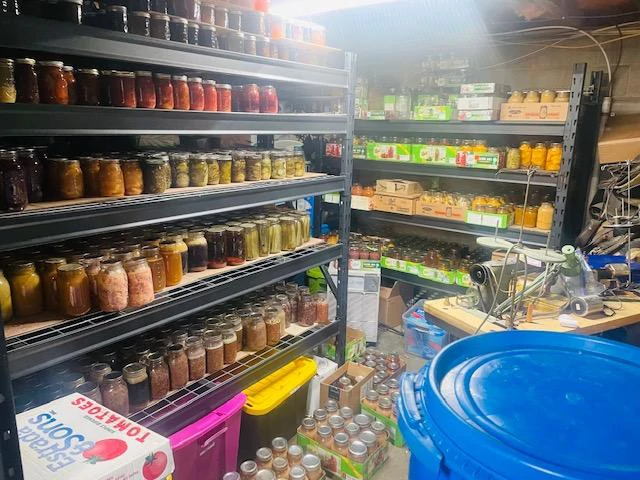
That’s where canning, dehydration, freezing, fermentation, and dry storage become important.
A huge tomato harvest doesn’t help much if you can’t preserve it.
I like having a small pantry or food-storage area near the kitchen.
Things like:
- Rice
- Beans
- Flour
- Pasta
- Canned vegetables
- Dehydrated produce
- Honey
- Sugar
- Salt
- Seeds
can all have a place.
The trick is not storing more than you can realistically use.
I once canned way too much of one crop.
Let’s just say we were eating the same thing for a VERY long time.
Leave Some Space for Things You Haven’t Thought About
This is probably my biggest piece of advice.
Don’t fill your entire acre on day one.
Leave open space.
Why?
Because after living on the property for a year, you’ll notice things you never saw on paper.
Maybe one corner stays wet.
Maybe another gets perfect afternoon sun.
Maybe the chickens need more room.
Maybe you discover that the spot you planned for the greenhouse is actually terrible.
A homestead changes as you learn.
Leave yourself some breathing room.
My Simple One-Acre Homestead Plan
If I had exactly one acre today, I’d roughly divide it like this:
House and living area: 20%
Vegetable garden: 15%
Orchard and berries: 20%
Chicken and small animal area: 15%
Greenhouse and nursery: 5%
Compost and utility area: 5%
Paths, water storage, and access: 10%
Open space/future projects: 10%
These numbers aren’t a rule.
They’re just a starting point.
Your property may need a completely different setup because of slope, climate, regulations, trees, water, or soil.
The Biggest Mistakes I’d Avoid
If I could go back and start my first homestead again, I’d do a few things differently.
I wouldn’t plant too much too soon.
I wouldn’t buy animals before building their housing.
I wouldn’t ignore water.
I wouldn’t build cheap fencing.
I wouldn’t put the compost pile a mile away from the kitchen.
And I definitely wouldn’t spend thousands of dollars on equipment before knowing what I actually needed.
Start small.
Learn.
Then expand.
That’s the beauty of homesteading.
You don’t have to build the perfect property in one weekend.
Can You Really Be Self-Sufficient on One Acre?
Not completely.
And anybody telling you otherwise is probably selling something.
But you can become much more self-reliant.
You can grow a meaningful portion of your vegetables, produce eggs, preserve food, collect rainwater for suitable uses, compost your organic waste, grow fruit, save seeds, and learn skills that don’t disappear when the power goes out.
That’s what I think self-sufficiency really means.
It’s not about disconnecting from the world completely.
It’s about needing the world a little less.
Final Thoughts
A self-sufficient 1-acre homestead doesn’t need to look like a magazine cover.
Mine sure doesn’t.
There are crooked fences, muddy boots, weeds where they shouldn’t be, and usually something that needs fixing.
But that’s homesteading.
If you’re starting with one acre, don’t try to do everything at once. Start with a productive garden, reliable water, a small compost system, a few fruit trees, and maybe chickens if they’re allowed where you live.
Then build from there.
After a few years, you’ll look around and realize that little piece of land is doing a whole lot more for you than you ever expected.
And honestly, that’s one of the best feelings in the world.