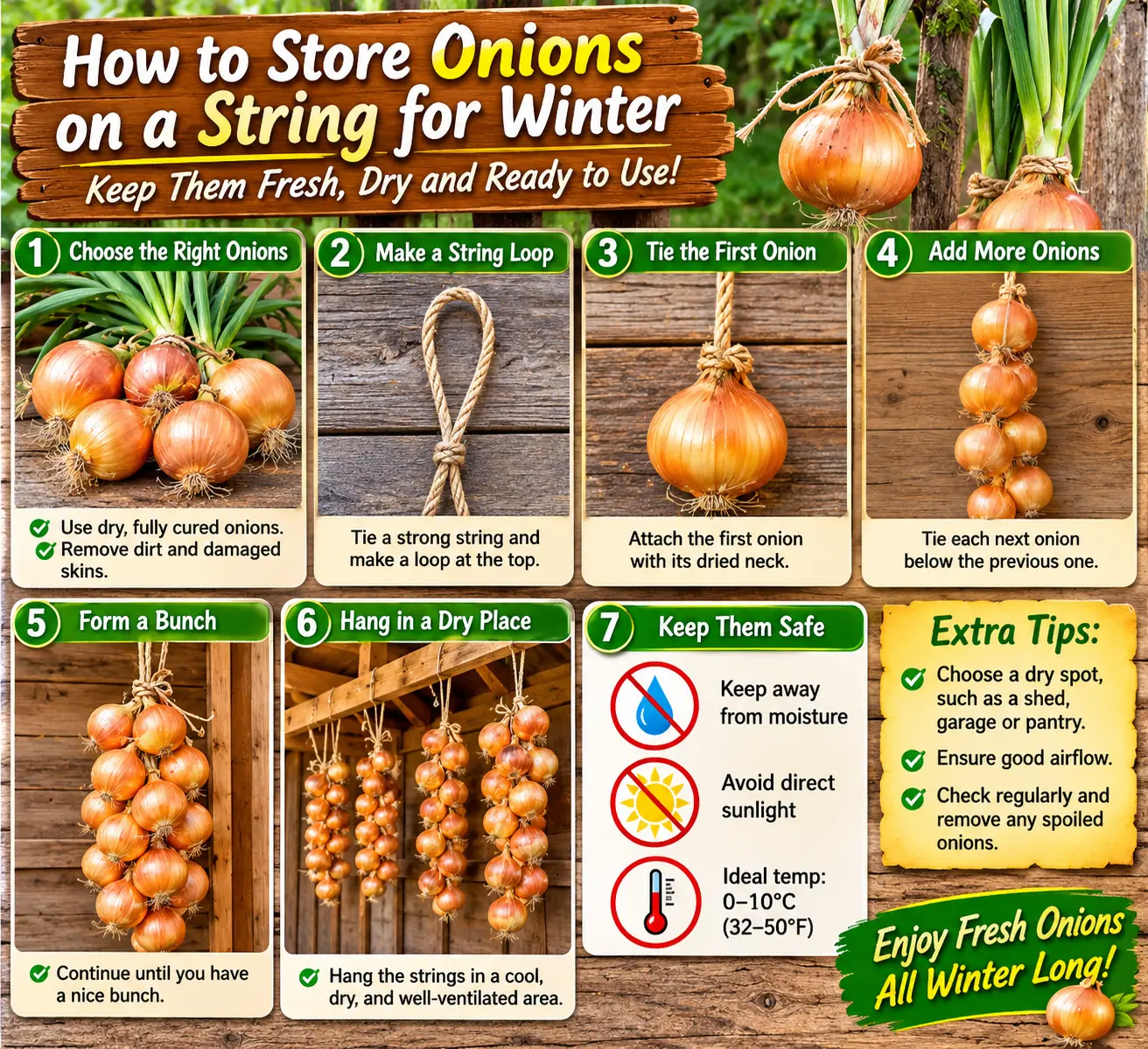
Storing onions on a string is a traditional way to keep cured storage onions organized, ventilated, and easy to inspect through winter. Instead of piling bulbs into a deep box, you tie or braid them into a hanging onion rope and remove one bulb at a time as you need it.
The vintage Pinterest illustration shows a simple method where onions are tied individually around a loop of string to form a spiral rope. The idea is sound, but the onions must be completely cured before long-term storage, and not every onion variety stores equally well.
The most important rule: do not string freshly harvested onions for winter storage while the necks are still green or moist. Cure them first until the outer skins are papery and the necks are dry and tight.
Why Store Onions on a String?
A hanging onion rope uses vertical space and keeps individual bulbs visible.
That gives you several practical advantages:
- Good air circulation around the bulbs
- Easy inspection for soft or rotting onions
- No heavy crate taking up shelf space
- Easy access to one onion at a time
- A useful traditional storage method for sheds, pantries, and cool storage rooms
Which Onions Are Best for String Storage?
Choose onions bred or known for storage rather than assuming every bulb will last all winter.
Pungent storage onions generally keep longer than many mild or sweet onions.
Illinois Extension specifically notes that many sweet varieties are poor keepers even when stored carefully.
Step 1: Harvest at the Right Time
Wait until the onions are mature.
University of Minnesota recommends harvesting when about half the tops have fallen over and begun drying.
Lift the bulbs carefully with a garden fork rather than yanking them aggressively from compact soil.
Step 2: Do Not Remove the Tops Yet
If you want to braid or tie onions into a rope, leave the tops attached while they cure.
The dried foliage becomes part of the support structure.
Avoid cutting into green or moist neck tissue. USU warns that cutting tops before they are fully dry can contribute to neck rot during storage.
Step 3: Cure the Onions Completely
Curing is what prepares the bulbs for storage.
UMN recommends curing onions in a warm, dry, well-ventilated location for roughly 2 to 4 weeks, until the outer scales are dry and the necks are tight.
Illinois Extension similarly notes that full air circulation for several weeks is important for complete drying and curing.
How to Tell When an Onion Is Cured
- The outer skin feels dry and papery.
- The neck is completely dry rather than thick and green.
- The roots are dry.
- The bulb feels firm.
- There are no soft or wet spots.
Step 4: Sort Before You Tie
Do not put every harvested onion into long-term storage.
Set aside bulbs that are:
- Bruised
- Cut
- Soft
- Diseased
- Thick-necked
- Still green
- Already sprouting
Use sound but imperfect onions first instead of hiding them inside a winter storage rope.
How to Make an Onion String Like the Pinterest Method
1. Make a Strong Loop
Use strong kitchen twine, jute cord, or another sturdy string.
Tie it into a long loop and hang it from a secure hook or beam so you can work with both hands.
2. Tie the First Onion at the Bottom
Choose one of the larger, fully cured onions for the bottom.
Wrap the dried neck securely around the two strands of the loop so the bulb cannot slip downward.
3. Add the Next Onion
Position the second onion slightly above the first, turning its dry top through or around the hanging string.
The goal is to let the bulb rest against the rope while its dry neck locks it into place.
4. Alternate the Bulbs
Add one onion at a time and rotate the bulbs around the string rather than stacking every bulb on exactly the same side.
This creates the spiral appearance shown in the vintage illustration and distributes the weight more evenly.
5. Do Not Make the Rope Too Heavy
A beautiful five-foot onion rope is not useful if the hook tears out of the ceiling or the dried stems break under the load.
Make several manageable strings rather than one extremely heavy one.
Can You Braid the Onions Instead?
Yes.
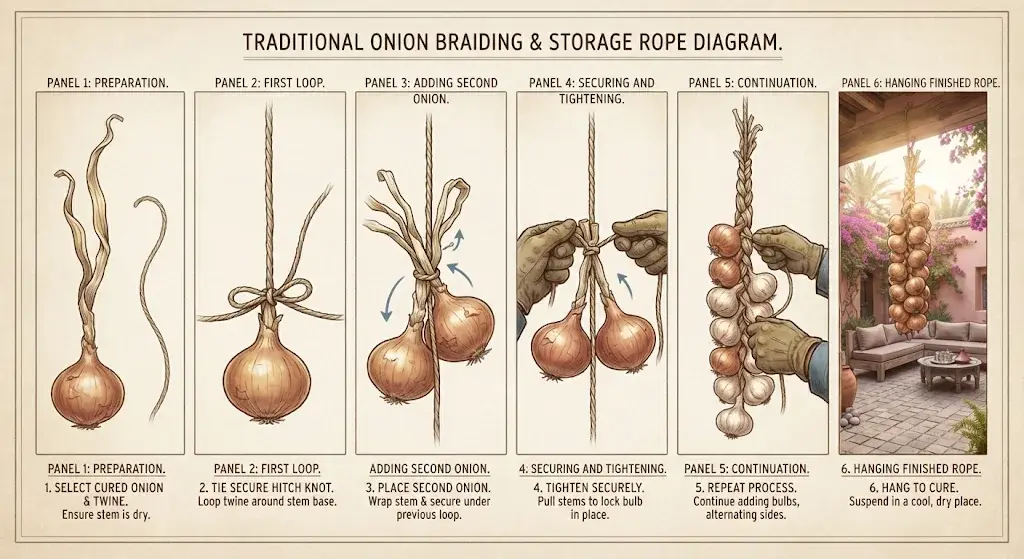
Illinois Extension and USU both describe braiding dried onion tops as a traditional storage option.
Twine can be braided into the dried foliage to add extra strength.
String vs. braid: a braid uses the onion tops themselves as the main structure. The string method shown in the Pin uses a separate cord to support individual bulbs. Both can work when the onions are fully cured.
Where Should You Hang Onion Strings?
The storage location matters more than the decorative appearance of the rope.
Use a place that is:
- Cool
- Dry
- Dark or protected from strong light
- Well ventilated
- Protected from freezing
- Protected from rodents
Possible locations include an appropriate basement, cellar dry zone, cool pantry, or frost-protected shed if actual temperatures remain suitable.
Best Temperature and Humidity for Stored Onions
Onions prefer colder and drier storage than carrots and many root crops.
UMN categorizes onions as a cold and dry storage crop and lists long-term storage near 32–40°F with relatively low humidity.
USU likewise recommends cool, dry conditions after curing.
Do Not Store Onion Ropes in a Humid Root Cellar Zone
This matters if your FarmSolo pantry also contains carrots, beets, or potatoes.
Carrots and many root crops prefer much higher humidity than onions.
Do not hang your onion strings directly above damp sand bins or in the wettest part of a root cellar.
Why Airflow Matters
Stored onions continue to respire after harvest.
Air movement helps prevent humid pockets around the bulbs and makes it easier for any moisture to dissipate.
This is why onion ropes, braids, mesh sacks, and ventilated crates are preferable to sealed plastic bags.
Never Store Onions in Sealed Plastic Bags
A sealed bag traps humidity around the bulbs.
That can encourage condensation, mold, and decay.
If you do not want to string onions, use mesh bags, open baskets, or slatted crates instead.
Check the Onion Rope Regularly
Traditional storage does not mean hang it once and forget it until spring.
Inspect the rope regularly for:
- Soft bulbs
- Mold
- Dark wet necks
- Sprouting
- Bad odors
- Leaking tissue
Remove deteriorating bulbs promptly so they do not create problems for neighboring onions.
How Long Can Onions Last?
Storage life depends on variety, curing, disease pressure, temperature, humidity, and handling.
UMN gives properly stored home-garden onions an expected storage life of roughly four months under suitable cold, dry conditions.
Illinois Extension notes that good storage onions may last for months and potentially into late winter.
Sweet onions usually have a much shorter storage life.
Can You Cut an Onion From the Rope Without Untying Everything?
Yes.
If the onions are tied or braided correctly, you can cut one bulb away as needed while leaving the rest of the rope hanging.
Illinois Extension specifically describes this as one advantage of a traditional onion braid.
Onion Rope vs. Mesh Bag vs. Crate
| Method | Advantages | Watch For |
|---|---|---|
| String or braid | Excellent visibility and vertical storage | Weak stems or overloaded ropes |
| Mesh bag | Easy and quick | Do not pack too densely |
| Slatted crate | Good for larger harvests | Avoid deep piles and poor airflow |
What This Vintage Onion-String Guide Gets Right
- Hanging onions is a legitimate storage method.
- A strong central cord adds support.
- Bulbs can be added one at a time to form a rope.
- Vertical storage improves visibility.
- Onions can be removed individually as needed.
What the Old Illustration Leaves Out
- The onions must be properly cured first.
- Damaged and thick-necked bulbs should not go into long-term storage.
- Sweet onions may not keep nearly as long as storage varieties.
- The storage area must be cool, dry, and ventilated.
- The onions should not freeze.
- The rope should be inspected regularly.
Storing Onions on a String FAQ
Do onions have to be cured before hanging?
Yes, for long-term storage. The outer skins should be dry and papery and the necks should be completely dry before the onions are tied or braided for storage.
Can I braid onions while the tops are green?
Do not put moist green-necked onions directly into long-term storage. Cure them first. Once the tops are sufficiently dry, they can be braided or tied.
Should I wash onions before storing them?
For long-term storage onions, avoid washing them before curing and storage. Brush away loose dry dirt after curing rather than introducing extra moisture.
Can I hang onions in the kitchen?
A warm kitchen may be convenient for short-term use but is not ideal for maximizing long-term storage. A cooler, dry, well-ventilated location generally works better.
Can onions freeze in storage?
Do not allow stored onions to freeze. Choose a cold but frost-protected location.
Should onions and potatoes be stored together?
It is better to give them separate storage zones. Onions prefer drier conditions than potatoes, which generally do better with higher humidity.
The Bottom Line
Storing onions on a string is not just an old-fashioned decoration. It is a practical way to keep properly cured storage onions ventilated, visible, and easy to use through winter.
Harvest mature onions, cure them thoroughly, reject damaged bulbs, tie or braid the dry tops securely, and hang the finished rope in a cool, dry, ventilated place. The string itself is simple—the curing and storage conditions are what determine whether the onions actually last.
Sources
- University of Illinois Extension — Onion
- University of Minnesota Extension — Growing Onions in Home Gardens
- University of Minnesota Extension — Harvesting and Storing Home Garden Vegetables
- Utah State University Extension — How to Grow Onions in Your Garden
- Utah State University Extension — Harvest and Storage of Vegetables and Fruits