Rain Garden: How I Made My Backyard Handle Rain Without a Muddy Mess
I didn’t really understand the value of a rain garden until I had one of those storms that dumps a crazy amount of water in a short time.
You know the kind I’m talking about. The sky gets dark, the rain starts coming down sideways, and five minutes later you’re standing at the kitchen window wondering if your backyard is turning into a swimming pool.
That was me.
Water was running off the roof, down the driveway, across the lawn and straight toward one of my garden beds. The soil got soaked, mulch washed away, and I found myself standing outside in old boots trying to redirect water with a shovel.
Not my smartest gardening moment.
That’s when I started learning more about rain gardens. I wasn’t looking for some fancy landscaping project. I just wanted to slow down the rain, keep my garden from washing out, and make better use of the water that was already falling on my property.
After experimenting with the location, plants, rocks and soil, I finally got something that worked pretty darn well.
So let me show you what I learned, including a couple things I definitely would NOT do again.
So, What Exactly Is a Rain Garden?
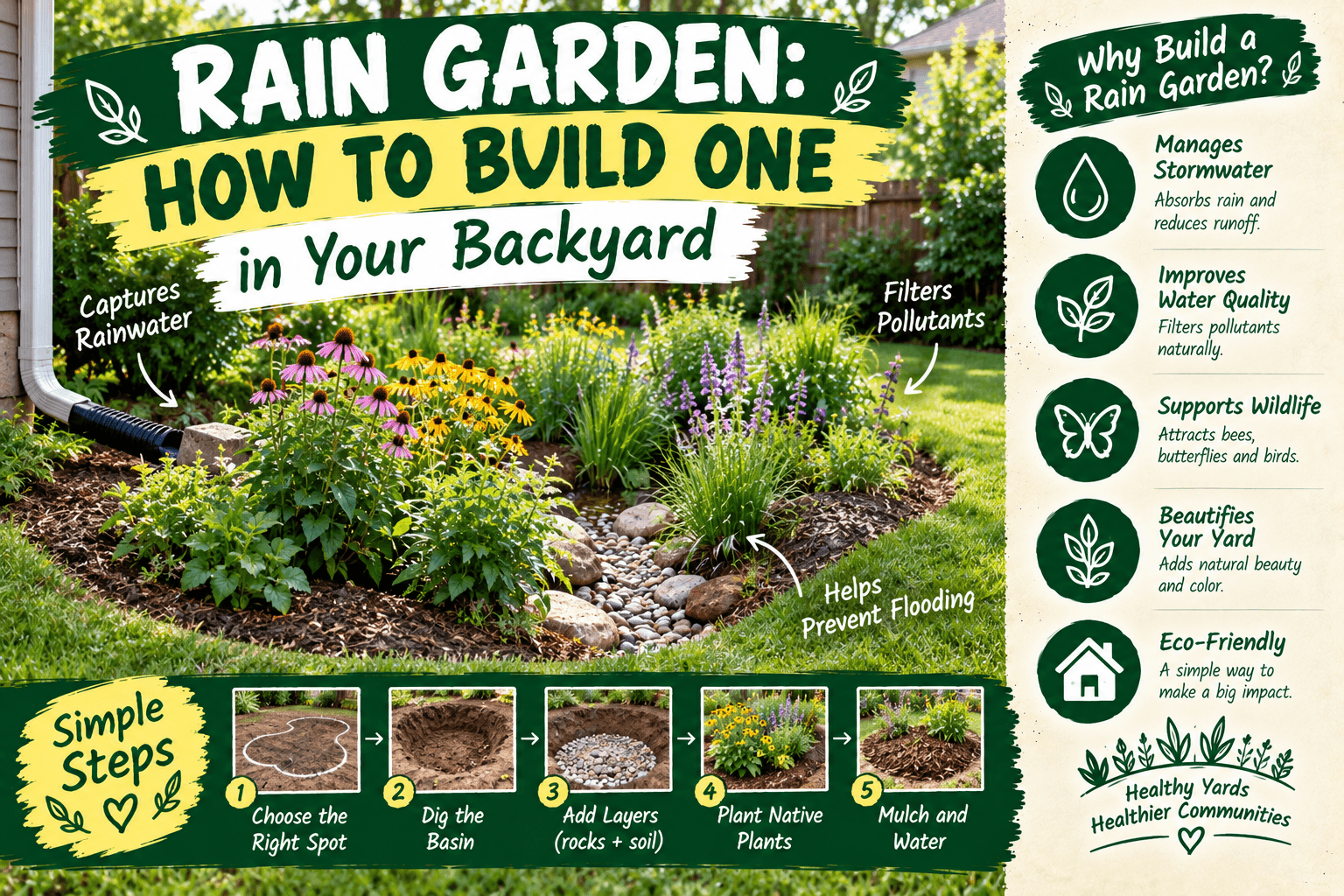
A rain garden is basically a shallow planted area designed to temporarily collect rainwater and let it soak into the ground instead of rushing across your yard.
It isn’t a pond.
That’s one thing that confused me at first.
A good rain garden might hold water for a little while after a storm, but the goal isn’t to keep it full all the time. The water should gradually soak into the soil.
Think of it as a little natural catch basin in your backyard.
Instead of fighting rainwater and trying to get rid of it as fast as possible, you’re giving the water a safe place to slow down and soak in.
Why I Wanted a Rain Garden in My Backyard
My biggest problem wasn’t really the amount of rain. It was where the rain was going.
The roof collected a lot of water, and the downspouts sent that water toward areas where I didn’t want it.
My vegetable garden was one of those places.
After a heavy storm, I could see little channels forming in the soil. Compost and mulch would move downhill. Seeds I’d planted carefully would disappear.
And sometimes the path around the garden became a muddy mess.
I got tired of fixing the same problem over and over.
A rain garden gave me a way to work with the water instead of constantly fighting it.
Where Should You Put a Rain Garden?
This is probably the most important part of the whole project.
Don’t just dig a hole in the lowest spot of your backyard and hope for the best.
Yep, that’s pretty much what I wanted to do at first.
Before digging, watch your yard during a heavy rain if you can. See where the water naturally travels.
Look at your downspouts too. You may find that one particular downspout is creating most of your runoff problem.
That’s probably the best advice I can give you.
A rain garden should generally be placed where it can receive runoff but not where water is already constantly sitting.
Also be careful around your home’s foundation, septic systems, wells, underground utilities and other structures. Local drainage conditions and rules can vary, so check before you start digging a serious-sized garden.
How I Picked the Spot
I spent a couple rainy days just watching the water.
Honestly, this saved me a lot of work.
I marked the areas where water naturally collected and followed the path backward toward the source.
Eventually I found a spot that could catch runoff without sending water toward the house.
That’s where I started.
If you’re working in a small urban backyard, you don’t need a giant rain garden either. Even a modest planted depression can be useful when it’s properly located and designed for your site.
How Big Does a Rain Garden Need to Be?
This is another question I see all the time.
The honest answer is: it depends.
The amount of roof or paved area sending water toward the garden matters. So does your soil, rainfall, slope and how quickly the ground absorbs water.
I wouldn’t pick a size just because somebody on the internet said, “Make it ten feet long.”
Your backyard isn’t their backyard.
Start by understanding how much water you’re trying to manage. If you’re dealing with a large roof area or a difficult drainage problem, it may be worth getting advice from a local drainage professional or extension service.
My Biggest Rain Garden Mistake
You’re gonna laugh at this.
I originally made my first test area too deep.
I thought deeper meant better because, well, more room for water, right?
Nope.
I ended up with a muddy little hole that stayed wet longer than I wanted. Some of the plants didn’t like it either.
I eventually reshaped the area into a much gentler depression.
That worked better for my particular yard.
Don’t think of a rain garden as digging the biggest hole you can. The shape, soil and drainage matter just as much as the size.
What Soil Should You Use?
Soil is where things get interesting.
My backyard has areas of heavy soil that don’t drain very quickly.
I learned pretty fast that simply dumping random garden soil into a hole isn’t a real solution.
Before building a rain garden, figure out how quickly your soil drains.
You want the water to soak in rather than sit there forever.
If your soil is extremely compacted or drains very slowly, you may need a different design or professional advice rather than simply adding more compost.
And please don’t assume that adding compost fixes every drainage problem. Compost is wonderful for many garden situations, but a rain garden has a specific job to do.
What Plants Work in a Rain Garden?
This is the fun part.
I like choosing plants that can handle periods of wet soil but don’t mind drying out between storms.
Native plants are especially worth looking at because they can be better adapted to your local climate and may provide useful habitat for pollinators and other wildlife.
Depending on where you live, options may include native grasses, sedges, flowering perennials, shrubs and other moisture-tolerant plants.
Don’t just grab a plant because the label says “likes water.”
Some plants want constantly wet soil. Others can handle a temporary soaking and then prefer things to dry out.
Those are very different situations.
My Favorite Way to Choose Rain Garden Plants
I divide the garden into little zones.
Plants here need to tolerate temporary wet conditions.
This area gets moisture but usually drains sooner.
Choose plants that can handle more normal garden conditions.
Your own backyard will teach you more after a few seasons.
Can You Use a Rain Garden for Vegetable Gardening?
I’d be careful with this one.
I wouldn’t turn the lowest, wettest part of a rain garden into a tomato or pepper bed.
Vegetables generally need predictable growing conditions, and many don’t appreciate sitting in saturated soil.
Instead, I like keeping my food-producing garden beds slightly separate from the rain garden.
The rain garden can help manage runoff nearby while your vegetables stay in a better-drained growing area.
That’s a much better setup for my backyard.
What About a Downspout?
This is where a rain garden can become really useful.
A downspout can deliver a surprising amount of water during a heavy storm.
If your downspout sends water toward your lawn or garden, you may be able to redirect the runoff toward an appropriately designed rain garden.
But don’t just point the downspout at the garden and walk away.
You need to make sure the water enters without causing erosion.
Rocks, gravel and a stable inlet area can help slow the incoming flow.
After the first big storm, go outside and look at what the water is actually doing. If soil is washing away, the flow needs attention. Your first storm is basically a free test run.
Adding Rocks and Mulch
I use rocks where water enters because they can help break up the force of the runoff.
They also look pretty good.
Around the planted areas, mulch can help protect the soil and make the whole thing look more like a garden instead of a drainage ditch.
But don’t pile mulch directly against plant stems or create thick layers that cause other problems.
I learned that lesson with a shrub that started looking pretty unhappy.
Can a Rain Garden Attract Wildlife?
One of the things I didn’t expect was how much more life I started noticing around the garden.
Bees showed up around the flowers. Butterflies visited. Birds came looking for insects.
That’s one reason I like combining rainwater management with permaculture ideas.
You’re not just solving a drainage problem. You can also create another useful little habitat in the backyard.
And if you’re trying to make your homestead more self-sufficient, every little piece matters.
What I Would Do Differently Next Time
If I were starting another rain garden tomorrow, I’d spend more time observing before picking up the shovel.
Seriously.
The digging part is easy. Fixing a bad location is the hard part.
I’d also choose the plants before digging so I knew what kind of growing conditions I was creating.
And I’d test the drainage before spending money on a bunch of plants.
There’s nothing worse than buying twenty beautiful plants and then discovering your soil is completely wrong for them.
My Simple Rain Garden Checklist
- Watch where rainwater naturally travels.
- Check where your downspouts send water.
- Keep water away from your home’s foundation.
- Check for underground utilities before digging.
- Test how quickly your soil drains.
- Choose plants suited to your local conditions.
- Use rocks or other erosion-control methods where water enters.
- Watch the garden during the first few heavy storms.
- Fix erosion or standing-water problems early.
- Give the plants time to establish.
Mini FAQ About Rain Gardens
Usually, that’s not the goal. A properly designed rain garden temporarily collects runoff and allows it to infiltrate the soil. How long water remains depends on your soil, rainfall and design.
Yes, you can work with a smaller space, but the design needs to match the amount of runoff you’re trying to manage. In a small urban yard, even a modest planted depression may help with localized runoff.
Once established, mine hasn’t been difficult. I pull weeds, check the plants, remove debris and watch for erosion after heavy rain. The first year usually takes more attention while everything gets established.
My Rain Garden Changed How I Look at Rain
Before I built one, I mostly looked at heavy rain as a problem.
Rain meant muddy paths, washed-out soil and water running wherever it wanted.
Now I look at it a little differently.
That water is useful. The trick is giving it somewhere sensible to go.
My rain garden isn’t perfect. Sometimes weeds show up. Sometimes a huge storm pushes more water through than I expected. And yes, I’ve had to move plants around because my first choices weren’t quite right.
But that’s gardening.
You try something, watch what happens, and make it better next season.
If you’re dealing with runoff in your backyard, a rain garden might be one of those projects that’s worth trying. Start by watching your water, understand your soil, pick the right location, and don’t rush the digging.
Give Your Rainwater Somewhere to Go
You don’t need a giant homestead or a huge landscaping budget to start working with rainwater.
Start small. Watch your yard after a storm. Find the problem area. Then build a solution around what your own backyard is telling you.
That’s what I like about a rain garden. It isn’t just another pretty garden project. Done right, it can help manage runoff, support useful plants and wildlife, and make your backyard a little more self-sufficient.
If you get stuck, just ask. I’ve messed up plenty of garden projects myself, so you’re definitely not alone.