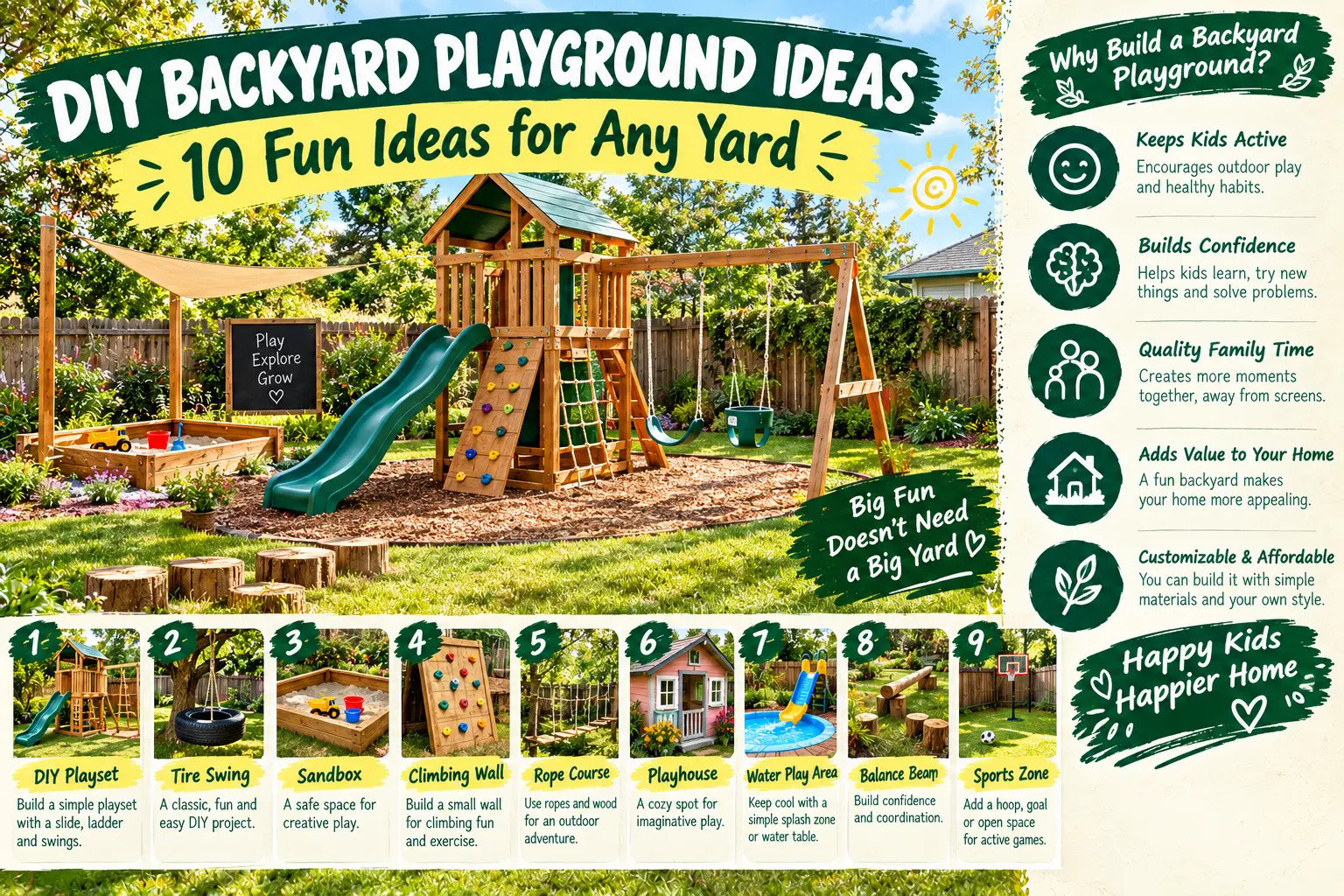
DIY Backyard Playground Ideas: How I Turned a Boring Backyard Into a Place Kids Actually Love
I’ll be honest with you. When I first started looking at DIY backyard playground ideas, I thought I needed one of those giant wooden playsets you see at the hardware store. You know the ones. Two swings, a climbing wall, a little fort, a slide, and enough lumber to build a small house.
Then I looked at the price.
Yeah… nope.
So I started thinking differently. I already had a backyard, some leftover lumber, old tires, rope, a few buckets, and a whole pile of things I probably should’ve thrown away years ago. Why not turn some of that stuff into something fun?
That’s how I started building simple backyard play areas instead of trying to copy those expensive playgrounds.
And honestly, the kids didn’t care that everything didn’t match. They cared that they could climb, swing, dig, hide, run around and make a mess. Which, let’s be honest, is pretty much the whole point.
Why I Like DIY Backyard Playground Ideas So Much
The biggest advantage is simple: you can build something that actually fits your yard.
Maybe you’ve got a tiny urban backyard. Maybe you have a bigger homestead with chickens wandering around everywhere. Or maybe your backyard is mostly grass with one sad-looking tree in the middle.
You don’t need a huge space.
When I built my first little play area, I made the mistake of trying to put too much into one spot. It looked good on paper. In real life, it felt crowded and nobody really used half of it.
Trust me, I learned the hard way.
Kids don’t need 15 different things. Give them a place to climb, something to swing on, somewhere to hide and a little space to use their imagination. That’s usually enough.
1. Build a Simple Wooden Climbing Wall
A small climbing wall is one of my favorite DIY backyard playground ideas because you can make it as simple or complicated as you want.
I like using a sturdy sheet of outdoor-rated plywood attached securely to a strong frame. Then you can add climbing holds made specifically for children’s climbing walls.
Don’t get creative with random pieces of hardware here. Playground equipment needs to be safe, especially anything kids are going to grab with their hands or put their feet on.
I also wouldn’t make the wall very tall for a backyard project. A low climbing wall can still be fun without turning your backyard into a mini mountain.
Put a soft landing area underneath it. Wood chips, engineered playground fiber or another appropriate playground surface are much better than bare dirt or concrete.
2. Turn an Old Tire Into a Backyard Swing
You’re gonna laugh at this one.
One of my favorite things to reuse around the homestead is an old tire. I’ve used them as planters, garden borders and even weird little seats. But they can also make a fun tire swing.
The important part is not the tire. It’s the support.
You need a strong tree branch or properly built swing frame that can safely handle the load. Use outdoor-rated hardware and inspect everything regularly.
I prefer a tire hanging vertically because it’s simple. But you can also make a horizontal tire swing with multiple connection points.
Just don’t hang it from a weak branch because it “looks strong enough.” That’s exactly the kind of shortcut that can turn a fun DIY project into a bad afternoon.
3. Make a Backyard Mud Kitchen
This one costs almost nothing, and kids can spend hours playing with it.
My first mud kitchen was basically an old little table, a few buckets and some kitchen utensils we weren’t using anymore.
That’s it.
Add a couple of old pots, wooden spoons, metal bowls and maybe a small shelf. Let the kids use dirt, sand, leaves, grass and water to make their own pretend recipes.
It gets messy.
Actually, it gets really messy.
But that’s part of the fun.
If you’re doing this on a homestead or backyard garden, put the mud kitchen away from your vegetable beds. Otherwise, you’ll eventually find a five-year-old chef digging up your carrots because they needed “potatoes” for the soup.
Ask me how I know.
4. Build a Small Backyard Fort
Kids love forts. I don’t care how many expensive toys they have.
A basic backyard fort can be built with a few sturdy posts and some outdoor lumber, or you can make a much simpler version with an existing tree and a weather-resistant tarp.
I like the simple version because you can change it later.
Add an old blanket. Put a little bench inside. Give them a small table. Suddenly you’ve got a reading corner, camping spot, secret clubhouse or pretend homestead cabin.
If you build a permanent wooden fort, make sure the structure is properly anchored and that there aren’t sharp screws, exposed nails or places where little fingers can get trapped.
5. Add a Rope Climbing Area
A rope can turn a boring corner of the backyard into something interesting.
You can install a sturdy climbing rope, a rope ladder or even a simple cargo-style climbing net designed for playground use.
But here’s where I get serious for a second.
Don’t use just any old rope you’ve got lying around. Check the weight rating, condition and attachment points. Anything that supports a child needs to be strong and securely attached.
Also keep ropes away from areas where children could get tangled or caught. Playground safety isn’t the place to experiment.
6. Make a DIY Backyard Balance Beam
This is one of the easiest projects on the whole list.
You basically need a solid piece of wood positioned very low above the ground.
That’s important.
Don’t build a high balance beam unless you’re using equipment designed and installed for that purpose. A low beam is plenty challenging for young kids.
I like putting mine near the garden because it gives the kids something to do while I’m working. They walk across it, jump off, walk backward and then start inventing their own games.
It’s funny how something so simple can keep them busy longer than a fancy toy.
7. Create a DIY Sandbox Corner
If your backyard has an unused corner, turn it into a sandbox.
You can build a simple wooden frame, add clean play sand and cover it when you’re done for the day.
I strongly recommend having a cover.
Without one, your sandbox can quickly become the neighborhood cat’s favorite bathroom.
Yeah. Not exactly the childhood memory we’re trying to create.
Keep the sandbox away from compost piles, animal areas and places where chemicals or garden treatments are stored.
8. Build a Little Obstacle Course
This is probably my favorite idea when you don’t have much money.
You don’t need fancy equipment. Use safe, sturdy objects to create different stations.
For example:
- Walk across a low balance beam.
- Step over a few low obstacles.
- Crawl through a large play tunnel.
- Toss a ball into a bucket.
- Run around a few cones.
- Finish with a small jumping area.
You can change the course every few weeks.
That’s what makes it great. You aren’t building one expensive thing that stays the same for ten years. You’re creating a backyard activity that can change whenever the kids get bored.
9. Use a Pallet for a Backyard Art Wall
If you’ve got a safe, clean pallet that is suitable for reuse, you can turn it into an outdoor art station.
Mount a large board or suitable outdoor painting surface and give the kids washable outdoor chalk or paints made for the job.
I wouldn’t use random old pallets without knowing where they came from. Some pallets may have been treated or exposed to chemicals, so be picky about reclaimed wood.
For an easier option, use a proper outdoor chalkboard panel.
Put it somewhere near a water source and you’ve got an easy little creative station.
10. Add a Garden to the Playground
This is where my homesteading brain kicks in.
Why not combine playtime with gardening?
A small raised garden bed near the play area can give kids something to care for. Let them grow cherry tomatoes, strawberries, peas, herbs or flowers.
My kids always seemed more interested in vegetables when they were allowed to pick them themselves.
There’s something about walking into the backyard, pulling a tiny carrot from the dirt and eating it right there.
That’s backyard farming and childhood fun in one little corner.
What I Would NOT Build in a DIY Backyard Playground
Here’s where I’ll save you some trouble.
I wouldn’t build anything tall just because it looks cool on Pinterest.
I also wouldn’t make homemade swings from questionable materials, build structures over concrete, or create complicated climbing equipment without understanding how the structure will handle the weight and movement.
And don’t forget about the sun.
One of my early mistakes was putting a play area in full afternoon sun. It looked great at 9 in the morning. By 3 PM, nobody wanted to be anywhere near it.
Shade matters.
A mature tree, shade sail or properly installed canopy can make the whole playground much more useful.
How I Keep a DIY Playground Safe
I don’t inspect my backyard playground like an engineer. I just make a habit of walking around it and looking at everything.
Loose bolts?
Fix them.
Cracked wood?
Replace it.
Sharp edges?
Sand them down or remove the part.
Worn rope?
Don’t try to get another year out of it.
Also check the ground underneath climbing and swinging equipment. Good playground surfacing matters, and fall areas should be kept clear of rocks, garden tools, buckets, hoses and anything else a child could land on.
And if you’re building something structural like a swing set, fort or climbing frame, follow appropriate playground safety guidance and local building requirements rather than relying only on my backyard experiments.
My Favorite Cheap Combination for a Small Backyard
If I had a small urban backyard and only a modest budget, here’s what I’d build.
I’d start with a little fort in one corner.
Then I’d add a low balance beam, a small sandbox and a mud kitchen.
I’d plant a few berry bushes around the outside, leaving enough space so the kids could move around safely.
Then I’d add one good shade area.
That’s plenty.
You don’t need to fill every square foot. Leave some open grass for running, kicking a ball and doing absolutely nothing.
Sometimes that’s the best part.
DIY Backyard Playground Ideas: A Few Questions I Get Asked
Can I build a backyard playground on a small lot?
Absolutely. In fact, small spaces can be easier because you can keep everything close together. Focus on one or two activities instead of trying to build a giant playset.
What’s the cheapest DIY playground idea?
A mud kitchen, low obstacle course, sandbox or simple outdoor fort can be very affordable. Reuse safe materials where you can, but don’t save money on structural hardware or safety surfaces.
Should I put a playground on grass?
Grass is fine for ordinary running and playing, but areas under swings, climbing equipment and other fall zones need more appropriate protective surfacing. Don’t assume regular grass will provide enough protection from a fall.
Start Small and Let the Backyard Grow With Your Family
The best DIY backyard playground ideas aren’t always the biggest ones. I’ve learned that after years of working on my own backyard and homestead.
Start with one project.
Use what you already have when it’s safe to do so. Leave room for imagination. Add shade. Keep the garden nearby. And most important, build things your family will actually use.
My favorite backyard memories aren’t from expensive projects. They’re from muddy shoes, kids arguing over who gets the swing first, tomatoes being picked before dinner and somebody turning an old bucket into a spaceship.
That’s what I like about DIY. You’re not just building a playground. You’re building a place where people actually spend time together.
So pick one of these DIY backyard playground ideas and start there. You don’t need to finish the whole backyard this weekend. Lemme show you what I’ve learned after all these years: the simple projects are usually the ones that get used the most.
And if you come up with something weird for your own backyard, tell me about it. I love weird homestead projects. If you get stuck, just ask. I’ve probably messed it up once already.