How to Make a Sourdough Starter: My Easy Beginner Method
If you’ve ever wanted to learn how to make a sourdough starter, let me tell you something first: it looks harder than it really is.
You’re basically mixing flour and water, then feeding it regularly while naturally occurring yeast and bacteria do their thing.
That’s it.
Well… mostly.
My first sourdough starter was not exactly a success story. I got impatient, changed the feeding routine, moved the jar around the kitchen like it was a science project, and then wondered why the thing wasn’t acting right.
Trust me, I learned the hard way. Once I stopped overthinking it, making a sourdough starter became one of my favorite little kitchen projects.
What Is a Sourdough Starter Anyway?
A sourdough starter is a mixture of flour and water that develops a living culture of wild yeast and friendly bacteria.
Those microorganisms help dough rise and give sourdough bread its familiar flavor.
You don’t need commercial yeast to start one from scratch.
You need flour, water, a clean jar, and a little patience.
That last one is probably the hardest ingredient.
Here’s my problem: I kept checking the jar every 20 minutes.
“Are you alive yet?”
Yep, I actually talked to it.
My family thought I had finally lost it.
After a few days, though, the starter started bubbling. That’s when I realized I wasn’t doing much at all. I was just giving the natural yeast and bacteria a good place to grow.
What You Need to Make a Sourdough Starter
You don’t need fancy sourdough equipment.
Basic Supplies
- Whole wheat or rye flour to get started
- Regular unbleached all-purpose or bread flour
- Clean water
- A clean glass jar
- A kitchen scale if you have one
- A spoon or small spatula
A kitchen scale makes the process much easier because you can measure flour and water accurately.
But don’t panic if you don’t own one yet. You can still learn the process using volume measurements, although the results can be less consistent.
Why I Like Whole Wheat Flour for Starting
For a new starter, I like using whole wheat flour or rye flour for at least the first few days.
Whole grain flour contains more of the grain and can be a good choice when you’re trying to get a starter going.
After the starter becomes active, you can switch to feeding it with all-purpose flour, bread flour, whole wheat, rye, or a combination that works for you.
I’ve tried several combinations over the years.
Honestly, don’t get too obsessed with the exact flour blend at first.
How to Make a Sourdough Starter From Scratch
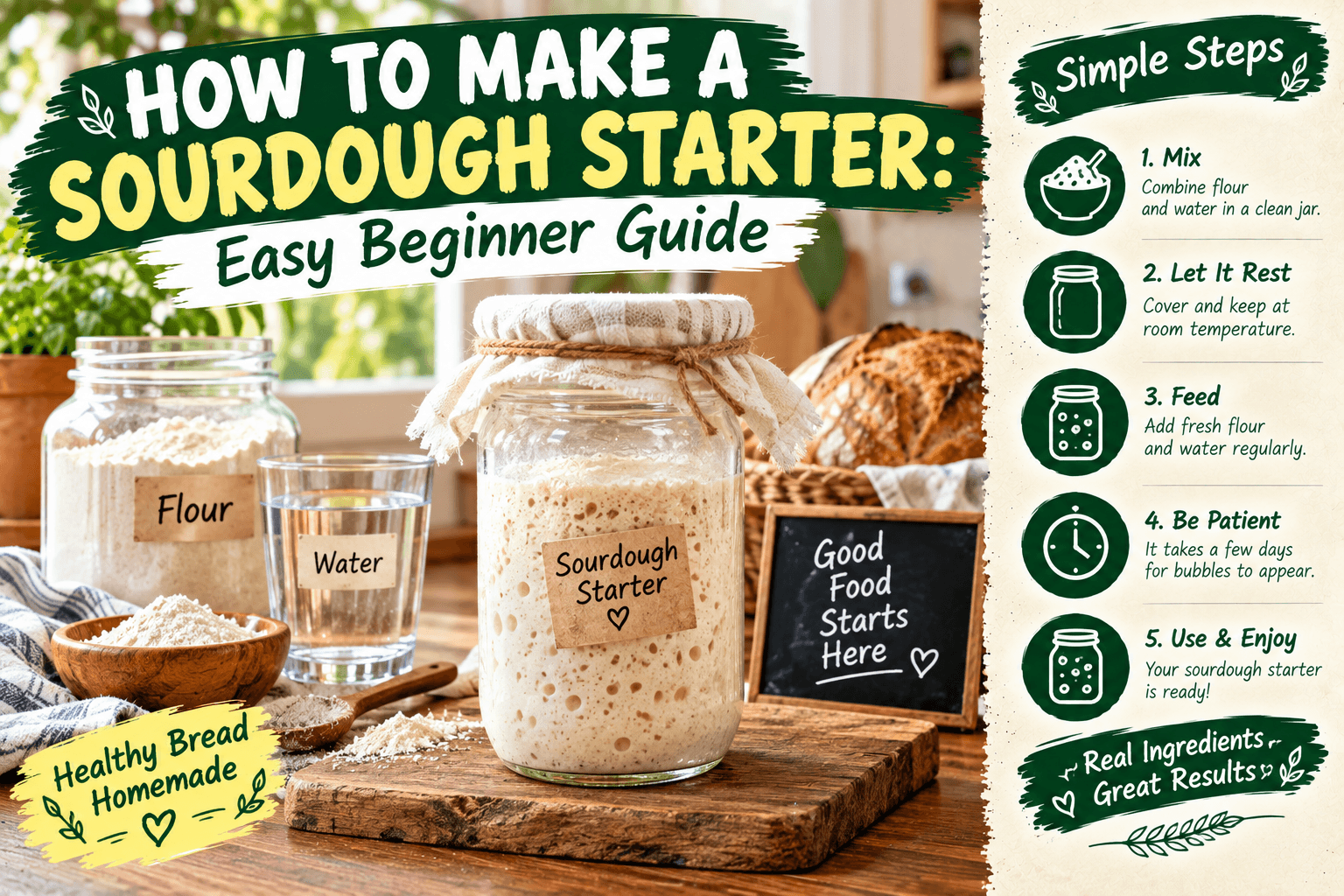
Here’s the basic method I use.
Day 1
Mix 50 grams of whole wheat or rye flour with 50 grams of water in a clean jar.
Stir until there are no obvious dry patches of flour.
Cover the jar loosely. You want to keep dust and bugs out while still allowing some airflow.
Leave it at room temperature.
Then walk away.
Seriously.
Don’t keep stirring it every hour.
I made that mistake once. I kept opening the jar and stirring it because I thought more activity would make it grow faster.
It didn’t.
It just made me crazy.
Day 2
You may see a few bubbles. You may see nothing.
Both can happen.
Don’t panic if your starter looks boring on day two.
Give it a stir and discard about half of the mixture.
Then feed it with 50 grams of flour and 50 grams of water.
Mix it well and loosely cover it again.
Day 3
This is where things can get interesting.
You might notice bubbles, a slightly sour smell, or the mixture becoming more active.
Discard about half again, then feed it with equal weights of flour and water.
Keep it somewhere reasonably warm but not hot.
Days 4–7
Continue the same basic feeding routine.
As your starter becomes more active, you should see it rise after feeding and then slowly fall again.
The exact timing depends on your room temperature, flour, water, and starter.
Don’t worry if yours takes longer than somebody else’s online.
How Do I Know My Sourdough Starter Is Ready?
This is where beginners sometimes get confused.
A starter isn’t ready just because you see a few bubbles.
You want an active starter that regularly rises after feeding and then falls as it uses up its food.
It should also have a pleasant sour, yeasty smell.
Depending on your flour and fermentation time, the smell can be fruity, tangy, earthy, or mildly sour.
My favorite trick: Put a rubber band around the jar at the level of your starter right after feeding it. Then you can easily see how much it rises.
This little trick saved me from a lot of guessing.
What If Your Starter Smells Bad?
This is one of the most common beginner questions.
Some sourdough smells can be pretty weird.
It might smell sharp, sour, fruity, or even a little like alcohol when it’s hungry.
That’s not necessarily a disaster.
However, if you see unusual colored mold or fuzzy growth, don’t try to rescue it. Throw it away and start fresh with a clean jar.
Don’t taste a starter that shows obvious mold or unusual contamination. When in doubt, toss it. Flour and water are cheap compared with getting sick.
Why Do You Have to Discard Part of the Starter?
This confused me at first.
I hated throwing away flour.
But if you keep adding more flour and water without removing some starter, the amount quickly gets ridiculous.
After several feedings, you’d have a giant jar of starter taking over your kitchen.
Discarding some helps keep the feeding amounts manageable and gives the remaining culture fresh flour and water.
And don’t feel like the discard has to go straight into the trash.
Once your starter is established, you can use discard in recipes like pancakes, waffles, crackers, and other baked foods.
My Sourdough Starter Feeding Routine
Once my starter is active, I don’t treat it like a full-time job.
If I’m baking regularly, I keep it at room temperature and feed it on a regular schedule that fits my baking.
If I’m not baking for a while, I usually keep it in the refrigerator and feed it when needed.
My Simple Routine
- Take the starter out when I plan to bake.
- Feed it with flour and water.
- Let it become active.
- Use the amount needed for my bread.
- Keep some starter behind for the next feeding.
It doesn’t need to be complicated.
What Temperature Is Best?
Sourdough is affected by temperature.
A warmer kitchen generally makes fermentation move faster. A cooler kitchen slows things down.
That’s why your starter may behave differently in summer and winter.
Mine definitely does.
In winter, I used to stare at my starter thinking something had gone terribly wrong.
Nothing was wrong.
My kitchen was just cold.
Once I moved the jar to a slightly warmer spot, the starter became much more active.
Don’t put your starter somewhere extremely hot. You want a comfortable room-temperature environment, not a sauna.
Do You Need Special Sourdough Water?
Usually, you don’t need anything fancy.
I use clean drinking water.
If your tap water has a very strong chlorine smell or your starter repeatedly struggles, you can experiment with filtered water.
But don’t spend a fortune on special bottled water before you’ve even made your first loaf.
Start simple.
Common Sourdough Starter Mistakes I’ve Made
I’ve made plenty, so here’s the short list.
- Feeding too often: I thought more feeding meant faster growth.
- Keeping it too cold: Everything slowed way down.
- Using a dirty jar: Start with clean equipment.
- Making too much starter: You don’t need a gallon of it.
- Changing everything at once: Flour, water, temperature, feeding schedule… don’t do this while troubleshooting.
- Panicking too early: Some starters simply need more time.
The biggest one is patience.
Sourdough isn’t instant bread.
That’s kind of the whole point.
Can You Make a Starter Without Whole Wheat Flour?
Yes.
You can make a sourdough starter with regular flour. Whole wheat or rye can simply be helpful choices when getting started.
If all you have is unbleached all-purpose flour, I’d rather see you start with that than wait six months for the perfect bag of flour.
Once your starter is active, you can experiment with different flours and see what your starter likes.
How I Keep My Starter From Taking Over the Kitchen
This sounds silly, but sourdough starter can multiply fast if you don’t pay attention.
Keep a small amount.
You don’t need a huge jar sitting on the counter unless you’re baking huge batches of bread.
I usually keep a modest amount and build it up when I know I’m going to bake.
That saves flour and saves counter space.
Little homestead tip: Mark the jar after feeding. It makes it much easier to see whether your starter is rising instead of trying to remember where it started.
What Can You Do With Sourdough Discard?
Once your starter is mature, don’t throw away all that discard unless you need to.
I’ve used it for pancakes and crackers, and there are plenty of other discard recipes you can try.
It’s also a nice way to reduce food waste.
That’s something I care about on my homestead. If I can turn something that would go in the trash into breakfast, I’m gonna do it.
Is Making Sourdough Worth the Trouble?
For me, absolutely.
Not because sourdough is some magical food that fixes everything.
I like it because it slows me down.
You mix the starter. You feed it. You watch it rise. Then you bake.
There’s something satisfying about using a living culture that you’ve kept going in your own kitchen.
And once you get comfortable with it, you stop worrying about every little bubble.
How to Make a Sourdough Starter: My Beginner Schedule
If you want the whole thing boiled down, here’s the routine I’d follow.
- Day 1: Mix 50g whole grain flour with 50g water.
- Day 2: Discard about half and feed with equal weights flour and water.
- Day 3: Repeat the feeding.
- Days 4–7: Continue feeding and watch for regular rising and falling.
- When active: Use the starter for baking and keep a small amount for your next feeding.
Your starter may take more than seven days to become reliably active. That’s okay.
Don’t throw it away just because your neighbor’s starter became active faster.
Sourdough Starter FAQ
How long does it take to make a sourdough starter?
Many starters become active within about a week, but it can take longer. Temperature, flour, water, and feeding routine all affect how quickly it develops.
Can I use all-purpose flour to make sourdough starter?
Yes. Whole wheat or rye can be useful when starting, but regular unbleached all-purpose flour can also work. Once your starter is active, you can experiment with different flours.
Why isn’t my sourdough starter bubbling?
It could be too cold, too young, or simply moving slowly. Check your feeding routine, keep it at a comfortable room temperature, and give it more time before deciding it has failed.
Should I keep sourdough starter in the refrigerator?
If you’re baking often, you may prefer keeping it at room temperature and feeding it regularly. If you bake less often, refrigeration can reduce how frequently you need to feed it. Bring it back to an active state before using it for bread.
Don’t Overthink Your First Starter
If you’re learning how to make a sourdough starter, my biggest advice is simple: don’t overthink it.
You don’t need a $200 sourdough kit.
You don’t need a special farmhouse kitchen.
You don’t need ten different kinds of flour sitting in your pantry.
Start with a clean jar, flour, water, and a little patience. Watch what happens. Make notes if you want. If something goes wrong, clean the jar and try again.
That’s how I learned most of my homesteading skills anyway.
You try something. You mess it up a little. Then you figure out what happened.
And one morning, you wake up, look at that bubbly starter on the counter and think, “Well, look at you.”
Ready to Bake?
If you’re starting your first sourdough starter, don’t be afraid of a few mistakes. Keep the process simple and pay attention to what your starter is telling you. Got a weird question about your starter? Leave a comment. I’ve probably made the same mistake already.