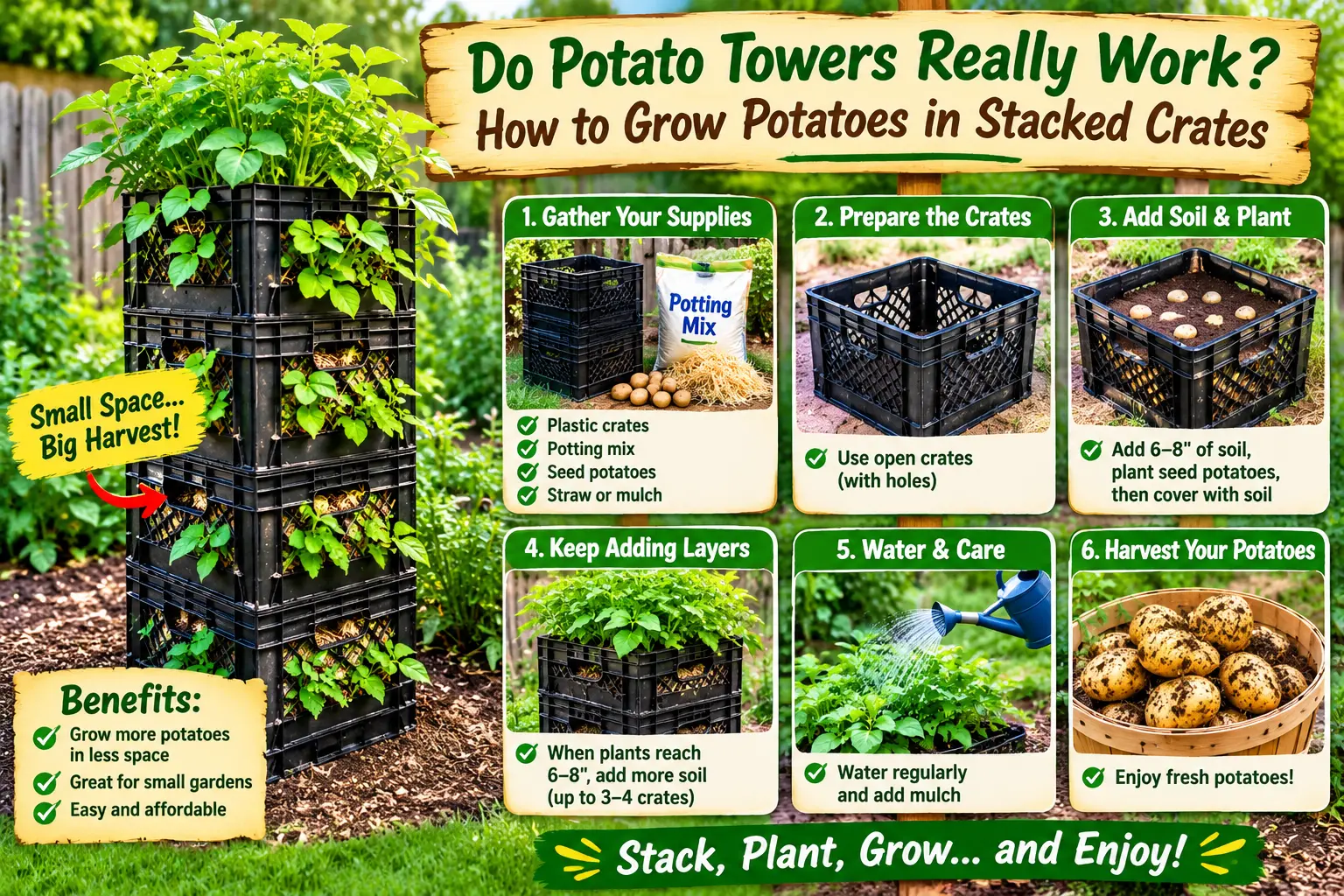
Potato towers can grow potatoes successfully, but stacking crates higher does not automatically mean a huge harvest from every level. The method works because potato stems can produce stolons when they are buried gradually, but the plant still needs enough light, root space, moisture, nutrients, and the right variety.
The Pinterest design uses several plastic crates stacked vertically, filled with straw and growing media, with potato foliage emerging from the top and sides. At harvest, the stack is opened and potatoes appear through the lower layers.
The realistic expectation: a potato tower is a space-saving container method, not a guaranteed way to multiply yield. Think of it as a vertical growing container rather than a magic potato machine.
Why Potato Towers Can Work
Potatoes form on underground stems called stolons. University of Minnesota Extension explains that stolons emerge from the main stems and that burying more of the stem can encourage additional stolon formation.
That is the same principle behind traditional hilling.
A tower simply applies that idea inside a container.
1. Use Certified Seed Potatoes
Start with certified healthy seed potatoes rather than old grocery-store potatoes when possible.
Utah State Extension recommends certified seed because it reduces the risk of introducing disease into the garden.
Each seed piece should have at least one healthy eye.
2. Use a Wide Tower, Not Just a Tall One
The biggest mistake with vertical potato towers is focusing on height.
Potato plants need enough growing volume for roots and tubers. A very narrow tower may dry quickly and restrict development even if it is several feet tall.
Penn State recommends large containers in roughly the 10- to 15-gallon range for container-grown potatoes, with drainage holes and enough room for several seed tubers.
3. Make Sure Every Level Can Drain
Potatoes need consistent moisture, but they do not like waterlogged conditions.
Crates naturally provide airflow, but the growing media inside still needs a clear route for excess water to leave.
Do not line the entire tower with waterproof plastic. If you need a liner to hold soil in place, use a material that still allows drainage and air movement.
4. Start With Potting Mix and Compost
Penn State recommends a mix of potting soil and compost for container potatoes rather than dense garden soil.
Heavy garden soil can compact inside a tower and reduce drainage and aeration.
5. Plant the First Seed Potatoes Near the Bottom
Begin with several inches of growing mix in the bottom crate.
Place seed potatoes with the eyes facing upward and cover them with a few inches of mix.
Penn State suggests starting container potatoes with about 4 inches of potting mixture, placing the seed pieces, then covering them with about 3 inches more.
6. Add More Mix as the Plants Grow
Once the stems emerge and grow several inches, add more growing media around them while leaving the upper leaves exposed.
Repeat gradually as the plants grow.
This is the container version of hilling.
7. Do Not Bury All the Leaves
The plant still needs green leaves exposed to sunlight for photosynthesis.
Add soil around the lower stems, but keep healthy foliage above the growing media.
8. Straw Alone Is Not Enough
The Pinterest image appears to use a large amount of straw inside the crates.
Straw can help retain moisture, block light, and keep the tower lighter, but it does not provide the same nutrient-holding capacity as a proper growing mix.
Use it as part of the system, not as the only rooting material.
9. Watering Is Harder in a Tall Tower
Tall containers can be dry near the top and wet near the bottom at the same time.
Utah State Extension emphasizes that potatoes perform best with regular, uniform moisture and that both drought and overwatering can reduce tuber quality.
Check moisture at more than one depth instead of watering only based on how the surface looks.
10. Keep Tubers Completely Covered
Potatoes exposed to light can turn green.
Oregon State notes that light exposure increases glycoalkaloid development, which is one reason traditional hilling is so important.
Crate openings make this especially important. Make sure developing tubers stay shielded from sunlight with soil, compost, straw, or an opaque breathable liner.
11. Do Potatoes Really Grow on Every Level?
Sometimes you may find tubers at multiple levels, but do not assume every buried section of stem will produce a heavy cluster.
Yield depends on:
- Potato variety
- Container volume
- Temperature
- Sunlight
- Water
- Fertility
- Plant health
- How much usable stolon growth actually develops
A tall tower can produce mostly foliage if the conditions are poor.
12. Tall Towers Can Overheat
Black plastic crates can absorb heat in direct summer sun.
That may cause the growing medium near the sides to become warmer and drier than garden soil.
In hot climates, light-colored wrapping, afternoon shade on the container sides, or a less heat-absorbing container can help reduce stress.
13. Make the Stack Physically Stable
A four-crate tower full of wet growing media is heavy.
Place it on a flat, stable surface and connect the crates securely so the stack cannot shift or tip when watered or bumped.
Do not rely on gravity alone.
14. Do Not Use Unknown Recycled Crates
If you are growing food in reused plastic containers, use crates with a known history that are suitable for the purpose.
Avoid containers that previously held pesticides, solvents, industrial chemicals, or unknown materials.
15. Harvesting Is the Fun Part
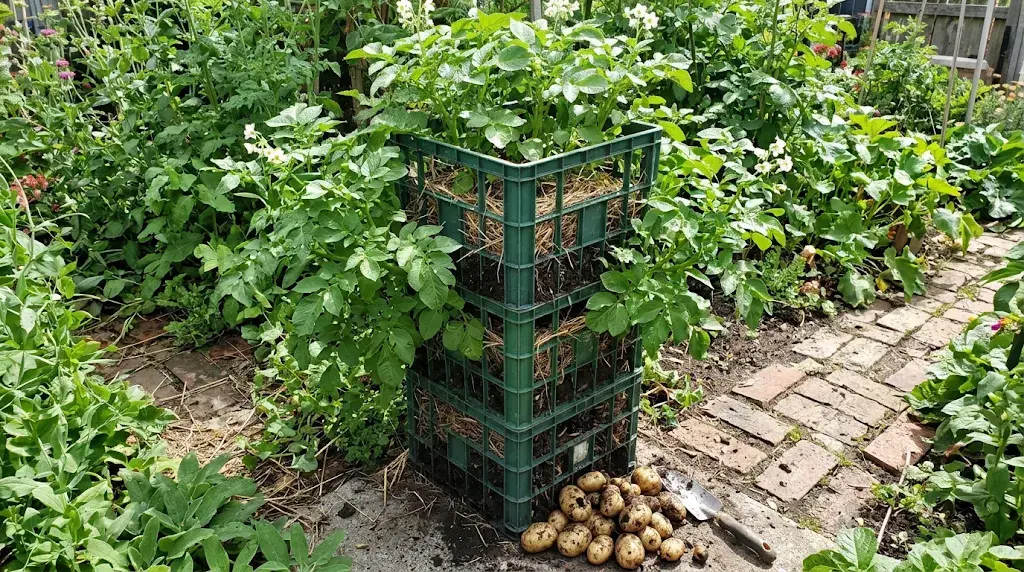
One real advantage of a crate tower is harvest access.
Instead of digging deeply through a bed, you can dismantle the tower level by level and sift through the growing medium.
Wait until the crop reaches the maturity stage you want, then carefully remove the upper crates and work downward.
Potato Tower vs. Grow Bag vs. Garden Row
| Method | Main Advantage | Main Drawback |
|---|---|---|
| Crate tower | Small footprint and easy harvest | Can dry unevenly and overheat |
| Grow bag | Simple and portable | Also dries quickly |
| Garden row | More stable soil moisture and temperature | Uses more ground space and requires digging |
What the Pinterest Potato Tower Gets Right
- Potatoes can be grown successfully in containers and towers.
- Adding growing media around stems is based on real hilling principles.
- Crates provide good airflow.
- The tower uses little garden footprint.
- Dismantling the crates can make harvest easier.
What the Image Oversimplifies
- A tall tower does not guarantee potatoes from top to bottom.
- Straw alone is not a complete growing medium.
- Black crates can heat up and dry quickly.
- The stack needs mechanical stability.
- Developing potatoes must remain protected from light.
- Uniform watering becomes harder as the tower gets taller.
Simple Build Order
- Choose clean, sturdy crates.
- Place the first crate on a level, drained surface.
- Add about 4 inches of potting mix and compost.
- Plant healthy certified seed potatoes.
- Cover with a few inches of mix.
- Keep the medium evenly moist.
- When stems grow several inches, add more mix around the lower stems.
- Add the next crate only when the plant growth justifies more height.
- Continue hilling gradually while leaving foliage exposed.
- Shield developing tubers from light through the crate openings.
- Check moisture at different depths.
- Stop adding height once the container has adequate growing volume.
- Harvest by dismantling the tower after the crop matures.
Potato Tower FAQ
Do potato towers really work?
Yes. Potatoes can be grown in towers and containers, but a taller tower does not automatically produce a larger harvest.
Can I grow potatoes in milk crates?
Yes, provided the crates are clean, stable, able to hold growing media, and allow good drainage. The open sides also need to be managed so developing potatoes are not exposed to light.
Can I fill a potato tower with straw?
Straw can be used as mulch or as part of the tower, but using a proper potting mix and compost gives the roots a more reliable growing environment.
How often should I add soil?
Add growing media gradually as the stems grow, leaving the upper leaves exposed. Do not bury the entire plant at once.
Why are my potatoes green?
Green potatoes have been exposed to light. Keep all developing tubers completely covered and discard heavily green potatoes rather than eating them.
Is a tower better than a grow bag?
Not automatically. Both are useful for small spaces. Grow bags are simpler, while stacked crates can make harvest easier and give you more access from the sides.
The Bottom Line
The Pinterest potato tower is based on a real growing method, and stacked crates can be a practical way to grow potatoes where ground space is limited.
What you should not assume is that every extra foot of tower creates another full layer of potatoes.
Use enough growing volume, hill gradually, maintain uniform moisture, protect tubers from light, and treat the tower as a container—not as a guaranteed high-yield hack.
Sources
- University of Minnesota Extension — Growing Potatoes in Home Gardens
- Penn State Extension — Potatoes in the Garden and the Kitchen
- Utah State University Extension — How to Grow Potatoes in Your Garden
- Utah State University Extension — Potato Irrigation
- Oregon State University Extension — Glycoalkaloids and Potato Greening