When I first started learning about permaculture garden design, I thought it was mostly about making a garden look wild and planting a bunch of things together.
I was wrong.
My first backyard garden was basically rows of vegetables, bare soil, a hose laying across the walkway, and me running around with a watering can every evening. It worked, but it felt like I was constantly fighting the garden.
One plant needed more water.
Another wanted shade.
The weeds came back five minutes after I pulled them.
And somehow, every summer I ended up with more work than I planned for.
After more than 10 years of growing food, composting, raising chickens, experimenting with small-space gardening, and making plenty of dumb mistakes, I started looking at my garden differently.
Instead of asking, “How do I grow more vegetables?”
I started asking:
“How can I design the garden so it does more of the work for me?”
That’s where permaculture garden design really started making sense.
What Is Permaculture Garden Design?
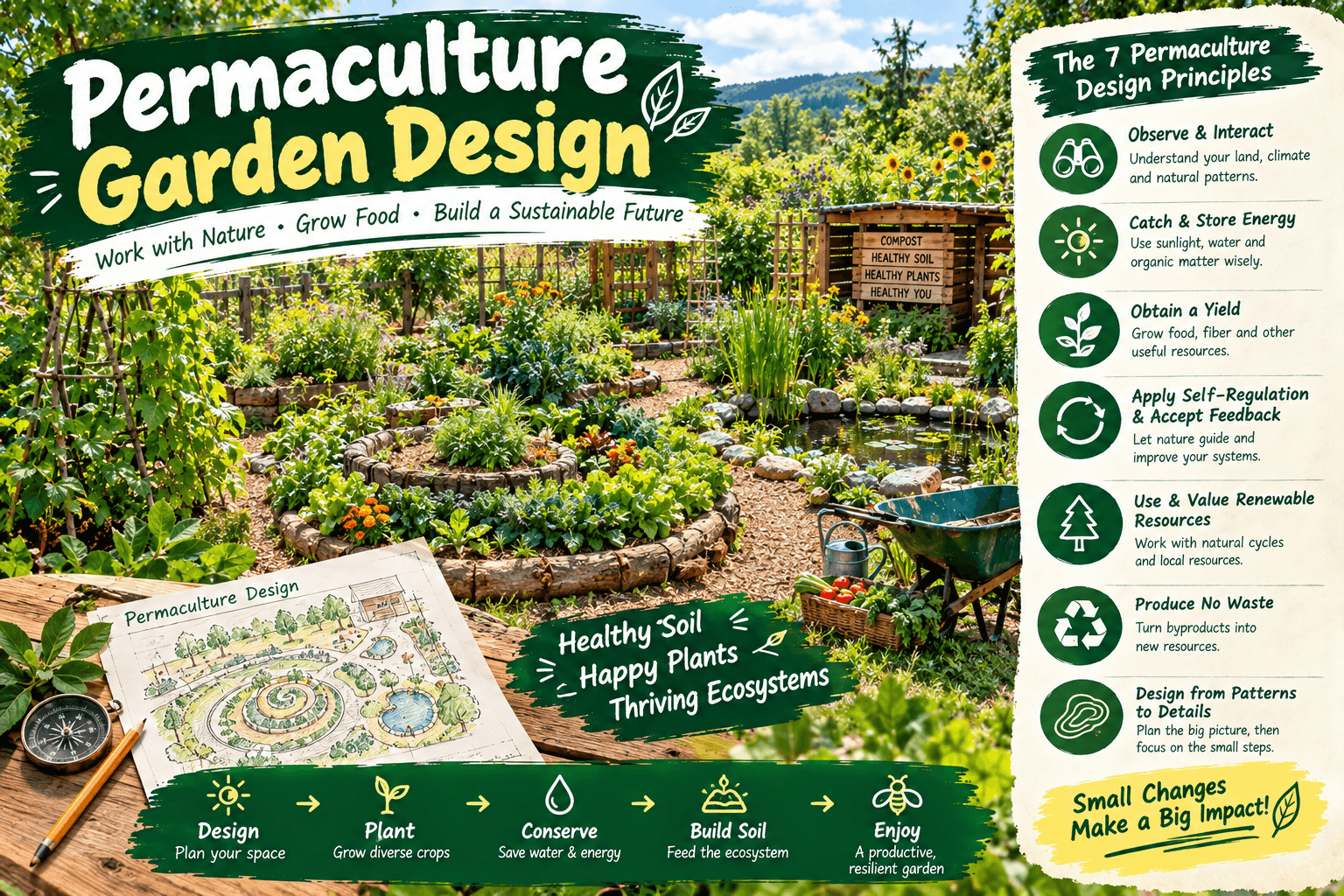
At its simplest, permaculture garden design is about creating a productive system where different parts support each other.
You’re not just thinking about one tomato plant.
You’re thinking about the tomato, the soil, the compost, the water, insects, trees, chickens, sunlight, paths, and even where you walk every morning.
The goal isn’t to make everything perfect.
It’s to create a garden that works more like a natural system.
In a natural ecosystem, nothing is really wasted.
Leaves fall.
They break down.
The soil gets nutrients.
Plants grow.
Animals eat plants.
Organic material returns to the soil.
The whole thing keeps moving.
That’s the basic idea I try to copy in my backyard.
My Biggest Permaculture Mistake Was Starting With the Plants
Here’s something I wish somebody had told me when I started.
Don’t start by buying plants.
I know.
That’s not very exciting.
When you walk into a garden center, it’s almost impossible not to grab a few tomato plants, some peppers, herbs, flowers, and maybe that weird plant you’ve never heard of.
I’ve done it.
Many times.
But a good permaculture garden design starts with the site, not the shopping cart.
Before planting, spend some time watching your property.
Where does the sun hit in the morning?
Where is it hottest in the afternoon?
Where does water collect after rain?
Which areas stay dry?
Where does the wind come from?
Where do you naturally walk?
I learned more from watching my backyard for one season than I learned from buying a pile of gardening books.
Start With Sunlight
Sunlight is one of the most important parts of garden design.
And it changes throughout the year.
A spot that gets full sun in June might be shaded by a tree in September.
That’s why I recommend spending a little time observing before putting permanent plants in the ground.
For most vegetables, you’ll want plenty of sunlight.
But don’t assume everything needs the same amount.
Leafy greens, herbs, and some shade-tolerant plants can work in areas where tomatoes would struggle.
This is where good design starts to save you work.
Put sun-loving crops where they naturally perform well.
Put shade-tolerant plants in the places that don’t get as much sun.
Simple.
Think About Water Before You Plant
I learned this one the hard way.
I once planted a beautiful little vegetable bed at the far end of my backyard.
It looked fantastic.
There was just one problem.
The hose barely reached it.
So every time the plants needed water, I had to drag the hose across the yard.
After a couple weeks, I was already annoyed.
Eventually, I stopped visiting that bed as often.
And guess what?
The plants suffered.
Your garden should be designed around your real life, not just how it looks in a photo.
If you have to walk 100 feet carrying a heavy watering can every day, you’re eventually going to stop doing it.
Put thirsty plants closer to your water source when possible.
Use mulch to reduce evaporation.
Collect rainwater where appropriate.
And think about how water naturally moves across your property.
Use Zones to Make Your Garden Easier
One idea from permaculture that really helped me was thinking in zones.
The basic idea is simple: things you use most often should be closest to your home.
So, near the house, you might have:
- Cooking herbs
- Salad greens
- Frequently harvested vegetables
- Compost collection
- Small containers
- Seed-starting supplies
Farther away, you might have:
- Fruit trees
- Larger vegetable beds
- Chickens
- Composting areas
- Perennial plants
- Storage
You don’t have to follow some perfect zone map.
I don’t.
Think about your daily routine instead.
If you use parsley every morning, don’t plant it at the far end of the property.
Put it somewhere you can reach while you’re half asleep waiting for your coffee.
Trust me, you’ll harvest it more often.
Build Soil Before Chasing Big Harvests
I used to think good gardening meant finding the perfect fertilizer.
Now I think much more about soil.
Healthy soil is the foundation of a productive garden.
I add finished compost to my beds, keep soil covered when possible, and try not to disturb the soil unnecessarily.
Organic matter helps improve soil structure and supports the organisms living underground.
And those little organisms are doing a lot more work than we can see.
One of my favorite habits is making compost from suitable kitchen and yard scraps.
Vegetable scraps, leaves, grass clippings, and other compostable materials can eventually become something useful for the garden.
It’s basically turning waste into a garden resource.
That’s exactly the kind of loop I want in a homestead.
Mulch Is One of My Favorite Permaculture Tools
If there’s one boring gardening job I hate, it’s weeding.
So I mulch.
A good organic mulch can help cover bare soil, reduce evaporation, moderate soil temperature, and make it harder for many weeds to get established.
I’ve used things like straw, shredded leaves, and other suitable organic materials depending on what’s available.
The key is not to pile mulch directly against plant stems or tree trunks.
Give plants some breathing room.
And don’t use material you aren’t sure is safe for the garden.
I’ve seen people throw almost anything onto garden beds because somebody online said it was “natural.”
Natural isn’t the same as appropriate.
Plant More Than One Thing in a Bed
One of the things I like about permaculture garden design is moving away from the idea that every plant needs its own perfect little row.
You can mix crops where it makes sense.
For example, you might combine:
- Tall plants with shorter crops
- Herbs with vegetables
- Flowers with food crops
- Ground-covering plants with taller plants
- Perennial plants around annual beds
The important thing is to understand each plant’s needs.
Don’t randomly throw 20 plants together and call it permaculture.
I’ve tried that too.
Sometimes you get a beautiful garden.
Other times you get a tangled jungle where you can’t find the lettuce.
Flowers Belong in a Food Garden
I didn’t appreciate flowers enough when I was younger.
I wanted every inch of my garden producing food.
Then I started noticing how many bees and other beneficial insects visited flowering plants.
Now I deliberately include flowers around my vegetable garden.
Marigolds, nasturtiums, sunflowers, calendula, and other flowers can add beauty while providing habitat and food for pollinators.
And honestly, a vegetable garden doesn’t have to look like a vegetable factory.
A few flowers make the whole backyard feel better.
Chickens Can Become Part of the System
My chickens have always been excellent at reminding me that gardens and animals don’t always cooperate.
If you’ve read any of my backyard chicken stories, you already know where this is going.
Chickens can scratch.
A lot.
And they’ll happily destroy a freshly planted garden bed if given the opportunity.
But managed properly, chickens can become part of a homestead system.
Their manure can contribute to composting when handled appropriately.
They eat certain food scraps.
They provide eggs.
They can help around areas where you’re preparing soil.
The important word is managed.
Don’t let chickens loose in your young vegetable garden and expect them to respect your permaculture principles.
They have their own principles.
Mostly involving bugs and anything you’ve just planted.
Create a Garden That Works Vertically
If you have a small backyard, don’t only think horizontally.
Think up.
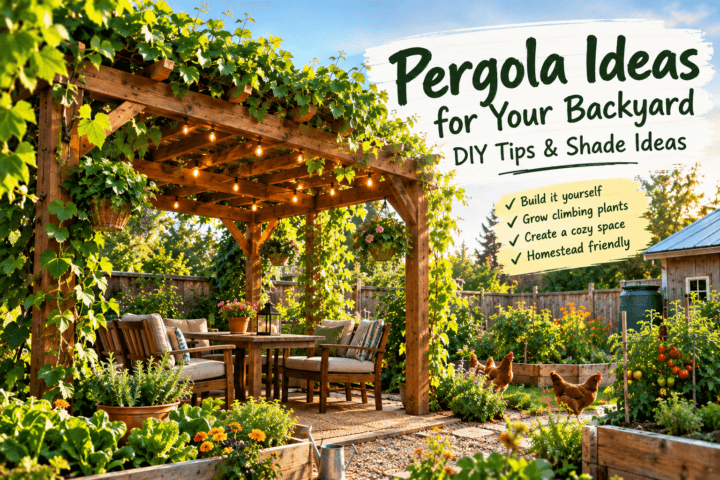
Trellises can allow cucumbers, beans, peas, and other suitable climbing plants to grow vertically.
This can save ground space and make harvesting easier.
I’ve grown cucumbers vertically for years now.
It’s one of those changes that makes a small garden feel much bigger.
A vertical trellis can also create shade.
That means you can potentially design one part of the garden to provide a different microclimate for another plant.
That’s where permaculture gets really interesting.
One element can perform multiple jobs.
Don’t Forget Paths
This sounds silly, but I wasted years making garden beds too large.
I wanted more growing space.
What I actually created was a garden where I couldn’t reach the middle without stepping into the soil.
That meant compacted soil, broken plants, and a lot of awkward stretching.
Now I leave enough space for myself.
A garden path should let you move comfortably with a bucket, wheelbarrow, basket, or garden hose.
If you have to squeeze sideways between two beds while carrying compost, your design needs some work.
Design for the gardener too.
You’re part of the ecosystem.
Make Your Garden Work With the Seasons
A permaculture garden isn’t just about what happens in July.
Think about the whole year.
Some plants thrive in cool weather.
Others love summer heat.
Some perennials come back every year.
Trees can provide shade as they mature.
Leaves can become mulch or compost.
The garden changes constantly.
I used to think the garden was “finished” once everything was planted.
Now I know it’s never finished.
It’s always changing.
That’s actually one of the things I love most about it.
What I Would Do If I Started a Permaculture Garden Today
If I were starting from an empty backyard today, I’d resist the temptation to build everything at once.
I’d start with a small area.
First I’d watch the sunlight.
Then I’d figure out water.
Then I’d build the soil.
After that I’d add paths.
Then I’d choose plants.
I’d probably include a few fruiting perennials, herbs, vegetables, flowers for pollinators, composting, and maybe eventually chickens if the space and local rules allowed.
I’d also leave some room for mistakes.
Because there will be mistakes.
There always are.
Common Permaculture Garden Design Mistakes
Making everything too complicated
Permaculture can sound complicated when you read about it online.
It doesn’t have to be.
Start with a few connections between plants, water, soil, compost, and wildlife.
Planting too much
I’ve made this mistake every spring.
You see empty soil and think, “I have room!”
Then everything grows.
Suddenly you’re harvesting 40 cucumbers a day and giving them away to people you’ve never met.
Start with what you can manage.
Ignoring maintenance
A garden still needs maintenance.
Permaculture doesn’t mean zero work.
The goal is to make the work smarter and reduce unnecessary work.
Copying somebody else’s design
A beautiful garden in Oregon might not work the same way in Arizona.
A design for a large rural property might make no sense in a small urban backyard.
Use other gardens for ideas, but design around your own climate, space, soil, water, and lifestyle.
FAQ About Permaculture Garden Design
Do I need a large property for permaculture?
Nope.
You can use permaculture ideas in a tiny backyard, balcony, patio, or even a collection of containers.
The principles can be scaled down.
Is permaculture gardening difficult?
It can be complicated if you try to do everything at once.
I’d start small. Observe your garden, improve the soil, manage water, add useful plants, and build from there.
Can I use permaculture in an urban backyard?
Absolutely.
Urban permaculture can include container gardening, composting, rainwater management where legal and appropriate, vertical growing, fruit trees, herbs, pollinator plants, and small livestock where local rules allow it.
My Biggest Lesson After Years of Gardening
The biggest change in my gardening didn’t come from buying better tools.
It came from changing the way I looked at the backyard.
I stopped asking how I could force the garden to produce more.
Instead, I started asking how I could make the garden more connected.
The compost feeds the soil.
The soil supports the plants.
Flowers attract pollinators.
Trees provide food and shade.
Mulch protects the soil.
Rain can be captured and used appropriately.
Chickens can contribute to the homestead when managed properly.
And I get to eat the results.
That’s what makes permaculture garden design so interesting to me. It’s not about creating some perfect garden that looks like it came from a magazine.
It’s about building a garden that makes sense for your life.
Start with one small corner.
Watch it.
Make a mistake.
Fix it.
Then improve it again next season.
That’s how I’d do it.
And trust me, after 10 years of gardening, I still mess things up.
If you’re working on your own permaculture garden design and don’t know where to start, leave a comment and tell me what you’re working with. Sometimes a small backyard needs a completely different plan than a big homestead—and that’s half the fun.