The first time I heard the words closed loop water garden, I pictured some fancy homestead system with pipes everywhere, a giant fish pond, pumps running all day, and a guy in overalls explaining water chemistry.
That wasn’t what I wanted.
I wanted something much simpler.
I wanted to use the same water over and over in my backyard instead of constantly watering plants and watching half of it disappear into the soil. After years of growing vegetables, composting, keeping chickens, and trying different permaculture ideas, I finally started thinking more seriously about how water could move around the garden instead of being used once and forgotten.
That’s where my closed loop water garden idea came from.
And I’ll be honest with you, my first version was a little ugly.
There were hoses going places they shouldn’t go, a pump that was too strong, and one afternoon I ended up with water running across the patio.
My wife was not impressed.
But after fixing a few things, I learned that a closed loop water garden doesn’t have to be complicated. You can build a small system that moves water between a pond, plants, filters, and a storage area while using the same water repeatedly.
Let’s look at how it works and what I learned the hard way.
What Is a Closed Loop Water Garden?
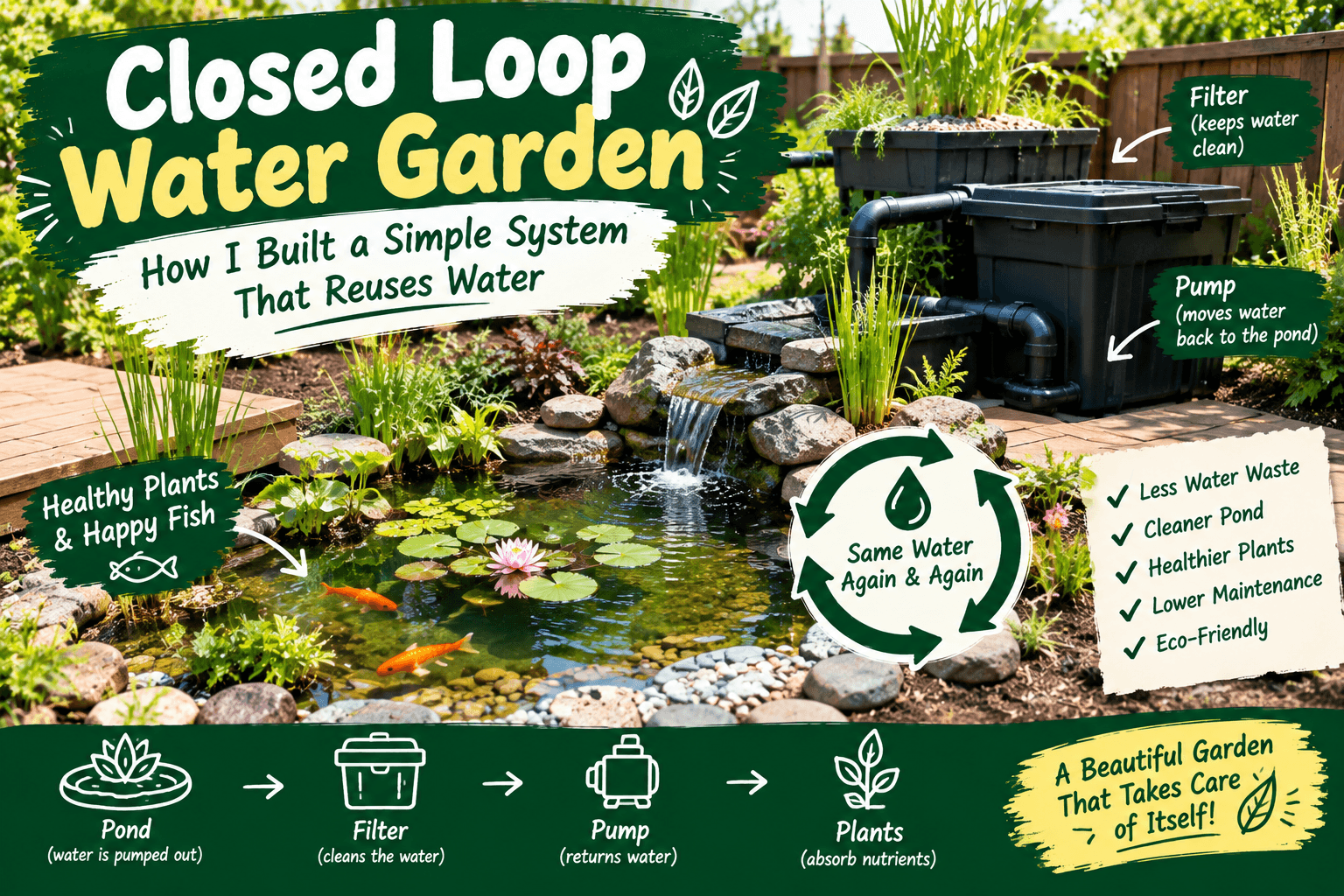
A closed loop water garden is basically a garden system designed to recirculate water instead of constantly using fresh water.
The basic idea looks something like this:
Water storage or pond → pump → plants/filter → return → pond or reservoir → repeat
The water keeps moving through the system.
Depending on how you build it, the garden might include:
- A small pond or reservoir
- Aquatic plants
- Vegetable or herb beds
- A water pump
- Gravel or other filter media
- Pipes or flexible tubing
- A biological filter
- A return pipe or small waterfall
Some systems also include fish.
That’s where things can get really interesting.
Fish produce waste. Microorganisms break down that waste. Plants can take up nutrients from the water. The plants help clean the water, and the cleaner water returns to the fish area.
That’s getting into aquaponics, although not every closed loop water garden is an aquaponic system.
You don’t need fish to make one.
Honestly, I’d recommend beginners start without fish.
I learned this after spending way too much time worrying about a fish pond when I really just wanted to grow herbs.
Why Would You Want a Closed Loop Water Garden?
For me, the biggest reason was simple.
I wanted to stop wasting water.
When you water a normal garden with a hose, some water gets used by plants, some evaporates, and some drains deeper into the soil.
That’s not necessarily bad. That’s how normal gardening works.
But a recirculating system gives you another option.
Instead of letting water disappear immediately, you can collect and reuse it.
There are other benefits too.
A small water garden can become a habitat for insects, birds, frogs, and other useful wildlife. Moving water can make a backyard feel cooler and more relaxing. And if you’re growing herbs or vegetables around the system, you’re combining several functions in one little space.
That’s very much the way I like to think about permaculture.
Don’t just build something for one purpose.
Try to make each part do several jobs.
My First Closed Loop Water Garden Was Definitely Not Perfect
Here’s the embarrassing part.
I originally thought I needed a huge reservoir.
So I started digging.
And digging.
Then I looked at the hole and realized I’d created something that looked less like a garden pond and more like evidence from a crime scene.
You’re gonna laugh, but I actually stood there with a shovel wondering how I got myself into this.
I eventually made the system much smaller.
That was a good lesson.
Start small.
You can always expand a water garden later. Making a giant hole first is harder to undo.
For a backyard or urban homestead, even a small reservoir can be useful.
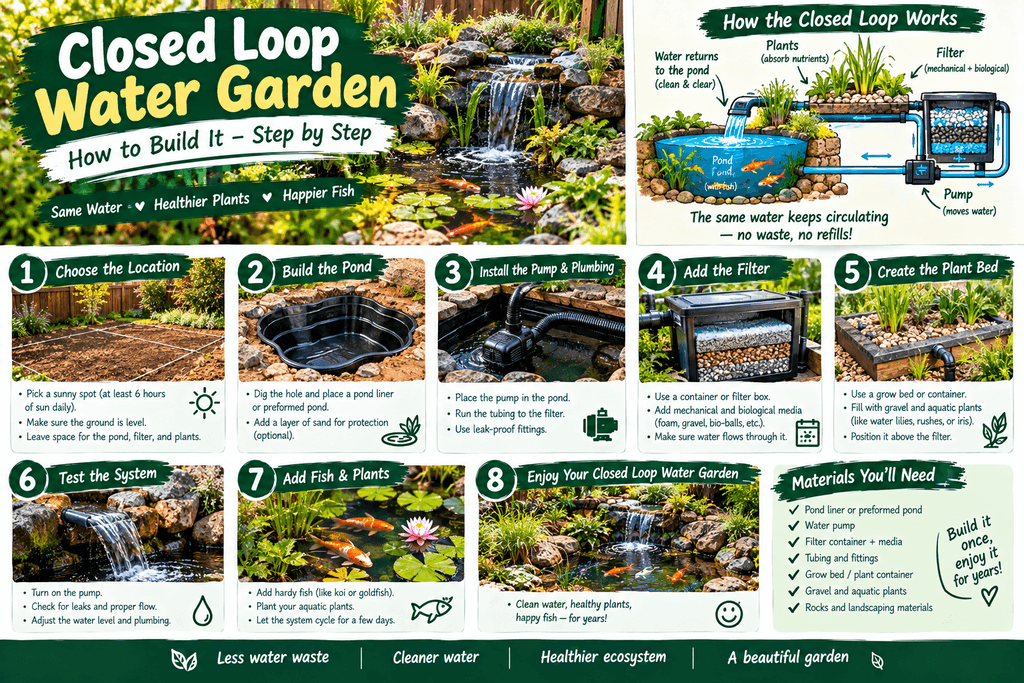
How the Water Cycle Works
The beauty of a closed loop system is the movement of the water.
Here’s a simple setup I like.
Step 1: Store the Water
Start with a pond, stock tank, barrel, or another suitable reservoir.
The container needs to be safe for the intended use and strong enough to hold the amount of water you’re putting into it.
Don’t use questionable containers that previously held chemicals.
I’ve seen people online turn just about anything into a garden project.
Sometimes that’s creative.
Sometimes it’s a terrible idea.
For anything involving food crops or animals, I prefer containers with a known history.
Step 2: Pump the Water
A small pump moves water from the reservoir toward your growing area or filter.
You don’t necessarily need a huge pump.
Actually, buying an oversized pump was one of my early mistakes.
The water moved so fast that I spent more time trying to control the flow than enjoying the garden.
The pump should match the size and design of your system.
And remember, pumps use electricity.
If you’re building an off-grid homestead system, you might eventually look at a small solar-powered pump, but make sure the pump and electrical components are properly rated for outdoor and wet locations.
Water and electricity aren’t a place to get creative.
Step 3: Let the Plants Do Some Work
This is my favorite part.
You can grow plants around or within the water system, depending on your design.
Some good choices for wet or water-edge areas include:
- Mint
- Watercress
- Water-loving herbs
- Certain leafy greens
- Aquatic plants
- Some ornamental wetland plants
But be careful with mint.
I love mint.
I also fear mint.
That stuff doesn’t need an invitation. Give it one little corner and next thing you know it’s trying to take over the neighborhood.
For edible plants, make sure you’re using a setup appropriate for food production and that the water quality is suitable.
If fish are involved, don’t assume pond water is automatically safe for every edible crop.
Step 4: Filter the Water
A filter helps remove particles and gives beneficial microorganisms a place to live.
One simple approach is a biological filter containing suitable filter media.
Water passes through the media, where beneficial bacteria can colonize.
You can also use mechanical filtration to catch larger particles.
Think of it like this:
Mechanical filter = catches stuff
Biological filter = supports microorganisms
You can combine both.
I like simple systems because when something goes wrong, I can actually figure out what happened.
A system with seventeen different filters and valves might be impressive.
It might also make me want to go back to growing tomatoes in buckets.
Can You Add Fish to a Closed Loop Water Garden?
Yes, but this changes the project.
Once you add fish, you’re not just managing plants anymore.
Now you’re responsible for living animals.
You need to think about:
- Water temperature
- Oxygen
- Ammonia
- Nitrite
- Nitrate
- Feeding
- Stocking levels
- Filtration
- Disease
- Predator protection
- Power outages
This is why I’d start without fish if you’re completely new to recirculating water.
Learn how your pump works.
Learn how your plants respond.
Learn how quickly water evaporates.
Then decide whether fish make sense.
There’s no prize for making your first garden project complicated.
What Plants Work Best?
This depends heavily on how wet your growing area is.
For a regular garden bed that receives water from the system, you can grow many of the same vegetables you’d normally grow.
Leafy greens are particularly useful because they grow relatively quickly.
Herbs can also work well.
If you’re using a more aquaponic-style setup, choose plants that are appropriate for that growing method.
Don’t make the mistake of thinking every plant loves wet roots.
Most vegetables don’t.
Tomatoes, peppers, and many other garden crops can struggle if their roots stay constantly saturated.
That’s one reason I like separating the wet zone from the regular garden soil.
Let the water move through the system without turning the whole backyard into a swamp.
The Biggest Mistake I Made: Too Much Water, Too Fast
My first pump was ridiculous.
It pushed water like I was trying to fill a swimming pool.
The return area overflowed.
Then the water found a path I hadn’t planned.
Then that path led directly toward my shoes.
Yep.
Wet shoes.
Again.
I’ve learned that water always finds the easiest route.
If you don’t plan the return path, water will make its own plan.
And it won’t ask permission.
So before turning on the pump, test everything slowly.
Watch where the water goes.
Look for leaks.
Check the return point.
Make sure the reservoir has enough free space to handle the system if the pump stops or starts unexpectedly.
How I Keep a Closed Loop Water Garden Healthy
I don’t treat my system like a set-it-and-forget-it project.
Every few days, I take a quick look.
Here’s what I’m checking:
Water level: Has evaporation dropped the level?
Pump: Is it running normally?
Flow: Is water moving where it should?
Plants: Any yellowing, wilting, or signs of pests?
Water: Is it unusually cloudy or smelly?
Leaks: Any wet spots where they shouldn’t be?
It takes a few minutes.
That’s it.
The goal isn’t to spend your whole Saturday maintaining the water garden.
The goal is to make it easier to manage.
What About Rainwater?
Rainwater can be a useful source for topping up a garden water system, depending on your local conditions and regulations.
A rain barrel or storage tank can collect water from a roof.
But remember, rainwater isn’t automatically drinking water.
Roof materials, bird droppings, dust, and other contaminants can enter collected water.
For a garden irrigation system, rainwater can be useful when properly managed.
For drinking water, you’d need an appropriate treatment and testing system.
I keep those two uses completely separate.
Can a Closed Loop Water Garden Save Water?
It can reduce how much fresh water you need for the system because the water is recirculated.
But “closed loop” doesn’t mean you never add water.
You will still lose some water through evaporation, plant use, splashing, leaks, and maintenance.
That’s important.
I see people online sometimes describe these systems like you fill them once and never touch them again.
That’s not real life.
You’ll probably need occasional top-ups.
The difference is that you’re reusing much more of the water rather than sending it away after one use.
Could You Build One in a Small Backyard?
Absolutely.
You don’t need ten acres.
A small stock tank, a little pump, some plants, and a simple filter can become a tiny recirculating garden.
You could even put the system near a patio where you can enjoy the sound of moving water.
For an urban homestead, that’s actually one of my favorite ideas.
You get a water feature, a growing area, wildlife habitat, and a little lesson in how natural systems work.
Just check local rules if you’re building a permanent pond, especially if children have access to it.
My Simple Setup for Beginners
If I were starting over today, I’d keep it boring.
Seriously.
I’d use:
- A small reservoir
- A properly rated water pump
- Tubing
- A simple filter
- A small planting area
- An overflow or safe drainage route
- A way to monitor the water level
I’d run it for a while before adding anything else.
No fish.
No giant pond.
No complicated plumbing.
Once you understand the system, then you can expand.
That’s the approach I wish I’d taken the first time.
FAQ About Closed Loop Water Gardens
Does a closed loop water garden need a pump?
Most recirculating systems use a pump to move water, although some designs can use gravity and natural elevation. A pump makes small backyard systems much easier to control.
Can I grow vegetables in a closed loop water garden?
Yes, depending on the design. You can grow plants around the water system or use a more specialized aquaponic setup. Make sure the growing conditions match the plants and that water used on edible crops is appropriate for food production.
Do I need fish?
Nope.
This is one of the biggest things I’d tell a beginner.
You can build a perfectly useful recirculating water garden without fish. Adding fish makes the system more complicated because now you’re managing animal health and water chemistry too.
Would I Build One Again?
Yep.
But I’d build it smaller.
That’s probably the biggest lesson I’ve learned from my years of homesteading.
You don’t need to build the biggest thing.
You need to build something you can actually maintain.
A closed loop water garden can be a great little project for a backyard, urban homestead, or permaculture garden. It gives you a chance to reuse water, grow plants, attract wildlife, and learn how different parts of a garden can work together.
And don’t worry if your first version looks a little rough.
Mine did.
Start with a small reservoir, move the water slowly, watch what happens, and improve it one piece at a time.
That’s how most of my best homesteading projects happened anyway.
One mistake at a time.
If you build one and run into a weird problem, leave a comment and tell me what happened. I can’t promise I’ve seen everything, but after 10+ years of messing around in the backyard, I’ve probably made a mistake that’s pretty close to yours.