FARMSOLO • CANNING & FOOD PRESERVATION
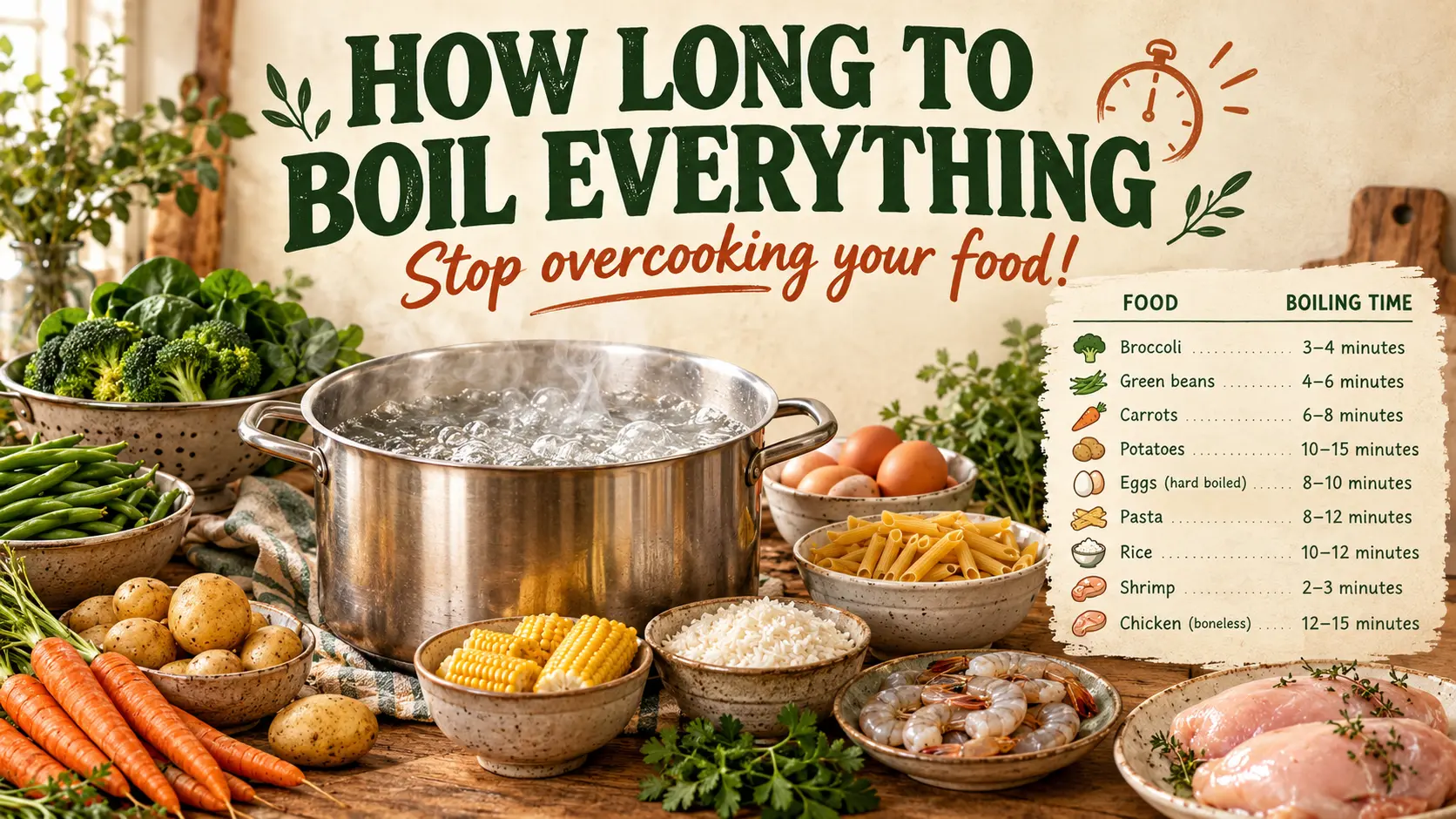
How long should you boil broccoli, potatoes, eggs, chicken or shrimp? A timer can get you close, but the right answer depends on the size of the food, whether it starts fresh or frozen, and what “done” actually means.
This simple guide gives useful starting times for 12 everyday foods—and shows when texture or internal temperature matters more than the clock.
Food-safety note: Time alone cannot tell you whether chicken is safe. All poultry should reach at least 165°F (74°C) in the thickest part. Seafood, eggs and other animal foods also have specific doneness or temperature guidance.
Quick Boiling Time Chart
Use these times as starting points. For most vegetables, begin timing after the water returns to a boil.
| Food | Approx. time | How to tell it is done |
|---|---|---|
| Broccoli florets | 3–5 minutes | Bright green and fork-tender |
| Spinach | 1–2 minutes | Wilted and tender |
| Green beans | 4–6 minutes | Tender but still slightly crisp |
| Sliced carrots | 5–8 minutes | Fork enters with light resistance |
| Potato chunks | 10–15 minutes | Fork slides easily into center |
| Baby potatoes | 15–20 minutes | Fork easily reaches center |
| White long-grain rice | About 18–20 minutes | Water absorbed and grains tender |
| Dry pasta | Usually 8–12 minutes | Follow package; taste for al dente |
| Corn on the cob | About 5 minutes | Hot, tender and juicy |
| Hard-cooked eggs | About 12–20 minutes covered off heat | White and yolk completely firm |
| Boneless chicken | Start checking around 12–15 minutes | 165°F (74°C) internally |
| Shrimp | About 2–3 minutes | Firm, pearly and opaque |
Important: These are everyday cooking times, not food-preservation blanching times. If you are blanching vegetables for freezing or processing food for canning, follow a tested preservation recipe and its exact timing.
How Long to Boil Vegetables
01 • BROCCOLI
Broccoli: 3–5 Minutes
Cut broccoli into similar-size florets so they finish at roughly the same time. Add them to boiling water and start checking at about 3 minutes.
For tender-crisp broccoli, remove it while the color is still bright green. If the florets turn dull, very soft and olive-colored, they have probably gone too far.
02 • SPINACH
Spinach: 1–2 Minutes
Spinach cooks extremely quickly. Add clean leaves to boiling water and remove them as soon as they are wilted and tender.
If the spinach is going into another cooked dish afterward, even less time may be enough.
03 • GREEN BEANS
Green Beans: 4–6 Minutes
Trim the ends, then boil the beans until they are tender enough to eat but still have a little bite.
Thin young beans may be ready earlier. Thick mature beans usually need longer.
04 • CARROTS
Carrots: About 5–8 Minutes for Slices
Carrot timing depends heavily on thickness. Thin coins cook faster than large chunks or whole carrots.
Start checking sliced carrots at about 5 minutes. For larger pieces, expect several extra minutes.
Best test: pierce the thickest piece with a fork.
How Long to Boil Potatoes
Potato Chunks: About 10–15 Minutes
Cut potatoes into similar pieces so one chunk does not turn to mush while another stays hard in the center.
One-inch chunks often become tender in roughly 10–15 minutes. Very small pieces may cook faster.
Whole Baby Potatoes: About 15–20 Minutes
Whole baby potatoes take longer because the heat must reach the center.
They are ready when a thin knife or fork slides into the center without much resistance.
How Long to Cook Rice and Pasta
White Rice: Usually About 18–20 Minutes
This is one place where the Pinterest chart is too simple.
Rice is normally brought to a boil with the correct amount of water, then covered and cooked over low heat. It is not usually left at a hard rolling boil.
Utah State University lists about 18–20 minutes for white long-grain rice, while medium and short-grain rice may take longer. Brown, black, parboiled and specialty rice can have very different cooking times.
Best rule: identify the type of rice before setting the timer.
Dry Pasta: Usually 8–12 Minutes
The Pinterest range is reasonable as a broad estimate, but pasta shape and thickness make a big difference.
Thin pasta may finish much faster than thick tubes or large shapes. Fresh pasta can cook in only a few minutes.
Best rule: follow the package time, then taste a piece about 1 minute before the suggested finish.
How Long to Boil Corn on the Cob
Fresh sweet corn does not necessarily need 8–10 minutes of active boiling.
One Utah State University method is simple: place husked ears into boiling water, cover the pot, let the water return to a boil, turn off the heat, and let the corn stand for about 5 minutes.
Older or larger ears may benefit from more time, but very fresh sweet corn can become less crisp when cooked much longer than necessary.
How Long to Boil Eggs
For hard-cooked eggs, a gentle method works better than letting eggs bounce in a rolling boil for 10 minutes.
- Place eggs in a saucepan and cover with water.
- Bring the water to a boil.
- Remove the pan from the heat.
- Cover and let the eggs stand until completely cooked.
- Cool promptly in cold or ice water.
Exact standing time varies with egg size and method, so a range around 12–20 minutes is more realistic than treating 8–10 minutes as universal.
For food safety, the white and yolk should be firm.
How Long to Boil Chicken
THE TIMER IS NOT THE SAFETY TEST
Boneless chicken pieces may take roughly 12–20 minutes in gently simmering liquid depending on their thickness, starting temperature and size.
But do not remove chicken from the pot because the timer reached 15 minutes.
Chicken is safely cooked when the thickest part reaches at least 165°F (74°C) on a food thermometer.
Large breasts, bone-in pieces and whole birds require different cooking times. Temperature is the reliable endpoint.
How Long to Boil Shrimp
Shrimp cook quickly. Small or medium shrimp may need only about 2–3 minutes once they are cooking in hot water.
Large shrimp may take a little longer. Frozen shrimp can also change the timing because they cool the water when added.
The FDA’s useful doneness test is visual: cooked shrimp should become firm, pearly and opaque.
Remove shrimp promptly when done. Leaving them in boiling water too long can make them firm and rubbery.
Should You Start Food in Cold or Boiling Water?
| Food | Good starting method |
|---|---|
| Broccoli | Boiling water |
| Spinach | Boiling water |
| Green beans | Boiling water |
| Carrots | Boiling water for small pieces |
| Potatoes | Often cold water, then bring up to a gentle boil |
| Rice | Follow method for the rice variety |
| Pasta | Boiling water |
| Corn | Boiling water |
| Eggs | Several methods work; avoid aggressive boiling |
| Chicken | Gentle simmer rather than violent rolling boil |
| Shrimp | Hot or boiling water |
5 Reasons Boiling Times Change
- Size: A whole potato takes much longer than a 1-inch potato cube.
- Starting temperature: Frozen food can take longer than refrigerated or room-temperature food.
- Amount in the pot: Adding a large batch can drop the water temperature considerably.
- Altitude: Water boils at a lower temperature at higher elevations, which can increase cooking time.
- Your preferred texture: Crisp-tender vegetables finish earlier than very soft vegetables.
Common Boiling Mistakes
- Starting the timer too early. For many vegetables, wait until the water returns to a boil.
- Using the same time for every size. Small and large pieces cook differently.
- Boiling chicken violently. A gentle simmer is easier to control.
- Trusting chicken color instead of a thermometer. Use 165°F as the minimum safe endpoint.
- Cooking rice like pasta. Many rice varieties are cooked covered at low heat with a measured amount of water.
- Ignoring the pasta package. Shapes vary too much for one universal time.
- Walking away from shrimp. A few extra minutes can dramatically change the texture.
- Overcooking vegetables for “safety.” Most vegetables simply need to reach the texture you want.
Boiling Time FAQ
When do I start timing food in boiling water?
For many vegetables, start timing after the water returns to a boil. Adding cold food can temporarily stop the boil.
How do I know potatoes are done?
Insert a fork or thin knife into the thickest piece. It should slide in easily without a hard center.
Is 15 minutes enough to boil chicken?
It may be enough for some small boneless pieces, but time is not a safe way to judge chicken. Check the thickest part with a food thermometer and cook to at least 165°F (74°C).
How long does white rice take?
White long-grain rice commonly needs about 18–20 minutes over low heat after the water comes to a boil. Other rice varieties can require very different times.
How long do shrimp take in boiling water?
Many shrimp cook in roughly 2–3 minutes, although size and starting temperature matter. Remove them when the flesh is firm, pearly and opaque.
Can I use this chart for freezing vegetables?
No. Blanching food for freezing uses tested preparation and timing instructions that may differ from normal cooking times. Follow a tested food-preservation guide.
Sources & Food-Safety References
- USDA FSIS — Safe Internal Temperatures for Meat and Poultry
- FDA — Selecting and Serving Fresh and Frozen Seafood Safely
- University of Minnesota Extension — Eggs
- University of Minnesota Extension — Vegetable Blanching Guidance
- Utah State University Extension — Corn Cooking Guide
THE FARMSOLO TAKEAWAY
Use the Clock as a Guide, Not a Guarantee
A boiling-time chart is useful when you need a quick starting point, but food is not manufactured to one exact size.
Check vegetables with a fork, taste pasta, use the correct method for rice, watch shrimp for opacity, and always use a food thermometer for poultry.
That is a more reliable answer to “how long to boil everything” than one universal timer.