
LARGER SYSTEM • IBC TOTES
What About an IBC Tote Rainwater Harvesting System?
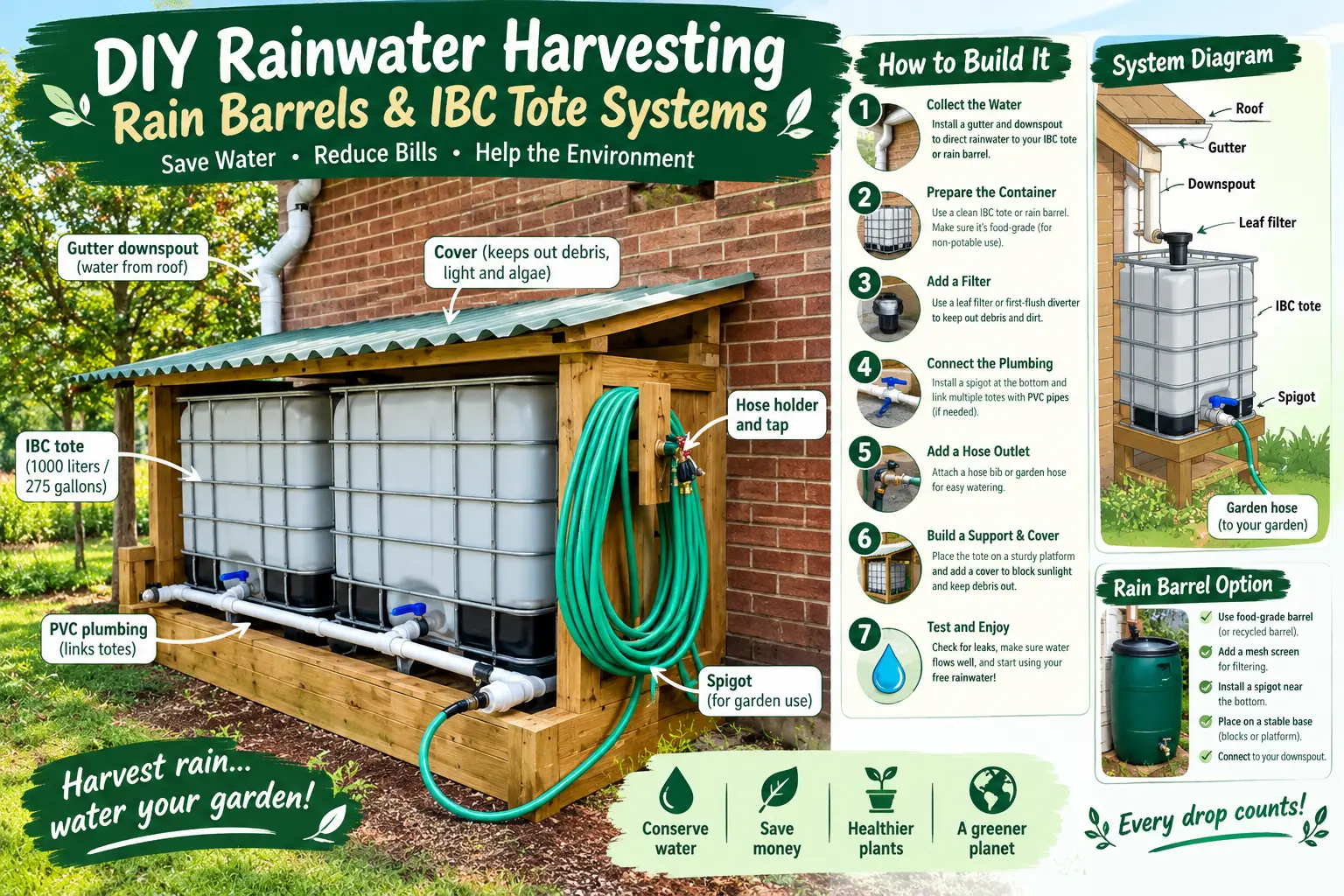
Once a small rain barrel starts feeling too small, an IBC tote is one of the larger storage options people consider for garden irrigation. A common setup uses one or two tanks connected to a roof downspout, with valves near the bottom and an overflow near the top.
The Pinterest idea is attractive because the tanks are grouped together inside a simple wooden enclosure, plumbing is kept near the front, and a garden hose can connect to the outlet. But several important details are hidden or impossible to verify from the photo.
Why Two Tanks?
Two totes can provide hundreds of gallons of storage and let you capture much more runoff than a small 50–60 gallon barrel.
The Big Difference
A full IBC tote can weigh well over 2,000 pounds. Two full tanks create several thousand pounds of concentrated load, so the base matters far more than it does with an empty tote.
8 Things I Would Plan Before Installing IBC Rainwater Tanks
01 • TANK HISTORY
Know What Was Stored in the Tote Before You Buy It
Cheap used IBC totes are easy to find, but that does not make every tote suitable for garden water.
Avoid containers with an unknown history or anything that previously held hazardous chemicals. For a garden system, I would rather use a purpose-built water container or a tote with a known food-grade history than gamble on a mystery tank.
02 • FOUNDATION
Build the Base for the Full Tank, Not the Empty One
An empty plastic tank is easy to move. A full one is a completely different object.
The supporting surface needs to be level, stable, well drained, and capable of carrying the full weight without settling or leaning. This becomes even more important when two tanks sit side by side near a house wall.
Do not rely on loose soil, a few random blocks, or a lightweight wooden platform unless the support has actually been designed for the load.
03 • SUNLIGHT
Protect Translucent Tanks From Light
The white plastic bottle inside many IBC cages allows some light to reach the stored water. Light encourages algae growth.
A shaded enclosure like the one in the inspiration photo can help, but I would also make sure the tank sides are protected from strong direct sunlight instead of assuming the small roof alone keeps the water dark.
04 • SCREEN & FIRST FLUSH
Keep Roof Debris Out Before It Reaches 500+ Gallons of Water
Cleaning a leaf out of a gutter is easy. Cleaning a layer of decomposing roof debris from the bottom of a large tank is not.
Use suitable screens before the storage tanks and consider a first-flush diverter. The first runoff after a dry period can carry dust, animal droppings, and other material from the roof and gutters.
05 • CONNECTING TWO TANKS
Give Each Tank a Valve Before Joining the Manifold
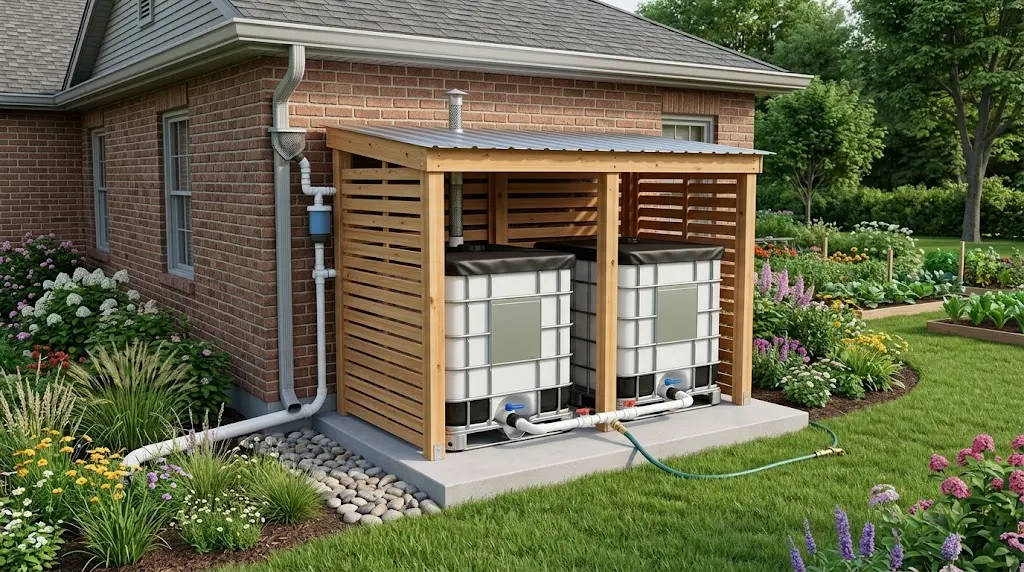
A useful two-tank system lets you isolate either tank for cleaning or repairs without draining everything.
That means individual shutoff valves near the outlets can be valuable before both tanks join a common line.
Make the plumbing accessible. Hiding every fitting permanently behind decorative boards may make the enclosure prettier today and repairs much more annoying later.
06 • OVERFLOW
Plan for the Moment Both Tanks Are Full
Eventually the storage system will fill. That is not a failure; it is a normal operating condition.
Install an adequately sized overflow and direct the excess water somewhere safe, such as an appropriate drainage area or rain garden. Do not let hundreds of gallons overflow next to the building foundation.
07 • MOSQUITO CONTROL
Screen Every Opening, Not Just the Main Inlet
Mosquitoes only need a way into stored water.
The main inlet, vent, overflow, and any other openings should be designed so insects cannot easily enter while air and water can still move as required.
08 • WATER USE
Treat Roof-Collected Rainwater as Non-Potable Unless Properly Treated
Rainwater can pick up dirt, microorganisms, animal waste, and chemicals as it moves across roofing, gutters, plumbing, and storage surfaces.
I would use a simple backyard IBC system for appropriate non-potable uses rather than assuming clear-looking water is safe to drink.
If rainwater will be used for drinking, cooking, bathing, or another higher-risk purpose, that becomes a different system involving appropriate treatment, testing, and local public-health requirements.
What the Pinterest IBC System Gets Right
| Idea in the photo | What I would check |
|---|---|
| Two tanks together | Useful capacity, but confirm a stable foundation and accessible plumbing. |
| Roof over the tanks | Helpful for shade, but translucent tank sides may still need protection from sunlight. |
| Individual tank valves | A good idea because each tank can potentially be isolated for maintenance. |
| Common outlet manifold | Convenient, but fittings and pipe sizes should suit the expected flow and remain serviceable. |
| Garden hose connection | Useful for watering, but a ground-level tank provides limited pressure compared with household plumbing. |
| Wood enclosure | Good visually, but it should not prevent tank inspection, cleaning, valve access, or safe overflow. |
A Better System Flow
Roof → clean gutter → debris screen → first-flush diverter → storage tanks → screened vent → controlled outlet → safe overflow.
Think of the tanks as one part of the system rather than the entire system. Good rainwater harvesting begins at the roof and does not end until the overflow has somewhere safe to go.
Can You Run a Garden Hose From an IBC Tote?
Yes, a suitable adapter can connect the tote outlet to garden-hose plumbing, but gravity pressure is usually modest when the tank sits near ground level.
A watering wand or short hose may work for simple gravity watering. Long hoses, restrictive fittings, uphill runs, or some irrigation equipment may need more pressure than the tank naturally provides.
If you need stronger pressure, design a suitable pump system rather than raising thousands of pounds of stored water onto a questionable platform.
Related FarmSolo guides: For the outlet and valve side of a larger system, see the DIY Water Tank Plumbing guide. A large sealed tank also needs proper air movement as water enters and leaves, which is covered in the Water Tank Vent Pipe guide.