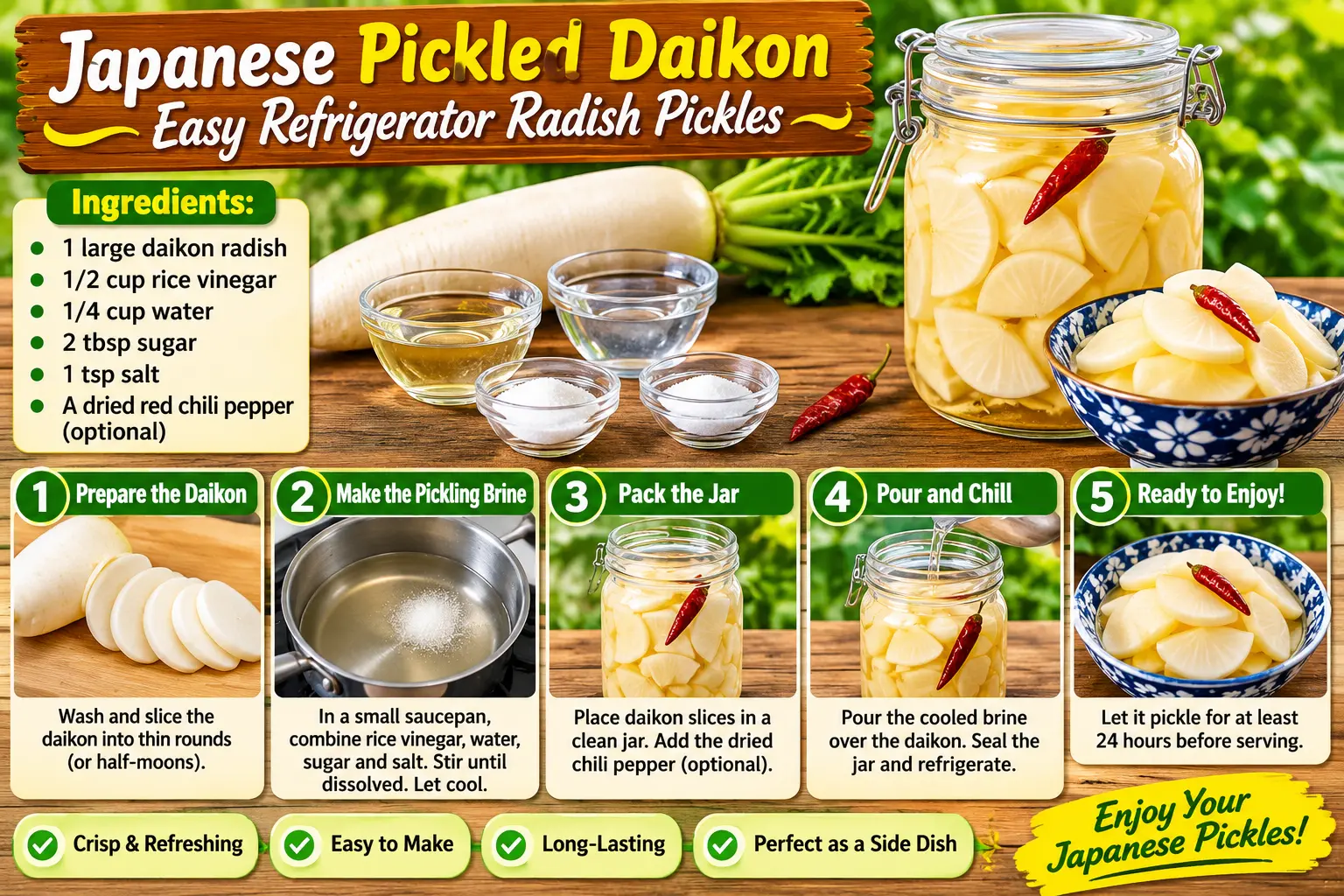
Japanese pickled daikon is a crisp, lightly sweet, tangy refrigerator pickle made with fresh daikon radish, rice vinegar, sugar, salt, and optional dried chili. Slice the radish, cover it with the simple vinegar mixture, refrigerate it, and let time do most of the work.
The Pinterest graphic calls this a 24-hour pickle, which is a reasonable way to let the flavor develop. Just remember that this is a refrigerator pickle. It is not a shelf-stable canned product and should not be stored in the pantry.
Food-safety note: Keep this batch refrigerated. Do not use this recipe for water-bath canning. Shelf-stable pickles require a research-tested recipe with validated acidity and processing instructions.
What Is Japanese Pickled Daikon?
Daikon is a large white radish widely used in Japanese and other Asian cuisines. Raw daikon has a fresh, slightly peppery flavor and a crisp, juicy texture.
A short soak in rice vinegar, sugar, and salt softens the sharp edge while keeping the slices pleasantly crunchy.
Japanese cuisine includes many different types of pickled vegetables, collectively called tsukemono. This quick vinegar version is different from yellow takuan, which traditionally involves drying and a different pickling process.
Ingredients
- 1 pound daikon radish, about 1/2 to 1 medium-large daikon
- 1/2 cup unseasoned rice vinegar
- 1/4 cup water
- 2 tablespoons granulated sugar
- 1 teaspoon pickling or canning salt
- 1 dried red chili pepper, optional
- 1 thin strip lemon or yuzu peel, optional
Use Unseasoned Rice Vinegar
Choose unseasoned rice vinegar so you control the amount of sugar and salt yourself.
Seasoned rice vinegar already contains added sugar and salt, which can make the final pickle much sweeter or saltier than expected.
Use Fresh, Firm Daikon
Choose a daikon that feels firm and heavy for its size. Avoid roots with large soft areas, deep cracks, slimy surfaces, or obvious spoilage.
Fresh produce gives you a better chance of getting the clean, crisp texture that makes quick daikon pickles so good.
How to Make Japanese Pickled Daikon
Step 1: Wash and Peel the Daikon
Wash the daikon thoroughly under clean running water.
Peel the outer skin with a vegetable peeler. Trim off the root tip and leafy top.
Step 2: Slice It Evenly
Cut the daikon lengthwise in half, then slice it crosswise into thin half-moons.
Around 1/8 to 1/4 inch thick works well for refrigerator pickles.
Uniform slices pickle more evenly than a jar containing a mixture of thick and thin pieces.
Step 3: Prepare the Pickling Liquid
Combine the rice vinegar, water, sugar, and salt in a small saucepan.
Warm gently while stirring until the sugar and salt dissolve. There is no need to boil the mixture aggressively.
Remove from the heat.
Step 4: Pack the Jar
Place the sliced daikon into a clean jar or other food-safe container.
Add the dried chili if you want a little heat. A strip of lemon or yuzu peel can also add a fresh citrus aroma.
Step 5: Add the Brine
Pour the prepared vinegar mixture over the daikon.
Press the pieces gently so they are surrounded by the liquid. The daikon will release additional moisture as it sits.
Step 6: Cool and Refrigerate
Let the jar cool briefly, cover it, and move it to the refrigerator.
You can taste thin slices after several hours, but the flavor becomes more balanced after 12 to 24 hours.
FarmSolo tip: Daikon can develop a strong cabbage-like aroma as it sits. Use a tightly sealing container if you do not want the smell spreading through the refrigerator.
How Long Should Daikon Pickle?
| Time | What to Expect |
|---|---|
| 2–4 hours | Lightly seasoned, very crisp |
| 12 hours | More balanced sweet-sour flavor |
| 24 hours | Well flavored and still crisp |
| Several days | Stronger flavor and stronger daikon aroma |
How Long Does Pickled Daikon Last?
For this small refrigerator batch, I would make only what you expect to eat within several days.
A practical quality target is about 4 to 5 days refrigerated in a clean airtight container.
Always use a clean utensil to remove the pickles. Discard the batch if you notice mold, slime, obvious spoilage, or a rotten odor rather than the normal strong radish smell.
This Is Not Takuan
The terms can be confusing because both involve daikon.
| Type | Method |
|---|---|
| This recipe | Quick vinegar refrigerator pickle |
| Takuan | Traditional dried and pickled daikon preparation |
| Fermented radish | Acidity develops through fermentation rather than only added vinegar |
They can all be delicious, but their preparation and food-safety rules are not interchangeable.
Can You Water-Bath Can This Recipe?
No—not from these instructions.
Do not put the jars in a boiling-water canner and assume that turns this refrigerator recipe into a shelf-stable pickle.
Safe home-canned pickles require a research-based formula that controls:
- Vegetable quantity
- Vinegar strength
- Water-to-vinegar ratio
- Jar size
- Headspace
- Processing method
- Processing time
- Altitude adjustments where required
If you want pantry storage, use a tested recipe developed specifically for canning instead.
Do You Need 5% Vinegar?
For shelf-stable pickling, tested recipes commonly specify vinegar labeled at 5% acidity, and the National Center for Home Food Preservation warns against changing vinegar, water, and vegetable proportions.
This recipe is intentionally handled as a refrigerator pickle rather than being presented as a tested canning formula.
Check the label on your rice vinegar and do not assume every bottle has identical acidity.
Why Use Pickling Salt?
Pickling or canning salt dissolves cleanly and does not contain the anti-caking additives found in some table salts.
Those additives are not necessarily dangerous, but they can make pickle liquid look cloudy.
Can You Reduce the Sugar?
In this refrigerator version, sugar mainly balances the sharp vinegar and peppery daikon flavor.
Reducing it will make the pickle noticeably more sour.
For shelf-stable canning recipes, however, do not casually alter a tested formula.
Easy Flavor Variations
Spicy Daikon
Add one dried red chili pepper or a small pinch of red pepper flakes.
Citrus Daikon
Add a thin strip of lemon peel or yuzu peel if available. Avoid adding a large amount of bitter white pith.
Daikon and Carrot
Add thin carrot slices for color and extra crunch. Keep the batch refrigerated and treat it as the same short-term refrigerator pickle.
Kombu Daikon
A small clean piece of kombu can add mild savory depth to the pickling liquid.
How to Serve Pickled Daikon
The crisp sweet-sour flavor works especially well beside richer foods.
- Rice bowls
- Grilled meats
- Teriyaki dishes
- Noodle bowls
- Sushi-style meals
- Sandwiches
- Fried foods
- Simple rice and miso soup
What the Pinterest Graphic Gets Right
- Daikon is excellent for quick vinegar pickling.
- Rice vinegar is a natural flavor match.
- Sugar and salt balance the brine.
- Dried chili is an optional traditional-style flavor addition.
- Waiting about 24 hours gives the daikon plenty of time to absorb flavor.
What the Graphic Leaves Out
- It does not clearly say the jar must stay refrigerated.
- It does not explain that this is not a tested canning recipe.
- It does not distinguish quick-pickled daikon from fermented daikon or takuan.
- It does not give a refrigerator storage window.
- It does not tell you to use clean jars and utensils.
- It does not explain that rice vinegars can vary in acidity.
Japanese Pickled Daikon Recipe Card
Japanese-Style Refrigerator Pickled Daikon
Prep: 15 minutes | Chill: 12–24 hours | Method: Refrigerator pickle
Ingredients
- 1 pound daikon radish
- 1/2 cup unseasoned rice vinegar
- 1/4 cup water
- 2 tablespoons granulated sugar
- 1 teaspoon pickling or canning salt
- 1 dried red chili pepper, optional
- Thin strip of lemon or yuzu peel, optional
Instructions
- Wash, peel, and trim the daikon.
- Slice into even 1/8- to 1/4-inch half-moons.
- Combine rice vinegar, water, sugar, and salt in a small saucepan.
- Warm gently until the sugar and salt dissolve.
- Pack daikon into a clean container with chili or citrus peel if using.
- Pour the pickling liquid over the daikon.
- Cool briefly, cover, and refrigerate.
- For best flavor, chill for 12 to 24 hours before serving.
- Keep refrigerated and use within about 4 to 5 days for best quality.
Important: This is a refrigerator recipe only. Do not use these instructions for shelf-stable canning.
Japanese Pickled Daikon FAQ
Is Japanese pickled daikon fermented?
Not this version. The acidity comes directly from rice vinegar, so it is a quick refrigerator pickle rather than a lactic-acid fermentation.
Is this the same as takuan?
No. Traditional takuan is a different Japanese daikon pickle involving dried daikon and a longer pickling process.
Can I eat it the same day?
Yes. Thin slices begin picking up flavor within a few hours, although 12 to 24 hours gives a stronger and more balanced result.
Why does pickled daikon smell strong?
Daikon belongs to the brassica family and contains sulfur compounds that can develop a strong aroma after cutting and pickling. An airtight container helps keep that smell contained.
Can I reuse the brine?
Do not use brine that has already held vegetables to make another preservation batch. Vegetables release water into the liquid and absorb acid, changing the original balance. Make fresh brine for the next batch.
Can I leave the jar on the counter?
No. This recipe is designed for refrigeration, not room-temperature fermentation or pantry storage.
The Bottom Line
Japanese-style pickled daikon is one of the easiest ways to turn a fresh garden radish into a crisp side dish without starting a full canning project.
Slice the daikon evenly, use unseasoned rice vinegar, balance it with sugar and salt, and give the jar several hours in the refrigerator.
The one thing the pretty Pinterest jar does not show clearly is the most important: this is a refrigerator pickle. Keep it cold, make small batches, and use a separate research-tested recipe if you want shelf-stable canned daikon.
Sources
- National Center for Home Food Preservation — General Information on Pickling
- University of Minnesota Extension — Preserving Food at Home: Pickling Produce
- Just One Cookbook — Japanese Pickled Daikon
- Just One Cookbook — Tsukemono: A Guide to Japanese Pickles