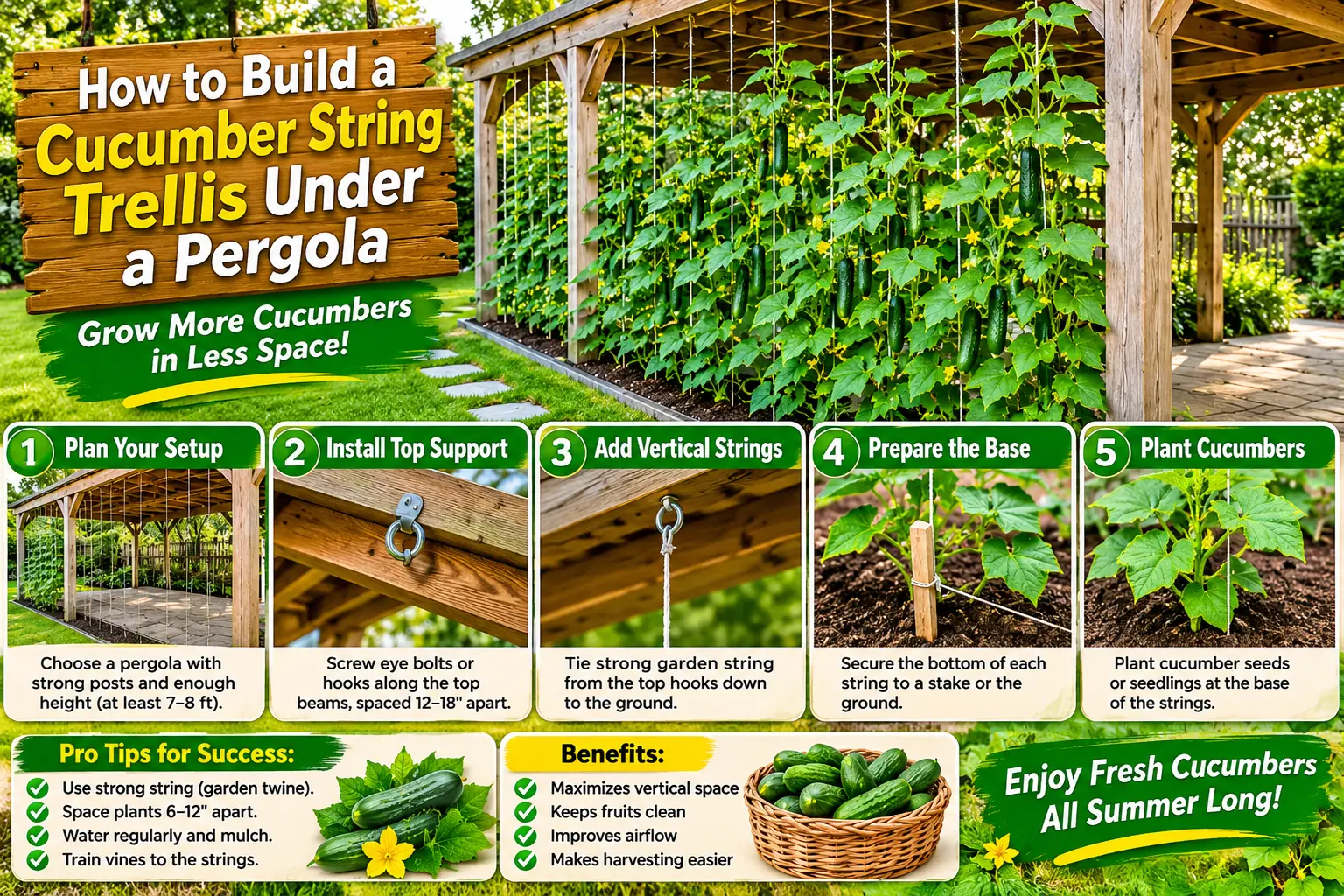
A cucumber string trellis is one of the simplest ways to grow vining cucumbers upward instead of letting them sprawl across the ground. With a strong overhead beam and vertical strings, each plant gets a clear climbing path while fruit stays visible, cleaner, and easier to harvest.
The Pinterest design uses an existing wooden pergola as the support frame. Long strings hang from the upper beam to the soil, and cucumber vines climb the strings until the entire side becomes a green wall.
This can work very well, especially in a small garden, but the system still needs good spacing, strong string, secure anchors, regular training, enough sunlight, and consistent watering.
Best use: vigorous vining cucumbers. Bush cucumber varieties usually do not need a tall overhead string system.
Why Grow Cucumbers Vertically?
Cucumber vines can spread several feet across the garden. Training them upward saves valuable ground space and keeps the planting more organized.
A vertical trellis can also make it easier to:
- See developing fruit
- Harvest without stepping through vines
- Keep cucumbers off wet soil
- Reduce tangled growth
- Improve light penetration
- Use narrow beds efficiently
1. Start With a Strong Overhead Support
The pergola in the image is doing more work than it may appear to be doing.
Each cucumber vine is fairly light when young, but a mature wall of wet foliage and fruit can add substantial weight and catch wind.
Your upper support can be:
- A pergola beam
- A wooden crossbar between posts
- A metal pipe frame
- A greenhouse or high-tunnel support designed for crop loads
Do not attach a full wall of cucumber vines to a weak decorative beam without checking its stability first.
2. Use String That Can Handle a Full Season
The string needs to remain strong through sun, rain, irrigation, wind, and the increasing weight of the vine.
Common options include:
- Strong garden twine
- Sisal twine
- Hemp twine
- UV-resistant synthetic trellis string
Natural-fiber twine has the advantage of being easier to compost with old vines at the end of the season, provided it has not been chemically treated.
3. Give Each Plant Its Own String
The cleanest setup is one vertical line per plant.
That keeps neighboring vines from becoming one tangled mass and makes training, inspection, and harvesting easier.
Do not crowd several plants around a single string just because the frame has room above them.
4. Keep Normal Plant Spacing
Vertical growing saves horizontal vine space, but it does not eliminate root competition.
Illinois Extension recommends thinning or planting cucumbers at about 12 inches apart in rows for many common garden types. Follow the spacing recommendation for the specific cultivar you grow.
Overcrowding can reduce airflow and make harvesting more difficult once the vines fill the strings.
5. Anchor the Bottom of the String Securely
A vertical string works best when it stays reasonably taut.
You can anchor the lower end to:
- A ground stake
- A lower horizontal wire
- A trellis base rail
- A dedicated anchor beside the plant
Avoid tying a tight permanent knot directly around the cucumber stem.
6. Guide Young Vines Early
Young cucumber vines may initially trail along the ground instead of finding the string immediately.
Gently guide the growing tip toward the string and allow the plant’s tendrils to begin attaching.
Check the plants every few days during rapid growth because a vine that misses its support can quickly tangle into neighboring plants.
7. Do Not Force the Vine Around the String
Cucumber stems are more brittle than some climbing plants.
Do not twist or bend the main vine sharply.
Guide it loosely and let the tendrils do much of the work.
8. Add Clips Only if Needed
If the plant repeatedly falls away from the string, use soft plant clips or loose ties.
Do not use thin wire or a tight plastic tie that can cut into the stem as it expands.
9. Watch the Shade From the Pergola
The Pinterest design is visually appealing because the cucumber wall grows directly under a wooden roof structure.
But cucumbers are warm-season crops and need strong light for good growth and fruiting.
If the pergola has a solid roof or dense overhead shade, the plants may not receive enough direct light.
Before planting: watch the site through the day. A strong frame is useless if the cucumber row spends most of the growing season in deep shade.
10. Put the Trellis Where It Will Not Shade Short Crops
A mature cucumber wall can create significant shade.
In the Northern Hemisphere, placing tall trellises toward the north side of a vegetable bed can reduce unwanted shade on shorter crops when the site allows it.
11. Keep the Root Zone Evenly Moist
Cucumbers need consistent soil moisture, particularly during flowering and fruit development.
University of Minnesota notes that vertically grown cucumbers may require watering more frequently.
Drip irrigation or a soaker hose at soil level can help keep moisture more consistent while keeping foliage drier.
12. Mulch Around the Base
Organic mulch can help reduce rapid moisture swings, suppress weeds, and limit soil splash around the plants.
Keep mulch slightly away from the crown rather than piling it tightly against the stem.
13. Do Not Let the Trellis Become a Solid Wall
The “after” photo shows a dense curtain of cucumber foliage.
That looks impressive, but excessive density can reduce airflow and make it harder to:
- Find fruit
- Spot cucumber beetles
- Notice disease symptoms
- Reach the center of the planting
- Keep foliage dry
Use reasonable plant spacing instead of trying to create the thickest possible green wall.
14. Should You Prune Cucumbers on a String Trellis?
Home gardeners do not always need intensive pruning.
However, commercial and high-tunnel cucumber systems sometimes prune side shoots and maintain a more controlled leader because vertical strings make that training system practical.
For a backyard garden, remove only enough excess or damaged growth to keep access and airflow reasonable unless your cultivar or growing system specifically calls for a single-leader method.
15. Cucumbers Usually Do Not Need Fruit Slings
Unlike trellised melons, normal cucumbers generally do not need individual slings.
University of Minnesota notes that cucumbers and small squash remain attached to the vine and usually do not need separate fruit support.
16. Harvest Often
A vertical trellis makes fruit easier to see, so take advantage of it.
Check plants frequently and harvest cucumbers at the proper size for the variety.
Illinois Extension notes that over-mature fruit left on the vine can slow continued cucumber production.
17. Avoid Working With Wet Vines
Illinois Extension recommends avoiding handling or harvesting cucumber plants when they are wet.
If possible, train, inspect, and harvest after foliage has dried.
18. Check the Strings After Wind
Vertical cucumber walls catch wind.
Illinois Extension specifically notes that strong winds can make vertical cucumber training less practical in exposed locations.
After storms, inspect:
- Top anchors
- Bottom anchors
- Broken vines
- Loose clips
- Damaged crossbars
19. Use the Pergola as a Multi-Use Garden Structure
One thing the Pinterest idea gets very right is using an existing permanent structure instead of building a separate trellis for every crop.
A strong pergola can potentially support seasonal climbers such as:
- Cucumbers
- Pole beans
- Peas during cooler seasons
- Light ornamental vines
Rotate crops where practical instead of planting cucumbers in the exact same soil every year.
20. Remove Old Vines at the End of the Season
Once plants finish producing, remove old vines and inspect the frame and strings.
Diseased plant material should be handled according to the disease involved rather than automatically added to the compost pile.
If you used compostable natural twine and healthy plant material, cleanup can be especially simple.
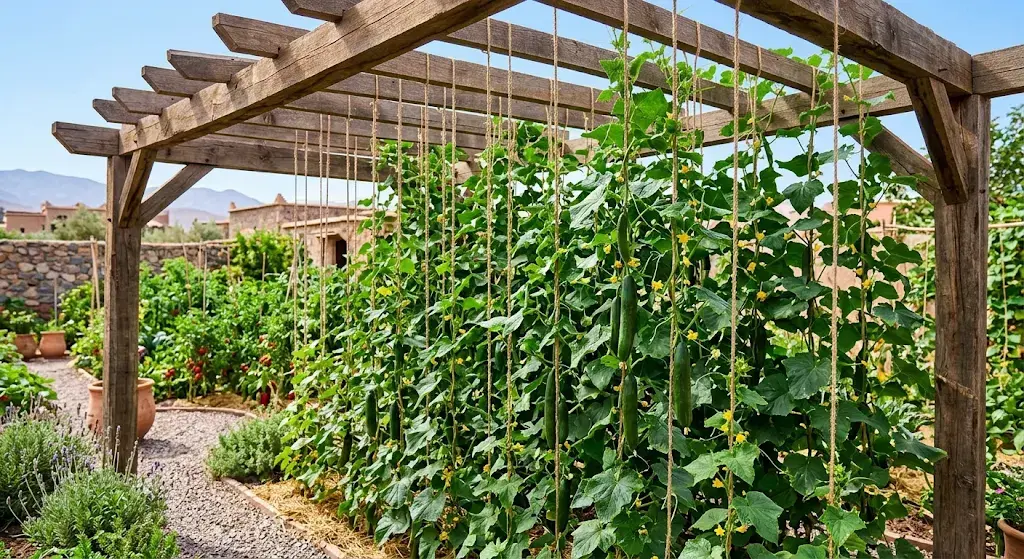
Simple Cucumber String Trellis Layout
| Part | Purpose |
|---|---|
| Overhead beam | Carries the vertical strings |
| Vertical string | One climbing path per plant |
| Bottom anchor | Keeps string reasonably taut |
| Plant row | Vining cucumbers spaced for airflow |
| Drip or soaker line | Provides consistent soil moisture |
| Mulch | Reduces weeds and moisture swings |
What This Pinterest Trellis Gets Right
- Uses vertical space instead of garden floor space.
- Reuses a strong overhead structure.
- Provides one simple climbing line per plant.
- Keeps cucumber fruit visible and off the ground.
- Creates easy harvest access from the path.
- Can form a productive seasonal green screen.
What I Would Improve
- Keep more space between plants so the vines do not become an overly dense wall.
- Add drip or soaker irrigation along the root zone.
- Use stronger top anchors than simple loose knots.
- Check how much shade the pergola creates before planting.
- Add a separate lower anchor for every string.
- Inspect the system after windy weather.
Cucumber String Trellis FAQ
Can cucumbers grow on string?
Yes. Vining cucumbers can be guided onto vertical twine or string and will use their tendrils to help climb as they grow.
What kind of string is best for cucumber trellises?
Use strong garden twine or UV-resistant trellis string. Natural-fiber options such as sisal, cotton, or hemp can be useful if you want a compostable material.
Do cucumbers need to be tied to the string?
Usually they only need help when young. Guide the vine toward the string and allow tendrils to attach. Soft clips can help where needed.
Do trellised cucumbers need fruit slings?
Normal cucumber fruit generally does not need individual slings. Melons are much more likely to require additional support.
How far apart should cucumber plants be on a string trellis?
Spacing depends on the cultivar and growing system. Around 12 inches is common for many garden cucumbers, but always follow the variety’s planting guidance.
Can I grow cucumbers under a pergola?
Yes if the site receives enough sun and the pergola frame is strong enough to hold a mature wall of vines. Deeply shaded pergolas are a poor location for productive cucumber plants.
Does growing vertically increase cucumber yield?
Trellising can improve space efficiency and make harvesting easier, but yield still depends on variety, soil fertility, moisture, pollination, pest pressure, weather, and plant health. Do not treat vertical growing as an automatic yield guarantee.
The Bottom Line
The Pinterest idea is simple because it uses an overhead structure that is already there.
Instead of allowing cucumber vines to spread across the soil, one string gives each plant a direct route upward.
Use a rigid top beam, strong string, individual anchors, sensible plant spacing, consistent soil moisture, and regular training while the vines are young. Done well, a cucumber string trellis can turn a narrow garden edge into a productive vertical growing wall without sacrificing harvest access.
Sources
- University of Minnesota Extension — Trellises and Cages to Support Garden Vegetables
- University of Minnesota Extension — Growing Cucumbers in Home Gardens
- Illinois Extension — Cucumber
- Illinois Extension — Supporting Garden Plants