A beautiful homestead pantry can store canned food, dried herbs, onions, potatoes, and part of your garden harvest—but those foods should not all be treated as if they need the same conditions.
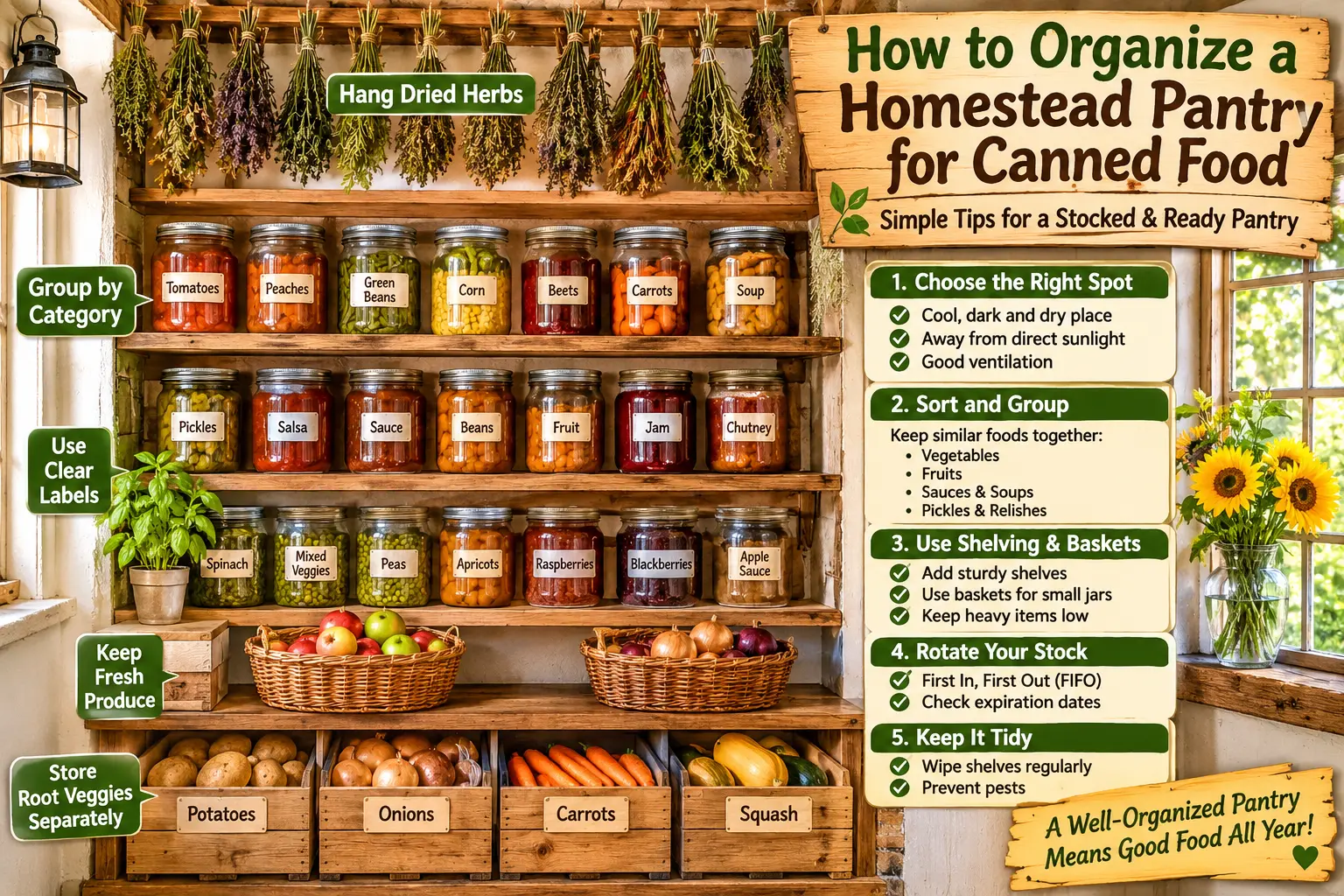
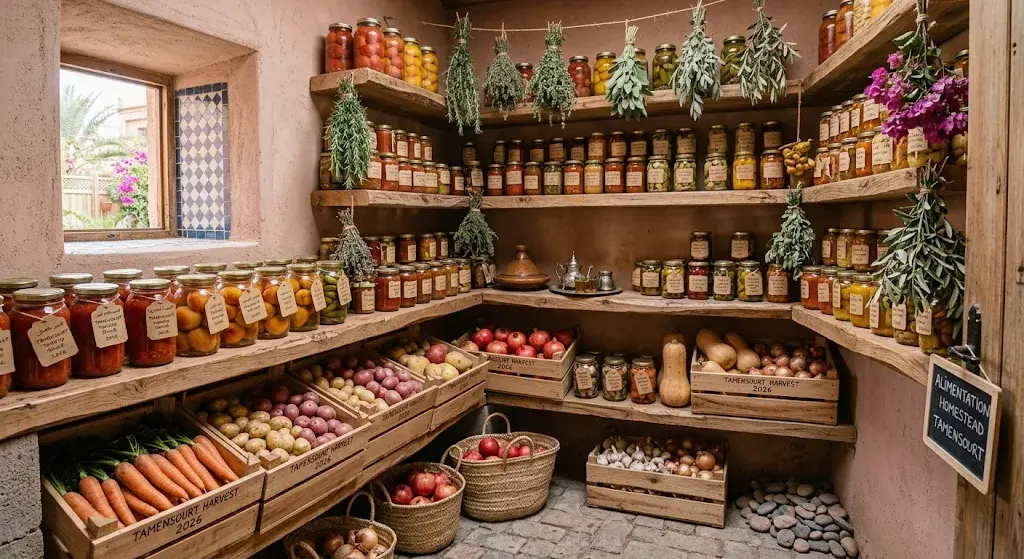
The Pinterest pantry looks almost perfect: dried herbs overhead, rows of labeled jars on wooden shelves, and ventilated crates of fresh vegetables below.
The organization idea is excellent. The storage science needs a few changes.
The best homestead pantry is divided into zones. Home-canned foods want a cool, dark, dry shelf. Dried herbs want dry airtight storage after drying. Potatoes prefer dark, cool, humid conditions. Onions prefer much drier air. Carrots prefer colder, very humid storage.
What Is a Homestead Pantry?
A homestead pantry is more than a shelf of canned food.
It can bring together several preservation systems:
- Home-canned foods
- Dried herbs
- Dried fruits and vegetables
- Fermented foods where appropriate
- Dry staples
- Storage onions and garlic
- Potatoes
- Root vegetables
The mistake is assuming all of those foods belong in one identical temperature and humidity zone.
1. Give Home-Canned Jars the Cool, Dark, Dry Zone
Home-canned jars should be stored in a clean, cool, dark, dry location.
The National Center for Home Food Preservation recommends about 50–70°F for best quality and warns against heat, direct sunlight, and damp storage conditions.
Dampness is especially undesirable because it can corrode metal lids and contribute to seal failure.
2. Store Canning Jars Without the Ring Bands
Once properly processed jars have cooled and you have confirmed that the lids are sealed, remove the screw bands before long-term storage.
This makes broken seals easier to notice and helps prevent moisture from being trapped around the lid.
Wash and dry jars before they go onto the pantry shelf.
3. Label Every Jar With the Food and Date
A good pantry should make rotation easy.
Label every jar with:
- Food name
- Processing date
- Batch information if useful
Use older jars first rather than letting attractive older batches disappear behind new ones.
4. Do Not Put Canning Shelves in Direct Sunlight
The large window in the Pinterest image makes the room beautiful, but jars should not sit where strong direct sunlight repeatedly heats them.
Light and heat accelerate quality loss.
If your pantry has a bright window, use shelves on the shaded wall or add a light-blocking shade.
5. Dry Herbs Before You Treat Them as Pantry Food
The hanging herb bundles in the image are useful during drying, but they should not hang indefinitely as open pantry storage.
University of Minnesota recommends bundling about four or five stems and hanging herbs upside down in a dark, dry, well-ventilated area until fully dry.
Afterward, remove the dried leaves and place them in airtight containers away from heat and light.
Hanging is the drying stage—not necessarily the final storage stage. Fully dried herbs stay cleaner and retain quality better in sealed containers.
6. Keep Dried Foods Away From Humidity
Dried foods can absorb moisture from the room again.
The National Center for Home Food Preservation recommends packing completely cooled dried foods into clean, dry, insect-proof containers and storing them in cool, dry, dark conditions.
If condensation appears inside a container, investigate immediately rather than ignoring it.
7. Potatoes Need Darkness
Potatoes should be stored away from light because light exposure can turn tubers green.
A bright pantry with open crates beside a window is therefore not the best potato-storage setup.
University of Minnesota recommends cool, dark, humid storage for potatoes, with conditions varying somewhat depending on how the potatoes will be used.
8. Cure Potatoes Before Long-Term Storage
Freshly dug potatoes should not immediately be stacked into long-term pantry crates.
Allow the skins to set and wounds to heal first. Remove soft, damaged, or shriveled potatoes rather than storing them with the rest.
9. Onions Want Drier Conditions Than Potatoes
This is one of the biggest corrections I would make to the Pinterest pantry.
Dry storage onions prefer much lower humidity than potatoes and carrots.
University of Minnesota lists onions at about 40°F and roughly 50% relative humidity, while potatoes and carrots perform much better with very high humidity.
That means one beautiful row of open wooden crates is not necessarily one correct storage environment.
10. Carrots Need Cold, Very Humid Storage
Carrots quickly lose moisture if the air is too dry.
Extension recommendations commonly put carrots near freezing with very high humidity.
A normal dry pantry shelf may keep them only briefly compared with a proper root-cellar environment, damp-sand system, or another cold humid storage method.
11. Build Three Pantry Zones Instead of One
| Zone | Good For | Main Conditions |
|---|---|---|
| Cool, dry pantry | Home-canned jars, dried herbs, dry goods | Cool, dark and dry |
| Cold, dry area | Storage onions and garlic | Cold with relatively low humidity |
| Cold, humid area | Carrots, beets, many root crops and potatoes | Cold, dark and humid with ventilation |
12. Wooden Crates Are Useful—If They Allow Airflow
Slatted wooden crates are useful because they allow air movement and make it easy to inspect stored produce.
Avoid packing vegetables so tightly that air cannot circulate.
Inspect the crates regularly and remove any item that begins to soften or rot.
13. Never Store Damaged Produce With the Best Produce
Long-term storage starts at harvest.
Set aside vegetables that are:
- Bruised
- Cut
- Cracked
- Soft
- Diseased
- Already beginning to rot
Use those first rather than hiding them at the bottom of a storage crate.
14. Keep the Lowest Crates Off a Damp Floor
A beautiful stone or concrete pantry floor can still transmit moisture.
Use shelves, feet, pallets designed for the purpose, or another raised support so wooden crates are not sitting permanently against a damp floor.
15. Make Heavy Jar Shelves Structural
Rows of full quart jars are extremely heavy.
Pantry shelves should be firmly attached to the wall or supported by a strong cabinet frame.
Do not depend on lightweight decorative floating shelves for a large collection of canned food.
16. Do Not Stack Canning Jars Too High
If you stack jars directly, avoid tall unstable stacks that place unnecessary pressure on the lower seals.
The National Center for Home Food Preservation recommends caution when stacking and notes that supportive material between layers is preferable if jars must be stacked.
17. Separate Food Storage From Heat Sources
Do not locate your preservation pantry immediately beside:
- A furnace
- Hot-water pipes
- A wood stove
- A range
- A boiler
- Strong direct sunlight
Stable cool conditions preserve quality much better than repeated heating and cooling.
18. Measure Temperature and Humidity Instead of Guessing
A pantry can feel cool to you while still being too warm for long-term vegetable storage.
Use an inexpensive thermometer and humidity gauge in each storage zone.
Actual measurements are far more useful than assuming a basement or pantry is automatically suitable.
What the Pinterest Pantry Gets Right
- Keeps jars organized and labeled.
- Uses ventilated crates for fresh produce.
- Separates shelves from floor storage.
- Uses vertical wall space efficiently.
- Creates a dedicated harvest-storage area.
- Includes a practical place for drying herbs.
What I Would Change
- Move canned jars away from direct window light.
- After herbs finish drying, store them in airtight containers.
- Keep potatoes dark.
- Give onions a drier storage zone.
- Move carrots to colder, much more humid storage.
- Keep produce crates off damp floors.
- Use strong, wall-secured shelving for heavy canned jars.
- Add temperature and humidity gauges.
The Bottom Line
The Pinterest pantry is beautiful and the basic organization idea is excellent, but a real homestead food-storage room works best when it is divided according to what each food actually needs.
Use the dry shelves for canned and dried foods, keep onions and garlic in a cool dry zone, and reserve colder high-humidity storage for crops such as carrots, beets, and potatoes.
That one change turns a pretty pantry into a much more useful preservation system.
Sources
- National Center for Home Food Preservation — Storing Home-Canned Foods
- National Center for Home Food Preservation — Packaging and Storing Dried Foods
- University of Minnesota Extension — Growing and Preserving Herbs
- University of Minnesota Extension — Harvesting and Storing Home Garden Vegetables
- University of Minnesota Extension — Postharvest Handling of Fruit and Vegetable Crops