When people ask me how many hens for eggs, I usually give them the same answer: probably fewer than you think.
When I first started keeping chickens, I figured more hens meant more eggs, and more eggs meant life would be easier. Makes sense, right?
Well… sort of.
I ended up with more eggs than my family could eat, more chicken poop than my garden could handle, and a flock that seemed to have a meeting every morning about how to make my life difficult.
After years of backyard farming, I’ve learned that the right number of hens depends on how many eggs you actually eat, how much space you have, the breed you choose, and whether you want eggs just for your family or enough to share with neighbors.
So let’s do some simple chicken math without making it complicated.
So, How Many Hens Do You Really Need for Eggs?
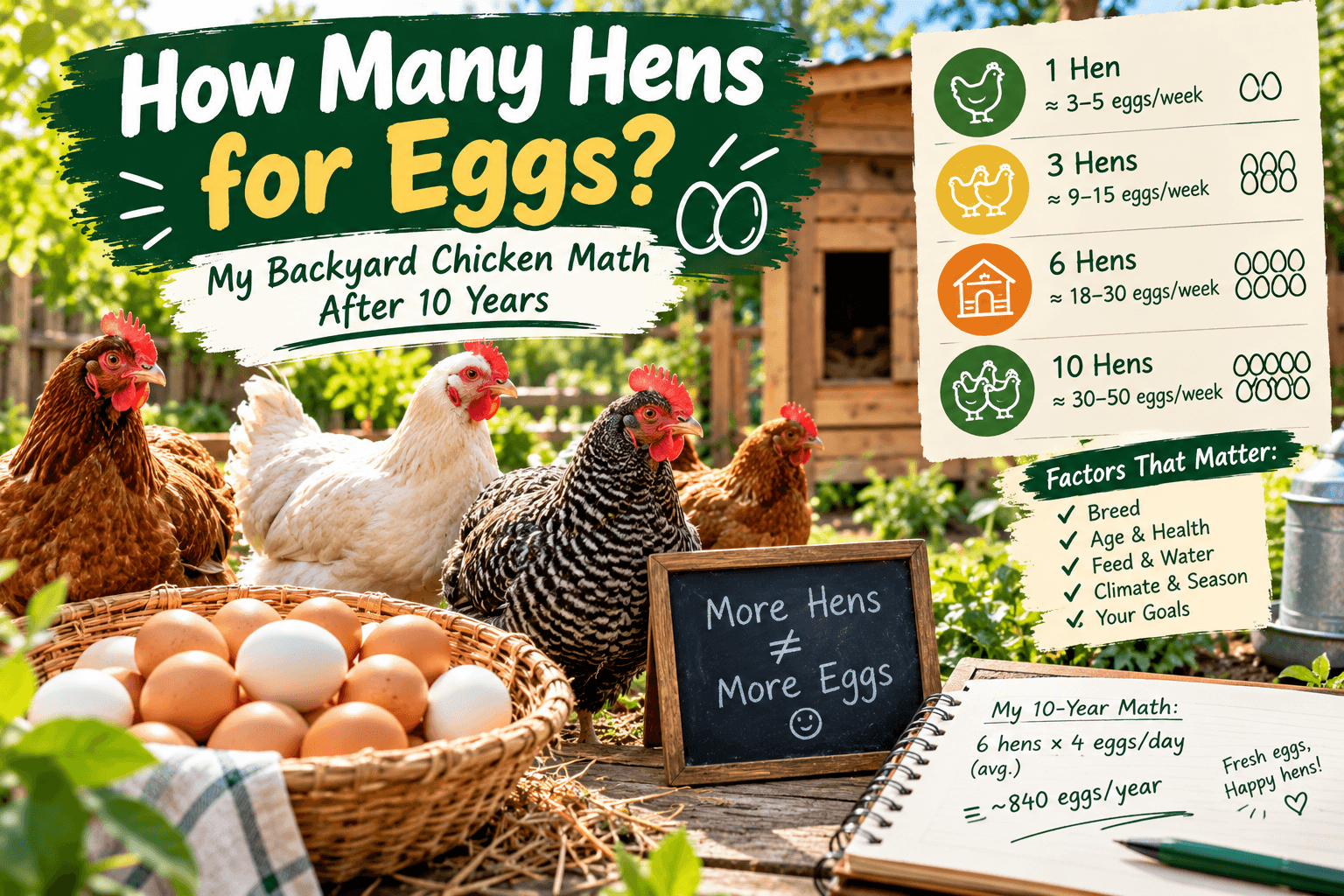
For most families, 3 to 6 hens is a very reasonable starting point.
Here’s how I’d look at it:
- 2–3 hens: Good for a small household with modest egg needs
- 4–6 hens: A great range for many families
- 6–10 hens: Better if you eat lots of eggs or want extras for friends
- 10+ hens: You’re getting into serious backyard egg production
A healthy laying hen can produce several eggs per week during her productive years, but she won’t lay an egg every single day forever.
That’s the part beginners sometimes forget.
I sure did.
I Thought More Hens Meant More Eggs
One spring, I got carried away.
I bought several young hens because they were cute.
That’s how it starts.
“You can never have too many chickens,” I told myself.
A few months later, I was standing in my kitchen staring at a basket full of eggs.
Then another basket.
Then another.
My wife asked, “What are we going to do with all these?”
Good question.
We gave some to neighbors, used plenty for cooking, and eventually I started planning meals around eggs.
That’s when I realized something important:
Don’t choose the number of hens based on how many eggs you can imagine eating. Choose it based on what you actually eat.
How Many Eggs Does a Hen Produce?
This depends heavily on the breed, age, health, diet, daylight, weather, and individual bird.
Some laying breeds are very productive, while others are better known for looks, personality, meat, or being good all-around backyard birds.
A productive hen might give you several eggs a week during her stronger laying periods.
But there will be slow periods.
Winter can change production.
Molting can change production.
Age changes production.
And sometimes a hen just decides she’s going to sit in the nesting box and stare at you.
Chickens have personalities.
Don’t let anybody tell you otherwise.
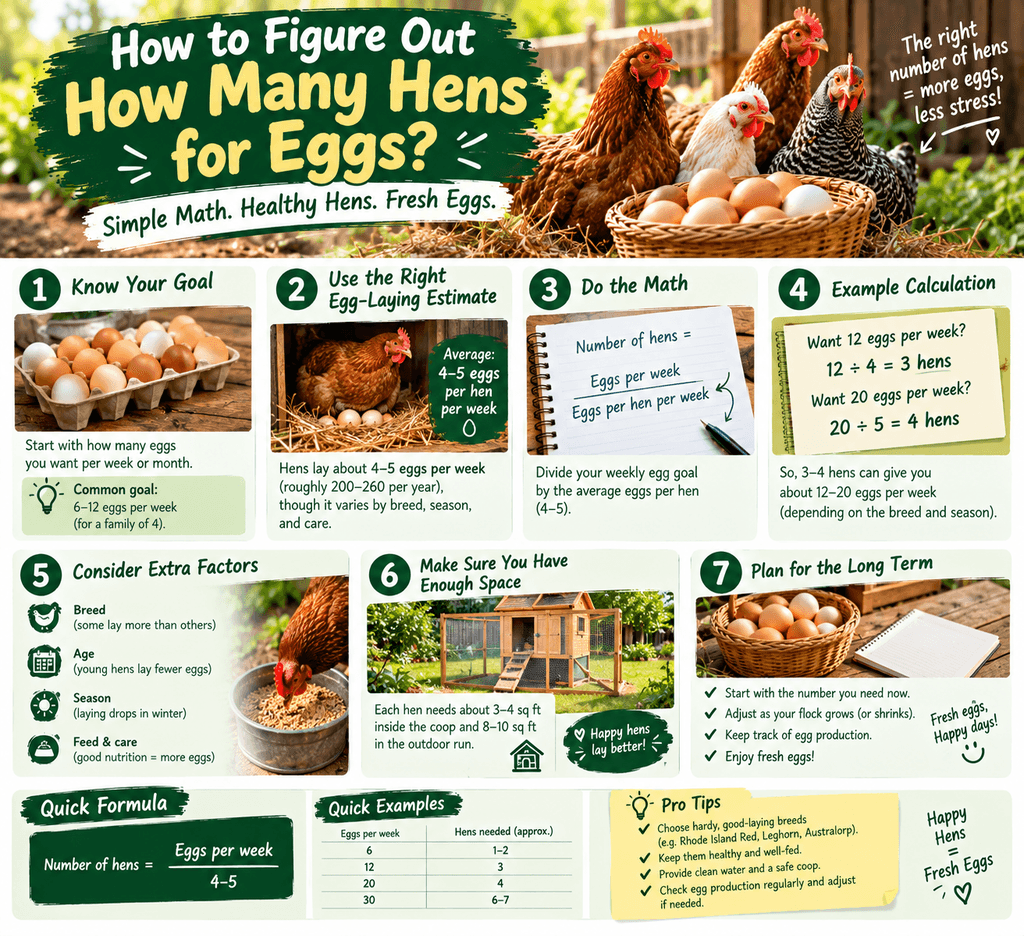
My Simple Rule: Count Eggs, Not Chickens
This is the easiest way I’ve found to figure out your flock size.
Look at how many eggs your household uses in a normal week.
Let’s say your family eats about 18 eggs per week.
If you have four good laying hens and they’re averaging around four eggs each per week during a productive period, you’re already around 16 eggs.
That’s pretty close.
But you don’t want to plan everything around the best possible production.
There will be weeks when you get fewer.
So having a little cushion is smart.
For a family eating around 18–24 eggs a week, I’d usually consider 4–6 hens a comfortable starting point.
Don’t Forget About Winter
This is where my early chicken math was terrible.
I thought:
“Six hens = six eggs every day.”
Nope.
Chicken production isn’t a vending machine.
Depending on breed and conditions, egg production can drop during shorter days and colder seasons.
Some hens may slow down considerably.
Others may continue laying reasonably well.
This is one reason I don’t recommend buying exactly the number of hens you need for your absolute minimum weekly egg supply.
Give yourself some breathing room.
If your family needs 18 eggs every week, don’t build a plan that only works when every hen is laying at maximum production.
That’s asking for trouble.
What About Three Hens?
Three hens can be a fantastic little backyard flock.
If you live in an urban area or have a smaller yard, this may be all you need.
You’ll still get fresh eggs without turning the backyard into a full chicken operation.
There is one thing I’d check first, though.
Local chicken rules.
Some cities limit the number of hens you can keep. Some require specific coop standards. Some have restrictions on roosters.
And honestly, check before buying chickens.
It’s a lot easier than finding out afterward that your neighborhood rules don’t allow the setup you just built.
What About Four to Six Hens?
This is my sweet spot for many backyard families.
Six hens can give you a nice supply of eggs while still being manageable.
You can use eggs for:
- Breakfast
- Baking
- Pancakes
- Homemade pasta
- Hard-boiled eggs
- Egg salad
- Breakfast casseroles
- Sharing with neighbors
- Some food preservation projects
And when production is high, you can put extra eggs aside for later use according to safe egg-storage practices.
This is where chickens become more than just pets.
They become part of the whole backyard system.
Chicken manure can contribute to composting when properly managed, kitchen scraps can sometimes supplement their diet when appropriate, and the finished compost can eventually help feed your garden.
That’s the homesteading part I really enjoy.
Do You Need a Rooster for Eggs?
No.
This question comes up constantly.
If your goal is simply fresh eggs, you don’t need a rooster.
Hens lay eggs without one.
A rooster is only needed if you want fertile eggs for hatching chicks.
And honestly, in an urban backyard, skipping the rooster can make life much easier.
Roosters can be loud.
Very loud.
And they don’t seem particularly interested in whether your neighbors are still sleeping at 5:00 in the morning.
If you’re keeping chickens mainly for eggs, hens alone are usually the simpler choice.
Choosing the Right Breed Matters
Not every chicken is going to produce eggs at the same rate.
When I choose birds for an egg-focused backyard flock, I look for breeds known for good laying ability, but I also think about temperament and climate.
You want chickens you actually enjoy keeping.
Some birds may be excellent layers but not the best fit for your situation.
For a beginner flock, I’d rather have friendly, healthy hens that fit my backyard than chase the absolute highest egg-production number.
Because you’re going to spend a lot of time with them.
And you’re going to name them.
Even if you swear you won’t.
My Biggest Chicken Mistake Was Ignoring Space
Here’s something I wish I’d paid more attention to earlier.
It’s not just about how many hens for eggs.
It’s about how many hens your space can comfortably support.
A crowded chicken coop can become dirty quickly.
The run gets worn down.
The ground turns to mud.
The birds compete more.
And cleaning becomes a bigger job.
Nobody tells you this part when you’re looking at cute baby chicks.
They show you fluffy little balls of feathers.
Then suddenly you’ve got adult chickens scratching through your garden beds.
I learned to plan the coop and outdoor space before adding birds.
Give them enough room to move, perch, dust-bathe, eat, drink, and get away from each other when they want to.
Your hens will be happier, and you’ll have less work.
What If You Want Eggs for a Big Family?
If you’ve got a large family that eats eggs every morning, your flock might need to be bigger.
For example, a household using several dozen eggs every week may find that 3 or 4 hens aren’t enough.
But I’d still start smaller if you’re completely new to chickens.
Why?
Because there are costs beyond buying the birds.
You’ve got:
- Chicken feed
- Bedding
- Coop construction
- Fencing
- Feeders
- Waterers
- Predator protection
- Cleaning
- Health care
- Time
And chickens are experts at turning a clean area into a dirty area.
Give them one afternoon.
You’ll see.
What I Feed My Hens Matters
A laying hen needs a balanced diet.
I don’t try to build their entire diet out of kitchen scraps.
That’s another mistake I see new chicken keepers make.
Kitchen scraps can be useful in moderation, but a proper commercial layer feed is a much more reliable foundation for laying hens.
Fresh clean water is also absolutely important.
And I make sure the birds have access to appropriate sources of calcium needed for eggshell production.
If eggshells suddenly become thin or production changes, don’t immediately assume the answer is “more food.”
Look at the whole situation: age, diet, stress, weather, daylight, health, and flock conditions.
What If You Get Too Many Eggs?
Congratulations.
You’ve entered the chicken owner’s club.
My favorite solution is simply to use more eggs in the kitchen.
Breakfast burritos are great.
So are frittatas, quiche, pancakes, cakes, muffins, and homemade noodles.
You can also share fresh eggs with family and neighbors where local rules allow it.
If you’re interested in selling eggs, check your local regulations first. Egg sales can be subject to specific food-safety and labeling requirements depending on where you live.
Don’t assume the rules are the same everywhere.
Should You Start With Baby Chicks or Adult Hens?
If your main goal is eggs soon, young laying-age birds can save you a lot of waiting.
Baby chicks are adorable, but they take time before they begin laying.
And they need a proper brooder setup and special care while they’re young.
I’ve raised chicks, and I enjoy it.
But if somebody tells me, “I just want fresh eggs for my family,” I don’t automatically tell them to buy 12 chicks.
I’d first figure out the number of eggs needed, check local rules, prepare the coop, then choose the flock size.
My Backyard Chicken Routine
Keeping a few hens doesn’t have to take your whole day.
My basic routine is pretty simple.
In the morning:
- Check the chickens
- Give them fresh water
- Make sure feed is available
- Open or check the coop/run setup
- Collect any eggs
Later in the day, I usually take another quick look.
That’s when I check for anything unusual.
Is one hen hiding?
Is somebody limping?
Is the water dirty?
Did a predator dig around the fence?
You don’t need to stare at chickens for hours.
But you do need to pay attention.
The more time you spend around them, the faster you’ll notice when something isn’t right.
Don’t Build a Flock Around Perfect Numbers
This might be my biggest piece of advice.
If you’ve searched how many hens for eggs, you’ve probably seen neat formulas saying exactly how many eggs you’ll get.
Use those numbers as rough planning tools.
Don’t treat them like guarantees.
Hens are living animals.
They age.
They molt.
They get stressed.
Weather changes.
Some are fantastic layers.
Some aren’t.
I’ve had hens that seemed to lay constantly, and I’ve had others that apparently considered egg production an optional hobby.
That’s chickens.
Frequently Asked Questions
How many hens do I need for a dozen eggs a week?
For many backyard keepers, 3–4 healthy laying hens may provide enough production to reach or exceed that amount during productive periods. Actual numbers vary by breed, age, season, and individual hen.
Is 6 hens too many for a backyard?
Not necessarily. Six hens can be a very manageable backyard flock if your local rules allow it and you have adequate coop and outdoor space. Always check your local regulations before getting chickens.
Do hens need a rooster to lay eggs?
No. Hens lay eggs without a rooster. You only need a rooster if you want fertile eggs for breeding and hatching chicks.
So, How Many Hens Would I Start With?
If I was starting over in a normal backyard and my main goal was fresh eggs for the family, I’d probably start with 4 to 6 hens.
That’s enough birds to give you a useful supply without going completely overboard.
If you live alone or have a very small household, three hens might be plenty.
If you’ve got a big family and eat eggs constantly, you may need more.
But don’t buy chickens just because you think you need a huge flock.
Start with what you can comfortably feed, house, clean up after, and care for.
That’s the real answer to how many hens for eggs.
And trust me, once you have your first little flock scratching around the backyard, you’ll probably discover something else: the eggs are great, but watching chickens do their ridiculous chicken things is half the fun.
Just don’t let them into your vegetable garden.
I learned that one the hard way.
Got chickens already, or are you thinking about starting a backyard flock? Tell me how many hens you have and how many eggs you usually get. I’d love to hear what’s working for you.