FARMSOLO • BACKYARD LANDSCAPING
A tree deck around a mature shade tree can turn an overlooked part of the yard into one of its most inviting places to sit. The safest version is not really a treehouse at all. It is a freestanding outdoor platform carefully designed around the tree, with its own supports, enough space for trunk growth, minimal disturbance to roots, and proper stairs and guards where required.
Best for: mature shade trees • woodland gardens • backyard seating • sloped yards • quiet reading spaces • natural garden retreats
Best Structural Idea
Support the platform independently on properly designed posts or another approved foundation system instead of depending on the living tree.
Protect the Tree First
Avoid unnecessary excavation, cut roots, compacted soil, trunk damage and materials piled over the root zone.
Quick Answer
A good tree deck should be designed as a deck that happens to surround a tree—not as a platform hanging from the tree. Check the tree’s health first, protect major roots during construction, keep structural supports independent of the trunk, leave a generous adjustable opening for future trunk growth and movement, and provide code-compliant stairs, guards and foundations for the finished platform.
Why Build a Deck Around a Tree?
A mature tree already gives the yard something that is difficult to build from scratch: height, character, shade and a natural focal point.
A small platform can use those qualities without turning the space into a full treehouse.
It can become a reading deck, a quiet morning coffee spot, a place to watch the garden, or simply a dry level sitting area in a part of the yard where grass struggles to grow under heavy shade.
But the tree is alive. Its trunk thickens, branches move, roots need oxygen and water, and the soil around it is part of the tree’s support system. The deck has to work around those realities.
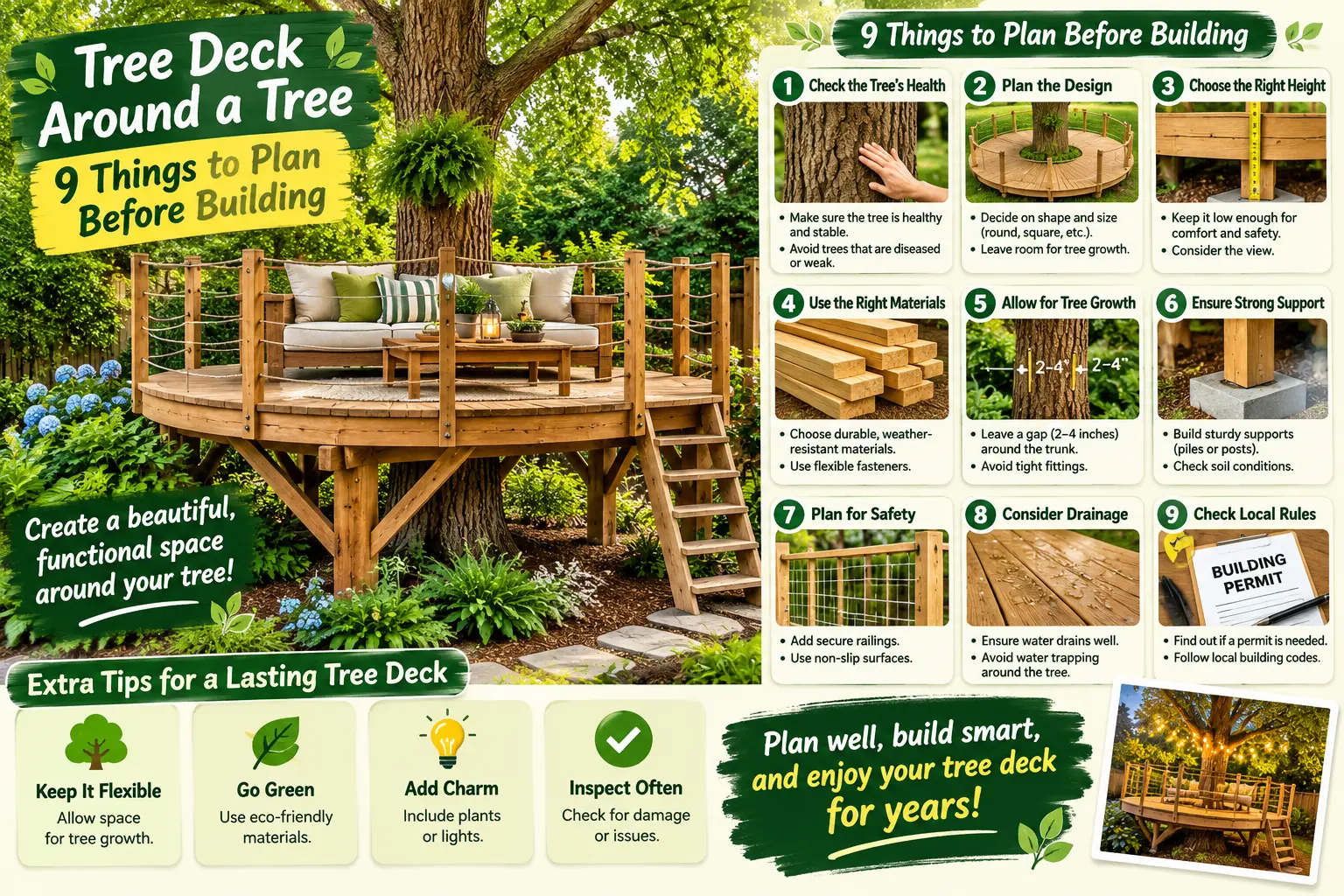
FarmSolo Reality Check: The inspiration photo is beautiful, but it should be treated as a garden-design idea rather than a construction plan. The hidden footings, beam sizes, joists, root locations, guard strength, stair geometry and tree clearances determine whether a similar platform is safe.
9 Things to Plan Before Building a Tree Deck
01 • TREE HEALTH
Make Sure the Tree Is Worth Building Around
Do this before buying lumber.
Look for major dead limbs, large cavities, severe decay, fungal fruiting bodies, cracks, recent leaning or other signs that the tree may need professional assessment.
A platform can last for years. It makes little sense to design the entire project around a tree that may need removal soon.
For a valuable mature tree, an ISA Certified Arborist can evaluate health and structural concerns before construction begins.
02 • INDEPENDENT STRUCTURE
Build the Deck Around the Tree, Not From the Tree
For this type of garden seating platform, a freestanding structure is usually the clearest concept.
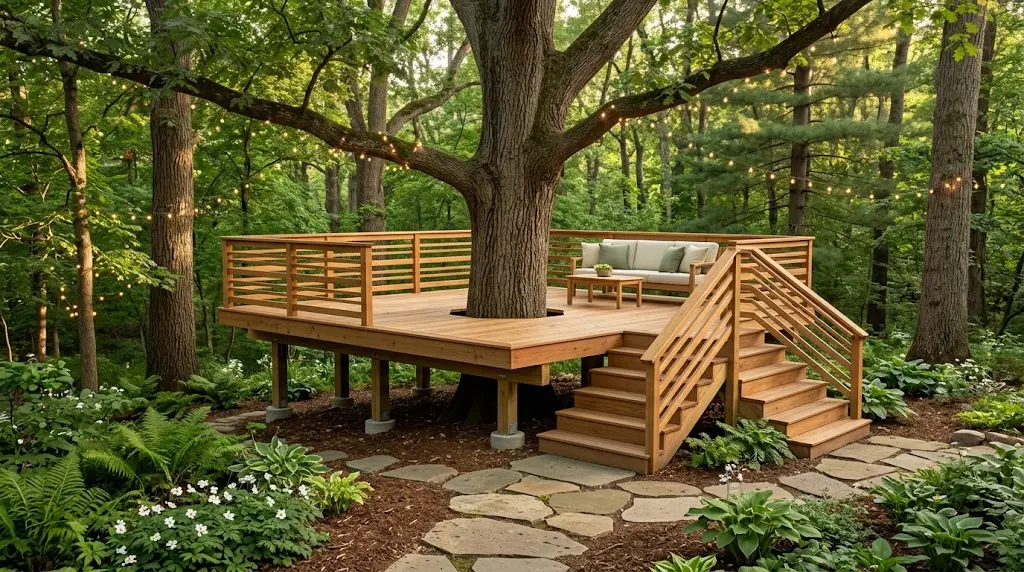
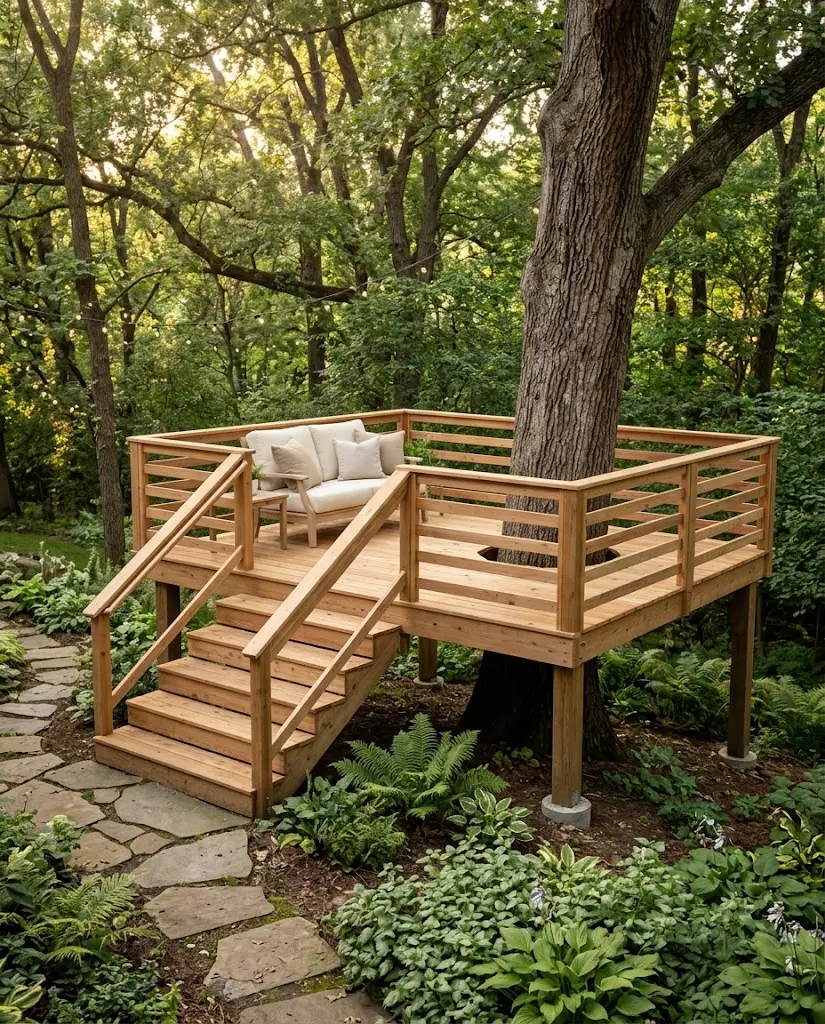
Posts, beams and joists carry the deck load independently. The trunk passes through an opening without becoming a deck post.
This also allows the tree and deck to move independently during wind and seasonal changes.
The actual framing and foundation sizes need to be appropriate for the platform dimensions, soil, loads, climate and local construction requirements.
03 • ROOT PROTECTION
Do Not Treat the Root Zone Like Empty Ground
One of the biggest risks may be below your feet rather than above your head.
Much of a tree’s important root system occupies relatively shallow soil and can extend well beyond the trunk.
Excavating several large footing holes, cutting major roots, driving equipment repeatedly over the area, stacking lumber on the soil or adding deep layers of fill can all damage the tree.
Plan post locations with the root system in mind instead of laying out a perfect geometric grid first and cutting through whatever roots appear.
04 • TRUNK CLEARANCE
Leave Space for the Trunk to Grow and Move
Do not cut the deck boards tightly against the bark.
Trees grow outward in diameter, and trunks also move in wind. A tight opening can eventually rub, trap moisture or begin pressing into the tree.
Plan framing with clearance around the trunk and make the visible decking opening large enough that it can be trimmed back later as the trunk expands.
Avoid rigid collars, tight bands or trim details that eventually become forgotten restraints around the tree.
05 • FOUNDATIONS
Plan Footings Around Roots, Soil and Frost Conditions
The photograph does not show what supports the platform below ground.
That hidden foundation is one of the most important parts of the project.
Post spacing and footing type depend on the platform design, soil bearing conditions, frost depth where applicable, local code and structural loads.
Near a valuable mature tree, the ideal footing layout may also need to shift to avoid important roots. This is another reason not to copy post locations from a photograph.
06 • GUARDS & STAIRS
Treat an Elevated Platform Like an Elevated Platform
The rope railing in the inspiration photo creates a beautiful woodland look, but decorative rope should not automatically be assumed to satisfy guard requirements.
For reference, the model International Residential Code requires guards on many open walking surfaces more than 30 inches above the grade below and includes requirements for guard height and openings. Local rules may be different, so check the code adopted where the project will be built.
Stairs deserve the same care. Use consistent risers and treads, a stable landing and required handrails rather than treating access as a simple removable ladder leaning against the platform.
Safety note: Do not copy the low rope barrier or steep ladder in an inspiration image without checking your actual platform height and local requirements. A decorative rail and a structural fall-protection guard are not necessarily the same thing.
07 • DECK SURFACE
Choose a Surface That Works in Shade
A deck under a large tree may stay damp longer than a deck sitting in full sun.
Leaves, pollen, seeds and organic debris can also collect between boards and around the trunk opening.
Choose an exterior decking system suited to your climate and maintain the surface so algae, decaying leaves and moisture do not turn the platform into a slippery sitting area.
Board spacing should follow the decking manufacturer’s installation requirements rather than being guessed for appearance.
08 • WATER & AIR
Do Not Seal the Root Zone Under a Solid Floor
A raised deck has one advantage over filling the entire area with concrete: the soil beneath can remain largely open.
Preserve airflow, drainage and rainfall access to the root area where practical.
Do not pile soil, gravel or construction waste around the trunk simply to hide the underside of the platform.
Keep the root flare at the base of the tree visible rather than burying it under new fill or decorative material.
09 • LONG-TERM MAINTENANCE
Design the Deck So It Can Change With the Tree
This is not a build-it-and-forget-it feature.
Inspect the trunk opening periodically. Trim the deck opening larger before boards or framing begin rubbing against the tree.
Check guards, steps, fasteners, wood decay and structural movement. Remove accumulated leaves around the trunk and under accessible areas of the platform.
Also continue looking at the tree itself. New dead limbs, cavities or structural changes above a seating area deserve attention.
What the Pinterest Tree Deck Gets Right
| Idea in the photo | FarmSolo take |
|---|---|
| Tree as the focal point | Excellent. The platform celebrates an existing mature tree instead of hiding it. |
| Platform raised above the garden | Useful on uneven ground and can leave more of the soil surface undisturbed than a solid patio. |
| Open woodland setting | Beautiful for shade-loving planting, but fallen leaves and damp decking need maintenance. |
| Comfortable outdoor sofa | Great design idea. Use exterior-rated furniture and keep the deck’s structural load in mind. |
| Rope railing | Attractive, but do not assume decorative rope meets required guard strength, height or opening limits. |
| Narrow ladder-style stairs | Visually light, but permanent elevated decks generally deserve properly planned stair access. |
| String lights in the tree | Can add atmosphere when exterior-rated products are installed without tight wires or hardware that girdle the trunk or branches. |
Should the Deck Touch the Tree?
For a freestanding garden deck, the goal is normally to avoid making the tree part of the structural system.
Leave enough space that normal trunk movement does not cause constant rubbing between bark and decking.
Do not pack the gap with rigid foam, mortar or trim fixed tightly around the trunk. Anything placed around a living trunk needs to account for continued diameter growth.
What Can You Plant Under a Tree Deck?
The inspiration photo uses ferns and broad-leaved shade plants to make the deck feel like part of the woodland garden.
That can work beautifully, but conditions below a raised platform can be difficult. Light may be limited and rainfall may not reach every area evenly.
Instead of digging aggressively through tree roots to create new planting holes, work with existing planting where possible and choose shade-tolerant plants appropriate to your climate and soil.
Do not raise the soil level around the tree simply to make a deeper flower bed.
Low Tree Deck or Elevated Tree Deck?
| Design | Best feature | Main planning issue |
|---|---|---|
| Low platform | Easy access and strong connection to garden paths | Ventilation, moisture and root disturbance |
| Moderately raised deck | Level sitting area on sloped or uneven ground | Foundation, stairs and guards |
| High platform | Treehouse-like view | Much greater structural and fall-protection requirements |
| Partial deck beside tree | Less framing around the trunk | Still requires protection of roots during construction |
| Full wraparound platform | Strong visual focal point | More framing complexity and future trunk clearance |
Common Tree Deck Mistakes
- Assuming a large tree is automatically healthy. Size alone does not tell you whether the tree is structurally sound.
- Making the tree carry the deck. A simple garden seating platform can usually be designed as an independent structure.
- Digging through major roots to keep posts perfectly symmetrical. Root protection should influence the layout.
- Compacting the soil with machinery. Construction traffic can damage the root environment even when no roots are visibly cut.
- Cutting decking tightly around the bark. The trunk will continue growing.
- Using decorative rope as the only fall barrier without checking requirements. Elevated surfaces may require structural guards.
- Using a steep loose ladder for permanent access. Plan safe access as part of the deck, not as an afterthought.
- Burying the root flare in soil or gravel. Keep the base of the trunk clear.
- Ignoring wet leaves. Shade and organic debris can make decking slippery and hold moisture.
- Never checking the tree again. Both the platform and the living tree change with time.
More FarmSolo outdoor-space ideas: If you prefer a ground-level seating space, see Cinder Block Outdoor Seating: 9 Built-In Patio Ideas. For overhead shade away from the tree canopy, explore Pergola Ideas for Your Backyard.
Tree Deck Around a Tree FAQ
Can you build a deck around a mature tree?
Yes, but the design should protect the tree’s trunk and root zone. A freestanding deck with independent supports and an adjustable opening around the trunk is often more appropriate than treating the tree as part of the deck structure.
Should a deck be attached directly to the tree?
For the type of backyard seating platform shown here, keeping the deck structurally independent from the tree simplifies future trunk growth, movement and maintenance. True treehouses use different specialized attachment and structural design methods.
How much space should you leave around the tree trunk?
There is no single clearance that fits every tree and project. Allow for current trunk size, future diameter growth and normal movement in wind. The framing normally needs more clearance than the visible finish boards, and the opening should be easy to enlarge later.
Can deck footings damage tree roots?
They can. Excavation can cut roots, while machinery and repeated foot traffic can compact root-zone soil. Plan footing locations carefully and consider professional arborist input around valuable mature trees.
Does a tree deck need a railing?
It depends on the finished height and rules adopted by your jurisdiction. As an example, the model residential code generally requires guards when certain open walking surfaces are more than 30 inches above grade. Always verify local requirements before construction.
Can I use rope for a tree deck railing?
Rope can be decorative, but do not assume a flexible rope system meets structural guard requirements. If a guard is required, use a system designed and installed to meet the applicable load, height and opening requirements.
Does a small freestanding deck need a permit?
Permit rules vary by location, platform height, size and use. Some jurisdictions exempt certain very small low freestanding decks, while elevated platforms may require permits and inspections. Check with your local building department before digging footings.
Build a Retreat Around the Tree, Not at the Tree’s Expense
The best part of this idea is not the circular deck or the outdoor sofa. It is the way the tree remains the center of the garden.
Protect the roots, keep the structure independent, leave room for the trunk to grow, build safe access and use a real guard system when the platform height requires one.
Done thoughtfully, a simple tree deck can feel like a woodland room without turning the living tree into a structural experiment.