FARMSOLO • BACKYARD FARMING
Dish pan nesting boxes are one of those chicken-keeping ideas that look almost too simple to work. Put a sturdy plastic pan in a secure shelf or cubby, add clean bedding, and you have a removable nest that is much easier to clean than a permanently built wooden floor. The idea can work very well, but size, privacy, stability, bedding, and placement still matter if you want clean eggs and hens that actually use the nests.
Best for: backyard hens • small coops • easy cleaning • removable nest inserts • budget-friendly chicken setups
Why Plastic Works
The entire pan can be pulled out, emptied, washed, dried, refilled, and returned without scraping bedding from a fixed wooden box.
You Need Fewer Than You Think
A common Extension recommendation is roughly one nesting box for every four to five hens. Chickens often share a favorite nest anyway.
Quick Answer
Yes, sturdy plastic dish pans can make practical chicken nesting box inserts. For most standard hens, choose a pan that gives roughly 12 inches or more of usable space, place it securely inside a private nest area, add a few inches of clean dry bedding, and provide about one nest for every four to five hens. The pan should slide out for cleaning but should not slide or tip when a hen steps inside.
Why Dish Pans Make Surprisingly Good Nest Box Inserts
A chicken does not care whether her nest came from a farm store or the housewares aisle.
She cares about whether the place feels safe, dry, comfortable, and private enough to lay an egg.
That is why a plastic pan can work well as the removable floor and sides of a nesting space. The surrounding wooden rack or cubby gives the nest structure and privacy, while the plastic pan holds the bedding and catches most of the mess.
When bedding becomes dirty, you can lift the entire pan out instead of reaching into a fixed wooden compartment and scraping the corners.
FarmSolo Tip: Think of the dish pan as a removable nest insert, not the entire nesting system. A good setup still needs a stable shelf, privacy, safe access, dry bedding, and protection from the weather.
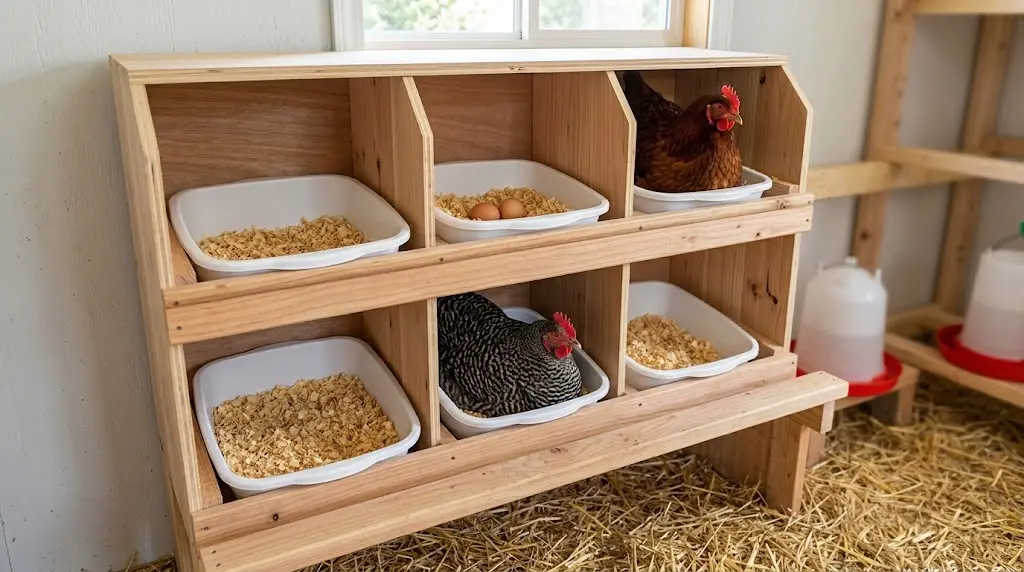
9 Tips for Better Dish Pan Nesting Boxes
01 • SIZE
Choose a Pan That Fits the Hen
For standard backyard hens, a nest with roughly 12 to 15 inches of usable width and height and at least about 12 inches of depth is a common starting range.
A small dish pan around 12 inches square can work well as an insert for many standard hens, but large breeds may need more room.
The hen should be able to step in, turn around, settle comfortably, and leave without getting wedged against the sides.
02 • NUMBER OF NESTS
Do Not Build One Pan for Every Hen
This is the first thing I would change from the Pinterest image if you keep a small backyard flock.
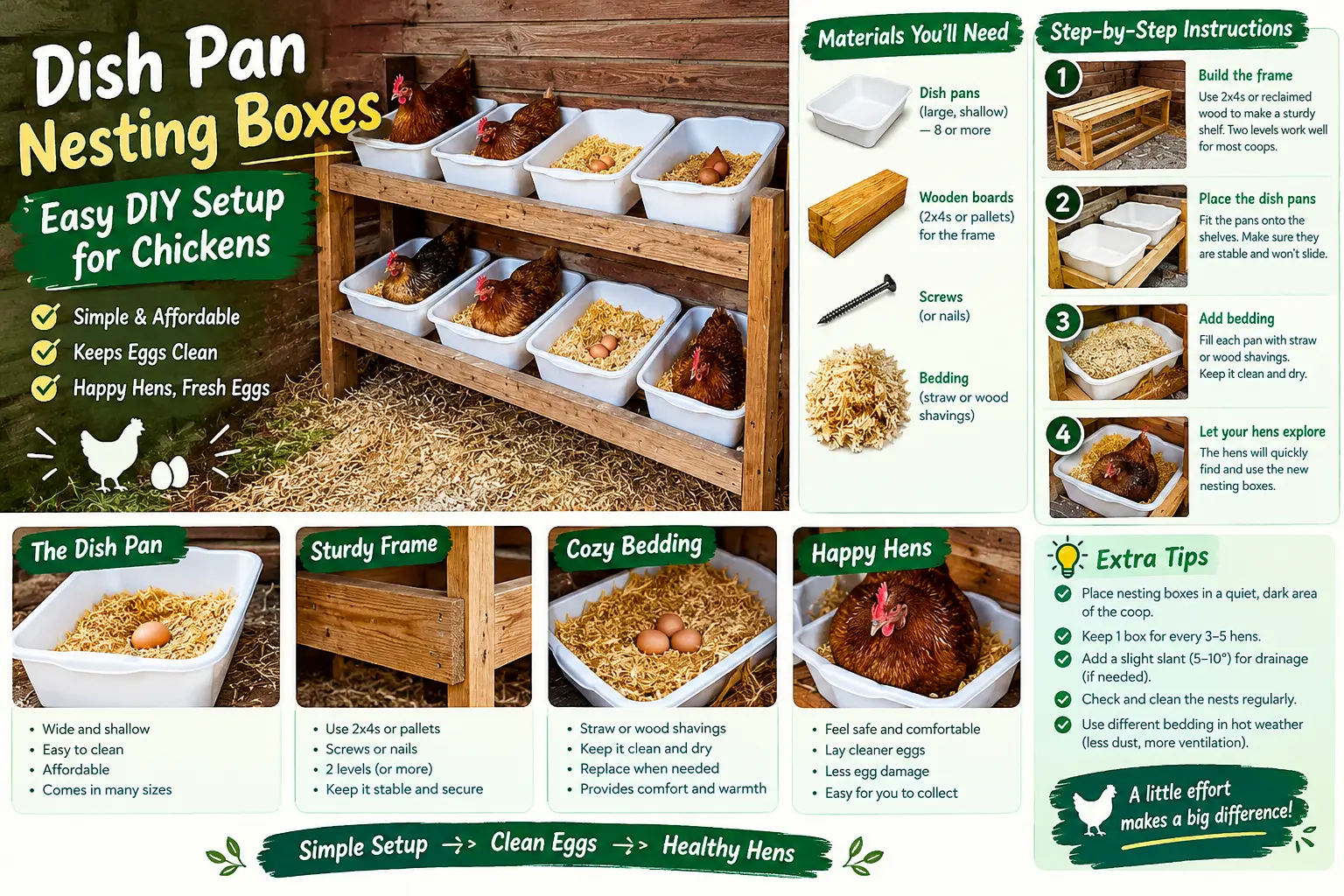
The photo shows eight dish pans. Using the common recommendation of one nest for every four to five hens, eight nests could serve a much larger flock than the few chickens shown in the picture.
Six hens, for example, will generally not need six separate boxes. Two comfortable nests may be plenty.
And even if you provide several choices, do not be surprised when half the flock waits for the exact same favorite nest.
03 • STABILITY
Make the Pan Removable Without Letting It Slide
The best part of a dish pan is that you can pull it out.
The worst version is a lightweight pan that moves every time a hen lands on the edge.
Build the shelf so each pan sits securely between side stops, shallow cleats, or another simple restraint. You should still be able to lift or slide the pan out for cleaning without tools.
Also check the plastic for cracks, sharp edges, or damaged handles that could catch a bird’s foot.
04 • PRIVACY
Make the Nest Feel More Private Than the Photo
Hens naturally look for a protected place when they are ready to lay.
The open shelving in the inspiration image makes the cleaning idea easy to understand, but I would give each pan more visual separation.
Wood dividers between pans, a solid back, and a partial top or front curtain can create a darker, calmer nesting area without making cleaning difficult.
05 • BEDDING
Add Enough Clean Bedding to Cushion the Egg
Do not leave the hen sitting directly on hard, slippery plastic.
Add roughly two to three inches of clean, dry nesting material such as suitable pine shavings or straw.
The bedding gives the hen something comfortable to settle into and helps cushion eggs against the bottom of the pan.
Replace damp or heavily soiled bedding promptly instead of simply adding clean material over a dirty layer.
06 • PLACEMENT
Keep Nest Boxes Separate From the Roosting Area
Nest boxes are for laying eggs. Roosts are for sleeping.
If the nests become the most attractive sleeping place, hens may spend the night inside them and quickly make the bedding dirty.
Keep proper roosts available and position the nesting area separately. Nest height recommendations vary somewhat among Extension guides, but raised boxes around 18 to 24 inches above the floor are common for standard setups.
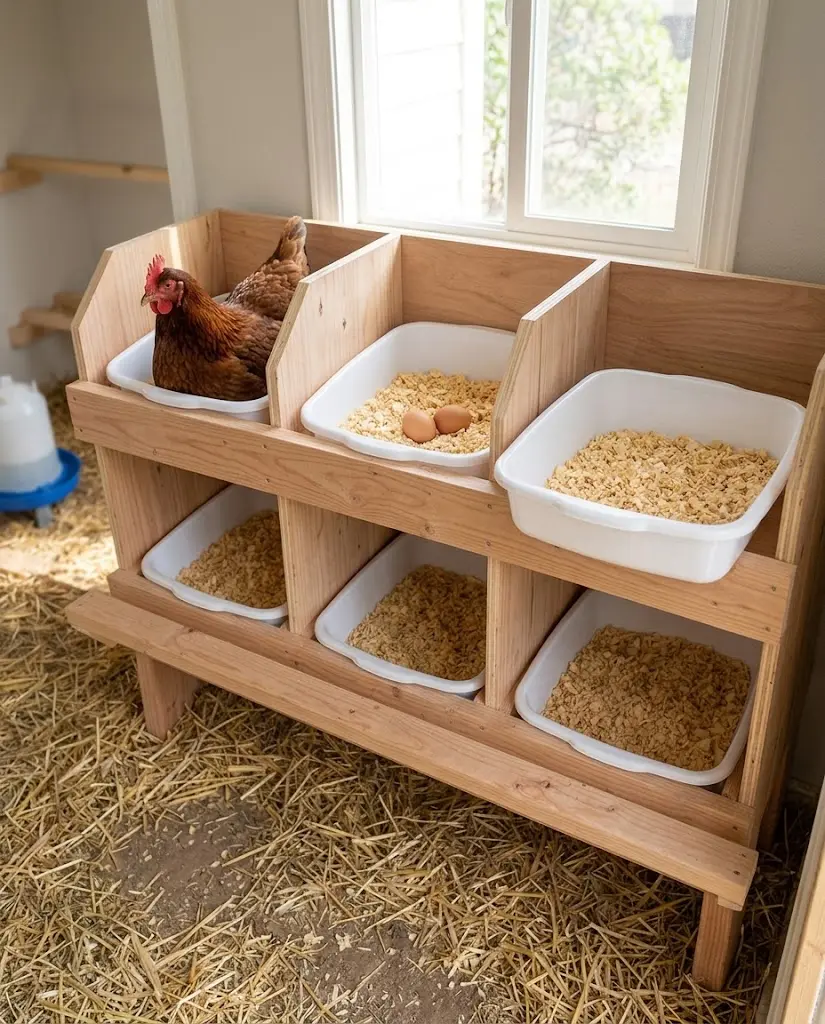
If you build a two-level rack like the photo, make sure hens can safely reach the upper level and that droppings from birds above cannot fall into nests below.
07 • CLEANING
Use the Biggest Advantage: Pull, Clean, Dry, Refill
This is where the dish pan idea really earns its place in the coop.
- Remove eggs.
- Pull out the pan.
- Dump the old bedding.
- Wash the pan when needed.
- Allow it to dry completely.
- Add fresh dry bedding.
- Return it securely to the rack.
Plastic is easier to wash thoroughly than unfinished wooden corners, especially after a broken egg or heavily soiled nest.
08 • TRAINING
Help Young Hens Understand Where to Lay
It is easier to establish good nesting habits before pullets start leaving eggs around the coop floor.
Have the nesting area ready before your young hens begin laying.
A clean fake egg or other purpose-made nest egg placed in the box can sometimes encourage hens to investigate the nest because chickens naturally notice places where eggs already appear to be present.
09 • WATCH THE HENS
Let Chicken Behavior Tell You What Needs Changing
Your hens will give you a pretty clear review of the design.
If they consistently lay on the floor instead, ask whether the pans are too exposed, hard to reach, unstable, dirty, or uncomfortable.
If hens sleep in the pans overnight, look at your roost placement and nesting-box height rather than assuming you need more nests.
If one pan gets used constantly while several stay empty, that is also normal. Hens are famous for agreeing that one box is clearly better than every identical box beside it.
What the Pinterest Dish Pan Setup Gets Right
| Idea in the photo | FarmSolo take |
|---|---|
| Removable plastic pans | Excellent idea for faster cleaning and easier sanitation. |
| Bedding inside every pan | Important for comfort and cushioning eggs against the plastic floor. |
| Wooden rack | Useful, but pans should be secured so they cannot tip or slide. |
| Two-level design | Can save coop space, but access and droppings between levels need to be considered. |
| Eight nest pans | Probably more than a small flock needs. Plan roughly one nest per four to five hens. |
| Very open nests | Easy to clean, but adding dividers or more enclosure may give hens better privacy. |
Simple Setup Formula
Sturdy shelf → private cubby → removable dish pan → dry bedding → safe access → easy cleaning.
The plastic pan handles the mess. The surrounding coop structure handles stability, privacy, and protection.
Dish Pan Nesting Boxes vs. Wooden Nesting Boxes
| Feature | Dish pan insert | Fixed wooden nest |
|---|---|---|
| Cleaning | Pan can be removed and washed | Usually cleaned in place |
| Sanitation | Smooth plastic is easy to scrub thoroughly | Rough wood and corners can hold debris |
| Privacy | Needs a surrounding cubby or divider | Can be built directly into the design |
| Replacement | Easy to replace a damaged pan | Repair may require carpentry |
| Stability | Must be secured against sliding or tipping | Usually fixed to the coop |
| Customization | Limited by available pan sizes | Can be built to almost any dimensions |
How Many Dish Pan Nests Do You Need?
For most backyard flocks, start with roughly one nest for every four to five laying hens.
| Number of hens | Practical starting number of nests |
|---|---|
| 3–4 hens | 1 nest |
| 5–8 hens | 2 nests |
| 9–12 hens | 3 nests |
| 13–16 hens | 4 nests |
| 17–20 hens | 4–5 nests |
You can provide an extra box if your flock has larger birds or strong competition around favorite nests, but doubling the number of boxes usually does not convince chickens to divide themselves evenly.
Can You Use Any Plastic Container?
Not every plastic tub in the garage belongs in a chicken coop.
Use a clean, sturdy container with a known history. Avoid containers that previously held hazardous chemicals, pesticides, fuels, strong cleaners, or other substances you would not want around hens and eggs.
Look for smooth edges and enough rigidity that the sides do not collapse or fold when a hen steps onto the rim.
What Bedding Should Go in a Dish Pan Nest?
Clean dry pine shavings and straw are common nesting materials.
Whatever you choose, the goal is the same: provide a dry cushion that stays underneath the egg instead of being kicked onto the coop floor.
One advantage of a dish pan is that its molded sides naturally help contain loose bedding.
Common Dish Pan Nesting Box Mistakes
- Buying one pan for every hen. Most flocks need far fewer nesting spaces.
- Leaving the pans loose on a shelf. Keep them removable but prevent tipping and sliding.
- Using pans that are too small. The hen needs enough room to enter, turn, and settle.
- Leaving bare plastic underneath the eggs. Use clean, dry cushioning bedding.
- Making the nests too exposed. Hens usually appreciate a quieter, more private laying area.
- Putting nests where hens want to sleep. Provide suitable roosts separately.
- Returning a wet pan after washing. Let the nest dry before adding fresh bedding.
- Ignoring the lower tier of a two-story rack. Design the upper level so dirt and droppings cannot fall into nests below.
- Using mystery containers. Avoid reused tubs with an unknown or hazardous previous use.
Building the rest of the coop? See FarmSolo’s DIY Chicken Coop From an Old Bed Frame for another low-cost coop idea. If you are keeping only a few hens in limited space, the Small Urban Backyard Chicken guide covers how nesting areas, roosts, cleaning, and space fit together.
Dish Pan Nesting Box FAQ
Can a dish pan really be used as a chicken nesting box?
Yes. A sturdy dish pan can work well as a removable nesting-box insert when it is appropriately sized, held securely, lined with clean bedding, and placed inside a private, protected nesting area.
What size dish pan works for chickens?
Around 12 inches square or larger is a practical starting point for many standard-size hens. Larger breeds may need more space, so judge the pan by the actual size of your birds rather than the label on the container.
How many nesting boxes do six chickens need?
Two nests are a practical starting point for six hens when using the common recommendation of about one nesting box for every four to five birds.
Is plastic better than wood for a nesting box?
Plastic is particularly useful as a removable insert because it is smooth and easy to wash. Wood is still useful for the surrounding rack, dividers, roof, and structural parts that create privacy and keep the pan stable.
How much bedding should be in the nest?
About two to three inches of clean, dry shavings or other appropriate nesting material is a useful starting point. Keep enough bedding in the pan to cushion eggs and replace it when it becomes dirty or damp.
Why are my hens ignoring the dish pan nests?
Check privacy, stability, cleanliness, accessibility, bedding, and location. Hens may ignore an exposed or unstable nest even when its physical size looks correct.
Can I wash plastic nesting boxes?
Yes. Removable plastic is useful because it can be emptied and washed when needed. Let the pan dry completely before adding fresh dry bedding and returning it to the coop.
Sometimes the Simplest Nest Is the Easiest to Live With
You do not need an expensive commercial nesting system to give backyard hens a clean place to lay.
A sturdy dish pan inside a well-planned wooden cubby can be simple, removable, comfortable, and much easier to clean than a fixed wooden floor.
Use the pan for easy cleaning. Use the coop design for privacy, stability, protection, and safe access. Get those two parts right, and the hens can take it from there.