FARMSOLO • BACKYARD LANDSCAPING
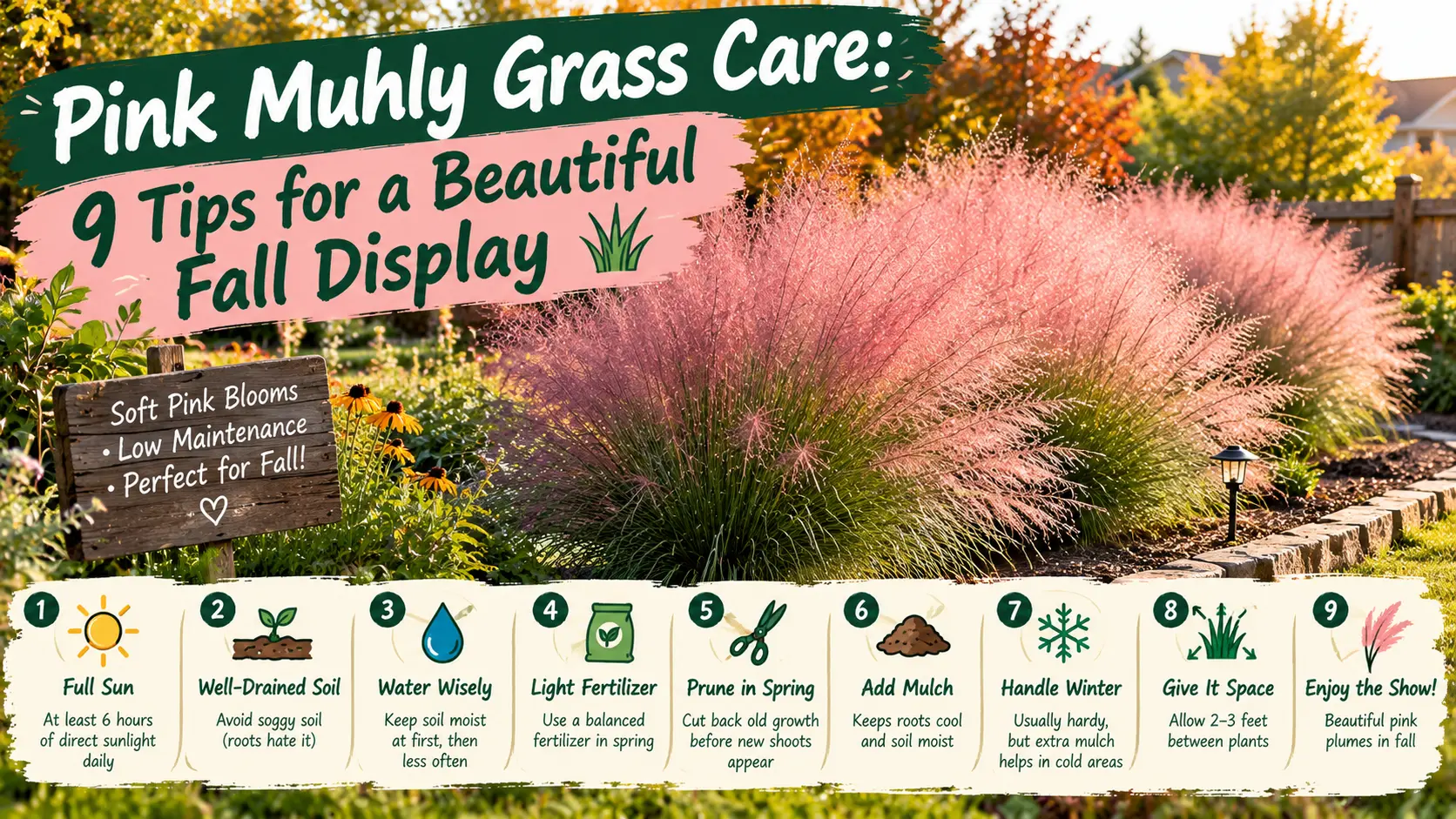
Pink muhly grass can turn an ordinary garden edge into a soft cloud of pink when fall arrives. The plant itself is surprisingly simple: give it plenty of sun, enough room to form a mature clump, sensible watering while it establishes, and avoid burying it in an overcrowded bed. Most of the dramatic look comes from good placement rather than complicated maintenance.
Best for: sunny borders • curved walkways • mass plantings • low-maintenance landscapes • fall garden color
Best Flowering
Give pink muhly grass full sun when possible. More light generally produces a stronger, fuller fall flower display.
Think Bigger Than 2 Feet
A mature clump is often around 3–4 feet tall and wide, especially when the airy flower plumes rise above the foliage.
Quick Answer
Pink muhly grass is a clumping perennial ornamental grass known for airy pink-to-purple flower plumes in fall. Plant it in a sunny location with reasonably well-drained soil, water new plants while they establish, and give each clump enough room to mature. Once established, it is highly drought tolerant and generally needs little routine care.
What Is Pink Muhly Grass?
Pink muhly grass, Muhlenbergia capillaris, is a warm-season perennial grass native to parts of eastern and central North America.
For much of the growing season, it looks like a neat clump of fine green foliage. Then fall changes everything.
Tiny flowers appear on delicate branching stems above the foliage. From a distance, those flowers blend together into the soft pink haze that makes the plant so recognizable.
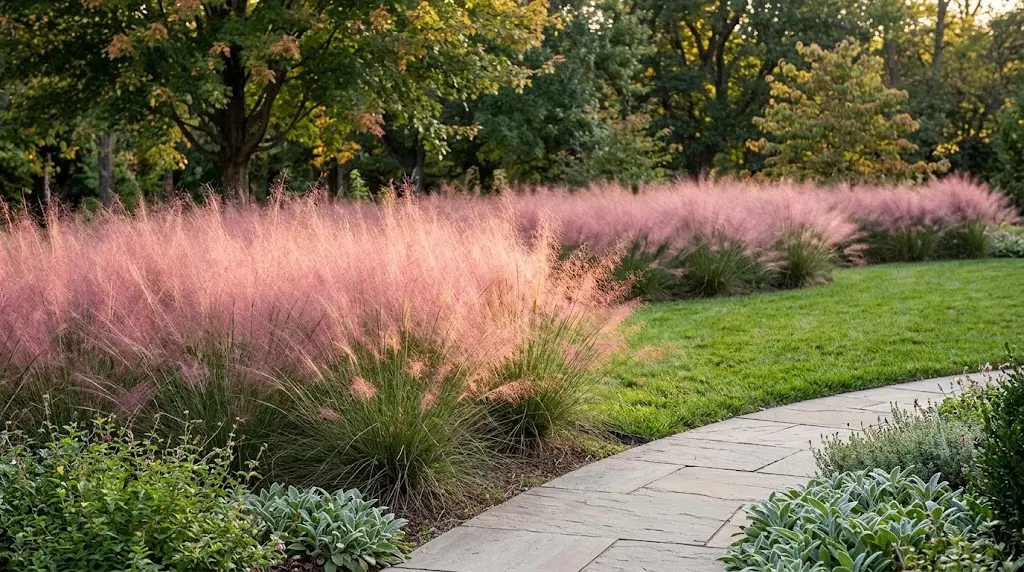
One plant can be attractive, but several repeated together create the drifting pink effect you see in large public gardens and landscape photos.
About the Pinterest claim: Pink muhly is drought tolerant, but “drought proof” is too strong. Newly planted grasses still need regular moisture while their roots establish.
9 Pink Muhly Grass Care Tips
01 • SUNLIGHT
Give It Plenty of Sun
If the pink flower display is your main reason for planting muhly grass, start with sunlight.
Full sun generally gives the plant its strongest growth and most impressive flowering. A location receiving about six or more hours of direct sun is a good target when your yard allows it.
Some partial shade can be tolerated, but a shaded plant may not create the dense pink cloud you expected from the inspiration photo.
02 • SOIL
Do Not Overcomplicate the Soil
Pink muhly grass is surprisingly adaptable.
It can grow in sandy, rocky, loamy, and clay soils. The bigger priority for most home landscapes is avoiding a poorly prepared site where water consistently sits around the crown.
The Pinterest phrase “hates wet feet” is too absolute. Pink muhly is more moisture-tolerant than that phrase suggests, but a reasonably draining planting site remains a simple and reliable choice for a garden border.
03 • SPACING
Give Each Clump Room to Become a Fountain
Do not judge spacing by the size of a small nursery pot.
A mature pink muhly clump can become roughly 3 feet wide, and some plants grow larger. Around 24–36 inches between plants is a useful starting range for many mass plantings.
Closer spacing creates a more continuous ribbon sooner. Wider spacing lets each individual fountain shape remain easier to see.
04 • WATER
Water New Plants Before Expecting Drought Tolerance
Established pink muhly grass is impressively drought tolerant, but the roots need time to establish first.
Water after planting and keep an eye on soil moisture during the establishment period, especially during hot or dry weather.
Once the plant is well rooted, you can usually reduce supplemental watering substantially compared with many thirsty ornamental plants.
05 • FLOWERING
Expect the Main Show in Fall
Pink muhly is not a plant you choose for nonstop flowers from spring through summer.
Its strength is late-season drama. In many areas, the airy pink flower heads are most noticeable around September and October, although exact timing shifts with climate.
After the pink color fades, the seed heads turn tan and can continue adding texture into winter.
06 • PRUNING
Wait Until Late Winter or Early Spring to Cut It Back
You do not have to remove the plant as soon as the pink flowers disappear.
The tan seed heads can look attractive through winter, especially when frost or low winter light catches them.
If the old foliage becomes messy, cut it back in late winter or early spring before strong new growth begins.
You are cleaning up last season’s growth, not repeatedly shearing the plant into a tight ball during summer.
07 • FERTILIZER
Do Not Feed It Like a Hungry Vegetable Bed
Pink muhly grass is valued partly because it performs in relatively lean soils.
That means routine heavy fertilizing is usually unnecessary.
If your landscape already grows healthy plants and a soil test does not identify a deficiency, avoid turning fertilizer into a habit just because you want more pink flowers.
08 • GROUPING
Plant Several Together for the Pink-Fog Effect
A single muhly grass plant can look elegant beside a rock or at the corner of a bed.
But the large pink landscapes in the inspiration image work because the grass is repeated again and again.
For a home garden, you do not need hundreds of plants. A group of three, five, or seven can already create a stronger visual rhythm than one isolated clump.
09 • PLACEMENT
Put It Where Low Sun Can Shine Through the Plumes
This is less about plant survival and more about making the garden look better.
The fine pink flowers become especially dramatic when early-morning or late-afternoon light shines through them.
Before planting a long border, spend a few days watching where lower-angle light falls across your yard in autumn.
What the Pinterest Graphic Gets Right — and Wrong
| Pinterest claim | Better guidance |
|---|---|
| Pink fog blooms Sept–Oct | Generally accurate. Pink muhly is known for its fall flower display, with timing varying somewhat by climate. |
| Full sun for best color | Good advice. Full sun generally gives the strongest flowering display. |
| Drought proof | Too absolute. It is highly drought tolerant after establishment, but new plants still need water. |
| Hates wet feet | Too simple. It is adaptable to a wider moisture range than this suggests, although a well-drained landscape site is a dependable choice. |
| 2–3 ft tall | Possible for foliage, but mature plants and flowering stems can commonly reach around 3–4 feet or more depending on conditions. |
| Prune in late winter | Good advice. Old foliage can be cut back in late winter or early spring before new growth becomes active. |
The Easiest Landscape Formula
Sunny site → repeated clumps → simple low companions → open view of the plumes.
You do not need a complicated flower border around every plant. The muhly itself should be allowed to create the main fall effect.
7 Ways to Use Pink Muhly Grass in a Landscape
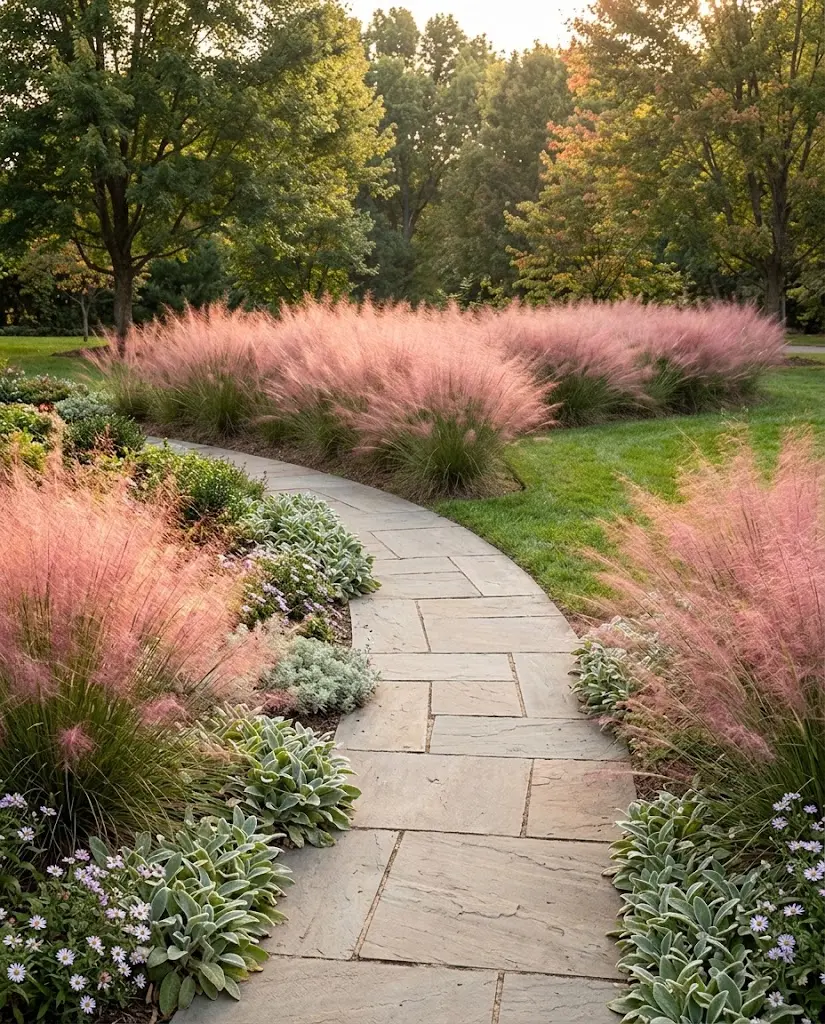
1. Curved Walkway
Repeat muhly grass along a curved path so the pink plumes soften the hard edge without hiding the route.
2. Lawn Edge
A long ribbon between lawn and planting bed creates a clean transition while adding movement.
3. Large Drift
Use several plants in an irregular mass instead of a perfectly straight row for a softer naturalistic effect.
4. Front-Yard Accent
A few repeated clumps can give a sunny front yard seasonal color without relying on annual flowers.
5. Around Trees
Use it near trees only where the grass still receives enough sun and does not compete with heavy surface roots.
6. Modern Border
Pair repeated clumps with simple stone, concrete, gravel, or clean paving for a modern landscape with soft movement.
7. Mixed Fall Border
Combine muhly grass with plants that offer contrasting leaf shapes and late-season flowers. Keep the companions low enough that the airy pink plumes remain visible.
How to Plant Pink Muhly Grass
- Choose the sunny location first. Do not place the grass simply where an empty gap exists.
- Check mature width. Plan for a clump several feet across instead of the nursery-pot size.
- Prepare a planting hole around the root ball. Avoid planting the crown unusually deep.
- Set the plant at an appropriate finished soil level.
- Backfill and gently firm the soil. Do not aggressively compact it around the roots.
- Water thoroughly after planting.
- Add mulch around the planting area if useful. Keep heavy mulch from burying the center of the grass.
- Monitor moisture during establishment. Do not switch immediately to a zero-water routine.
How Far Apart Should Pink Muhly Grass Be Planted?
For many home landscapes, spacing plants roughly 24–36 inches apart gives them room to develop while still creating a connected mass.
But spacing is also a design decision.
If you want individual fountain-shaped plants, give them more breathing room. If you want the continuous pink-river look from Pinterest, repeated plants can be placed closer within the mature-width recommendations for your selection.
Also leave enough clearance from paths so mature foliage does not constantly flop into the walking area.
Why Is My Pink Muhly Grass Not Turning Pink?
First, check the season. Muhly grass is a fall performer, so green foliage during summer is normal.
Next, look at sunlight. A plant growing in substantial shade may flower less dramatically than one in full sun.
Young plants may also need time to develop enough size for an impressive show.
Finally, make sure the plant you purchased is actually the pink-flowering form you expected. Not every ornamental grass sold with fine foliage produces the same pink flower effect.
Does Pink Muhly Grass Spread Everywhere?
Pink muhly grows as a clumping ornamental grass rather than running across the garden through aggressive underground stems like some spreading grasses.
The clump itself becomes larger with age, so you should still plan around its mature width.
Older clumps can also be divided when appropriate, giving you additional plants for another part of the landscape.
Common Pink Muhly Grass Mistakes
- Planting for the nursery-pot size. Give the mature clump several feet of usable space.
- Expecting the pink color all summer. The main flowering display is a fall feature.
- Putting it in deep shade. Full sun gives a better chance of strong flowering.
- Calling it drought proof. New plants still need water while establishing.
- Overfertilizing it. Pink muhly does not need to be treated like a heavily fed vegetable crop.
- Cutting it down immediately after flowering. The tan winter seed heads can provide attractive seasonal texture.
- Planting one clump and expecting a field of pink. Repetition creates the strongest landscape effect.
- Crowding it with taller neighbors. Keep the airy flower heads visible.
- Ignoring the path edge. Mature foliage needs room so it does not constantly spill across the walkway.
Planning the rest of the yard? Use FarmSolo’s Homestead Garden Layout guide to think about paths, sunlight, working areas, and planting zones before filling every open space. If this will be part of your front landscape, the DIY Front Yard Garden Bed guide can help you shape the surrounding bed.
Pink Muhly Grass FAQ
Does pink muhly grass need full sun?
It performs best in full sun, especially when the goal is a strong fall flower display. Some partial shade may be tolerated.
How tall does pink muhly grass get?
A mature plant commonly reaches around 3–4 feet tall and wide, although size varies with climate and growing conditions and flowering stems may extend above the foliage.
When does pink muhly grass bloom?
Its main display is in fall. September and October are common bloom months in parts of its growing range, but local climate affects exact timing.
Is pink muhly grass drought tolerant?
Yes. Established plants are highly drought tolerant. Newly planted muhly grass still needs appropriate watering while its root system develops.
When should pink muhly grass be cut back?
Late winter or early spring is a good time to remove unattractive old foliage before the new season’s growth becomes active.
Is pink muhly grass deer resistant?
It is generally considered highly resistant to deer browsing, which can make it useful in landscapes where deer pressure is common.
Does pink muhly grass need fertilizer?
Usually not much. The plant naturally tolerates relatively poor soils. Use soil conditions and actual plant performance rather than automatically applying heavy fertilizer every season.
Let the Grass Do the Decorating
Pink muhly grass looks dramatic, but creating that look does not require a complicated garden.
Start with a sunny site. Give the clumps enough room. Water them while they establish. Repeat several plants where you want a stronger pink drift, and leave enough open space for the fine flowers to catch the light.
By fall, the plant does most of the visual work for you.