
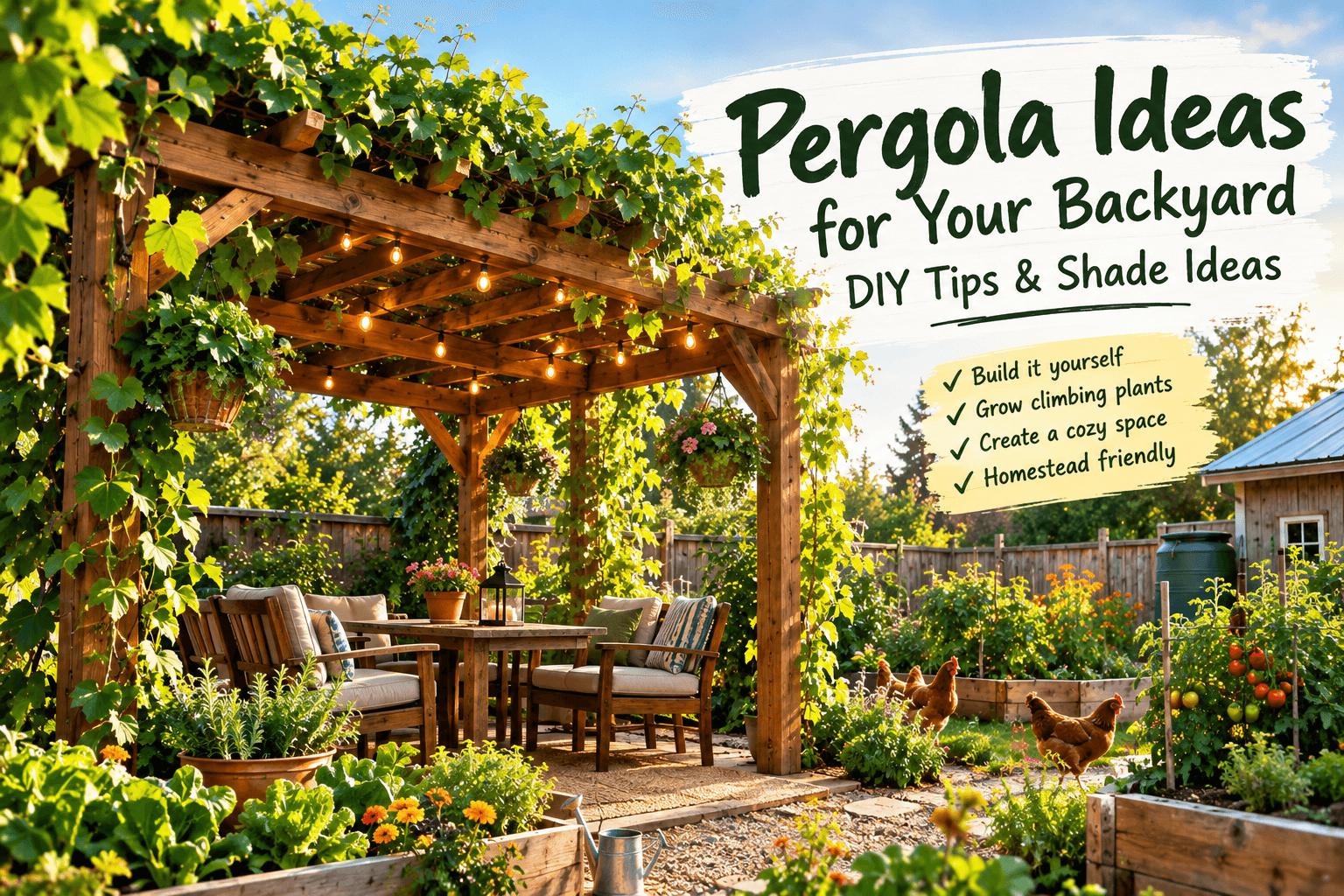
The first pergola I built in my backyard was supposed to be a simple weekend project. That’s what I told my wife, anyway. “We’ll have it done by Sunday afternoon.” Yeah… that didn’t happen.
By Sunday evening, I had wood everywhere, one sore shoulder, two trips to the hardware store, and a pile of screws that somehow weren’t the right size. But when I finally got the thing standing, I knew right away it was worth the trouble.
I’ve been messing around with homesteading for more than 10 years now. I’ve grown vegetables in raised beds, kept chickens, made compost, preserved food, and tried more DIY projects than I probably should admit. Some worked great. Others… let’s just say the firewood pile got a few extra boards.
A backyard pergola turned out to be one of those projects I use all the time.
It gave us shade, a place to sit, somewhere to grow vines, and a nice little outdoor room without building a whole addition to the house.
If you’re thinking about adding a pergola to your backyard, garden, or homestead, here’s what I learned the hard way.
Why I Decided to Build a Pergola
Our backyard gets pretty hot during the summer.
The garden loves the sunshine. I don’t always.
I’d sit outside in the morning with my coffee and everything felt perfect. By early afternoon, though, the patio was baking. There wasn’t much shade, and moving a patio umbrella every few hours got old fast.
That’s when I started looking at pergola ideas.
What I liked was that a pergola doesn’t completely close off the backyard. You still get sunlight and plenty of air moving through it. It feels more natural than putting a big roof over the whole patio.
For a homestead, I also liked the fact that I could use the structure for plants.
That’s when it became more than just a seating area.
Where Should You Put a Backyard Pergola?
This is probably the most important decision you’ll make.
And I almost got it wrong.
I originally wanted to put mine beside the garden because I thought it would look nice in pictures. The problem was that I didn’t pay enough attention to the afternoon sun.
A pergola can look beautiful in the morning and still give you almost no useful shade later in the day.
So before you build anything, spend a day watching your backyard.
Notice where the sun is around:
- Morning
- Noon
- Mid-afternoon
- Evening
Think about when you’ll actually use the pergola.
If you want somewhere to drink coffee in the morning, morning shade might matter most. If you’re planning outdoor dinners, look at the late afternoon and evening sun.
Here’s another trick I wish I’d used the first time.
Take a garden hose or some rope and mark the size of the pergola on the ground. Put your chairs and table inside that space.
Then walk around.
Open the chairs. Sit down. Stand up. Pretend you’re carrying a basket full of tomatoes.
If you’re bumping into everything, make it bigger.
How Big Does a Pergola Need to Be?
There’s no single perfect size.
It depends on what you want underneath it.
A small pergola with two chairs can work beautifully in an urban backyard. You don’t need a huge structure just because you see giant pergolas online.
If you’re planning a dining table, outdoor sofa, garden storage, or cooking area, you’ll need more space.
I made mine slightly larger than I first planned, and I’m glad I did.
Furniture takes up more room than you think.
And don’t forget walking space. You don’t want to squeeze sideways every time you need to get to the garden.
For a small backyard, I’d rather have a simple pergola that’s comfortable than a giant one that takes over the whole yard.
Choosing Wood for Your Pergola
I like wood for backyard projects.
Maybe that’s just me, but wood looks right in a garden. It blends with raised beds, fruit trees, fences, compost bins and all the other stuff going on around a homestead.
Cedar is a popular choice for outdoor structures because it naturally handles outdoor conditions well. Pressure-treated lumber is another practical option for many projects.
I’ve used both types of wood.
The important thing is to think about your local weather.
If you get lots of rain, humidity, snow, or strong summer sun, your pergola is going to take a beating over the years.
Don’t just grab the cheapest boards at the store and hope for the best.
I did that once with a garden structure.
It looked fantastic for about one season.
Then the wood started splitting and weathering badly. I ended up replacing parts of it, which wasn’t exactly the money-saving project I’d imagined.
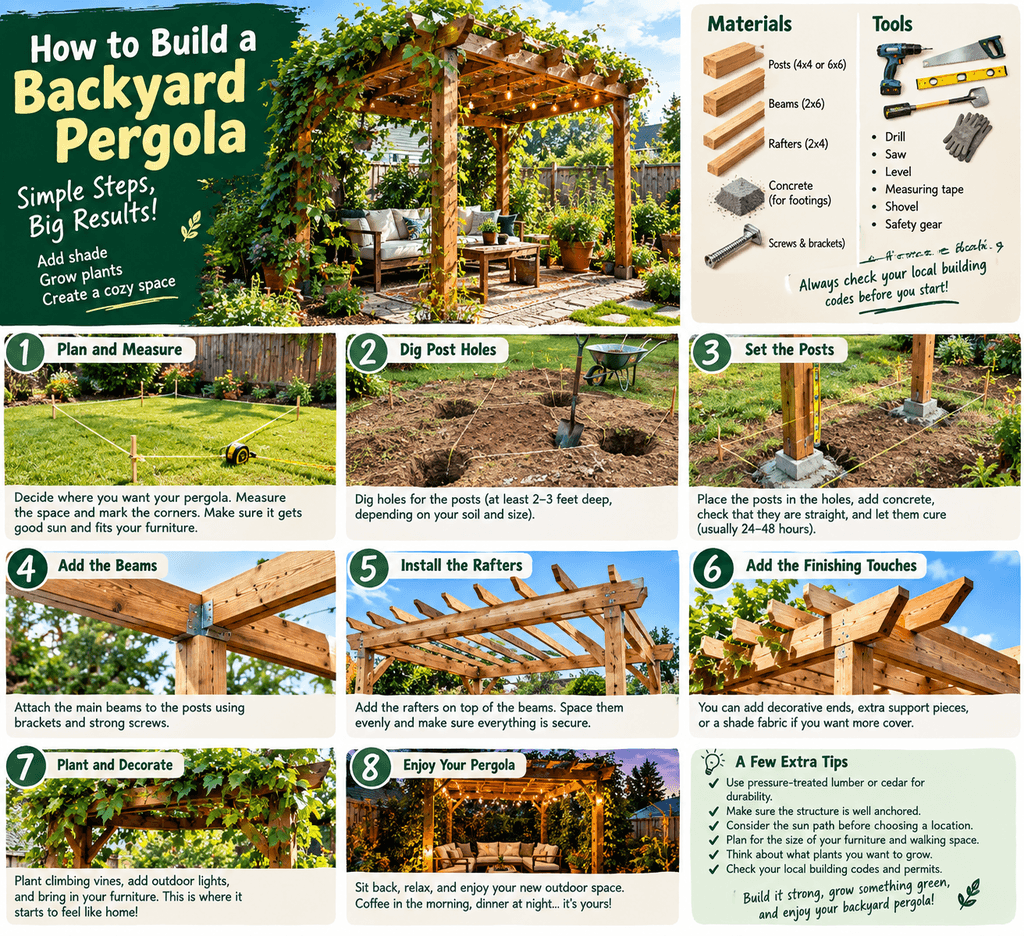
Don’t Rush the Foundation
Here’s where I tell you to slow down.
The pretty part of a pergola is the top. That’s what everybody notices.
But the foundation and posts are what keep everything standing.
You need to think about your soil, local weather, structure size, and how the posts will be anchored.
If you’re building a permanent pergola, don’t treat the posts like fence stakes.
A large structure needs proper support.
Depending on where you live, there may also be local building rules about height, setbacks, permits, and foundations. Check those before you start digging.
I know checking regulations isn’t nearly as exciting as buying lumber.
But getting halfway through a project and finding out you’ve built it too close to a property line is even less exciting.
Open Roof or Solid Roof?
This is another decision that depends on what you want.
Traditional pergolas usually have an open roof made from beams or slats.
I really like this design because you get filtered sunlight rather than complete darkness.
During the morning, the sunlight comes through. Later, as the sun moves, the beams create more shade.
You can also add shade fabric if you need more protection.
But here’s something I really enjoy about an open pergola: plants can become part of the roof.
And that’s where things get fun.
Grow Vines Over Your Pergola
If you’re building a pergola on a homestead, don’t waste all that vertical space.
Use it.
Climbing plants can turn a plain wooden structure into a living garden feature.
Depending on your climate, you might grow:
- Grapes
- Cucumbers
- Climbing beans
- Flowering vines
- Hardy climbing fruit plants
- Other suitable garden climbers
I’ve had cucumbers completely take over a structure before.
You know that saying about gardening being relaxing?
Well, try removing a cucumber vine that’s wrapped itself around everything.
You’ll learn some new words.
The trick is to give climbing plants something to grab onto and guide them as they grow.
Also, think about the mature size of the plant.
A tiny vine looks harmless in spring.
By late summer, you’ve got a green monster sitting on top of your pergola.
That’s why I recommend planning the plants before building the structure.
Pergola Ideas for a Small Backyard
You don’t need acres of land to enjoy a pergola.
Some of my favorite setups are actually small.
If you have a narrow backyard, try putting a compact pergola over a small seating area. Two chairs, a little table, some potted herbs and a climbing plant can be enough.
Another idea is to place your pergola beside raised garden beds.
That way, it becomes part of the garden instead of looking like something that was dropped into the middle of the yard.
In an urban homestead, you could even combine the pergola with container gardening.
Put large containers around the posts and grow climbing vegetables or flowers upward.
You’re using space in two directions instead of only planting along the ground.
That’s something I’ve learned over the years.
When you don’t have much land, you have to start thinking vertically.
Add String Lights for Evening Use
I wasn’t sure about string lights at first.
Then I installed them.
Now I’m a fan.
A few simple outdoor-rated lights can make the pergola useful long after the sun goes down.
We sit outside after dinner sometimes, especially when the weather is good. There’s something nice about sitting under the vines with a cup of coffee while the garden is quiet.
Just make sure your electrical equipment and connections are suitable for outdoor use and protected properly from moisture.
Don’t do what I did years ago and think, “It probably won’t rain.”
That’s not a safety strategy.
Can a Pergola Help Your Vegetable Garden?
Absolutely.
A pergola can become a useful part of a backyard food-growing system.
For example, climbing cucumbers can grow upward instead of spreading across the ground.
Beans can use vertical supports too.
Grapes are another classic choice if they’re suitable for your climate and you’re willing to give them the care they need.
Growing vertically has some nice benefits.
It can save ground space, make harvesting easier, and add shade around certain areas.
But remember that a productive plant can get heavy.
Don’t build a lightweight decorative pergola and then expect it to carry years of thick vines and fruit.
Build with the finished plant in mind.
My Three Biggest Pergola Mistakes
If I could go back and build my first pergola again, I’d do a few things differently.
I would study the sun first
This sounds obvious now.
It wasn’t obvious to me then.
The location should be based on how you use the space, not just where the pergola looks good.
I would leave more walking space
I planned for furniture but didn’t plan enough for people moving around the furniture.
Big mistake.
Leave enough room to pull chairs out and walk around comfortably.
I would plan drainage
Water sitting around posts or under the structure can cause problems over time.
Think about where rainwater goes and how the ground behaves after a heavy storm.
Your future self will thank you.
How I Use My Pergola on the Homestead
The funny thing is, I originally built the pergola for shade.
Now we use it for all kinds of things.
Sometimes it’s breakfast outside.
Sometimes it’s sorting vegetables after harvesting.
Sometimes I’ll sit there with a notebook and plan the next garden project.
And sometimes it’s just a place to sit and do nothing.
That last one is important.
Homesteading can turn into one long list of jobs.
Feed the chickens.
Water the plants.
Pull weeds.
Turn the compost.
Fix something.
Preserve food.
Then do it all again tomorrow.
Having a comfortable outdoor space where you can actually enjoy the results of all that work matters.
A pergola gave us that.
How to Maintain Your Pergola
You don’t need to spend every weekend maintaining it.
I usually give mine a good look a few times throughout the year.
I check for loose hardware, damaged wood, rot, insect damage, and anything that looks like it needs attention.
If you’ve got vines growing over the top, check those too.
Plants can become heavy, and some vines will happily grow into places where you don’t want them.
Trim them when necessary.
Keep pathways clear.
Check lighting and electrical connections.
And after a big storm, take five minutes to look everything over.
Small repairs are much easier than big repairs.
I’ve learned that one across pretty much every homestead project I’ve ever done.
Is a DIY Pergola Worth It?
For me, yes.
But I wouldn’t tell everybody to build one themselves.
If you’re comfortable measuring, cutting wood, using basic tools, and following a construction plan, a simple DIY pergola can be a very rewarding project.
But don’t underestimate the structural side.
A pergola is not just garden decoration. A larger structure needs proper support and secure connections.
If you’re unsure about the foundation, load, or local requirements, get help from somebody who knows what they’re doing.
There’s no prize for doing every single part yourself.
Believe me.
I’ve spent enough weekends learning that lesson.
Pergola FAQ
Does a pergola provide complete shade?
Usually not. A traditional pergola has an open roof, so it gives partial or filtered shade. You can add shade cloth or climbing plants if you want more coverage.
What are the best plants for a pergola?
That depends heavily on your climate. Grapes, cucumbers, climbing beans, and suitable flowering vines are some possibilities. Choose plants that match your growing conditions and make sure the structure can support their mature weight.
Can I build a pergola in a small backyard?
Yes. A compact pergola can work very well in a small urban or suburban yard. Just measure carefully and don’t forget space for furniture and walking.
Does a pergola need a foundation?
A permanent pergola needs appropriate structural support and anchoring. The exact method depends on the design, soil, local weather, and building requirements. Don’t guess on this part.
Final Thoughts
After more than 10 years of homesteading, I’ve learned that the best backyard projects aren’t always the ones that produce the most food.
Sometimes they’re the projects that make you want to spend more time outside.
That’s what happened with my pergola.
It started as a shade project and turned into a place for garden planning, outdoor meals, climbing plants, evening conversations, and quiet mornings with coffee.
So if you’re thinking about building one, don’t worry about making it perfect.
Watch the sun.
Measure your space.
Build it strong.
Think about your plants.
And leave enough room for real life.
You’ll probably make a mistake somewhere. I sure did.
That’s part of the fun.
And when you finally sit underneath your finished pergola, with the garden growing around you, you’ll probably forget about that one crooked board anyway.





4 thoughts on “Pergola Ideas for Your Backyard: What I Learned After Years of Homesteading”