FARMSOLO • URBAN HOMESTEADING
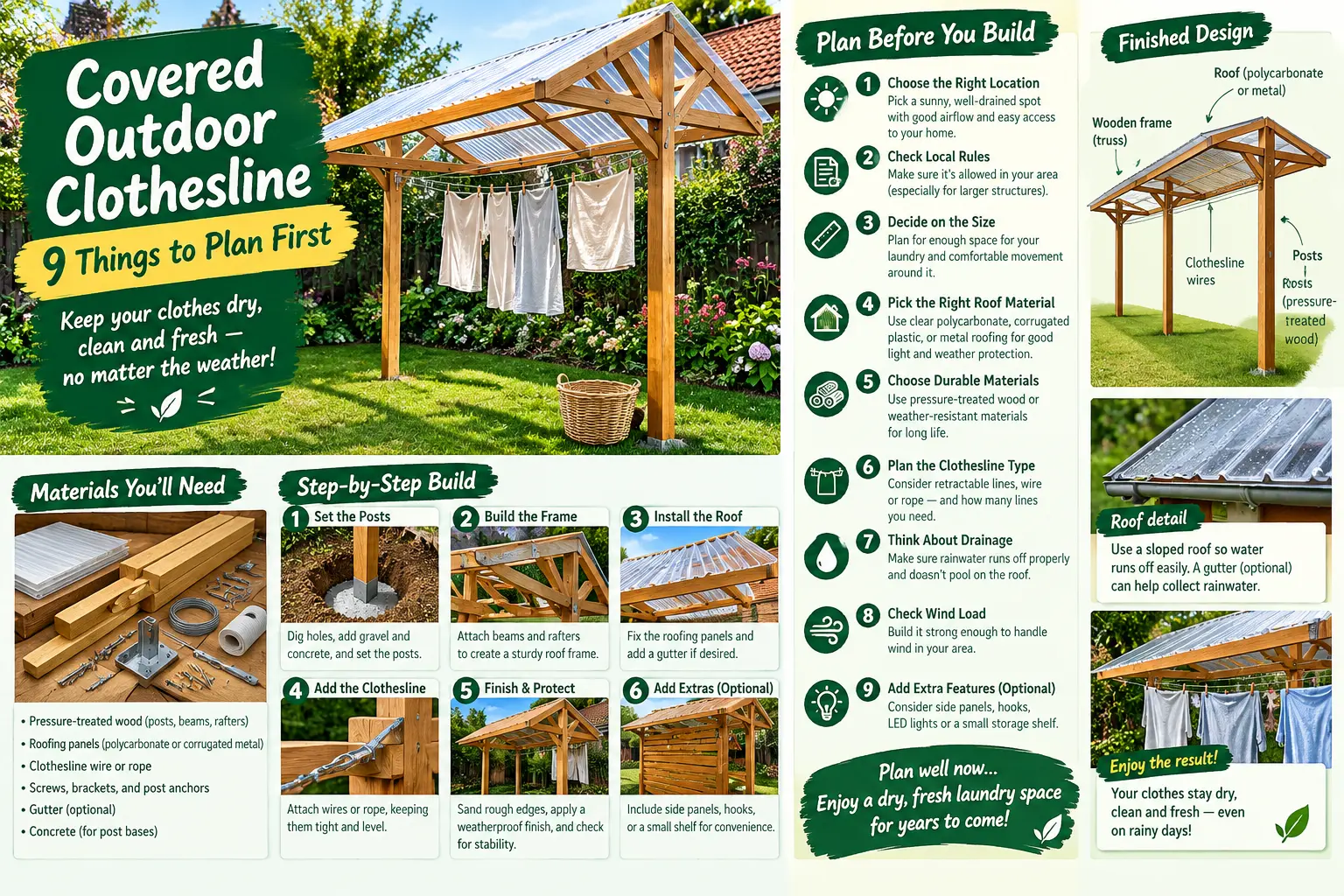
A covered outdoor clothesline gives you the fresh-air simplicity of line drying without leaving every load completely exposed to surprise rain. The best version is not an enclosed laundry shed. It is an open, airy structure with a weather-shedding roof, strong posts, comfortable clotheslines, and enough room for wind to move between the hanging clothes.
Best for: backyard laundry • homesteads • small homes • low-energy living • rainy climates • everyday sheets and clothes
What Makes It Work?
Air movement matters more than turning the structure into an enclosed room. Keep the sides open so damp laundry can release moisture.
What the Roof Does
A roof can protect laundry from vertical rainfall and provide shade, but open sides cannot completely stop wind-driven rain.
Quick Answer
A practical covered outdoor clothesline uses a simple roof over several well-spaced drying lines while keeping the sides mostly open. Put it somewhere with good natural airflow, size the roof so rain is less likely to reach the clothes, provide safe drainage, and build the posts and roof for local wind, rain, and snow conditions. Keep every line easy to reach and avoid excessive line tension that can pull hard on the support structure.
Why Build a Covered Clothesline?
A basic clothesline already does something useful: it lets air do the drying instead of using a powered clothes dryer for every load.
The problem is weather.
You wash sheets in the morning, hang everything outside, and then spend the afternoon watching a dark cloud move toward the house.
A roof gives the drying area a little more flexibility. Light rain does not automatically mean the whole load has to come inside immediately. The roof can also shade fabrics from intense direct sun while still allowing outdoor air around the laundry.
For a homestead, it also creates a permanent place for sheets, work clothes, towels, washable garden cloths, and other everyday laundry without filling the porch with temporary racks.
FarmSolo Tip: Think of this as a rain-sheltered clothesline, not a waterproof outdoor laundry room. Wind-driven rain can still reach clothes from the open sides.
9 Things to Plan Before Building a Covered Outdoor Clothesline
01 • LOCATION
Choose Airflow Before You Choose the View
Wet clothes dry because moisture leaves the fabric and moves into the surrounding air. That makes airflow one of the most important parts of the whole design.
Avoid squeezing the clothesline into a narrow corner between solid fences, sheds, and tall hedges where air barely moves.
An open part of the backyard with gentle cross-breezes is usually more useful than a perfectly hidden location with stagnant air.
02 • ROOF SIZE
Make the Roof Wider Than the Laundry Zone
A roof ending directly above the outermost clothesline gives very little protection when rain falls at an angle.
Allow useful overhang beyond the drying lines so roof runoff falls outside the laundry area rather than directly onto hanging sheets.
The exact overhang depends on roof height, prevailing weather, available space, and the structure itself. Bigger is not always better because a larger roof also catches more wind and adds more structural load.
03 • ROOF DRAINAGE
Give Water a Clear Way Off the Roof
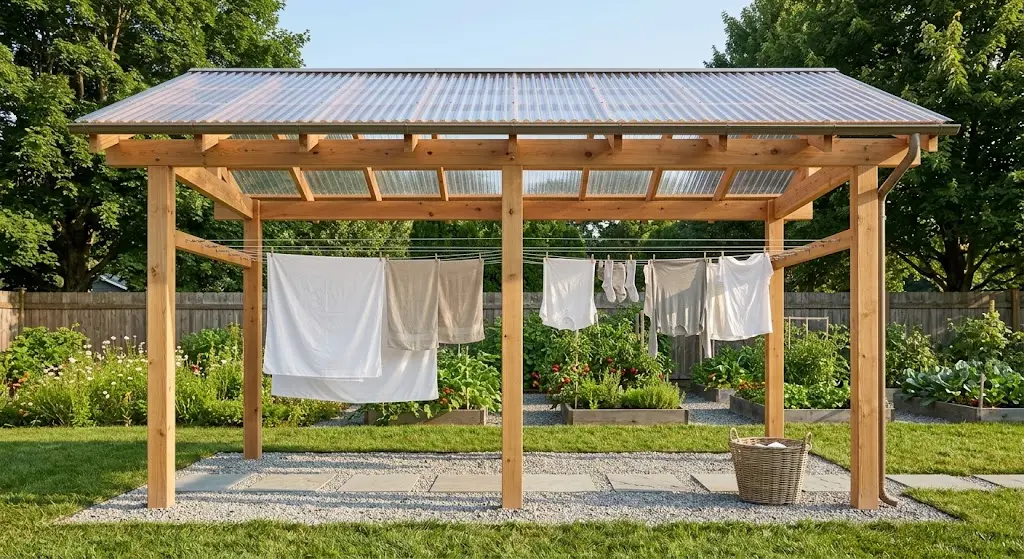
The Pinterest version uses a pitched roof, which is a much better idea than laying clear roofing nearly flat and hoping water disappears.
Use the minimum slope, support spacing, overlaps, and fasteners specified for the exact roofing product you buy.
Think about where the runoff lands too. Water should not pour onto the path where you stand with a laundry basket or collect around wooden posts.
04 • POLYCARBONATE ROOF
Install Clear Roofing as Roofing, Not Just Plastic Sheets
Corrugated polycarbonate is attractive for this project because it can shelter laundry while still keeping the area bright.
But polycarbonate expands and contracts as temperatures change. Follow the panel manufacturer’s installation instructions for hole size, fasteners, washers, overlaps, support spacing, roof pitch, and expansion clearance.
If the product has a designated UV-protected side, make sure that side faces outward as required.
05 • STRUCTURE
Build the Posts for the Roof and the Wind
The empty wooden frame may not look heavy, but the structure has to deal with more than its own weight.
Wind pushes and lifts on roofing. Rain adds runoff. Snow can add significant roof load in cold climates. Tensioned clotheslines also pull sideways on the supports.
Use appropriately sized posts, bracing, connections, and foundations for your local conditions rather than choosing them from the Pinterest photo alone.
06 • LINE HEIGHT
Make the Clotheslines Comfortable to Reach
A line that looks neat high under the roof can become annoying when you have to stretch above your head for every sock.
Set the lines for the people who will actually use them. You should be able to hang a clothespin comfortably without standing on your toes.
Also leave enough clearance below for longer clothes, towels, and sheets without letting them touch the ground.
07 • LINE SPACING
Do Not Pack Every Line Together
More lines do not automatically mean more useful drying capacity.
If wet sheets on neighboring lines touch each other, air movement drops exactly where you need it most.
As a practical starting point, leave generous space between parallel lines—often around 12 to 18 inches works better than trying to squeeze in as many lines as possible.
08 • LINE TENSION
Tight Is Good. Extremely Tight Is Not Better.
A sagging clothesline is frustrating, especially when it is loaded with heavy wet towels.
But every tensioned line also pulls inward on the posts or beams supporting it. Over-tensioning several long lines can place much more sideways force on the structure than it appears to.
Use appropriate line hardware and tension only enough to limit excessive sag. Multiple manageable lines are usually easier to live with than one extremely long, highly tensioned run.
09 • PATH & DRAINAGE
Do Not Build a Great Clothesline Over a Mud Pit
Think about the ground before the first post goes in.
You will walk back and forth underneath this structure carrying clean laundry. Roof runoff should not create puddles directly under the lines.
A simple gravel, paver, or other well-drained path can make the drying area much easier to use after rain.
Can Clothes Really Dry Under a Roof?
Yes. Direct sunshine is helpful, but it is not the only thing that dries laundry.
Warm air, lower humidity, fabric surface area, and moving air all affect how quickly water evaporates.
That is why the open-sided design shown in the inspiration photo makes sense. The roof blocks some direct rain while the laundry remains exposed to outdoor air.
Drying will still be slower on a cool, humid, windless day. A roof cannot change the weather completely.
A Simple Drying Rule
More airflow + more space between wet fabrics + less humidity = faster drying.
What the Pinterest Design Gets Right
| Idea in the photo | Why it works |
|---|---|
| Open sides | Allows cross-ventilation instead of trapping damp air around the clothes. |
| Clear pitched roof | Provides rain shelter while keeping the drying area bright. |
| Several parallel lines | Makes it possible to separate laundry instead of crowding everything onto one line. |
| Freestanding posts | Keeps the clothesline independent from the house or fence when properly designed. |
| High roof | Creates headroom and keeps the structure feeling open rather than cramped. |
| Simple rectangular footprint | Easy to organize around baskets, sheets, towels, and everyday walking space. |
What I Would Change From the Pinterest Photo
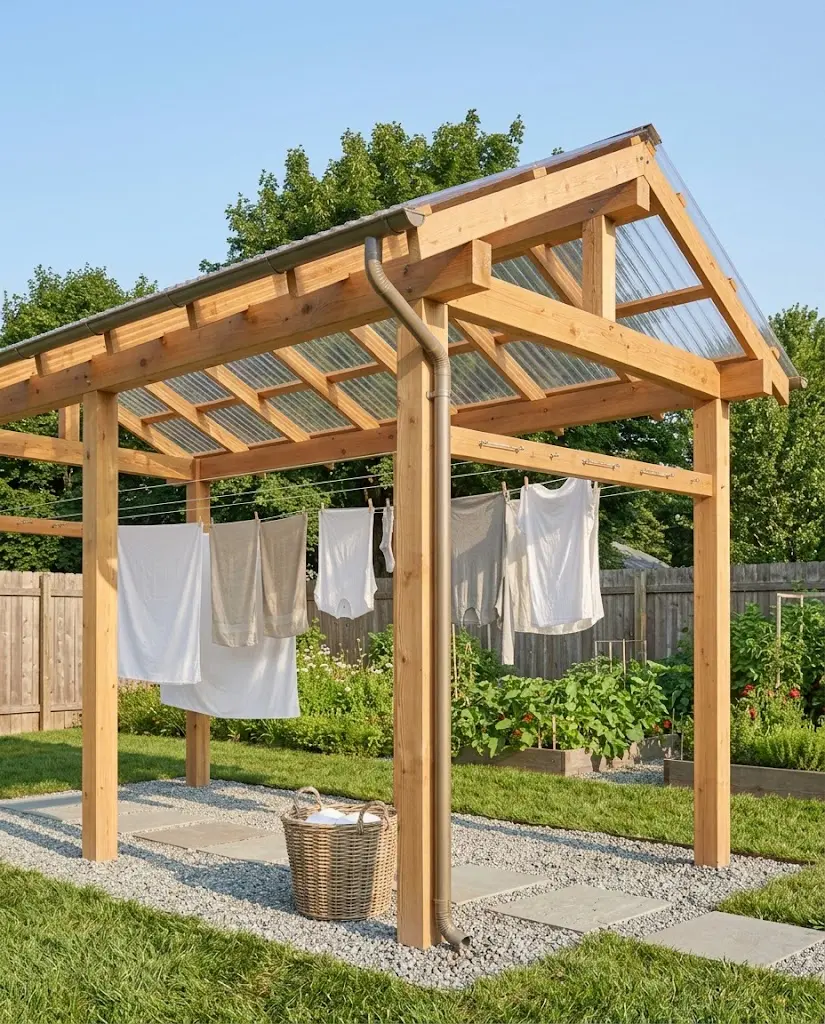
- Add a gutter. Instead of letting all roof water fall along the edge, collect or direct it away from the laundry path.
- Give the roof generous but sensible overhang. This improves shelter without making the canopy unnecessarily large.
- Use proper roof flashing and ridge details. Clear panels still need to behave like a real roof.
- Add diagonal or engineered bracing where required. A simple frame can rack sideways under wind.
- Keep clotheslines below the main roof framing. You do not want sheets rubbing against rafters or roof hardware.
- Use line tensioners. They make future adjustments easier as the line stretches.
- Plan the floor or path. Grass can work, but a clean dry walking strip is much nicer with freshly washed laundry.
- Consider prevailing rain direction. A deeper overhang on the weather side may be more useful than perfectly equal roof edges.
Clear Polycarbonate vs. Metal Roofing
| Roof material | Advantages | Things to consider |
|---|---|---|
| Clear polycarbonate | Bright, lightweight, rain protection, attractive over a garden | Needs correct UV orientation, expansion space, suitable fasteners, and product-specific support spacing |
| Tinted polycarbonate | Light with reduced glare and more shade | Still requires correct installation for thermal movement |
| Metal roofing | Durable, opaque shade, familiar roofing details | Darker underneath and can be noisy during rain |
| Fabric canopy | Lightweight and sometimes removable | Generally less permanent and more sensitive to wind and weather exposure |
How Many Clotheslines Should You Install?
Start with your normal laundry rather than trying to maximize the number of lines.
A family drying towels and sheets needs more hanging length than someone mostly drying shirts and lightweight clothes.
For a compact shelter, four to six well-spaced lines can be more useful than eight crowded lines.
If you regularly dry king-size sheets, measure the sheet before finalizing the structure. Nothing is more frustrating than finishing a beautiful clothesline and discovering your largest laundry hangs on the ground.
Can the Roof Water Be Collected?
Yes, and this is one of the easiest ways to make the project work harder for the homestead.
A gutter along the lower roof edge can send runoff toward an appropriate drainage area or into a properly designed rainwater collection system.
Do not allow the downspout to empty directly around the timber posts or create a muddy patch under clean laundry.
If you want to reuse roof water in the garden, FarmSolo’s DIY Rainwater Harvesting guide explains the larger system, including screens, first flush, storage, overflow, and safe non-potable use.
Will a Covered Clothesline Save Energy?
Whenever a load is air-dried instead of tumble-dried, the powered dryer does not have to supply the heat and airflow for that load.
That does not mean you have to stop using a dryer completely. A covered clothesline works well as another option.
Use the line when weather and time allow it. Use the dryer when you need fast drying, the humidity is too high, or particular laundry is better handled indoors.
For a broader look at practical low-energy systems around a homestead, see FarmSolo’s Off-Grid Home Essentials guide.
What About Wind-Driven Rain?
This is the biggest limitation of the open design.
A roof can stop rain falling mostly downward. It cannot stop a strong storm blowing rain sideways through an open structure.
If your site gets frequent wind-driven rain from one direction, you may consider a deeper roof edge or a partial windbreak on that side—but avoid closing every side and destroying the airflow that makes outdoor drying useful.
Simple Materials List
- Exterior-rated structural posts and framing lumber
- Appropriate post bases or foundations for the site
- Roof rafters and purlins sized for the selected roofing system
- Corrugated polycarbonate, metal roofing, or another exterior roofing product
- Manufacturer-approved roof fasteners, washers, ridge pieces, and flashings
- Exterior structural screws or bolts
- Diagonal bracing where required
- Outdoor clothesline cord, coated wire, or another purpose-made line
- Line tensioners and secure anchor hardware
- Optional gutter and downspout
- Gravel, pavers, or another suitable walking surface
- Exterior wood finish if appropriate for the lumber selected
Common Covered Clothesline Mistakes
- Putting it in a dead-air corner. Laundry needs moving air.
- Making the roof exactly the same width as the lines. Some overhang improves rain shelter.
- Assuming clear plastic panels can be installed any way you want. Follow the exact roofing manufacturer’s instructions.
- Installing the UV-protected face downward. Check the markings before fastening polycarbonate panels.
- Over-tightening clotheslines. Excess tension increases lateral load on the frame.
- Putting every line too close together. Wet fabric needs air around it.
- Making the lines too high. Everyday usability matters more than the photo.
- Forgetting the roof runoff. Clean laundry and muddy ground are a bad combination.
- Using indoor fasteners outside. Exterior structures need appropriate corrosion-resistant connections.
- Ignoring local wind or snow loads. The roof is a real outdoor structure, not simply a clothesline accessory.
Covered Outdoor Clothesline FAQ
Will clothes dry outside without direct sunlight?
Yes. Moving air and lower humidity can dry clothes without direct sun, although drying may be slower in cool, humid, or windless conditions.
Does a covered clothesline keep laundry completely dry in rain?
Not necessarily. A sufficiently sized roof can protect against much of the rain falling from above, but strong wind can blow rain through the open sides.
Is polycarbonate a good roof for a clothesline?
It can be. Corrugated polycarbonate is lightweight, weather resistant, and allows daylight through. It must be installed according to the manufacturer’s requirements for pitch, support spacing, fasteners, thermal expansion, overlaps, and UV orientation.
How high should an outdoor clothesline be?
There is no single comfortable height for everyone. Set it so the main user can reach the line and clothespins easily without stretching overhead, while still leaving enough clearance for long laundry.
How do I stop a clothesline from sagging?
Use a purpose-made outdoor line, secure anchor points, and a suitable tensioner. Keep the span reasonable and tighten only enough to control sag instead of placing extreme tension on the structure.
Should the clothesline structure have gutters?
They are optional, but a gutter can keep roof runoff away from the walking area and can direct water toward drainage or a suitable rainwater collection system.
Do I need a permit for a covered clothesline?
Requirements vary by location and by the size, height, foundation, roof area, and position of the structure. Check local building, setback, utility, neighborhood, or property rules before treating the canopy as a permit-free project.
Build a Drying Area You Will Actually Use
A covered clothesline does not need complicated gadgets to be useful.
Give it a strong structure, a roof that drains properly, open sides for airflow, enough line space for real laundry, and a clean path underneath.
The best version is not the one that looks most impressive in a photo. It is the one that makes hanging a normal load of laundry easier every week.