
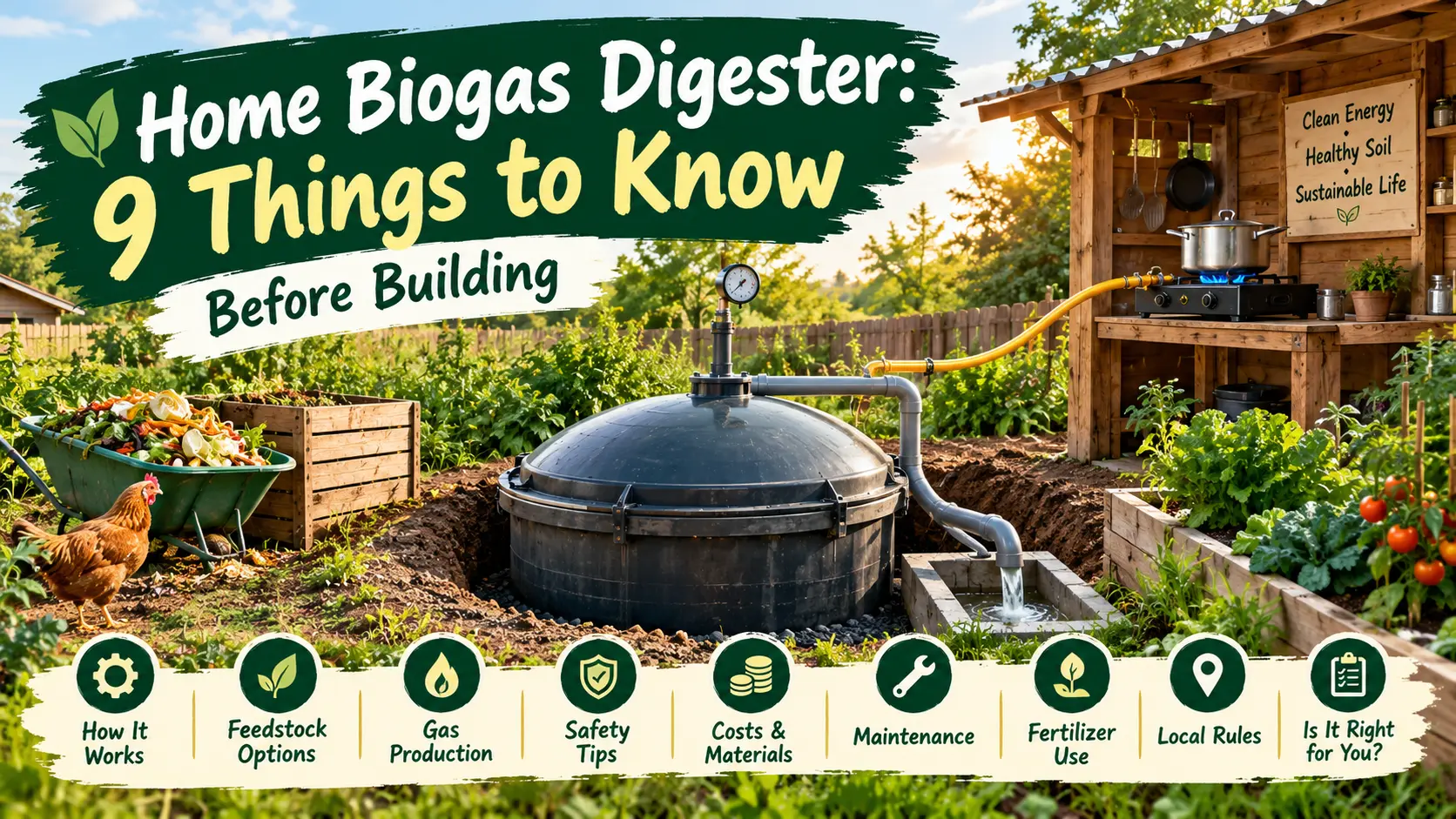
A home biogas digester can turn suitable manure and organic waste into useful biogas while leaving behind a nutrient-rich material called digestate. But a real biodigester is more than a buried tank connected to a kitchen stove. Gas quality, pressure control, ventilation, feedstock, temperature, maintenance, digestate handling, and serious methane and hydrogen sulfide hazards all have to be planned before the system is used.
Before planning a homestead biodigester
- Choose a system designed for the feedstock you actually produce.
- Do not treat raw biogas as interchangeable with household natural gas.
- Plan gas cleaning, moisture management, pressure control, and safe shutdowns.
- Keep flames and ignition sources away from gas-handling equipment.
- Never enter a digester or manure chamber without professional confined-space procedures.
- Do not assume digestate is automatically safe fertilizer for every garden crop.
- Check local building, gas, environmental, and waste-management rules first.

What Is a Home Biogas Digester?
A biogas digester is an enclosed system where microorganisms break down organic material without oxygen.
This process is called anaerobic digestion.
Instead of turning the material into ordinary aerobic compost, anaerobic digestion produces two main outputs: biogas and digestate.
Biogas is made mostly of methane and carbon dioxide. It also contains smaller amounts of water vapor and gases such as hydrogen sulfide.
The material left after digestion is called digestate. It still contains water, organic material, nitrogen, phosphorus, potassium, and other nutrients from the original feedstock.
That is why a biodigester can potentially connect waste management, energy production, and nutrient recycling on a farm or homestead.
Do not use the Pinterest diagram as a construction blueprint. It does not show the complete gas-treatment system, pressure controls, gas detection, emergency shutdown equipment, appliance requirements, structural design, groundwater protection, electrical classification, or safe service procedures.
9 Things to Know Before Building a Home Biogas Digester
1. Start With the Feedstock
A digester should be planned around the material you can supply consistently.
Common anaerobic-digestion feedstocks include livestock manure, suitable food waste, crop residues, and other biodegradable organic materials.
That does not mean every kitchen scrap or farm waste belongs in every biodigester.
Different systems are designed for different solids levels, feeding rates, temperatures, mixing methods, and organic materials.
A system built mainly around liquid livestock manure may operate very differently from one designed for food waste.
Choose the digester for the feedstock instead of building a tank first and deciding later what to put into it.
2. A Biodigester Needs Stable Operating Conditions
The microorganisms producing methane are living organisms.
They perform best when conditions remain reasonably stable.
Temperature, acidity, moisture, feed rate, and feedstock composition can all affect gas production.
Suddenly changing what goes into the digester or overloading it can upset the biological process.
This is one reason a successful biodigester behaves more like managed farm equipment than a passive compost pile.
3. Raw Biogas Is Not the Same as Natural Gas
The gas coming directly from a digester contains more than methane.
Carbon dioxide reduces its energy content, while water vapor can condense inside gas-handling equipment.
Hydrogen sulfide is another important contaminant. It is toxic and can also corrode piping and equipment.
Depending on how the biogas will be used, the system may need moisture removal, contaminant removal, regulated pressure, suitable storage or buffering, and appliances specifically configured for that gas.
Do not connect an improvised gas pipe from a homemade digester directly to a normal household appliance.
4. One “Safety Valve” Is Not a Complete Safety System
The Pinterest drawing shows a valve and labels it as a safety valve.
A real biogas installation can require several layers of protection depending on the design.
Those may include pressure control, emergency shutoff, suitable gas piping, condensate management, flame protection, gas detection, ventilation, barriers, warning signs, and correctly located equipment.
The exact safety system should come from the equipment manufacturer, qualified designer, and applicable codes.
Methane can create an explosive mixture when enough air enters the system, while hydrogen sulfide can become immediately dangerous to people nearby.
Critical safety point: Never enter a digester, manure tank, pit, sump, or similar enclosed chamber because it “looks empty.” Oxygen can be dangerously low and invisible gases such as hydrogen sulfide can be fatal. Confined-space entry requires specialized procedures, gas monitoring, ventilation, rescue planning, and trained personnel.
5. Cooking With Biogas Needs the Right Equipment
Biogas can be used as a fuel for heating and cooking in properly designed systems.
But raw biogas has different composition and energy characteristics from pipeline natural gas or propane.
The appliance, burner, regulator, gas treatment, piping, ventilation, and safety equipment all need to be compatible with the actual gas supplied.
Combustion appliances also create their own hazards, including fire and carbon monoxide if they are installed or operated incorrectly.
For a home or outdoor kitchen, use a system and appliance specifically designed or professionally configured for biogas rather than modifying a standard stove by guesswork.
6. Digestate Is Useful, but It Is Not Magic Liquid Fertilizer
The liquid leaving the digester can contain valuable plant nutrients.
That is why digestate is often used as an agricultural fertilizer or soil amendment.
But the nutrient concentration depends on what went into the digester and how the system operated.
Digestate may also contain high levels of available nitrogen and other nutrients, so applying too much can create nutrient runoff, ammonia losses, or plant and water-quality problems.
Pathogen reduction also depends on treatment conditions.
Do not assume every bucket of digestate is automatically suitable for pouring around tomatoes, lettuce, or other food crops.
Use soil testing, nutrient planning, system guidance, and local agricultural or sanitation rules to determine appropriate use.
7. A Digester Does Not Make the Waste Disappear
This is one of the biggest misconceptions about biodigesters.
Some of the biodegradable material is converted to biogas, but a large amount of liquid and solids still leaves the system as digestate.
If water is added to create a pumpable slurry, the total volume that needs to be handled can even increase.
You still need storage, transfer, nutrient management, and a safe end use for the output.
A biodigester is therefore better described as a waste-treatment and resource-recovery system than a machine that makes organic waste vanish.
8. Plan Maintenance Before You Bury Anything
The underground dome in the Pinterest image looks simple because most of the working system is hidden.
Real digesters need inspection and maintenance.
Gas lines can collect condensation. Pumps and valves can fail. Solids may settle. Scum can form. Corrosion can damage gas-handling components.
Make sure normal maintenance can be performed without anyone entering the digester itself.
Service points, valves, monitoring equipment, and other components should remain accessible to trained people.
9. Check Whether a Digester Actually Fits Your Homestead
Biogas is attractive because one system can potentially manage organic waste while producing useful fuel and nutrients.
But that does not automatically make it the best first project for every homestead.
A digester makes the most sense when you have a dependable feedstock, a useful destination for the gas, a safe plan for digestate, room for the equipment, and enough time and technical ability to maintain it.
A small property producing only occasional kitchen scraps may get more value from a good composting system than from installing complex gas equipment.
If you are still planning the larger property, FarmSolo’s off-grid home essentials and permaculture homestead layout guides can help you decide where energy, composting, livestock, gardens, storage, and water systems should fit before adding another permanent system.
Can a Home Biodigester Really Produce Cooking Gas?
Yes. Anaerobic digestion produces methane-rich biogas that can be burned as fuel in appropriately designed systems.
But “the digester makes gas” and “the gas is ready to pipe safely into my kitchen” are two different statements.
Biogas normally contains carbon dioxide, moisture, hydrogen sulfide, and other trace compounds.
The gas-handling system may therefore need conditioning before the gas reaches an appliance.
The appliance must also be compatible with biogas and installed with appropriate combustion ventilation and fire protection.
For a residential homestead, I would choose a complete engineered or purpose-built biogas system rather than designing the gas train from a social-media diagram.
What Is Actually in Biogas?
| Component | Why it matters |
|---|---|
| Methane | The main combustible component that gives biogas its energy value. |
| Carbon dioxide | Does not burn and lowers the energy content compared with purified natural gas. |
| Water vapor | Can condense in gas lines and equipment. |
| Hydrogen sulfide | Highly toxic and corrosive; requires serious safety consideration. |
| Other trace gases | Composition varies with feedstock and digester conditions. |
Can You Put Kitchen Scraps in a Biodigester?
Food waste can be a suitable anaerobic-digestion feedstock.
But whether your particular digester can handle it depends on the system.
A sudden load of fats, oils, fibrous waste, chemicals, cleaning products, packaging, or other unsuitable material can interfere with operation or damage equipment.
Use the approved feedstock list for the actual digester instead of treating the inlet like a general trash chute.
For ordinary fruit scraps, vegetable waste, leaves, and yard material that do not need energy recovery, FarmSolo’s home composting guide may be the simpler option.
Is Digestate the Same as Compost?
No.
Traditional compost is created through an aerobic process where oxygen is part of decomposition.
Digestate comes from anaerobic digestion, where decomposition occurs without oxygen.
The two materials can both contribute nutrients and organic matter to soil, but their chemistry, moisture, stability, pathogen reduction, and nutrient availability are different.
Some digestate is further separated, dried, treated, or composted before its final use.
Can Digestate Go Directly on a Vegetable Garden?
Do not assume that it can.
The answer depends on the feedstock, digestion conditions, pathogen reduction, nutrient analysis, local rules, application method, and crop.
A manure-based digestate can still contain substantial nitrogen, phosphorus, and other nutrients.
Overapplication can waste nutrients and increase the risk of runoff or groundwater problems.
Be especially cautious with edible crops that may contact soil or fertilizer directly.
Use agricultural guidance and nutrient testing rather than treating digestate like weak compost tea.
Can a Small Homestead Biodigester Save Money?
Possibly, but gas production alone does not determine the economics.
Consider the cost of the digester, installation, excavation where required, gas treatment, storage or pressure equipment, appliance conversion or replacement, monitoring, repairs, digestate management, and permits.
You also need enough feedstock to keep the biological system productive.
Large livestock farms have a major advantage because manure arrives every day in predictable quantities.
A backyard household with only small amounts of food waste may have a much harder time producing enough consistent gas to justify a complicated custom installation.
Common Home Biodigester Mistakes
- Treating the Pinterest diagram as a construction plan. Critical gas, structural, and safety details are missing.
- Connecting raw biogas directly to a normal stove. Gas quality and appliance compatibility matter.
- Thinking one valve makes the system safe. Biogas installations can require several independent safety controls.
- Ignoring hydrogen sulfide. It can be highly toxic and may accumulate in low or enclosed spaces.
- Entering the digester for maintenance. Digesters are potentially deadly confined spaces.
- Feeding random waste into the inlet. Use feedstocks the system is designed to process.
- Assuming digestate is automatically safe fertilizer. Nutrients, pathogens, regulations, and crop use still matter.
- Forgetting the remaining waste volume. Most material does not simply disappear into gas.
- Building before checking permits. Gas, waste, environmental, plumbing, building, and agricultural rules may apply.
Home Biogas Digester FAQ
Can you make biogas at home?
Yes. Small anaerobic-digestion systems exist for households and farms. The challenge is not only producing methane-rich gas but producing, handling, conditioning, storing, and using it safely.
Can biogas be used for cooking?
Yes, in a properly designed system with appropriate gas treatment, pressure control, piping, appliance compatibility, ventilation, and safety equipment. Do not improvise a connection to an ordinary household stove.
Does a biodigester smell?
A properly enclosed and operated digester can reduce the odor associated with raw manure. Strong persistent odors or escaping gas can indicate a problem that should be investigated safely.
What gas does a biodigester produce?
Biogas consists mainly of methane and carbon dioxide, with water vapor and smaller amounts of gases such as hydrogen sulfide and ammonia depending on the feedstock and process.
Is biogas dangerous?
It can be. Methane is flammable and can form explosive mixtures with air. Hydrogen sulfide can be acutely toxic. Safe design, gas monitoring, ventilation, suitable equipment, and trained operation are important.
Is biodigester slurry good fertilizer?
Digestate can contain useful nutrients and is widely used agriculturally, but its quality and safe application depend on the feedstock, digestion process, nutrient content, pathogen reduction, crop, soil, and local rules.
Is a biodigester better than composting?
They solve different problems. Composting is simpler for many household and garden wastes. Anaerobic digestion becomes more attractive when you have a steady suitable feedstock and a useful need for captured biogas.
Can I build a biodigester from the Pinterest diagram?
No. The illustration is useful for understanding the basic concept, but it does not provide enough information for safe structural, gas, plumbing, environmental, or process design.
Think of a Biodigester as Infrastructure, Not a Weekend Compost Project
The Pinterest image gets the basic cycle right: suitable organic material can enter an anaerobic digester, biogas can be captured, and nutrient-rich digestate remains afterward.
The problem is how easy the diagram makes the system look.
Methane production, toxic gases, gas treatment, pressure, combustion, confined spaces, nutrient management, corrosion, maintenance, and local codes all sit behind those few arrows.
If a biogas system fits your homestead, start with a proven digester design and the amount of feedstock you actually have.
Then plan the gas use, safety system, digestate destination, maintenance access, and permits together.
That approach gives you a realistic resource-recovery system instead of a buried tank that creates more problems than it solves.