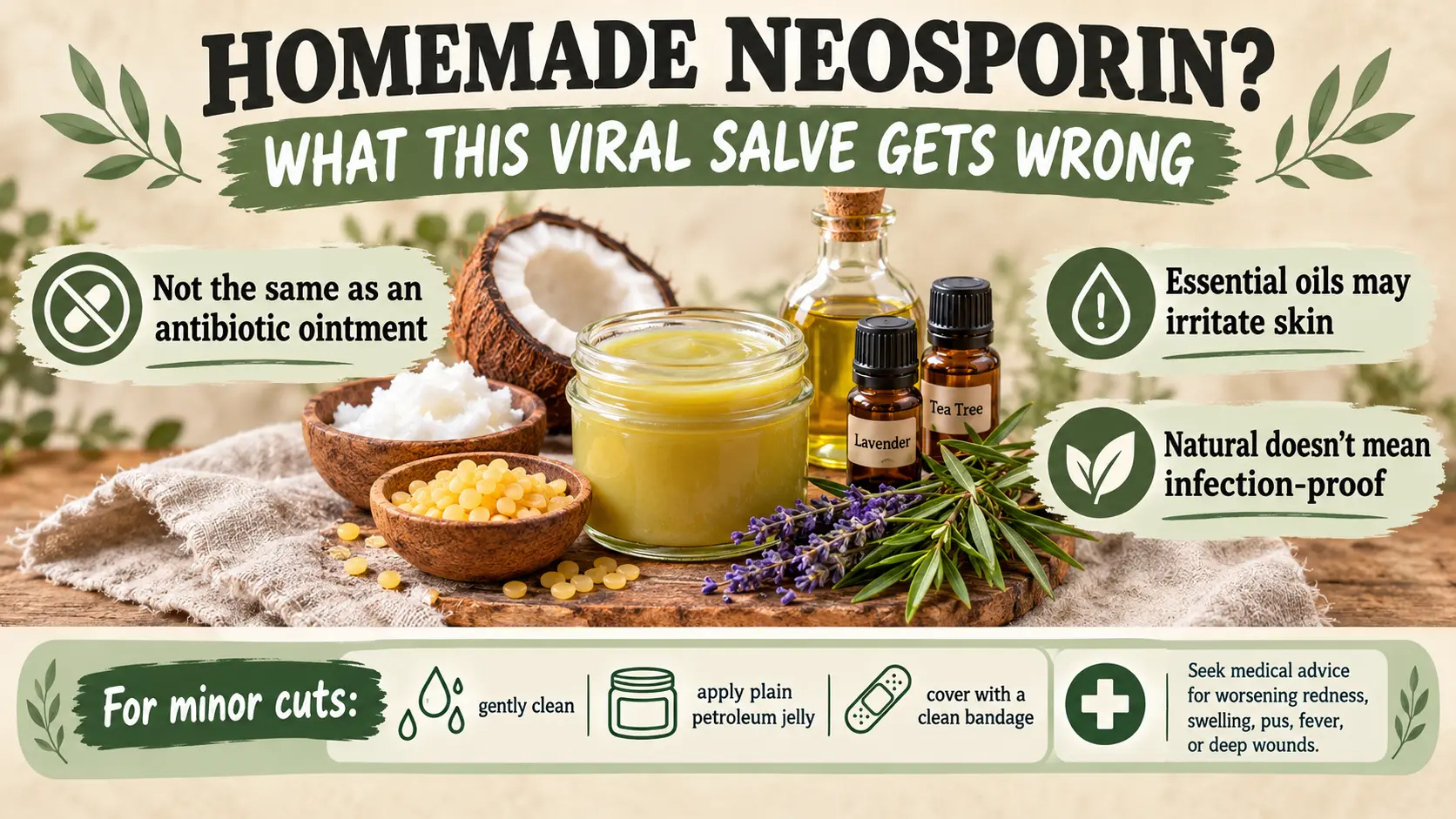
The viral “homemade Neosporin” recipe made with coconut oil, olive oil, beeswax, and essential oils is not the same thing as an antibiotic ointment. For most minor cuts and scrapes, dermatologists recommend something much simpler: clean the injury gently, keep it moist with plain petroleum jelly, and cover it with a clean bandage while it heals.
Quick answer
- The Pinterest salve is not NEOSPORIN and does not contain the same antibiotic medicines.
- Most clean minor cuts do not need a topical antibiotic.
- Plain petroleum jelly is commonly recommended for keeping a minor wound moist while it heals.
- Tea tree and lavender oils can irritate or sensitize skin.
- Some lemon essential oils can cause phototoxic skin reactions with UV exposure.
- Do not use a homemade essential-oil balm to treat an infected, deep, puncture, bite, or badly contaminated wound.

Is “Homemade Neosporin” Really Neosporin?
No.
NEOSPORIN is a branded over-the-counter antibiotic product. The company’s Original antibiotic ointment uses active antibiotic ingredients including neomycin, polymyxin B, and bacitracin.
The Pinterest recipe contains coconut oil, olive oil, beeswax, lavender, frankincense, lemon, and tea tree essential oils.
Those ingredients may create an oily skin balm, but they do not turn the mixture into the same medication or make it a proven substitute for an antibiotic ointment.
That distinction matters because calling a homemade salve “Neosporin” can make readers think it has the same infection-prevention properties as a regulated drug when it does not.
Better name: If coconut oil, olive oil, and beeswax are made into a cosmetic product for intact skin, call it a skin balm or salve. Do not label it an antibiotic ointment unless it actually contains an approved antibiotic medicine and is regulated for that purpose.
Do Minor Cuts Need Antibiotic Ointment?
Usually not.
The American Academy of Dermatology says most minor cuts and wounds do not require antibiotics when there are no signs of infection.
Topical antibiotic ointments can also cause irritation or allergic contact dermatitis in some people. Neomycin is a well-known contact allergen.
That means the choice is not simply between a commercial antibiotic ointment and a homemade herbal antibiotic ointment.
For a normal clean minor cut, dermatologists often recommend basic wound care instead.
What Dermatologists Recommend for a Minor Cut
Start by washing your hands.
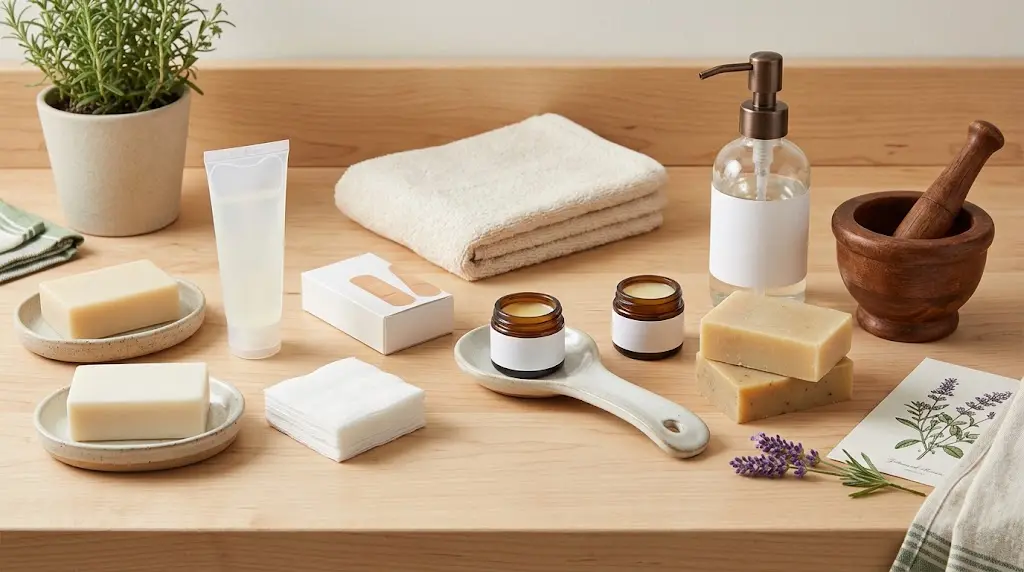
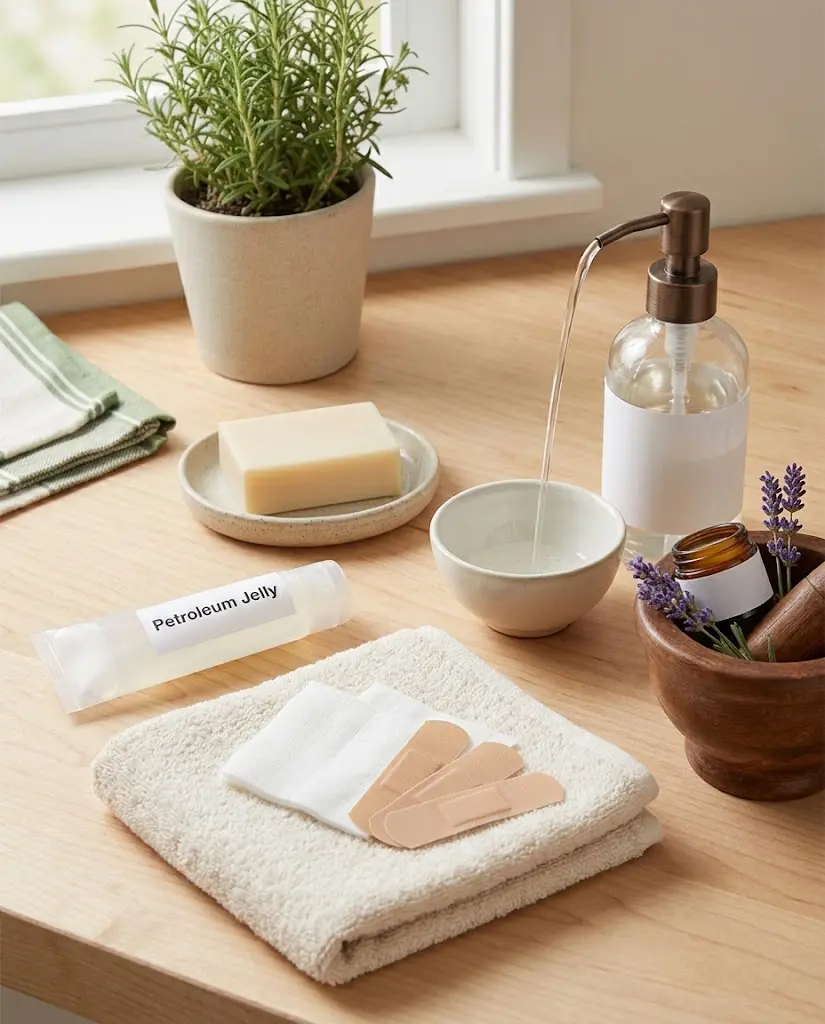
Gently clean the cut with cool or lukewarm water and mild soap or cleanser to remove dirt and debris.
If the wound is bleeding, apply steady pressure with clean gauze or a clean cloth until the bleeding stops.
Then apply a thin layer of plain petroleum jelly to help keep the wound moist. The American Academy of Dermatology recommends petroleum jelly from a squeeze tube because a jar can be contaminated when fingers repeatedly touch the product.
Cover the area with a clean adhesive bandage or sterile nonstick dressing and change it regularly while the wound heals.
You can read the full American Academy of Dermatology minor-cut guidance here.
Why Keep a Wound Moist?
Many of us grew up hearing that a cut should dry out and form a hard scab.
Dermatologists generally recommend the opposite for uncomplicated minor wounds.
Keeping the surface moist with petroleum jelly can help prevent the wound from drying into a thick scab and may support more comfortable healing.
Covering the wound also protects it from dirt and repeated rubbing.
What About Coconut Oil and Olive Oil?
Coconut oil and olive oil are common ingredients in homemade skin products.
Mixed with beeswax, they can create a soft balm that stays on the skin longer than liquid oil alone.
That can be useful as a cosmetic formulation for suitable intact skin, but it does not make the mixture sterile or turn it into an antibiotic medication.
An open wound is also different from healthy dry skin. Once the skin barrier is broken, avoiding unnecessary irritants and contamination becomes more important.
Beeswax Makes a Balm, Not an Antibiotic
Beeswax thickens oils and helps create the firm texture people expect from a salve.
That is a useful cosmetic property.
It does not prove that the finished product can prevent or treat bacterial infection in an open wound.
This is an important pattern to remember with homemade remedies: texture and appearance tell you almost nothing about whether a product is an effective medicine.
Is Tea Tree Oil a Natural Antibiotic for Cuts?
Tea tree oil has antimicrobial activity in laboratory research, which is one reason it appears in so many homemade first-aid recipes.
But laboratory antimicrobial activity is not the same thing as proving that a homemade tea tree mixture safely prevents infection in an open wound.
The National Center for Complementary and Integrative Health says there is limited evidence for topical tea tree oil in conditions such as acne and athlete’s foot, but there is not enough evidence to determine whether it is useful for many other promoted uses.
Tea tree oil can also cause redness, burning, itching, dryness, or allergic reactions in some people.
It should never be swallowed.
For those reasons, I would not use concentrated tea tree oil as a substitute for standard wound care.
What About Lavender Essential Oil?
Lavender smells pleasant to many people and is widely used in aromatherapy and personal-care products.
That does not make it an antibiotic wound treatment.
NCCIH says more high-quality research is needed for many promoted lavender uses and notes that topical lavender products can cause allergic skin reactions in some people.
Adding 20 drops of concentrated lavender oil to a homemade balm therefore adds another potential source of skin irritation without establishing that the mixture can prevent a wound infection.
Lemon Essential Oil Adds Another Problem
Lemon essential oil should not be treated as a harmless fragrance ingredient on damaged skin.
Some lemon essential oils, particularly expressed or cold-pressed citrus peel oils containing furocoumarins, can produce phototoxic reactions when treated skin is later exposed to ultraviolet light.
The risk depends on the specific oil, how it was produced, and its concentration.
The Pinterest recipe does not tell us what type of lemon oil is being used, its chemical profile, or whether the final concentration has been evaluated for skin safety.
That uncertainty is another reason not to put this mixture on a fresh cut.
Does Frankincense Make the Salve a Wound Treatment?
Frankincense has a long history in traditional preparations and is widely promoted online for skin care.
But a traditional use or laboratory finding does not establish that adding frankincense essential oil to a homemade mixture makes it a proven first-aid antibiotic.
If a wound actually needs antimicrobial treatment, that decision should be based on the type of injury and whether infection is present, not on how many essential oils are in the jar.
Homemade Salves Are Not Sterile Medicines
This is another important difference that viral recipes rarely discuss.
Melting ingredients in a kitchen does not produce a sterile pharmaceutical ointment.
The container, utensils, fingers, herbs, oils, and storage conditions can all introduce contamination.
That matters more when a product is being placed on broken skin.
The American Academy of Dermatology even recommends petroleum jelly from a squeeze tube instead of a jar for wound care because repeatedly reaching into a jar can transfer dirt and bacteria.
When a Cut Needs More Than Home Care
Minor surface cuts often heal with simple home care, but not every injury belongs in the DIY category.
The American Academy of Dermatology recommends getting medical help when a cut is large or deep, when bleeding does not stop, or when signs of infection develop.
Signs that can suggest infection include increasing redness or discoloration, swelling, warmth, worsening pain, pus, drainage, red streaking, fever, or feeling unusually ill.
Puncture wounds, animal or human bites, badly contaminated injuries, wounds containing foreign material, and injuries involving major tissue damage also deserve more careful evaluation.
If the cut came from a dirty or rusty object, check whether your tetanus vaccination is current.
Do not put a homemade salve on a serious or infected wound and wait to see what happens. Increasing pain, swelling, pus, spreading redness, fever, uncontrolled bleeding, or a deep injury are reasons to get appropriate medical care.
What About Commercial Antibiotic Ointment?
This article is not saying that antibiotic ointments never have a role.
They are real medicines used in specific situations.
The point is that most uncomplicated minor wounds do not automatically need them, and using antibiotics unnecessarily can cause problems such as contact dermatitis and contributes to unnecessary antibiotic exposure.
If a clinician recommends a topical antibiotic for a particular wound or infection, follow those instructions rather than replacing the medication with essential oils.
Can You Still Make an Herbal Skin Balm?
You can make cosmetic balms for intact skin if you enjoy DIY personal-care projects.
That is a different goal.
A beeswax-and-oil balm can be described as a moisturizing or protective cosmetic product when used appropriately on healthy skin.
Essential oils remain optional, and anyone with sensitive skin should remember that fragrance ingredients can cause irritation or allergy.
Do not market a cosmetic balm as a homemade antibiotic, infection treatment, or substitute for prescription or over-the-counter medication.
FarmSolo’s rosemary guide explains a similar rule for herbal topical products: concentrated essential oils and broken skin are not a good combination.
Viral “Homemade Neosporin” Claims Checked
| Claim | What to know |
|---|---|
| “This is homemade Neosporin” | No. The viral salve does not contain the antibiotic medicines found in the branded product. |
| “Essential oils prevent wound infection” | Laboratory antimicrobial activity does not prove a homemade mixture safely prevents infection in an open wound. |
| “Tea tree oil is a natural antibiotic” | Tea tree has limited evidence for some skin conditions and can irritate skin. Evidence does not establish this recipe as wound antibiotic therapy. |
| “Lavender makes the wound heal” | Reliable clinical evidence is limited, and topical lavender can cause allergic reactions. |
| “Lemon oil is safe because it is natural” | Some lemon oils can be phototoxic or irritating depending on the product and concentration. |
| “A homemade jar is safer than antibiotic ointment” | Homemade products are not sterile medicines and may introduce additional irritants or contamination. |
| “Every cut needs an antibiotic” | Dermatologists say most uncomplicated minor cuts can be cared for with cleaning, petroleum jelly, and a clean dressing. |
Homemade Neosporin FAQ
Can I make Neosporin at home?
No homemade combination of oils and beeswax is the same as the branded antibiotic medicine. You can make a cosmetic skin balm, but it should not be described as homemade Neosporin or a proven antibiotic treatment.
What can I put on a minor cut instead of antibiotic ointment?
For many uncomplicated minor cuts, dermatologists recommend gently cleaning the wound, applying plain petroleum jelly, and covering it with a clean bandage. Seek medical care if the injury is serious or becomes infected.
Can coconut oil go on an open cut?
A homemade coconut-oil balm is not necessary for standard minor wound care. Plain petroleum jelly has clearer dermatology guidance for keeping uncomplicated cuts moist while they heal.
Can tea tree oil be put directly on a wound?
I would not use concentrated tea tree oil on a fresh wound. Tea tree products can cause burning, redness, dryness, or allergic reactions, and evidence does not establish concentrated tea tree oil as a replacement for proper wound care.
Is lavender oil safe on cuts?
Lavender is not needed for normal minor-cut care, and topical lavender products can cause allergic skin reactions in some people. Avoid adding unnecessary fragrance to damaged skin.
Why use petroleum jelly on a cut?
Petroleum jelly helps keep the wound moist, which can support healing and help prevent a thick dry scab. Dermatologists commonly recommend it for uncomplicated minor cuts and scrapes.
When should I see a doctor for a cut?
Get appropriate medical help for deep or large wounds, uncontrolled bleeding, significant contamination, bites, punctures, severe pain, foreign objects in the wound, or signs of infection such as pus, increasing swelling, spreading redness, warmth, worsening pain, or fever.
Keep the Homemade Balm, Drop the Antibiotic Claim
The Pinterest recipe combines ingredients that can make a pleasant-smelling balm.
That does not make it homemade Neosporin.
Coconut oil, olive oil, beeswax, lavender, frankincense, lemon, and tea tree oil do not reproduce the active antibiotic ingredients in the commercial medicine, and several essential oils add their own irritation or allergy risks.
For a normal minor cut, simple wound care is easier and better supported: wash it, stop the bleeding, keep it moist with plain petroleum jelly, and protect it with a clean dressing.
If the wound is infected or serious enough to need medication, that is the point to use appropriate medical treatment rather than trying to turn an essential-oil salve into an antibiotic.