An off-grid composting toilet can reduce water use and provide sanitation where a conventional sewer connection is unavailable, but it is not simply a bucket of waste that turns into safe garden compost after a few months. A reliable system needs proper containment, ventilation, moisture control, handwashing, maintenance, safe emptying, and an approved plan for the final material.
Plan these before building
- Check local sanitation, plumbing, building, and waste-disposal rules.
- Decide whether you need a certified composting toilet or a urine-diverting dry toilet system.
- Keep human waste completely contained and protected from insects, animals, rainwater, and groundwater.
- Plan ventilation and moisture management before thinking about odor.
- Provide clean running water and soap for handwashing.
- Do not assume toilet material is safe fertilizer because it looks like soil.

What Is an Off-Grid Composting Toilet?
A composting toilet is a sanitation system that uses little or no flushing water and manages human waste in a contained environment where biological decomposition can take place.
Unlike an ordinary backyard compost pile, the system has to deal safely with fecal pathogens, excess moisture, odors, insects, liquids, toilet paper, and eventual emptying.
NSF describes composting toilets as non-liquid-saturated treatment systems that rely on an enclosed aerobic decomposition process. Certified systems tested under NSF/ANSI 41 must meet requirements for capacity, odors, accessibility of waste, and bacterial levels in the finished output.
That is why a purchased, certified system can be a much more predictable starting point than designing a waste-treatment chamber only from an online drawing.
Important distinction: Do not put human feces into the ordinary backyard compost pile you use for vegetable scraps and leaves. A sanitation system is designed and managed differently because human excreta can contain disease-causing organisms.
Composting Toilet vs. Urine-Diverting Dry Toilet
The terms are often mixed together online, but they do not always describe the same system.
| System | What it does | Main management issue |
|---|---|---|
| Composting toilet | Contains waste in a managed biological treatment system | Airflow, moisture, temperature, capacity, and safe finished output |
| Urine-diverting dry toilet | Separates urine from feces at the toilet interface | Keeping streams separate and safely handling both outputs |
| Simple dry toilet | Uses no flush water but may rely on another containment or treatment method | Safe storage, treatment, emptying, and disposal |
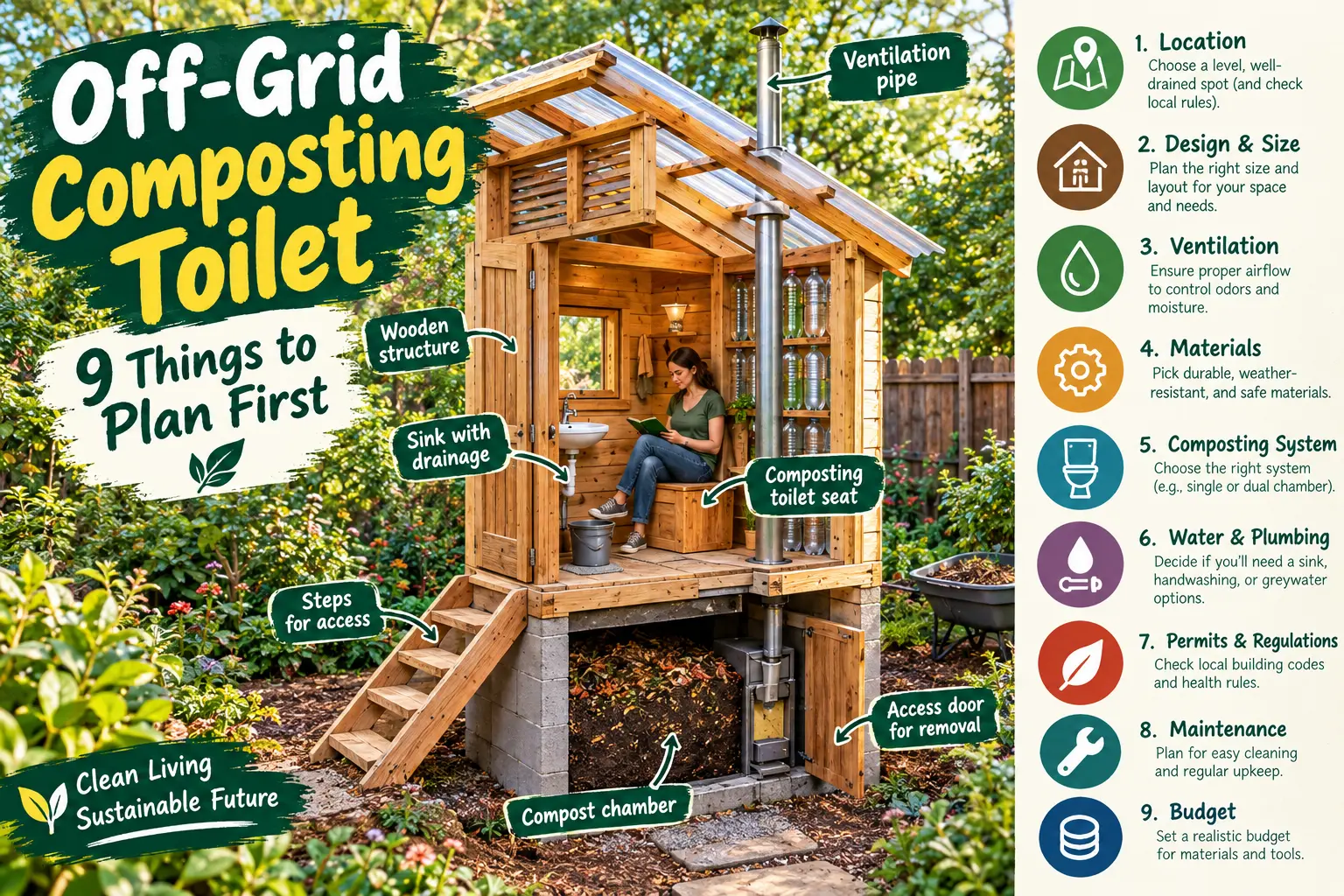
The Pinterest illustration appears closest to a urine-diverting dry toilet combined with an onsite solids chamber.
That can be a legitimate sanitation concept, but the details determine whether it actually works safely.
9 Things to Plan Before an Off-Grid Composting Toilet
1. Start With the Rules, Not the Shed
The most important first step is not choosing wood siding or deciding where the toilet seat goes.
Find out what sanitation systems are permitted where the property is located.
Depending on the jurisdiction, composting toilets may require approval, a certified model, permits, inspections, a separate greywater system, or another approved method for handling liquids and residual waste.
A composting toilet also may not automatically eliminate every requirement for septic or wastewater management because sinks, showers, and other fixtures still produce wastewater.
Design around the approved sanitation system rather than building the outhouse first and trying to legalize the waste system afterward.
2. Choose a System With Enough Capacity
A system used by one person on occasional weekends has a completely different loading pattern from a toilet serving a family every day.
Capacity affects chamber size, emptying frequency, moisture, airflow, and whether the biological process can keep up with incoming material.
This is one advantage of a system tested under a recognized sanitation standard: its capacity and performance have been evaluated instead of estimated from a drawing.
Do not design a tiny chamber around the assumption that waste will disappear quickly.
3. Treat Ventilation as Part of the Treatment System
The vertical vent pipe shown in the illustration is not just an odor accessory.
Composting depends on aerobic conditions, meaning oxygen needs to reach the material. Ventilation also helps remove moisture and move odors away from the occupied space.
A vent that is too short, blocked, poorly routed, or installed where wind pushes air back toward the building may perform badly.
Use the venting arrangement required by the specific toilet system instead of assuming any vertical pipe will work.
4. Control Moisture
A composting chamber needs enough moisture for biological activity but should not become a flooded anaerobic tank.
This is one reason some dry systems separate urine from feces.
Urine diversion can reduce the liquid entering the solids chamber and make moisture easier to manage, but separating urine also creates a second waste stream that needs its own safe storage, treatment, or disposal plan.
Do not simply connect a hose to the urine outlet and discharge it onto the ground because an illustration says “diverted and diluted urine.”
5. Use Bulking Material for the Job It Actually Does
Sawdust, wood shavings, or another carbon-rich bulking material appears in many dry-toilet systems.
Its job may include helping manage moisture, adding carbon, improving texture, and reducing exposed wet waste.
But adding a scoop of sawdust does not disinfect feces or guarantee that the material is composting correctly.
Follow the quantity and material recommendations for the actual sanitation system being used.
FarmSolo’s home composting guide explains the basic carbon-and-nitrogen idea for ordinary garden compost, but human waste sanitation requires stricter containment and safety controls.
6. Provide Proper Handwashing
The small sink in the illustration is actually one of the most important features.
Human feces can contain pathogens such as E. coli, Salmonella, and norovirus. CDC recommends washing hands with soap and clean running water after using the toilet.
Provide soap, clean water, a practical drying method, and a sink that can be used without touching contaminated equipment.
The sink wastewater also needs an approved drainage or greywater solution. An “independent drain pipe” should not simply discharge wastewater beside the building unless that is permitted and suitable for the site.
7. Keep Rainwater and Groundwater Out
A sanitation chamber should remain isolated from uncontrolled water.
Roof runoff, surface drainage, high groundwater, or flooding can overwhelm a poorly designed system and move contamination beyond the chamber.
Site grading should send stormwater away from the sanitation structure, and the containment area should be constructed according to the approved design.
If the property already has drainage problems, FarmSolo’s backyard drainage guide is useful for understanding why water movement should be addressed before permanent structures are installed.
8. Design Safe Access for Emptying
Eventually, a contained system needs maintenance.
The operator may need to inspect the chamber, remove finished or partially treated material, service urine containers, clear a vent, or replace components.
That means access should be possible without crawling beneath an unstable building or carrying contaminated material through the occupied toilet room.
WHO sanitation guidance treats emptying and transport as part of the sanitation chain, not as an afterthought.
Use gloves and other appropriate protective equipment when handling sanitation-system material and follow the system’s operating instructions.
9. Decide Where the Finished Material Can Legally and Safely Go
This decision should happen before the first person uses the toilet.
Do not assume dark, crumbly material is pathogen-free because it looks like ordinary garden compost.
The safe end use depends on treatment performance, the system design, local regulations, storage or treatment time, and the crops or areas where the material could be used.
If local rules require disposal rather than garden use, follow those requirements.
If agricultural reuse is allowed, follow the validated sanitation process and public-health guidance for that specific application.
Do not use untreated or uncertain material around crops eaten raw.
Is the “6 to 8 Months” Compost Claim Safe?
It should not be used as a universal rule.
The Pinterest image labels the lower chamber “organic compost in 6–8 months,” but sanitation treatment cannot safely be reduced to a single calendar number.
WHO’s current sanitation fact sheet for dry and urine-diverting toilets with alternating pits or compost chambers describes treatment systems in which material is isolated and allowed to transform before removal. For alternating pits, WHO describes allowing the resting pit to degrade for at least two years before use of the humic material.
A properly operated composting chamber may use a different validated treatment process, but that does not make six or eight months automatically safe for every climate, design, loading rate, or final use.
Use the performance requirements and operating instructions for the approved system rather than a Pinterest timer.
Do not judge sanitation safety by appearance or time alone. Material can look fully decomposed and still require additional treatment or restricted disposal because pathogens are invisible.
Does Urine Diversion Eliminate Odor?
It can help, but it is not a guarantee.
Keeping excess liquid out of a solids chamber can improve moisture control. Good ventilation can also move odors out of the occupied room.
Persistent strong odor usually means something in the system deserves attention: moisture may be too high, airflow may be poor, a vent may be obstructed, the system may be overloaded, or liquid may be collecting where it should not.
A well-maintained composting toilet should not need perfume or chemical fragrance to hide routine odors.
Can Urine Be Used as Fertilizer?
Human urine contains nutrients, particularly nitrogen, and some sanitation systems are designed around nutrient recovery.
But that does not mean urine from every toilet should simply be diluted and poured onto the vegetable garden.
The safe handling and reuse method depends on the collection system, storage, possible contamination with feces, local sanitation rules, crops, application method, and public-health guidance.
WHO notes that urine-diverting sanitation can support resource recovery, but safe storage, management, and end use remain part of the sanitation system.
For a beginner off-grid bathroom, an approved collection and disposal method is much safer than improvising a fertilizer program from a social media diagram.
What About the Sink Drain?
A handwashing sink produces greywater, not toilet waste, but greywater still needs proper management.
EPA describes onsite non-potable reuse systems as systems in which sources such as sink greywater are collected, appropriately treated, and reused for suitable non-drinking applications.
Local requirements can determine where sink water may be discharged, whether treatment is required, and whether subsurface dispersal or reuse is allowed.
Do not pipe the sink directly toward the compost chamber or allow greywater to create a permanently wet area beneath the toilet building.
Do You Need a Two-Chamber System?
Alternating chambers are one way to give stored material a long period without receiving fresh waste.
While one chamber is active, the other can remain closed for treatment or resting.
That principle is used in several established dry sanitation systems, but the required chamber size, containment, treatment period, ventilation, and emptying procedure should come from an approved design rather than an improvised masonry box.
A self-contained certified toilet may achieve the same sanitation goal using a completely different internal design.
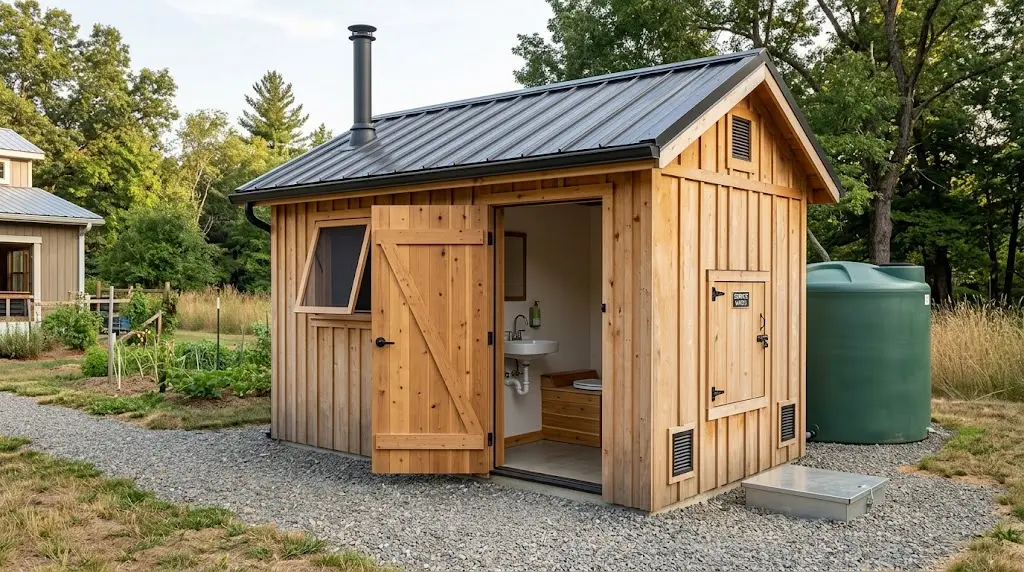
Should the Toilet Shed Have Cross Ventilation?
Ventilating the occupied room is useful for comfort and moisture control, but room ventilation and waste-chamber ventilation are not the same thing.
Privacy louvers, screened openings, or an operable window can help the room dry after cleaning and reduce heat buildup.
Keep openings screened against insects where appropriate, and do not let rain enter the waste system.
The toilet’s dedicated vent should still follow the design of the actual sanitation unit.
Are Plastic Bottle Walls a Good Idea?
The bottle wall shown in the illustration is visually interesting, but I would treat it as a decorative concept rather than a necessary sanitation feature.
An outdoor toilet wall still has to deal with weather, pests, privacy, durability, cleaning, structural loads, and potentially insulation.
If reused bottles cannot provide a durable, cleanable, weather-resistant wall assembly for your climate, use a conventional exterior wall or rated translucent panel instead.
Recycling a material is useful only when it still performs the job the building needs it to perform.
Composting Toilet vs. Septic System
| Feature | Composting toilet | Conventional septic system |
|---|---|---|
| Flush water | Little or none | Uses water to convey waste |
| Waste treatment | Contained dry or semi-dry biological system | Septic tank plus soil treatment/dispersal |
| Maintenance | Regular inspection and eventual material removal | Tank inspection and pumping plus drainfield care |
| Greywater | Often needs a separate approved solution | Usually enters the septic system with other wastewater |
| Best fit | Some cabins, water-scarce sites, remote or approved off-grid systems | Properties suited to conventional onsite wastewater treatment |
EPA notes that composting and urine-diverting toilets can reduce the nitrogen and phosphorus entering a septic system, but they are still part of a larger sanitation and wastewater plan.
If you are planning several independent systems for a homestead, FarmSolo’s off-grid home essentials guide is a useful reminder to plan water, energy, sanitation, food, and maintenance together rather than as unrelated projects.
Common Off-Grid Toilet Mistakes
- Assuming “dry” automatically means sanitary. Human waste still needs safe containment and treatment.
- Using a fixed six-month timer. Safe treatment depends on the validated system and end use, not appearance alone.
- Discharging diverted urine wherever convenient. It needs an approved management plan.
- Connecting the handwashing sink to an uncontrolled drain. Greywater is still wastewater.
- Ignoring stormwater. Rain and flooding should never enter or spread toilet waste.
- Using sawdust as if it sterilizes waste. Bulking material helps the process but does not replace treatment.
- Building a chamber that cannot be serviced safely. Plan emptying and maintenance from the start.
- Mixing toilet waste with ordinary garden compost. Keep sanitation materials in their designed treatment system.
- Skipping handwashing. Soap and clean water are a core sanitation feature, not an optional upgrade.
Off-Grid Composting Toilet FAQ
Do composting toilets smell?
A correctly sized and properly operated system should control objectionable odors. Persistent smell can indicate problems with ventilation, moisture, overload, liquid management, or maintenance.
Do composting toilets need water?
Many composting and dry toilets use little or no flush water. You still need safe water for handwashing and may have other wastewater from sinks or showers that requires management.
Can I put sawdust in a composting toilet?
Some systems use sawdust, shavings, or another bulking material, while others do not. Follow the instructions for the specific toilet rather than adding material automatically.
Is toilet compost safe after six months?
Do not assume that. Treatment times and required performance vary by sanitation system, climate, storage conditions, regulation, and intended end use. Some WHO-described alternating-pit systems use resting periods of at least two years.
Can composting toilet material go in a vegetable garden?
Only where the sanitation system, treatment process, local regulations, and end-use guidance explicitly support that use. Do not apply untreated or uncertain human waste to crops, especially produce eaten raw.
Does urine diversion make a composting toilet better?
It can make moisture management easier in some systems, but it also creates a separate liquid stream that must be collected, treated, reused, or disposed of safely.
Do composting toilets need electricity?
Some passive systems operate without electricity, while others use small fans, heaters, mixers, or controls. Choose the system based on the site and the power available.
Do I still need a septic system?
Possibly. A composting toilet may reduce or remove toilet blackwater, but sinks, showers, laundry, and other fixtures still create wastewater. Local regulations determine what systems are required for the property.
Treat It as Sanitation, Not Just Composting
The Pinterest diagram has several useful ideas: urine separation, a dedicated vent, handwashing, a dry cover material, and maintenance access.
The mistake would be treating the picture as a complete engineering and public-health plan.
A safe off-grid toilet has to manage every step: use, containment, moisture, ventilation, cleaning, handwashing, treatment, emptying, transport, and final disposal or reuse.
Start with the sanitation method and local requirements. Choose a system with enough capacity. Keep water and waste contained. Make maintenance safe. Then build the attractive wooden shed around a sanitation system you know how to operate.
That approach is less exciting than copying a diagram, but it is much more useful on a real homestead.