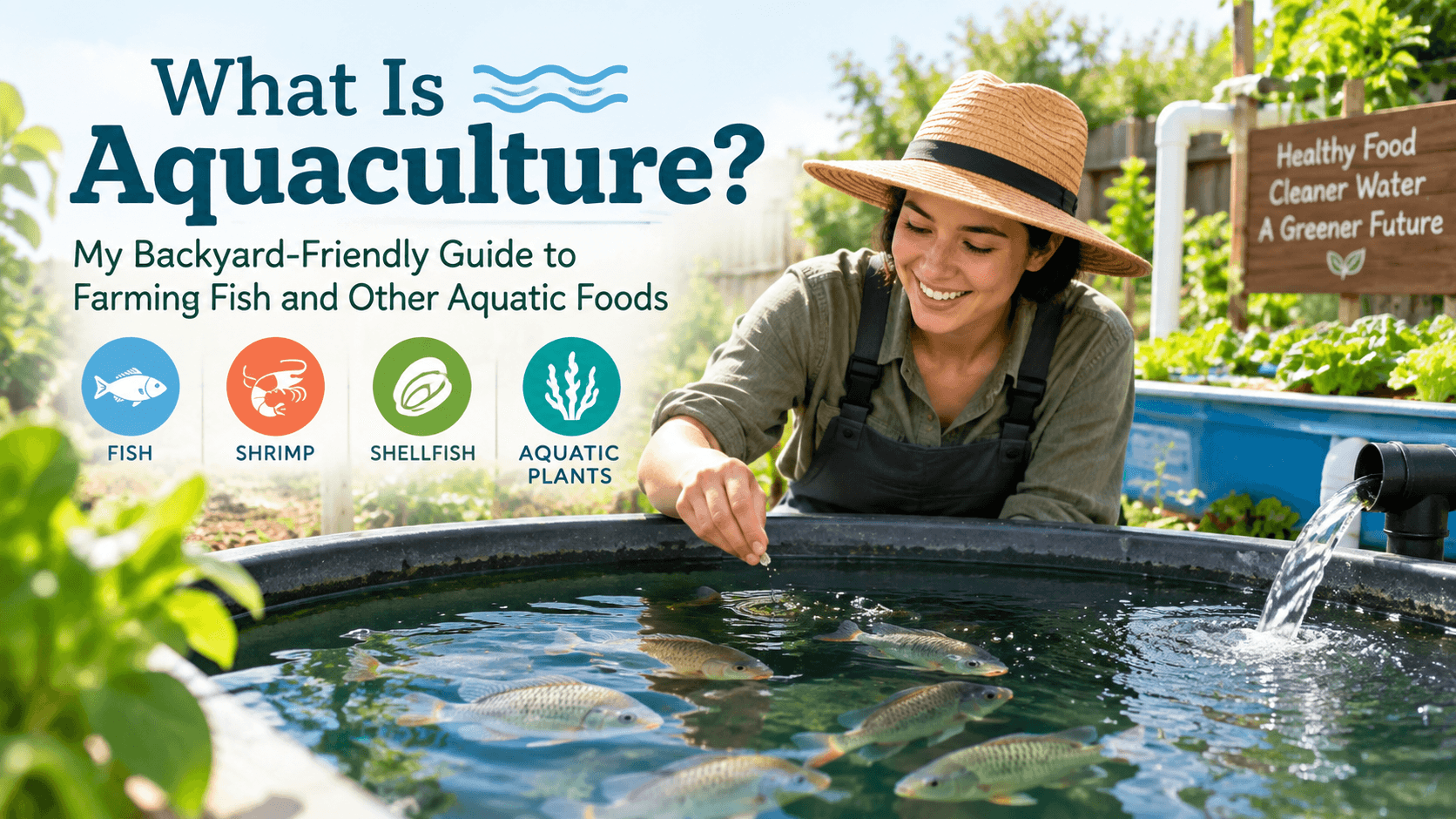
The first time I really started wondering what is aquaculture, I was standing beside a little water tank thinking about how strange farming can be. We normally picture farming as rows of tomatoes, chickens scratching around the backyard, or maybe a goat trying to eat something it shouldn’t. But farming doesn’t have to happen on dry land. Aquaculture is basically farming aquatic animals and plants, such as fish, shellfish, and algae, in controlled environments. NOAA describes it as the breeding, rearing, and harvesting of aquatic organisms in different water environments.
That simple idea actually opens up a pretty big world. Aquaculture can happen in freshwater ponds, tanks, rivers, coastal waters, or the ocean. It can be a huge commercial operation, but the basic idea is surprisingly similar to what many of us already do in a backyard garden: provide the right conditions, protect the crop, feed it when necessary, keep an eye on problems, and eventually harvest what you’ve grown. I’ve spent years messing around with homesteading projects, and one thing I’ve learned is that the simple-looking projects are often the ones that teach you the most. Water just happens to have a few more ways of biting you when you get things wrong.
So, What Is Aquaculture Really?
At its simplest, aquaculture means farming things that live in water. That includes fish, shrimp, oysters, clams, mussels, algae, and other aquatic organisms. The important word is farming. You’re not simply going down to a lake, catching a fish, and calling that aquaculture. FAO defines aquaculture around human intervention such as stocking, feeding, protecting the animals, and managing their growth.
Think about your vegetable garden. If you plant ten tomato plants, water them, protect them from pests, add nutrients, and eventually pick tomatoes, you’re farming. Aquaculture follows basically the same concept, except your “garden bed” is water. You might stock a pond with fish, provide feed, monitor water quality, protect the fish from predators, and harvest them when they’re ready. Some systems are incredibly simple, while others look more like a science laboratory with pipes, pumps, filters, sensors, and backup equipment everywhere.
Aquaculture vs. Wild Fishing
This difference is important because people sometimes use the words interchangeably. Wild fishing means catching aquatic animals that are living freely in oceans, rivers, lakes, or other natural environments. Aquaculture means raising aquatic organisms under managed conditions. FAO specifically separates farmed aquatic organisms from capture fisheries because the farmer owns and manages the stock during the growing period.
It’s a little like the difference between raising chickens in your backyard and walking into the woods hoping to find a chicken. One is farming. The other would be a very strange Tuesday.
Why Aquaculture Has Become So Important
Here’s where the subject gets much bigger than a backyard pond. According to the latest FAO State of World Fisheries and Aquaculture 2026, global aquaculture production of aquatic animals reached about 103 million tonnes in 2024, passing 100 million tonnes for the first time. Aquaculture accounted for about 53% of total aquatic animal production that year. When algae are included, aquaculture production reached about 141 million tonnes, valued at roughly $391 billion.
That’s not a little backyard experiment anymore.
The reason is pretty simple: people eat a lot of aquatic food, and wild fisheries can’t simply grow forever. FAO reports that capture fisheries have generally stabilized while aquaculture has continued expanding. Aquatic foods are also an important source of nutrition for billions of people.
How Big Is Aquaculture Today?
The numbers surprised me when I first looked into them. In 2024, global production of aquatic animals reached around 195 million tonnes, with aquaculture producing more than half of that amount. Asia is especially important in the industry and accounted for a very large share of global aquatic production.
But don’t let those huge numbers make you think aquaculture is only for giant companies. The same basic principles can be useful on a much smaller scale. A homesteader might have a small pond, stock fish, or experiment with a tank system. Someone else might use aquaponics to combine fish production with vegetable growing.
That’s what I like about it. The scale can change, but the basic farming idea stays the same.
The Main Types of Aquaculture
There are two broad categories you’ll hear about most often: freshwater aquaculture and marine aquaculture. Freshwater systems use water with very low salt levels and can include ponds, tanks, and other inland systems. Marine aquaculture involves species that live in saltwater or coastal environments and can include fish, shellfish, and seaweed. NOAA recognizes both freshwater and marine aquaculture and gives examples ranging from catfish and trout to oysters, clams, shrimp, salmon, and seaweeds.
For somebody interested in homesteading, freshwater systems are generally the easier concept to understand because you can potentially work with ponds or tanks on land. Marine aquaculture is a completely different ball game. You’re dealing with saltwater, tides, coastal conditions, specialized equipment, regulations, and species adapted to marine environments.
Freshwater Aquaculture
Freshwater aquaculture can be done in ponds, tanks, raceways, and other managed systems. Depending on where you live and local regulations, farmers may raise species such as trout, catfish, tilapia, carp, and others.
A small pond might sound easy, but here’s where I would slow down. Fish aren’t vegetables. You can’t just throw some in a pond and check back three months later while sipping coffee. Water temperature, oxygen, stocking density, feeding, disease, predators, and water chemistry all matter.
And fish have no problem reminding you when something is wrong.
Marine Aquaculture
Marine aquaculture includes farming species in the ocean, coastal waters, estuaries, or land-based systems using seawater. Shellfish can be grown in cages, on the seafloor, or in other managed environments, while some fish are raised in tanks or net pens.
It can also include seaweed and other aquatic plants. That’s one reason I like the term aquaculture more than simply “fish farming.” Fish are only one piece of the puzzle.
What Can You Raise Through Aquaculture?
This is probably the part that makes people realize just how broad aquaculture really is. Fish are the obvious example, but aquaculture can involve molluscs such as oysters and clams, crustaceans such as shrimp, aquatic plants and algae, and several other aquatic organisms. FAO’s broader definition includes fish, molluscs, crustaceans, aquatic plants, amphibians, and some other aquatic animals.
For a homestead, fish are probably the easiest place to start learning about the concept. But don’t assume every fish works in every climate. That’s a mistake I see people make with gardening too. Somebody grows a vegetable successfully in Florida and assumes it will behave the same way in a cold northern backyard. Nope.
The same goes for fish. Species selection needs to match your climate, water temperature, available space, local regulations, feed availability, and the kind of system you’re planning.
How Does a Small Aquaculture System Work?
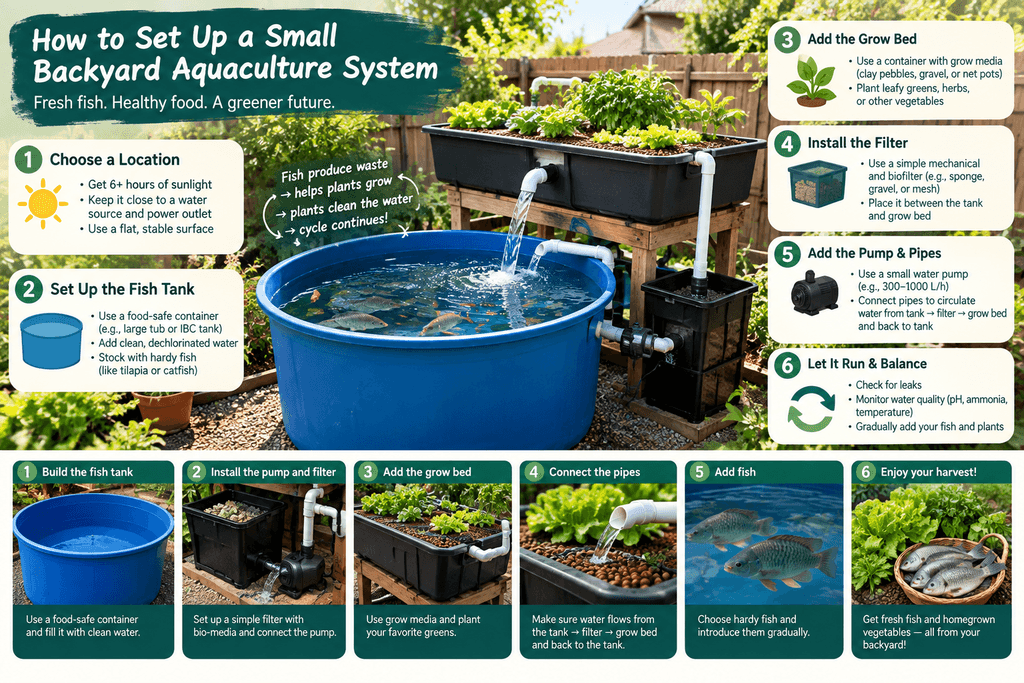
A basic aquaculture system needs a few things to work properly: water, suitable aquatic species, food or nutrients, oxygen, filtration or water management, and regular observation. That’s the simple version.
The tricky part is keeping all those pieces balanced.
Imagine your fish tank as a tiny living neighborhood. The fish produce waste. Microorganisms break down some of that waste. Plants may use certain nutrients in some systems. Water needs oxygen. Temperature affects metabolism. Too many fish can overwhelm the system. Too much food can create even more waste.
Water Quality Is Everything
If you’ve ever kept a bucket of water outside for too long, you already know water can change faster than you expect. It can warm up, become cloudy, grow algae, collect debris, and start smelling pretty awful.
Fish are living in that water 24 hours a day.
That’s why water quality is one of the biggest parts of aquaculture. Depending on the system and species, farmers may monitor temperature, oxygen, pH, ammonia, nitrite, salinity, and other conditions. You don’t necessarily need a giant commercial laboratory to understand the basics, but you do need to take water seriously.
Trust me, the fish aren’t going to politely tell you, “Hey buddy, the ammonia looks a little high today.”
They’ll just start struggling.
Could Aquaculture Work on a Homestead?
Yes, it can, but I’d approach it like any other new homesteading project: start smaller than your imagination wants you to.
I’ve made the classic mistake of getting excited about a project and buying too much stuff before understanding what I was doing. Suddenly you’ve got pipes, buckets, pumps, fittings, and a pile of equipment sitting around while you’re still asking yourself what half of it does.
Don’t do that.
Start by learning the biology. Understand the species. Learn what the water needs to look like. Understand feeding and stocking. Then think about equipment.
A small tank can teach you plenty before you ever consider a larger pond.
You also need to check local rules. Aquaculture, fish stocking, water use, ponds, and selling food can all be regulated differently depending on where you live. What works on one property may not be legal or practical on another.
Aquaponics and Aquaculture: What’s the Difference?
People often confuse aquaculture with aquaponics, and I don’t blame them. They’re closely related, but they’re not exactly the same thing.
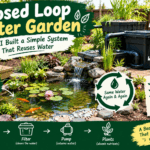
Aquaculture is the broader idea of farming aquatic organisms. Aquaponics combines aquaculture with plant production, creating a system where fish and plants are grown together. Fish waste provides nutrients that can be processed and used by plants, while the plant system helps clean the water before it returns to the fish.
For a homesteader, aquaponics can be especially interesting because you’re thinking about more than one harvest. You’re looking at fish and vegetables as parts of one little ecosystem.
It’s clever, but don’t believe every video that makes it look like you can build the whole thing from three plastic buckets in an afternoon. You can build simple systems, sure, but keeping living systems balanced takes observation.
My Biggest Lessons From Thinking Like a Homesteader
The biggest lesson I’ve learned from homesteading is that simple is usually better when you’re learning.
If I were starting an aquaculture project from scratch, I’d spend more time learning before buying equipment. I’d figure out what species fit my climate, how much space they need, what they’ll eat, how water quality is maintained, and what happens during a power failure.
That last one is easy to forget.
A garden can survive you forgetting to water it for a day. Fish can have much less patience when pumps or aeration systems stop working. A backup plan matters.
I’d also keep records. Write down water temperature, feeding amounts, problems, changes, and anything unusual. It sounds boring until something goes wrong and you suddenly realize you have no idea what changed.
That’s when a notebook becomes your best friend.
The Good and Bad Sides of Aquaculture
Aquaculture has some real advantages. It can produce food in controlled environments, support food security, create jobs, and reduce pressure on some wild fisheries. NOAA describes aquaculture as an important source of seafood and says it can also support habitat restoration and rebuilding certain populations.
But it isn’t magic.
Poorly managed aquaculture can create environmental problems, disease concerns, waste issues, escapes, or other impacts depending on the species and production system. That’s why responsible management matters so much. FAO’s latest reporting also emphasizes sustainability, science-based governance, innovation, and climate-smart approaches as aquaculture continues growing.
For me, that’s the important part. Don’t look at aquaculture as automatically good or automatically bad. Look at how it is being done.
A well-managed system is very different from a neglected one.
Conclusion: What Is Aquaculture Worth Knowing For?
So, what is aquaculture? In plain English, it’s farming aquatic animals and plants under managed conditions. It can mean raising fish in a backyard pond, growing shellfish in coastal waters, producing seaweed, operating a commercial fish farm, or combining fish and vegetables through aquaponics. The industry has become a major part of the world’s food system, with global aquaculture production of aquatic animals reaching 103 million tonnes in 2024 according to the latest FAO figures.
For a homesteader, I think the most useful way to look at it is simply as another form of food production. You don’t need to jump into a huge system tomorrow. Learn first. Start small. Watch the water. Understand your animals. And please, don’t buy a garage full of equipment before you know what half of it does.
I’ve made that mistake enough times for both of us.
If you’re interested in becoming more self-sufficient, aquaculture is definitely worth learning about. It might become your next big homesteading project, or you might decide that keeping a vegetable garden and a few chickens is plenty. Either way, understanding what is aquaculture gives you another useful piece of the self-sufficiency puzzle.
Got a weird aquaculture question? Ask it. I like the weird ones.
Frequently Asked Questions About Aquaculture
1. What is aquaculture in simple words?
Aquaculture is farming in water. Instead of growing tomatoes, corn, or chickens on land, you raise aquatic animals or plants such as fish, shrimp, oysters, clams, or algae in managed conditions.
2. Is aquaculture the same as fish farming?
Not exactly. Fish farming is one type of aquaculture, but aquaculture is a much bigger category. It can include fish, shellfish, shrimp, aquatic plants, and algae.
3. Can aquaculture be done on a small homestead?
It can, depending on your land, climate, water supply, species, equipment, and local rules. A small tank or suitable pond can be a learning project, but don’t underestimate water quality, oxygen, feeding, and emergency planning.
4. Is aquaculture environmentally friendly?
It depends on how the system is designed and managed. Some aquaculture systems can be highly efficient, while poorly managed operations can cause environmental problems. Sustainable practices, good stocking levels, waste management, and responsible species selection are important.
5. What is the difference between aquaculture and aquaponics?
Aquaculture focuses on farming aquatic organisms. Aquaponics combines aquaculture with plant growing, using connected water and nutrient cycles to raise fish and plants in one system.