
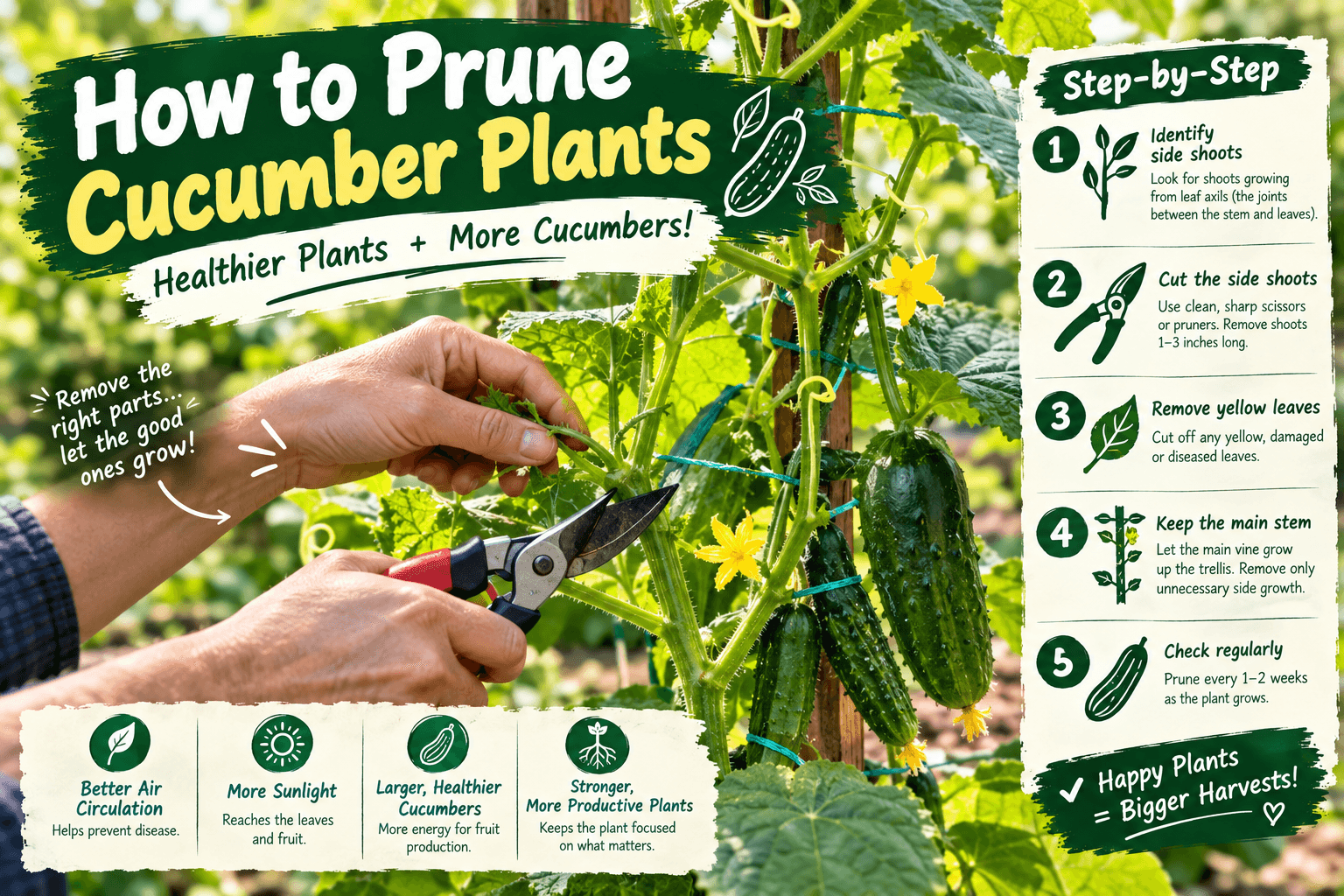
How to Prune Cucumber Plants . The first year I grew cucumbers, I thought more vines meant more cucumbers.
So I let them grow.
And grow.
And grow.
Pretty soon the cucumber vines had taken over one whole corner of my backyard garden. They climbed over the trellis, crawled into the tomatoes, grabbed onto the fence, and somehow ended up halfway across the walkway.
I remember standing there with a cucumber in one hand and pruning shears in the other thinking, “Am I supposed to cut this thing or just let it take over the property?”
That’s when I finally learned how to prune cucumber plants properly.
And here’s the funny thing. You don’t need to attack the plant with a pair of scissors every morning. Cucumber pruning is actually pretty simple when you understand what you’re trying to accomplish.
The goal isn’t to make the plant look perfect.
The goal is to keep it manageable, improve airflow, remove damaged growth, and help the plant put its energy into healthy growth and fruit.
Do Cucumber Plants Really Need Pruning?
Not every cucumber plant needs heavy pruning.
That’s the first thing I’d tell a new gardener.
Some cucumber varieties are naturally compact. Others are vigorous vines that seem determined to cover every square inch they can reach.
If you’re growing cucumbers on the ground in a large garden, you may not need to prune much at all.
But if you’re growing cucumbers vertically on a trellis, pruning can make things much easier.
I especially like pruning when I’m working with limited backyard or urban garden space.
Instead of having a giant tangled pile of vines, I can train the plant where I want it to go.
And when harvest time comes, I can actually find the cucumbers.
That sounds like a small thing.
It isn’t.
I’ve lost plenty of cucumbers inside a jungle of leaves before.
First, Know What Kind of Cucumber You’re Growing
Before you start cutting, look at the variety.
This matters.
Some cucumbers are bush types and stay relatively compact.
Others are vining cucumbers that can grow several feet or more and need support.
If you have a vining variety, a trellis makes pruning and training much easier.
I like a sturdy vertical trellis because cucumbers are natural climbers.
They grab onto supports with their tendrils and will happily climb upward if you give them something to hold.
For a small garden, this can save a surprising amount of space.
When Should You Start Pruning Cucumbers?
I don’t start cutting the plant when it’s a tiny seedling.
Let it establish first.
Once the cucumber plant is actively growing and has several healthy leaves and a main vine, that’s when I start paying attention.
You don’t need to remove every little side shoot.
Instead, I watch how the plant is growing.
Is it heading where I want?
Are some leaves touching the soil?
Are there damaged leaves?
Are several vines becoming tangled together?
Is the plant getting so thick that I can’t see inside it?
Those are the things I look for.
How to Prune Cucumber Plants Step by Step
Here’s the basic method I use.
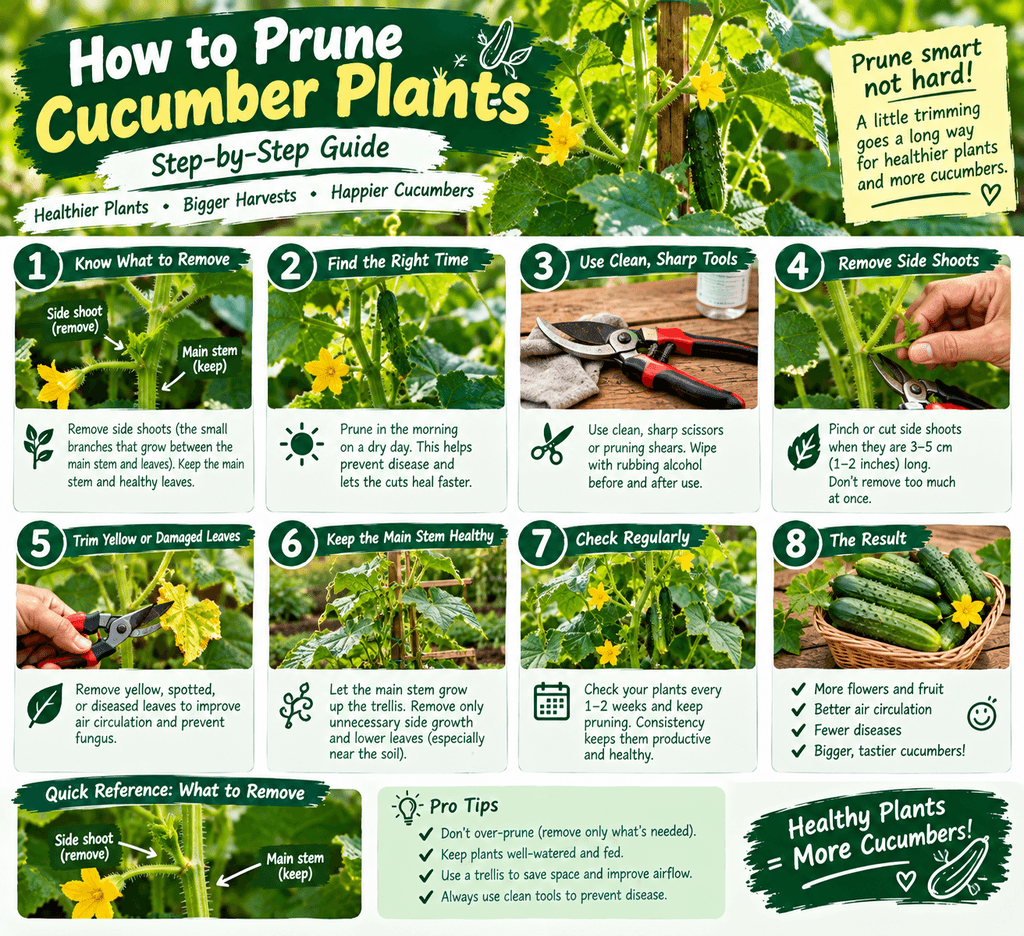
1. Start With Clean Pruning Shears
Before cutting anything, make sure your pruning shears are clean and reasonably sharp.
You don’t want to crush the stems.
And you don’t want to casually move plant diseases from one plant to another with dirty tools.
I learned that lesson after pruning several plants in a row without cleaning my shears.
Not my brightest gardening moment.
2. Remove Dead or Damaged Leaves
This is usually where I start.
If a leaf is completely dead, badly damaged, or clearly diseased, I remove it.
Don’t keep a dead leaf just because you feel bad about cutting it.
The plant isn’t going to miss it.
I cut the leaf stem cleanly rather than ripping it off.
If I suspect a leaf is diseased, I avoid tossing it into my compost pile unless I know my composting system will properly handle the problem.
I don’t want to spread disease back into next year’s garden.
3. Remove Leaves Touching the Ground
Leaves sitting directly on damp soil can become dirty and are more likely to run into disease and pest problems.
If a cucumber vine has leaves dragging across the ground, I’ll usually remove some of the lowest ones.
This also helps me keep the area underneath the plant easier to inspect.
And believe me, being able to see what’s happening under your cucumber plant is useful.
I’ve found slugs, weeds, little cucumber fruits hiding under leaves, and once a very annoyed frog.
He looked like he owned the place.
Should You Cut Off Cucumber Suckers?
Cucumber plants don’t behave exactly like tomatoes, so I don’t treat every side shoot like a tomato sucker that must be removed.
This is where gardeners sometimes go overboard.
A healthy cucumber side shoot can produce flowers and fruit.
So I don’t automatically cut every branch that appears.
Instead, I decide whether that side shoot is helping or making the plant impossible to manage.
If the plant is growing vertically and has plenty of room, I may allow several healthy side shoots.
If everything is becoming tangled, I’ll selectively remove some of the smaller or poorly placed growth.
Think selective pruning, not haircut.
Training Cucumbers Up a Trellis
This is probably my favorite way to grow them.
When the main vine starts reaching the trellis, I gently guide it toward the support.
Don’t bend a thick vine sharply.
Cucumber stems can be surprisingly easy to damage.
I guide the plant gradually and let the tendrils do much of the work.
Once the plant understands where it’s supposed to grow, it’ll usually take over from there.
Every few days, I check the vines and redirect any that are heading into the wrong direction.
This takes maybe five minutes.
That’s a lot easier than trying to untangle a cucumber jungle later.
What About the Top of the Plant?
This depends on how you’re growing it and how much space you have.
If my cucumber reaches the top of a trellis, I don’t immediately chop the main vine just because it got tall.
I first look at the overall plant.
If the vine has room to grow and remains healthy, I may let it continue.
If it’s getting out of control or growing far beyond the support, I may redirect it or carefully prune it.
The important thing is not to remove huge amounts of healthy growth all at once.
That’s one of my biggest rules with pruning.
Small cuts.
Watch the plant.
Then decide what to do next.
Don’t Remove Too Many Leaves
Here’s where I messed up badly one summer.
I thought opening up the plant would improve airflow.
So I removed a bunch of leaves.
Then I stood there admiring my “beautifully pruned” cucumber plant.
The next few days were hot and sunny.
The cucumbers were not impressed.
Leaves are important.
They help the plant capture sunlight and produce the energy it needs to grow.
So don’t strip the plant bare.
You want a balance.
Remove unhealthy, damaged, overcrowded, or poorly placed growth while keeping plenty of healthy leaves.
What About Flowers?
I don’t normally remove healthy cucumber flowers just because they’re there.
The flowers are how you’re going to get cucumbers.
But here’s something worth knowing.
Some cucumber varieties produce separate male and female flowers, while certain greenhouse or parthenocarpic varieties behave differently.
So don’t panic if you see flowers but don’t immediately see fruit.
And don’t start chopping flowers off because someone told you that you need to.
Know your variety first.
Why Pruning Can Help in a Small Garden
This is where how to prune cucumber plants becomes especially useful for urban homesteaders.
When you have a big country garden, you can let cucumber vines wander.
When you’re working with a small backyard, patio, or raised bed, you’ve got limited space.
I want my cucumber vines growing upward rather than taking over my walkway.
A trellis combined with light pruning gives me much more control.
I can grow several plants in an area that would otherwise become completely covered.
It’s one of those simple permaculture-style ideas I like: use vertical space instead of constantly trying to find more ground.
Pruning Can Make Harvesting Easier
This might be my favorite benefit.
Cucumber plants can hide fruit incredibly well.
One day you see a tiny cucumber.
Two days later you can’t find it.
A week later you’ve got something the size of a baseball bat hiding under a leaf.
I swear cucumbers do this on purpose.
Keeping some of the growth organized makes it easier to spot fruit.
And regular harvesting is important because leaving mature cucumbers on the plant can reduce the plant’s usefulness for producing more young fruit.
So while you’re pruning, look for cucumbers at the same time.
Two jobs.
One garden walk.
What I Do With Yellow Leaves
Not every yellow leaf means disease.
Sometimes an older leaf naturally ages.
Other times yellowing can be related to watering problems, nutrient issues, pests, disease, or stress.
That’s why I don’t immediately grab the fertilizer when I see yellow.
First I look at the whole plant.
Is the soil soaking wet?
Is it bone dry?
Are there insects underneath the leaves?
Are new leaves healthy?
Are there spots or unusual patterns?
One leaf doesn’t tell you the whole story.
That’s a mistake I made when I was younger.
I’d see yellow and immediately assume the plant needed something.
Sometimes the plant just needed me to stop watering it every five minutes.
Watch for Cucumber Pests While Pruning
Pruning time is a good time to inspect your plants.
Look underneath leaves.
Check the stems.
Look at new growth.
Cucumber plants can attract several pests, and catching problems early is much easier than dealing with a major infestation later.
I pay special attention to anything chewing holes in leaves or clustering around tender new growth.
If something looks suspicious, I take a closer look before deciding what to do.
I don’t spray something just because I saw one bug.
Some insects are harmless or even useful.
The garden isn’t supposed to be completely bug-free.
That’s not realistic.
How Often Should You Prune Cucumbers?
I don’t put cucumber pruning on a strict calendar.
I check the plants regularly.
Usually, when I’m already watering, harvesting, or walking through the garden, I’ll spend a couple minutes looking at the vines.
That’s enough.
If everything looks good, I don’t cut anything.
If I see a dead leaf, I remove it.
If a vine is heading into the tomatoes, I redirect it.
If the lower leaves are touching the soil, I clean some of them up.
If there’s a badly damaged section, I deal with it.
It’s more like maintenance than a big gardening job.
My Biggest Cucumber Pruning Mistakes
I’ve made plenty, so let me save you some trouble.
Cutting Too Much
This is probably the biggest one.
Don’t think more pruning automatically means more cucumbers.
It doesn’t.
Using Dirty Tools
Clean your shears, especially when moving between plants.
Pruning When the Plant Is Stressed
If the cucumber is already struggling from heat, drought, transplant shock, or another problem, I don’t start giving it a major haircut.
Fix the basic problem first.
Ignoring the Trellis
A trellis is much easier to use if you train the cucumber early.
Don’t wait until you’ve got six feet of tangled vines.
Ask me how I know.
Letting Giant Cucumbers Hide
Check under the leaves regularly.
The cucumber you can’t see is usually the one that’s getting enormous.
My Simple Cucumber Routine
Here’s what I do during the growing season.
I walk past the plants.
I check the soil.
I look for ripe cucumbers.
I inspect the leaves.
I redirect vines.
I remove dead or damaged growth.
And then, very importantly, I leave the plant alone.
That’s it.
You don’t need to turn cucumber pruning into a full-time job.
The plant already knows how to grow.
We’re just helping it grow where we want it.
Frequently Asked Questions about How to Prune Cucumber Plants
Should I prune cucumber plants?
You don’t always need to heavily prune cucumbers. Light pruning can be useful for removing dead or damaged leaves, improving organization on a trellis, keeping foliage off the soil, and controlling excessive growth.
Where do I cut cucumber vines?
Make clean cuts with clean, sharp shears. Remove damaged leaves or unwanted growth at an appropriate junction rather than tearing the plant. Avoid removing large amounts of healthy foliage at once.
Can I prune cucumber plants growing on a trellis?
Yes. Trellised cucumbers are often easier to manage with light, selective pruning and regular training. Guide the vines upward and remove growth that’s becoming crowded, damaged, or difficult to manage.
The Way I Look at Cucumber Pruning Now
After years of growing vegetables, I’ve stopped trying to make every plant look perfect.
My cucumber plants aren’t going to win any garden beauty contest.
They’re messy.
They’re always reaching for something.
They grab onto tomatoes, fences, trellises, and occasionally me when I’m trying to harvest them.
But that’s okay.
The goal isn’t perfect-looking vines.
The goal is healthy plants and plenty of cucumbers.
If you’re learning how to prune cucumber plants, start small. Remove dead leaves, clean up the bottom of the plant, guide the vines onto a support, and only remove healthy growth when you actually have a reason.
Don’t stand there with the pruning shears thinking, “Well, I’ve got these, so I better cut something.”
I’ve done that.
It doesn’t end well.
Give your cucumber plants good sunlight, steady moisture, a decent trellis, healthy soil, and regular harvesting. Then use pruning as a little bit of maintenance to keep everything under control.
And if your cucumber vines still manage to take over half the backyard?
Welcome to the club.
Got a cucumber plant that’s growing completely wild? Leave a comment and tell me what it’s doing. I’ve probably seen something similar in my own garden.