
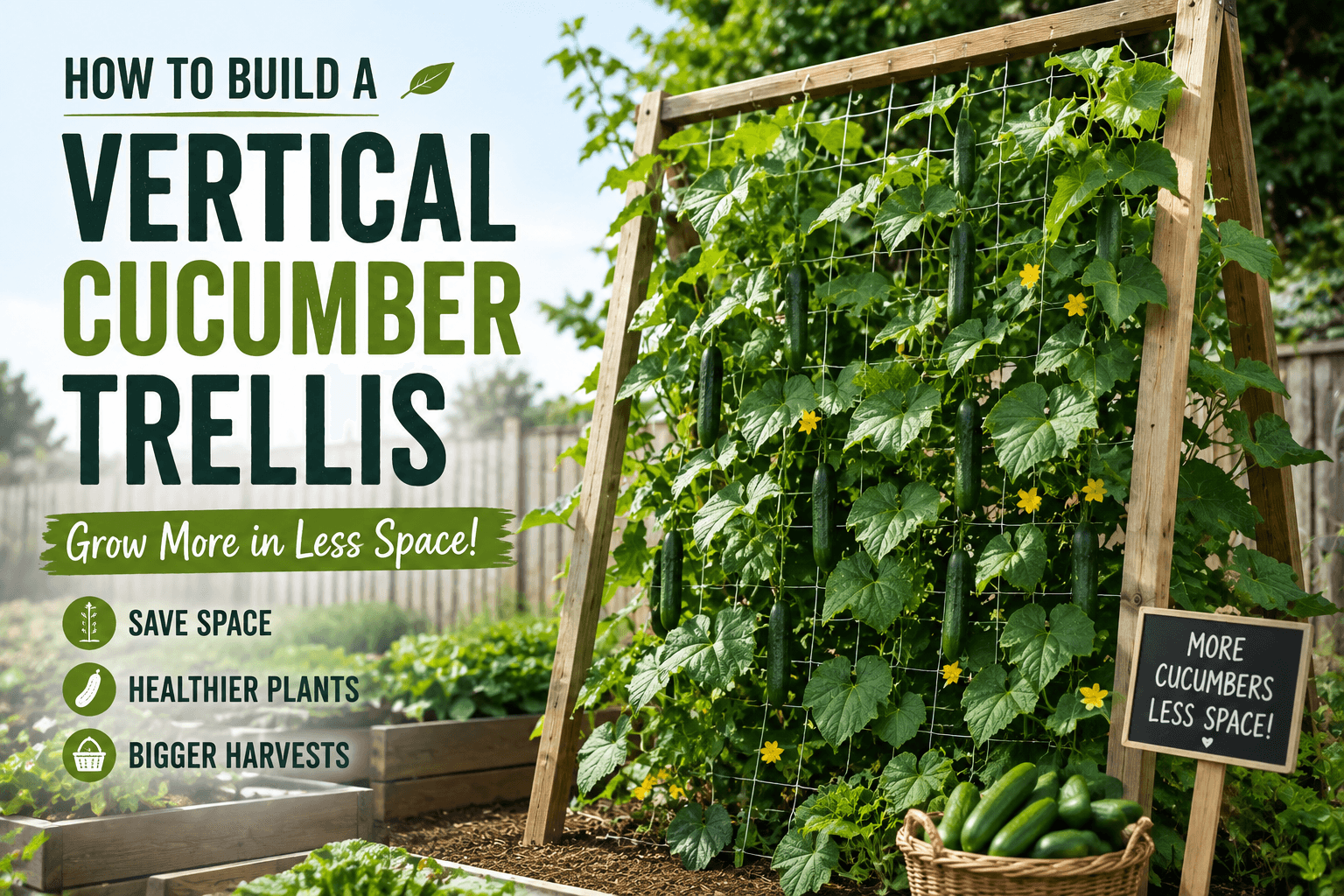
Vertical Cucumber Trellis .The first time I tried growing cucumbers vertically, I wasn’t completely convinced it would work.
I was used to letting cucumber vines crawl all over the garden. By July, they had taken over half the bed, climbed into the tomatoes, and somehow managed to wrap themselves around a garden chair.
I’m still not sure how they did that.
The problem was that I was losing a lot of garden space to vines. The cucumbers themselves were fine, but finding them was another story. I’d lift a leaf and find one tiny cucumber, then move another leaf and discover a cucumber that had somehow turned into a baseball bat.
That’s when I started using a vertical cucumber trellis.
And honestly, I wish I’d done it years earlier.
Growing cucumbers vertically doesn’t mean you need a fancy garden structure. A few strong posts, some trellis netting, and a little patience can turn a messy cucumber patch into a much easier crop to manage.
So let me show you how I build and use a vertical cucumber trellis, what I learned from doing it wrong, and a few things I’d definitely do differently if I were starting again.
Why I Started Growing Cucumbers Vertically
Space was the biggest reason.
Cucumber plants can take up a surprising amount of room when you let the vines run across the ground.
In a small backyard garden, that’s a problem.
I’d rather use that space for tomatoes, peppers, beans, lettuce, herbs, or another crop.
A vertical cucumber trellis lets the vines grow upward instead of spreading everywhere.
You still need enough space around the roots, but the vines can use the air above the garden.
That’s especially useful for:
- Small backyard gardens
- Raised garden beds
- Urban homesteading
- Patio gardens
- Small vegetable plots
- Container gardens
- Square-foot style gardening
And there’s another benefit I really like.
It’s easier to find the cucumbers.
Once the vines are trained upward, I can actually see what I’m growing.
That means fewer cucumbers hiding under leaves until they’re enormous.
What Kind of Trellis Do Cucumbers Need?
Here’s where I made a mistake the first time.
I thought a little garden net hanging from a fence would be enough.
It wasn’t.
Cucumber vines may look lightweight, but once they’re covered with leaves and loaded with fruit, the whole plant gets heavier.
Then add wind.
Then add rain.
Suddenly that little piece of netting isn’t looking so clever anymore.
A good cucumber trellis needs to be strong, stable, and tall enough for the variety you’re growing.
Some simple options include:
- Wooden posts with trellis netting
- Cattle panels
- Garden fencing
- Metal garden arches
- Wooden lattice
- Heavy-duty garden mesh
- A-frame trellises
I’ve used several styles over the years.
My favorite is still a simple wooden frame with sturdy trellis netting because it’s inexpensive and easy to repair.
How Tall Should a Vertical Cucumber Trellis Be?
There’s no single perfect height.
It depends on the cucumber variety and how much room you have.
For many backyard setups, around 5 to 7 feet gives the vines plenty of room to climb.
But don’t build a giant structure just because you can.
I made that mistake too.
I built one taller than I really needed, and harvesting the top section became a ridiculous exercise involving a step ladder and me trying not to fall into the garden.
These days, I build the trellis high enough for the variety I’m growing and high enough that I can comfortably reach the fruit.
That’s the important part.
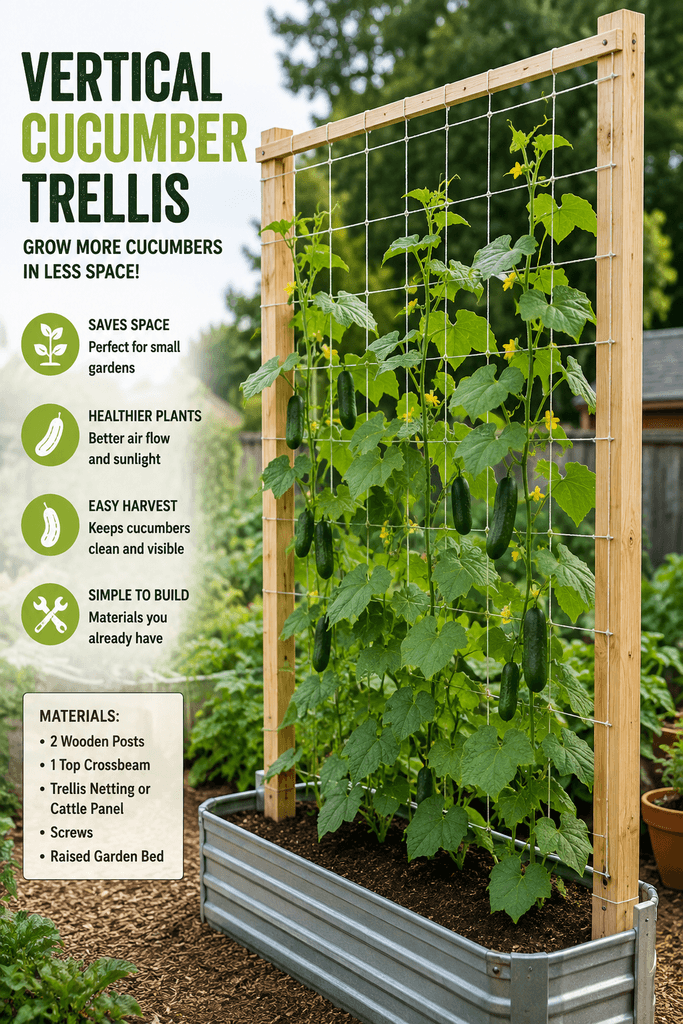
What You’ll Need to Build a Simple Cucumber Trellis
You don’t need a truckload of materials.
For a basic setup, I’d use:
- 2 sturdy wooden posts
- 1 top crosspiece
- Trellis netting or strong garden mesh
- Outdoor screws
- Staple gun or suitable fasteners
- Drill
- Measuring tape
- Cucumber plants
You can make it more complicated if you want.
But I’ve learned that simple is usually better.
The more parts you add, the more things there are to break.
Step 1: Choose the Right Location
Before building anything, look at your garden.
Cucumbers love sunlight, so choose a location that gets plenty of light.
Don’t put the trellis somewhere that gets shaded most of the day by a garage, tall fence, or large tree.
I learned this with one of my first raised beds.
The location looked sunny when I planted.
Then summer arrived and the afternoon shade covered half the bed.
The cucumbers grew, but they were nowhere near as productive as the ones getting better light.
Watch the area before you build.
That’s a lot easier than moving a heavy trellis later.
Step 2: Make the Frame Strong
This is probably the most important part of the project.
Push or secure your posts firmly into the ground.
If you’re working with a raised bed, make sure the posts are properly attached to the bed or supported independently.
Then add your top crosspiece.
You want the frame to stay upright when the plants become heavy.
Don’t build it like a decorative garden fence.
Build it like something that has a job to do.
Because it does.
Step 3: Attach the Trellis Netting
Stretch the netting between the posts.
Try not to leave it hanging loose.
The vines need something they can grab onto as they grow.
Secure the top and sides well.
If you’re using a heavier material like welded wire or a cattle panel, make sure your posts are strong enough to support it.
For lighter cucumber varieties, garden netting can work very well.
Just remember that the trellis itself is only half the system.
The other half is how you train the plants.
Step 4: Plant Your Cucumbers
You can start cucumbers from seed directly in the garden or transplant healthy young plants.
When planting near a trellis, give the roots enough space.
Don’t cram six cucumber plants into a tiny bed just because you have a tall trellis.
I’ve done this.
The plants looked great for about two weeks.
Then everything became a jungle.
More plants doesn’t always mean more cucumbers.
Sometimes it just means more leaves fighting for sunlight, more watering, and more problems finding the actual fruit.
Step 5: Start Training the Vines
This is the part that looks almost too simple.
As the cucumber vines grow, gently guide them toward the trellis.
At first, they may need a little help.
You can loosely tie them with soft garden twine or use suitable plant clips.
Don’t tie the stems tightly.
Cucumber vines are soft and easy to damage.
Once the tendrils start grabbing the trellis, they’ll often do much of the work themselves.
I still check them every few days.
A vine can decide to grow sideways overnight.
Plants don’t read the instructions.
What If the Cucumber Vine Falls Away From the Trellis?
Don’t panic.
I’ve had this happen plenty of times.
Just gently guide the vine back toward the support.
If it has become heavy, use a soft tie to help hold it in place.
Don’t yank it.
Cucumber stems can be surprisingly easy to damage.
A few minutes of gentle training every few days is much easier than trying to untangle a giant mess later.
Trust me.
I learned that the hard way.
Why Growing Cucumbers Vertically Can Make Harvesting Easier
This is probably my favorite part.
When cucumbers grow along the ground, the leaves can hide the fruit.
You lift one leaf.
Nothing.
Move another.
Still nothing.
Then you discover a cucumber the size of a baseball bat.
Growing vertically gives you a better view of the vines and fruit.
I can walk along the trellis and spot cucumbers much faster.
That means I can pick them while they’re still the size and shape I actually want.
Regular harvesting also encourages you to keep checking the plant.
And once you’re picking cucumbers regularly, you suddenly have a new problem.
What the heck are you going to do with all of them?
That’s a good problem, though.
Pickles, salads, sandwiches, refrigerator pickles…
I’ve done all of them.
Keep the Cucumbers Off the Ground
Another thing I like about vertical growing is keeping the fruit away from wet soil.
When cucumbers are sitting directly on the ground, they can get dirty and may have more contact with damp soil.
Growing upward keeps the fruit cleaner and makes it easier to inspect.
I also find it easier to notice damaged or misshapen cucumbers before they become a bigger issue.
It’s not a cure-all for pests or disease, but getting better airflow and keeping foliage and fruit organized certainly makes the garden easier to manage.
Watering Vertical Cucumbers
Here’s another lesson I learned.
Don’t assume vertical plants need less water.
They don’t.
The roots are still sitting in the same garden soil, and cucumbers can be thirsty plants, especially during hot weather when they’re actively producing fruit.
I water deeply when needed rather than giving the plants a tiny splash every day.
The exact schedule depends on your soil, temperature, rainfall, and container size.
If you’re growing cucumbers in a container or raised bed, check the soil more often because it can dry out faster.
And try to water the soil rather than constantly soaking the leaves.
Give Your Cucumbers Good Soil
Cucumbers grow best when they have fertile soil and consistent moisture.
Before planting, I like to work finished compost into my garden beds.
That’s one of those boring jobs that pays off later.
I’ve tried growing cucumbers in poor soil before.
The plants grew, but they weren’t nearly as impressive.
Now I start with soil that’s already in decent shape.
If you’re growing in containers, use a quality potting mix rather than digging up a bucket of heavy backyard dirt.
I learned that one after nearly throwing my back out trying to move a container full of wet garden soil.
Don’t Overcrowd the Trellis
This deserves its own section because it’s an easy mistake.
You see all that empty trellis space and think:
“I can fit another plant.”
Then another.
And maybe one more.
Don’t.
Leave enough room for air to move through the foliage.
A dense wall of cucumber leaves can become difficult to manage.
I’d rather have fewer healthy plants that I can easily inspect than a giant wall of tangled vines.
What Cucumbers Are Best for Vertical Growing?
Most vining cucumber varieties can benefit from support.
Look for varieties described as:
- Vining
- Climbing
- Trellis-friendly
- Compact
- Patio varieties
Bush cucumbers are different.
They generally don’t climb in the same way, so they’re often better suited to containers or smaller garden spaces without a tall trellis.
Always check the seed packet or plant label before building your setup.
That’s one of the easiest ways to avoid growing the wrong variety for your space.
My Biggest Vertical Cucumber Trellis Mistakes
I’ve made plenty.
Mistake #1: Making the Trellis Too Weak
The vines got heavy and the structure started leaning.
Not good.
Build stronger than you think you need.
Mistake #2: Waiting Too Long to Train the Vines
I once waited until the vines were tangled together.
That was a nightmare.
Start training while the plants are young.
Mistake #3: Planting Too Many Cucumbers
More plants aren’t automatically more harvest.
Give them room.
Mistake #4: Ignoring the Bottom of the Trellis
I focused so much on the vines climbing upward that I forgot about the base.
Make sure the bottom is secure and the plants have good soil and enough space.
Mistake #5: Forgetting to Harvest
This sounds ridiculous.
But when cucumber plants get going, they can produce quickly.
Check them regularly.
A cucumber that looks small today can be huge surprisingly fast.
Can You Build a Vertical Cucumber Trellis in a Raised Bed?
Absolutely.
Actually, this is one of my favorite setups.
You can place the trellis along the back edge of a raised bed and grow cucumbers upward.
Then use the front portion of the bed for smaller crops.
For example, you could grow:
Back: Cucumbers
Middle: Bush beans or peppers
Front: Lettuce, herbs, or radishes
That lets you use vertical space and ground space at the same time.
That’s exactly the kind of thing I like about backyard homesteading.
You don’t necessarily need more land.
Sometimes you just need to use the land you already have a little smarter.
What About a Cucumber Trellis in a Small Garden?
This is where vertical gardening really shines.
If you’re working with a tiny backyard, you don’t want cucumber vines covering every inch of soil.
A trellis lets you move the vines upward.
You can even build an A-frame trellis over a narrow garden bed.
Just make sure it’s stable and doesn’t block sunlight from other plants.
In an urban garden, vertical growing can make a huge difference.
A small garden can still produce a surprising amount of food when you use the vertical space.
My Simple Cucumber Trellis Routine
Once the plants are established, I don’t spend hours working on them.
A few times each week, I:
- Check the vines
- Guide loose stems back onto the trellis
- Look for pests
- Check the soil moisture
- Remove damaged leaves when necessary
- Pick cucumbers that are ready
That’s pretty much it.
The biggest job is keeping up with the harvest.
And honestly, that’s a problem I don’t mind having.
FAQ About Vertical Cucumber Trellises
Do cucumbers need a trellis?
Not always. Some cucumber varieties can grow along the ground, but vining varieties often benefit from a trellis. Vertical support can save garden space and make harvesting easier.
How tall should a cucumber trellis be?
Around 5 to 7 feet works well for many backyard setups, but the ideal height depends on the cucumber variety and your available space. Build it so you can comfortably reach the plants and fruit.
Can cucumbers grow vertically in containers?
Yes. Compact or vining cucumber varieties can grow in suitable containers with a strong trellis. The container needs enough root space, good drainage, and consistent moisture.
What can I use for a cucumber trellis?
You can use trellis netting, sturdy garden mesh, welded wire, cattle panels, wooden lattice, or a homemade wooden frame. The important thing is that the structure can support the mature plant and fruit.
Final Thoughts
I started using a vertical cucumber trellis because I was tired of cucumber vines taking over my garden.
What I didn’t expect was how much easier the whole crop would become.
I can see the plants.
I can find the cucumbers.
I can harvest without crawling through a jungle of vines.
And most importantly, I’m using my garden space much better.
You don’t need an expensive system either.
A couple of sturdy posts, some good trellis material, healthy cucumber plants, and a little time can get you started.
If you’re growing cucumbers in a small backyard, raised bed, or urban garden, I’d definitely give vertical growing a try.
Just don’t make my mistake and wait until the vines are six feet long before training them.
By then, you’ve got a cucumber wrestling match on your hands.
Build the vertical cucumber trellis first, give the plants something strong to climb, and keep checking those vines as they grow.
And if you end up with more cucumbers than your family can eat, well…
That’s when the pickle jars come out.










1 thought on “My Vertical Cucumber Trellis: How I Grow More Cucumbers in Less Space”