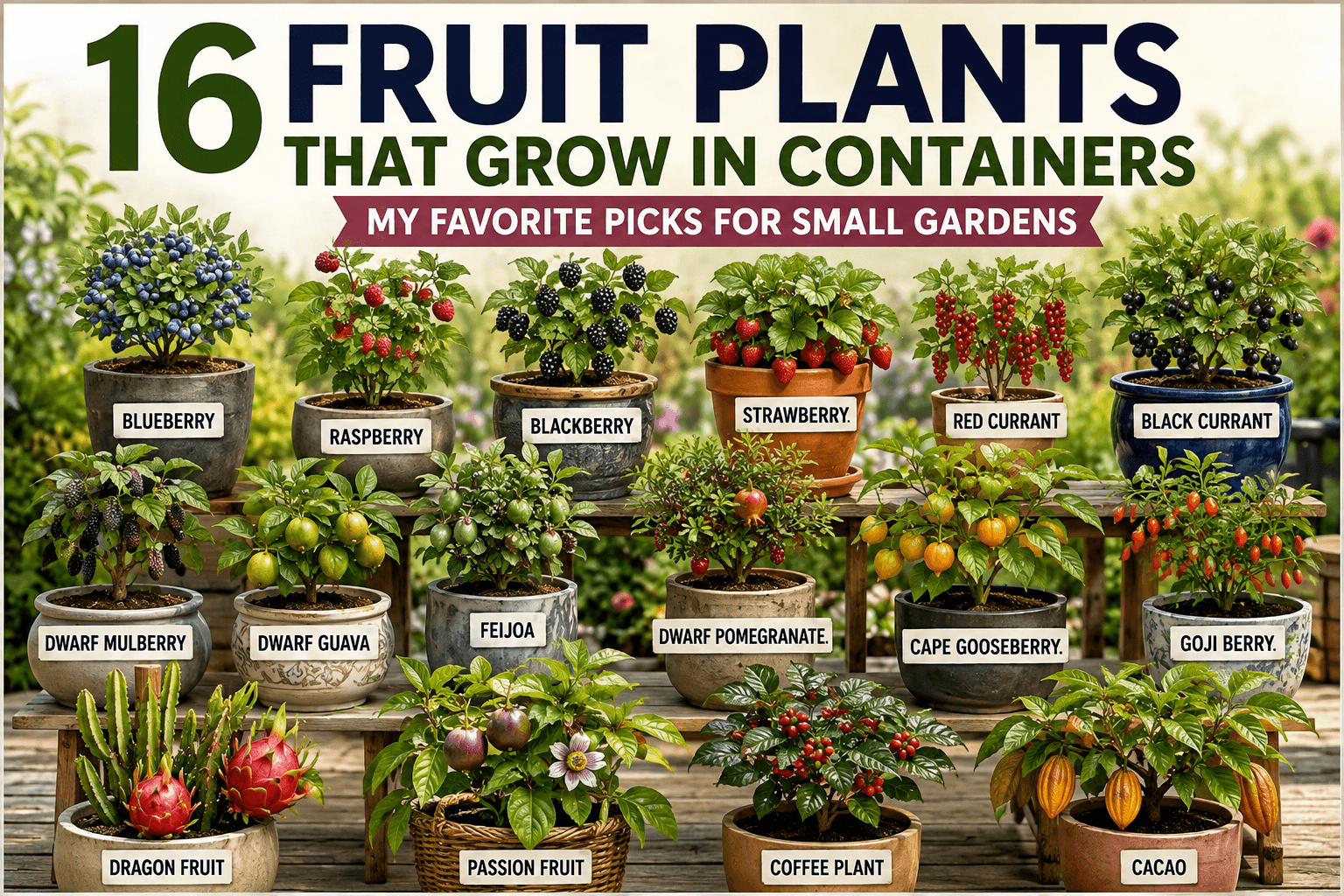
Fruit Plants That Grow in Containers . The first time I tried growing fruit in containers, I honestly didn’t expect much.
I had a couple of big pots sitting around the backyard and thought, why not put something useful in them?
So I bought a small blueberry plant, filled a container with soil, and stuck it in the corner of the patio.
Simple, right?
Well… sort of.
The blueberry survived, but I learned pretty quickly that fruit plants that grow in containers have different needs than vegetables. The pot size matters. Drainage matters. Sunlight matters. And some plants are much happier in containers than others.
I also made the classic mistake of choosing a pot that was too small.
The plant looked great at the garden center. A few months later, it was basically sitting there wondering why I’d put it in a coffee cup.
Since then, I’ve tried quite a few different fruit plants in containers. Some were easy. Some needed more attention. And a couple made me wonder why I bothered.
So if you’re working with a small backyard, patio, balcony, or urban garden, lemme show you my favorite fruit plants that grow in containers and what I’ve learned along the way.
Can You Really Grow Fruit in Containers?
Absolutely.
You don’t need a huge piece of land to grow fruit.
That’s one of the things I really like about container gardening.
With the right variety and a large enough container, you can grow certain berries, citrus, dwarf fruit trees, grapes, and other fruiting plants in a surprisingly small space.
But there’s an important difference between growing a plant in a pot and growing a plant that actually produces a useful harvest.
A plant might survive in a container without really thriving.
That’s why I pay attention to the mature size of the plant before buying it.
If the label says it wants to become a 20-foot tree, I probably don’t want it sitting on my patio.
Look for dwarf, compact, patio, or container-friendly varieties whenever possible.
1. Blueberries
Blueberries are probably one of my favorite container fruit plants.
They don’t need a massive tree-sized container, and the plants can look pretty nice even when they’re not producing fruit.
But there’s one thing you really need to understand.
Blueberries like acidic soil.
I learned this after planting one in regular garden soil and wondering why it wasn’t happy.
These days, I use a growing medium suited to acid-loving plants and keep an eye on the plant rather than just watering it and hoping for the best.
A large container with good drainage is important.
And don’t forget that some blueberry varieties benefit from having another compatible variety nearby for better pollination.
That’s something worth checking before you buy.
2. Strawberries
If you’re looking for easy fruit plants that grow in containers, strawberries are hard to beat.
I’ve grown them in pots, hanging containers, and even little garden boxes.
They don’t need much vertical space, and they’re perfect for small gardens.
The biggest problem?
Birds.
Apparently, birds have excellent strawberry radar.
I’d check the plants in the morning and think I had several ripe berries coming.
Then I’d come back later and find nothing but little bite marks.
If you want to protect your harvest, some lightweight bird netting can save you a lot of frustration.
Strawberries also produce runners, so they can spread beyond the original plant if you let them.
3. Dwarf Lemon Trees
A dwarf lemon tree can be a fantastic container plant if you live in a suitable climate.
I’ve always liked citrus because the plants are useful and look good at the same time.
The smell of citrus flowers is pretty hard to beat too.
The important thing with container citrus is sunlight.
They need plenty of light, and they don’t like sitting in constantly wet soil.
If you live somewhere with cold winters, you may need to protect the tree or move it indoors or into a protected area during freezing weather.
That’s one reason I recommend putting citrus trees in containers that you can actually move.
Don’t buy a giant pot and then realize in November that you can’t lift it.
I’ve made enough gardening mistakes without adding a back injury to the list.
4. Dwarf Orange Trees
Orange trees can also work in containers when you choose an appropriate compact variety.
They’re especially useful if you have a sunny patio.
The flowers smell wonderful, and eventually you can get actual fruit from the tree.
But don’t expect a little orange tree in a pot to produce the same amount of fruit as a full-size orchard tree.
Container growing has limits.
I look at these plants as a way to grow some of my own fruit, not as a replacement for an entire orchard.
And that’s perfectly fine with me.
Even a small harvest feels pretty good when you grew it yourself.
5. Figs
Figs are another excellent option.
One thing I learned about figs is that they can actually do well when their roots are somewhat restricted.
That makes them interesting for container growing.
Choose a large, sturdy container and a suitable fig variety.
The branches can become quite substantial, so don’t use a flimsy pot.
I’ve also found that figs appreciate a warm, sunny position.
And when those first ripe figs start appearing, keep an eye on them.
Because if you don’t pick them at the right time, something else will.
Usually birds.
Sometimes ants.
Occasionally both.
6. Dwarf Apple Trees
You can grow apples in containers, but variety selection is extremely important.
You’re not going to put a standard apple tree into a small pot and expect it to behave like a dwarf tree.
Look for dwarf or patio varieties that are suitable for container growing.
You’ll also want to pay attention to pollination requirements.
Some apple trees need another compatible variety nearby to produce a good crop.
This is one of those things I wish I’d paid more attention to when I first started.
I was focused on the fruit.
The tree was focused on biology.
Biology won.
7. Dwarf Peach Trees
Peaches can be grown in containers when you choose a suitable dwarf variety and give the plant enough room.
They need plenty of sunlight and good drainage.
One thing I’ve learned with container fruit trees is that pruning isn’t something to ignore.
If you let everything grow wild, the plant can become difficult to manage.
A little regular pruning helps keep the tree at a size you can actually handle.
And when you’re growing fruit on a patio, being able to reach the fruit without a ladder is a pretty nice feature.
8. Nectarines
Nectarines are closely related to peaches and can also be grown in suitable containers.
The same basic rules apply:
Good sunlight.
Good drainage.
A suitable container.
A compact variety.
And some patience.
I like nectarines for small gardens because you get the benefit of a fruit tree without necessarily needing a huge backyard orchard.
Just remember that fruit trees still have root systems and nutritional needs.
A tiny decorative pot isn’t enough for a productive tree.
9. Dwarf Pear Trees
Pears can also work in containers if you choose a compact or dwarf variety.
They’re another good choice for someone who wants a small fruit tree without committing to a full-size tree.
Before buying, check whether the particular variety is self-fertile or needs another compatible pear variety for pollination.
This little bit of planning can save you years of wondering why your beautiful tree has no fruit.
Yep.
I’ve been there.
10. Raspberries
Raspberries are another fun option for containers.
They can grow quite vigorously, so I like using a large container and giving the canes some support.
This is where a trellis can help.
If you’ve ever watched raspberry canes flop all over the place, you know what I mean.
A simple support structure keeps them more organized.
Container-grown raspberries also give you more control over where the roots spread.
Just remember that the plants can still produce new shoots, depending on the variety.
11. Blackberries
Blackberries can be surprisingly productive in the right container.
The big issue is their growth habit.
Some varieties have long canes that need support.
So if you grow blackberries in a pot, give them something to climb or tie onto.
A simple trellis beside the container works nicely.
And wear gloves when you’re working around thorny varieties.
I learned that lesson while reaching into a blackberry plant for one perfect berry.
The berry was delicious.
My arm looked like I’d lost a fight with a cat.
Thornless varieties are worth considering if you have kids around or simply don’t enjoy being stabbed by your own garden.
12. Grapes
Grapes can be grown in containers, but they need more planning than strawberries or herbs.
They are vigorous vines.
That means they need a strong support system.
A trellis, pergola, or sturdy frame gives the vines somewhere to go.
Don’t build the support after the grapevine becomes huge.
Build it first.
Ask me how I know.
A large container and regular pruning are also important.
With the right setup, grapes can be a really productive addition to a small backyard.
And there’s something pretty satisfying about seeing a grapevine climbing over a little homemade trellis.
13. Dwarf Pomegranate
Pomegranates can make interesting container plants, especially in warm climates.
They appreciate lots of sunlight and well-draining soil.
Compact varieties are much easier to manage than full-size trees.
If you’re in a cooler area, container growing also gives you more options for protecting the plant during cold weather.
I like plants like this because they can do double duty.
They produce fruit, but they also add something interesting to the patio or garden.
Just remember that fruit production can vary depending on climate and growing conditions.
14. Kumquats
Kumquats are one of my favorite citrus options for containers.
The trees can stay relatively compact, and the fruit is small enough that it doesn’t require a giant tree to give you a useful harvest.
They need plenty of sunlight and good drainage.
Like other citrus, cold weather can be a problem depending on where you live.
One advantage of growing them in containers is that you have more control over their location.
Move them to a sheltered spot when conditions get rough.
Just don’t wait until the pot is too heavy to move.
Again, learned that one the hard way.
15. Gooseberries
Gooseberries don’t get nearly as much attention as strawberries or blueberries, but they’re worth considering.
They can work well in containers when given enough root space and appropriate growing conditions.
The plants are generally more compact than many fruit trees, making them useful for smaller gardens.
They’re also a nice option if you want something a little different.
I like growing at least one unusual crop every year.
Sometimes it works brilliantly.
Sometimes the chickens seem more interested in it than I am.
That’s gardening.
16. Dwarf Mulberry Trees
Mulberries are another fruit that can be grown in a container if you choose an appropriately compact variety.
A full-size mulberry tree can become very large, so variety selection is critical.
Give the plant a large container, plenty of sunlight, and good drainage.
And be prepared for fruit.
Mulberries can produce heavily when conditions are right.
The fruit can also stain surfaces, so think about where you’re putting the pot.
Don’t put it directly beside a white patio.
Unless you enjoy explaining purple stains to your spouse.
How Big Should a Container Be?
This is one of the biggest questions I get.
The answer depends on the plant.
Strawberries can manage with relatively small containers.
A dwarf fruit tree needs much more room.
As a general rule, don’t look at the plant’s size today.
Think about how large it’s supposed to become.
That tiny little apple tree at the garden center isn’t going to stay tiny forever.
I prefer to buy the right-sized container from the beginning rather than constantly repotting plants.
And make sure it has drainage holes.
Always.
My Container Fruit Growing Mistakes
I’ve made plenty over the years.
I Used Pots That Were Too Small
This slowed growth and meant I was watering constantly.
Bigger isn’t always better, but too small definitely isn’t good for fruit trees.
I Forgot About Drainage
One pot held water after heavy rain.
The plant wasn’t happy.
I drilled better drainage and changed the growing setup.
Much better.
I Picked the Wrong Variety
A standard-size fruit tree isn’t a good choice for a tiny patio.
Look for dwarf or compact varieties.
I Didn’t Think About Winter
Citrus and other cold-sensitive fruit plants can need protection in colder climates.
A container gives you flexibility, but only if you can actually move the plant.
I Ignored Pollination
Some fruit trees need another compatible variety to produce fruit.
Always check the variety before buying.
How I Take Care of Fruit Plants in Containers
My routine is pretty simple.
I check the soil before watering.
I make sure the drainage holes aren’t blocked.
I watch for pests.
I remove dead or damaged growth.
I add appropriate fertilizer when the plant needs it.
And I keep an eye on the roots as the plant grows.
Container plants depend on us more than plants growing directly in the ground.
They don’t have an unlimited soil system underneath them.
That means watering and feeding need a little more attention.
But once you get into a routine, it’s not difficult.
Which Fruit Plants Are Best for Beginners?
If you’re completely new to growing fruit in containers, I’d start small.
My easiest picks would be:
Strawberries
Blueberries
Figs
Raspberries
Compact citrus
These give you a nice mix of plants without jumping straight into a giant fruit tree project.
If you’re feeling more confident, then try grapes, dwarf apples, peaches, pears, or nectarines.
Can You Grow Fruit on a Balcony?
Yes, but weight is something you need to take seriously.
A large container full of soil, water, and a mature plant can become very heavy.
If you’re gardening on a balcony, check the building’s rules and load limitations before adding large containers.
For a small balcony, berries and strawberries may be much more practical than a large fruit tree.
And remember sunlight.
A balcony that looks bright to you might not provide enough direct light for certain fruit plants.
FAQ About Fruit Plants That Grow in Containers
What are the easiest fruit plants to grow in containers?
Strawberries, blueberries, figs, raspberries, and suitable dwarf citrus varieties are good places to start. The best choice depends on your climate and the amount of sunlight you have.
Can fruit trees live in pots permanently?
Some dwarf and compact fruit trees can grow successfully in containers for many years with proper care. They need an appropriately sized container, good drainage, regular nutrition, pruning, and suitable growing conditions.
How often should I water fruit plants in containers?
Don’t follow a rigid calendar. Check the growing medium regularly. Containers can dry out faster than garden soil, especially during hot weather. Water when the plant needs it while avoiding constantly saturated soil.
Do container fruit plants need fertilizer?
They generally need nutrients because the amount of growing medium is limited. Use a fertilizer appropriate for the specific plant and follow the product directions rather than adding fertilizer every time you water.
Final Thoughts
Growing fruit in containers has become one of my favorite ways to squeeze a little more food out of a small garden.
You don’t need ten acres.
You don’t even need a traditional backyard garden.
A sunny patio with a few good containers can produce strawberries, blueberries, figs, citrus, raspberries, and even some dwarf fruit trees.
The trick is choosing the right plant for the space you actually have.
Don’t buy a huge tree because it looks impressive at the garden center.
I’ve done that.
It’s not impressive when you’re trying to move it later.
Start with something manageable. Use a container with good drainage. Give the plant enough sunlight. Pay attention to watering and nutrition. And most importantly, choose varieties that are actually suited to container growing.
The best fruit plants that grow in containers aren’t necessarily the biggest or fanciest ones.
They’re the plants that fit your space, your climate, and the amount of time you’re willing to give them.
And if you get your first handful of homegrown berries or your first lemon from a tree sitting on the patio, you’ll understand why I keep doing this.
There’s just something special about walking outside, picking fruit, and knowing you grew it yourself.
Even if the pot is sitting three feet from the kitchen door.
That’s still homesteading to me.