vegetables that grow in partial shade . When I first started gardening, I thought every vegetable needed a full day of blazing sun.
So I put my garden beds in the sunniest part of the backyard I could find.
The problem?
Not every part of the yard gets that kind of sunlight.
I had a shady corner near the fence that I basically ignored for years. Then one summer I decided to experiment with a few vegetables there.
And honestly, I was surprised.
Some vegetables actually prefer a little protection from the afternoon heat.
Now, when somebody tells me they don’t have a full-sun garden, I don’t tell them to give up.
I tell them to work with the sunlight they’ve got.
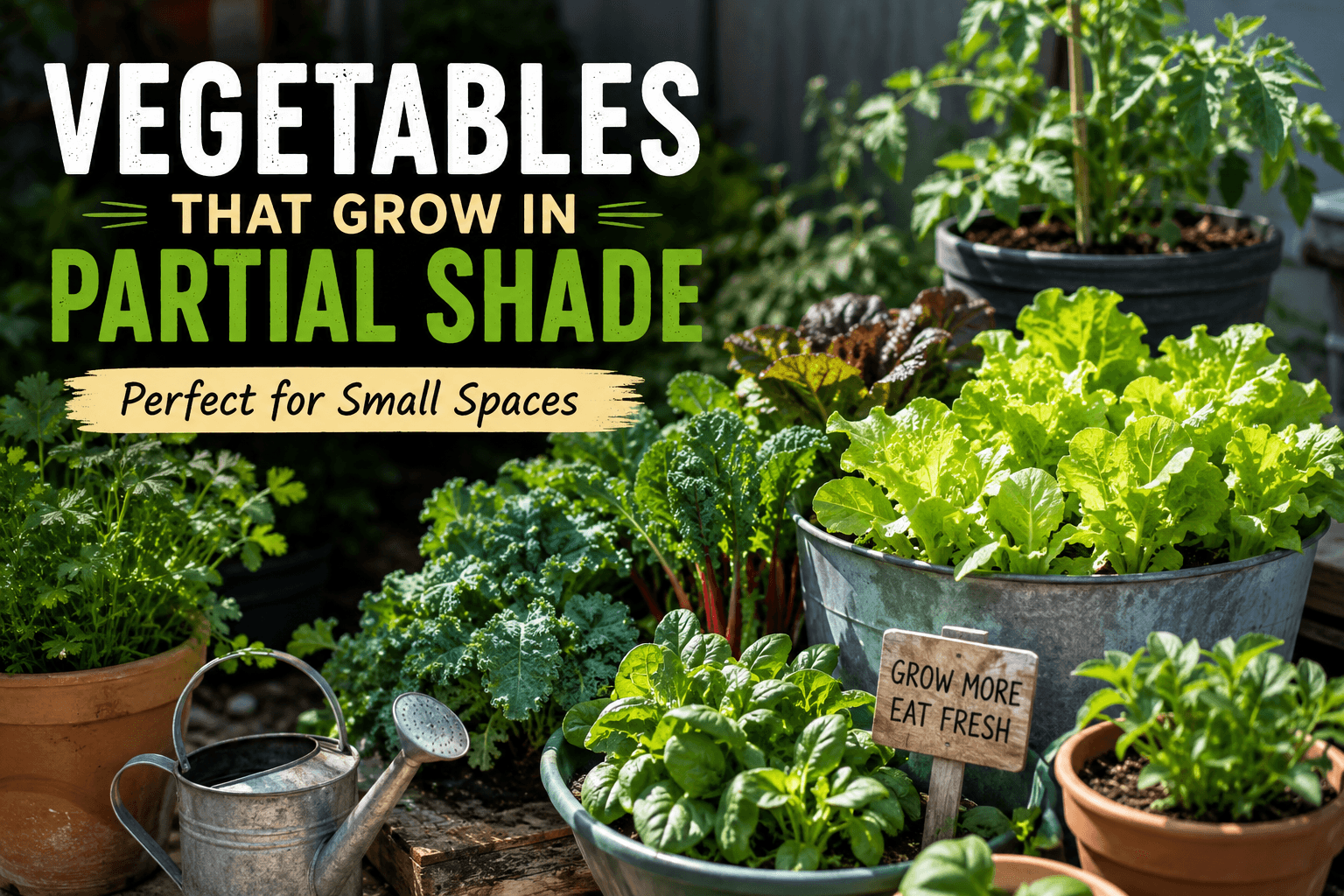
If you’re growing in an urban backyard, under trees, beside a fence, or on a balcony where buildings block the afternoon sun, here are some of the best vegetables that grow in partial shade that I’d try first.
What Does Partial Shade Actually Mean?
Let’s clear this up first because I used to get confused about it.
Partial shade doesn’t mean complete darkness.
Most vegetables that tolerate partial shade still need some direct sunlight.
Generally, you’re looking for a spot that gets around 3–6 hours of direct sunlight, with some shade during the rest of the day.
Morning sun is often especially useful.
A garden that gets four hours of morning sunlight and then afternoon shade can be much more productive than a garden that gets only two hours of weak, filtered light all day.
And here’s another thing I’ve learned:
Leafy vegetables usually handle shade much better than fruiting vegetables.
That’s because lettuce, spinach, kale, and similar crops don’t need to produce large fruits.
Tomatoes, peppers, cucumbers, melons, and squash are a different story.
They generally want much more sunlight.
1. Lettuce
If you’ve got a shady garden, lettuce is one of the first vegetables I’d try.
I’ve grown lettuce in spots where tomatoes would have struggled.
In fact, during hot weather, a little afternoon shade can actually be helpful because lettuce doesn’t love extreme heat.
Too much heat can cause lettuce to bolt, which means it starts sending up a flower stalk and the leaves can become bitter.
My Tip
Give lettuce morning sun and afternoon shade if possible.
Keep the soil consistently moist, but not soggy.
And don’t wait forever to harvest.
I like picking the outer leaves while the plant is still producing.
It’s simple, fast, and perfect for a small backyard garden.
2. Spinach
Spinach is another excellent choice for partial shade.
I’ve had much better luck growing spinach during cooler weather, but some shade can help when temperatures start climbing.
The nice thing about spinach is that you don’t need a giant garden bed.
A few plants in a container can give you fresh leaves for salads, eggs, soups, and sandwiches.
One mistake I made was planting spinach too late in the season.
It got hot, the plants bolted, and I basically ended up growing spinach flowers.
Not exactly what I had planned.
Now I think of spinach as a cool-season crop and use partial shade to my advantage when needed.
3. Kale
Kale is tough.
I’ve neglected kale.
I’ve forgotten to water it.
I’ve planted it in less-than-perfect locations.
And somehow it keeps growing.
That’s one reason I like it for backyard farming.
Kale can tolerate partial shade, although more sunlight generally means better growth.
If your garden gets several hours of sunlight but not all-day sun, give kale a try.
Harvest the older outer leaves first and let the center continue producing.
I especially like this approach when I’m trying to keep fresh greens available for several weeks.
4. Swiss Chard
Swiss chard is one of my favorites for a partially shaded garden.
It’s productive, colorful, and doesn’t require a huge amount of space.
I’ve grown it in raised beds and containers, and it has handled less-than-full-sun conditions pretty well.
The leaves are useful in soups, stir-fries, omelets, and all kinds of meals where I need some greens.
One Thing I Like About Chard
You can harvest individual leaves instead of pulling up the entire plant.
That means one plant can keep feeding you for quite a while if conditions are good.
That’s exactly the kind of crop I like on a small homestead.
Plant once.
Harvest many times.
5. Radishes
Radishes are another vegetable worth trying in partial shade.
They’re fast compared with many garden crops, which makes them great when you want to experiment.
I usually prefer giving them more sun when possible, but they can tolerate some shade.
The main thing is not to expect the same growth speed you’d get in a bright, sunny bed.
And don’t crowd them.
Thin the seedlings so the roots have room to develop.
I learned that lesson after growing a row of radishes that looked like a green carpet.
Beautiful tops.
Tiny roots.
Not exactly the harvest I wanted.
6. Beets
Beets can also handle partial shade.
They’re particularly useful because you can eat both the roots and the greens.
That’s two crops from one plant.
I like that.
In a smaller garden, getting multiple uses from one crop is a big deal.
The roots may develop more slowly with less sunlight, but you can still get a worthwhile harvest if the plants have enough light and good soil.
And beet greens?
Don’t throw them away.
Sauté them with garlic and a little olive oil.
That’s one of my favorite ways to use them.
7. Carrots
Here’s one I didn’t expect.
Carrots can tolerate some partial shade.
They may grow more slowly compared with carrots grown in full sun, but they can still produce roots.
The bigger issue for carrots is often the soil.
If your soil is hard, rocky, or full of clumps, the carrots aren’t going to be happy.
I’ve pulled carrots that looked like little potatoes with legs because they hit rocks and compacted soil.
Now I loosen the soil deeply before planting.
For Better Carrots
Use loose soil.
Remove rocks.
Don’t over-fertilize with nitrogen.
Keep moisture consistent.
And be patient.
Carrots aren’t in a hurry.
8. Broccoli
Broccoli can handle some partial shade, especially in warmer climates where afternoon shade can help reduce heat stress.
I’ve found that broccoli likes cooler conditions much more than the hot summer weather we sometimes get.
The biggest problem isn’t always sunlight.
It’s heat.
If you can give broccoli several hours of sunlight and some protection from intense afternoon heat, that can be useful.
Just remember that broccoli needs enough light to develop good heads.
Too much shade can result in weak, slow growth.
9. Cauliflower
Cauliflower is similar to broccoli.
It can tolerate some partial shade, but don’t put it in the darkest corner of the yard and expect giant heads.
I’ve grown cauliflower and learned that it can be a little fussy.
Temperature swings, inconsistent moisture, pests, and poor nutrition can all cause trouble.
If you’re a beginner, I’d honestly start with broccoli before cauliflower.
But if you’ve got a partially shaded garden and want to experiment, cauliflower is worth a try.
10. Peas
Peas can tolerate partial shade, especially when temperatures are cooler.
They don’t need the same intense sunlight as many fruiting crops.
The important thing is timing.
I prefer growing peas during the cooler part of the season.
Give them something to climb on, like a trellis or simple support.
One spring I didn’t bother supporting them properly.
The vines sprawled everywhere and tangled together.
Harvesting became a wrestling match.
Now I trellis them from the beginning.
Much easier.
11. Turnips
Turnips are another root crop that can work in partial shade.
Like carrots and beets, they may grow slower when they receive less sunlight.
But they’re still worth considering.
And just like beets, the greens are edible too.
I like crops that give me more than one thing to eat.
That’s a big part of my approach to self-sufficient gardening.
If I’m using garden space, I want as much food from that space as I can reasonably get.
12. Potatoes
Potatoes aren’t the first crop I’d choose for a deeply shaded garden, but they can tolerate some light shade.
The more sunlight they get, generally, the better their growth will be.
If you’re trying potatoes in partial shade, make sure the plants still receive several hours of direct light and have loose, well-drained soil.
Container growing can also work if you’re short on space.
Just don’t put the container behind a shed where it gets almost no sun.
That’s not partial shade.
That’s potato prison.
13. Arugula
Arugula is another great leafy green for a partially shaded garden.
It’s quick, doesn’t need much space, and has that peppery flavor that I really like.
During hot weather, some afternoon shade can help slow bolting.
I usually sow small amounts every couple of weeks rather than planting one huge batch.
That way I’m not standing in the kitchen with a mountain of arugula wondering what on earth I’m going to do with it.
14. Mustard Greens
Mustard greens can also do well with some shade.
They’re another cool-season crop that can benefit from protection when temperatures climb.
The leaves can be spicy, especially as the plants mature.
If you’ve never grown them before, try harvesting them young.
They’re usually much milder.
Which Vegetables Don’t Like Partial Shade AS vegetables that grow in partial shade?
This is just as important.
I’ve tried squeezing sun-loving crops into shady spaces because I didn’t want to waste garden room.
Usually, that wasn’t a great idea.
Tomatoes
Tomatoes want plenty of sunlight.
You might get some growth in partial shade, but fruit production will usually suffer.
Peppers
Peppers are another crop I’d reserve for the sunniest location.
Watermelons
Don’t even think about putting watermelon in the shady corner.
I made that mistake once.
The vines grew.
The fruit didn’t impress me.
Cucumbers
Cucumbers can tolerate some shade, but if you’re trying to maximize production, give them more sunlight.
Squash
Summer and winter squash generally perform much better in full sun.
So do melons.
How I Plan a Partially Shaded Garden
This is something I started doing after wasting too much space.
Instead of looking at the backyard and thinking:
“Where can I put vegetables?”
I look at the sunlight first.
I watch the garden throughout the day.
Morning.
Noon.
Afternoon.
Then I make a mental map.
The brightest area goes to tomatoes, peppers, cucumbers, and other crops that really want sun.
The areas with morning sun and afternoon shade go to lettuce, kale, chard, spinach, radishes, and similar vegetables.
It sounds simple, but it made a big difference.
Morning Sun Is Better Than You Think
If you have a choice between two shady spots, I usually prefer the one that gets direct morning sunlight.
A spot that gets three or four hours of morning sun can be surprisingly productive.
This is especially useful in an urban garden where buildings, fences, or trees block afternoon light.
Don’t automatically assume a shady yard means you can’t grow food.
You just need to choose the right crops.
Use Containers When the Yard Is Tricky
This is one of my favorite urban homesteading tricks.
If the garden bed gets too much shade, grow your sun-loving crops in containers and move them.
I’ve done this with peppers and tomatoes.
A container gives you some flexibility.
You can place it where the sunlight is best.
Just remember that containers dry out faster than garden soil.
You’ll need to keep an eye on moisture.
My Biggest Mistake With Shade Gardening
I tried growing the wrong vegetables.
That’s really it.
I thought:
“Well, I have this empty shady space, so I’ll put a tomato there.”
The tomato survived.
It wasn’t happy.
I got a few flowers.
Very few tomatoes.
Meanwhile, the lettuce planted nearby was doing great.
That’s when it clicked.
Don’t fight the garden. Work with it.
If you’ve got shade, grow crops that actually tolerate it.
Save the sunny spots for the vegetables that need them.
FAQ: Vegetables That Grow in Partial Shade
What vegetables grow best in partial shade?
Some of my best choices are lettuce, spinach, kale, Swiss chard, radishes, beets, carrots, peas, turnips, arugula, broccoli, and mustard greens.
Can tomatoes grow in partial shade?
They can survive with less sunlight, but tomato plants generally perform much better with plenty of direct sun. If you’re limited on sunlight, I’d use that space for leafy greens instead.
How many hours of sunlight do vegetables need?
It depends on the crop. Leafy greens can often tolerate around 3–6 hours of direct sunlight, while fruiting vegetables generally need considerably more.
Is afternoon shade good for a vegetable garden?
It can be. Afternoon shade can help cool plants during hot weather, especially leafy greens and cool-season crops. But plants still need enough total light to grow well.
Final Thoughts
I used to think shade was the enemy of gardening.
Now I see it differently.
Shade is just another growing condition.
You wouldn’t plant a watermelon in a tiny pot and complain that the watermelon isn’t happy.
Same thing with sunlight.
Put the right vegetable in the right place.
If you’ve got a shady urban backyard, don’t give up on growing food. Start with lettuce, kale, spinach, chard, radishes, carrots, beets, peas, or other crops that can handle less sunlight.
Watch your garden for a few days and figure out where the sun actually moves.
Then plant accordingly.
That’s one of the biggest lessons I’ve learned from vegetables that grow in partial shade.
You don’t need a perfect garden.
You need to understand the garden you’ve got.
And sometimes that shady little corner you’ve been ignoring for years can become one of the most productive parts of the backyard.