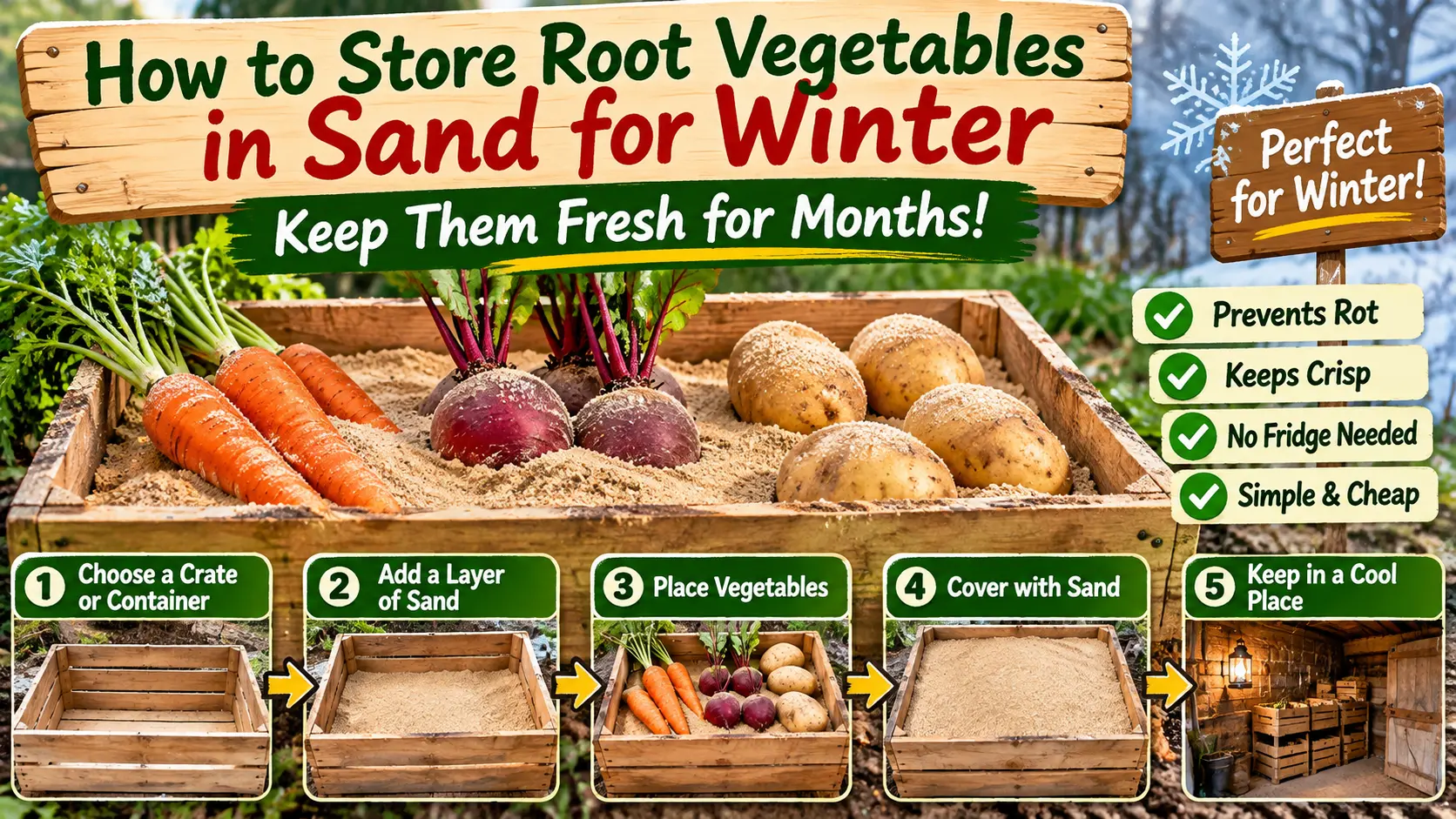
Before freezers and modern refrigerators, gardeners had to find ways to keep part of the fall harvest usable through winter. One of the simplest methods was storing certain root vegetables in a cold, humid cellar surrounded by slightly damp sand or another moisture-holding material.
The method is still useful today if you grow more carrots, beets, parsnips, turnips, or similar crops than your refrigerator can hold.
But the sand itself is not magic. Long storage depends mainly on temperature, humidity, vegetable condition, ventilation, and proper preparation before storage.
Quick answer
Carrots, beets, parsnips, turnips, rutabagas, and some other root crops can be packed in layers of slightly damp sand and kept in a cold, humid, frost-free location. Under good conditions, some crops can last for several months—but six months should be treated as a possibility for certain crops, not a guaranteed storage time.
Why Store Root Vegetables in Sand?
Freshly harvested root vegetables continue losing moisture after they leave the soil.
That moisture loss is one reason carrots become limp and beets begin to shrivel during storage.
A slightly damp packing material helps create a humid microclimate around the roots and reduces rapid moisture loss.
Utah State University Extension recommends storing many root crops in cool, moist conditions and specifically describes bins or crates containing layers of moist sand, peat moss, or sawdust as a long-term storage option.
Which Vegetables Can Be Stored in Sand?
Penn State Extension specifically lists several vegetables that can be buried in damp sand in a cold, humid storage area:
- Carrots
- Parsnips
- Beets
- Turnips
- Rutabagas
- Leeks
These vegetables generally prefer cold, humid storage conditions.
Do not assume the method works equally well for every vegetable in the garden.
Vegetables That Need Different Storage Conditions
Some crops prefer much drier storage.
Utah State University groups onions and garlic with crops that prefer cold and dry conditions rather than the humid environment used for carrots and beets.
Winter squash, pumpkins, and sweet potatoes also have different temperature and humidity requirements.
Important: Do not put every harvested vegetable into the same damp sand box. Crops have different storage requirements, and conditions that preserve carrots can shorten the life of onions, garlic, squash, or sweet potatoes.
How Long Can Vegetables Last?
This depends heavily on the crop and storage conditions.
| Crop | Potential Storage |
|---|---|
| Carrots | Several months under suitable cold, humid conditions; some storage references list up to about 6 months. |
| Beets | Commonly several months under optimal cold, humid storage. |
| Turnips / Rutabagas | Approximately 2–6 months under good commercial-style cold, humid conditions. |
| Parsnips | Can keep for an extended winter period under suitable conditions. |
These are estimates, not promises. A basement at 55°F will not perform like a root cellar at temperatures just above freezing.
The Best Temperature for Root Vegetable Storage
Cold temperatures slow respiration, sprouting, moisture loss, and many forms of deterioration.
Utah State lists many root vegetables in a storage category of approximately:
Cold + Moist Storage
Temperature: roughly 32–40°F (0–4°C)
Relative humidity: about 90–95%
The goal is to stay cold without freezing the vegetables.
Where Can You Create These Conditions?
A traditional underground root cellar is ideal, but it is not the only option.
Depending on your climate, possible locations include:
- A traditional root cellar
- A cold basement corner
- An unheated but frost-protected garage
- An insulated storage room
- Cold basement steps near an exterior entrance
Penn State specifically notes that buckets of damp sand placed on cool basement steps leading outdoors can sometimes reproduce useful root-cellar conditions.
Step 1: Harvest at the Right Time
Choose mature roots in good condition.
Dig carefully with a garden fork rather than pulling aggressively and breaking the roots.
Damaged vegetables usually store less successfully than intact ones.
Step 2: Sort Before Storage
This is one of the most important steps.
Do not put damaged produce into long-term storage with healthy roots.
Set aside vegetables that are:
- Cut
- Bruised
- Soft
- Cracked
- Diseased
- Showing signs of decay
Use those first if they are otherwise sound enough to eat.
Step 3: Remove the Tops
Green tops continue losing water after harvest.
Utah State recommends trimming carrot foliage before storage, and beet storage guidance similarly calls for removing most of the leafy growth.
Be careful not to cut deeply into the storage root itself.
Step 4: Decide Whether to Wash
Extension recommendations vary somewhat by storage system and crop.
The important principle is to avoid storing roots that are wet on the surface, damaged, or covered with decaying plant debris.
If you wash vegetables before storage, handle them gently and allow excess surface moisture to drain before packing.
Step 5: Prepare the Sand
The sand should be slightly damp—not wet enough to release water when squeezed.
The purpose is to help maintain humidity around the vegetables, not create a waterlogged box.
Simple moisture check
The sand should feel cool and slightly moist. If water drips out or the box develops standing moisture, it is too wet.
Step 6: Add a Bottom Layer
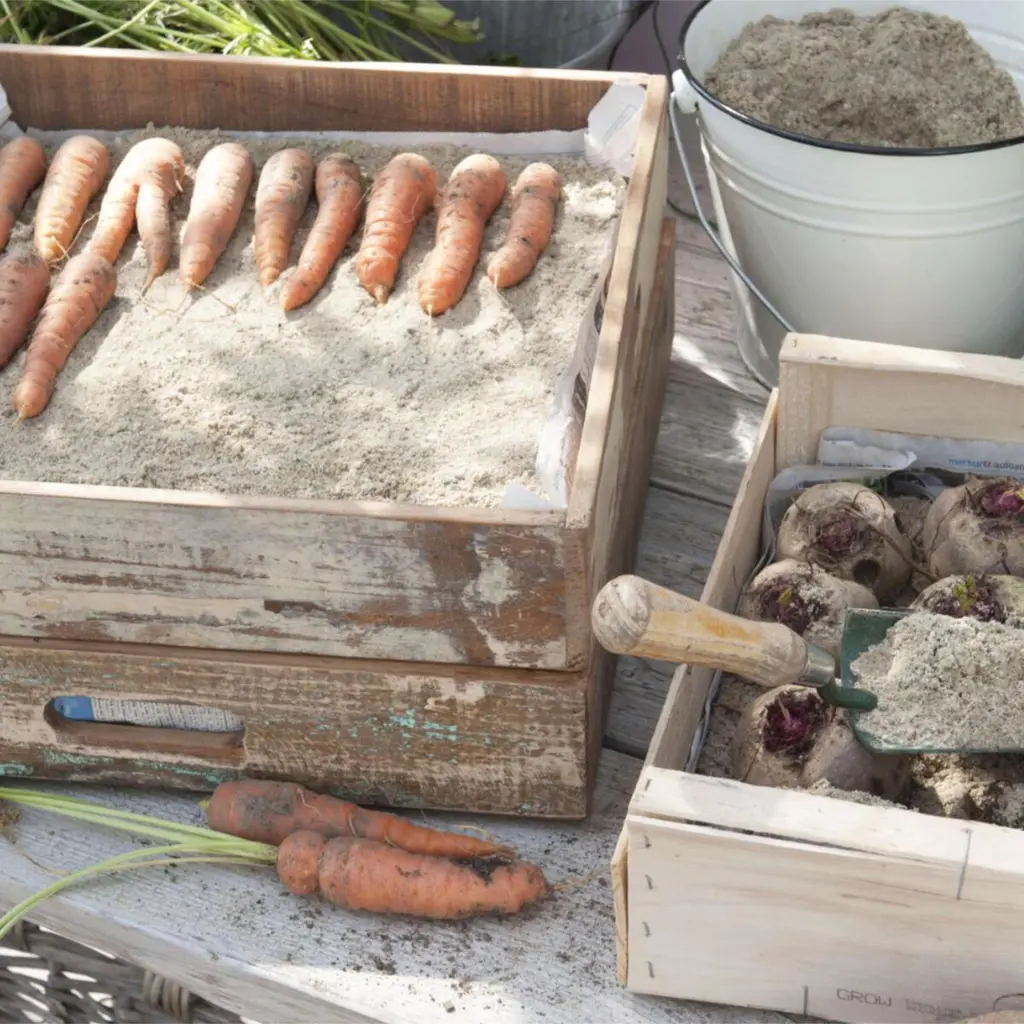
Put a layer of damp sand in the bottom of a sturdy box, crate, bucket, or other suitable storage container.
Use a container that is clean and strong enough for the combined weight of sand and vegetables.
Step 7: Arrange the Root Vegetables
Place the roots in a layer without packing them tightly together.
Leaving packing material around each root helps limit direct contact between vegetables.
This also makes it easier to remove one vegetable without disturbing the entire box.
Step 8: Cover With More Damp Sand
Cover the first layer until the roots are surrounded, then add another layer if your container is deep enough.
Continue alternating vegetables and packing material without crushing the produce.
Step 9: Keep the Storage Area Dark
Root-cellar storage works best in a dark environment.
Light and warmth can encourage unwanted sprouting or quality loss in some stored crops.
Step 10: Check the Box Regularly
Traditional storage is not a “pack it once and forget it until spring” system.
Check periodically for:
- Soft roots
- Mold
- Rot
- Sprouting
- Excessive shriveling
- Sand that has become excessively dry or wet
Remove deteriorating produce promptly.
Do Not Store Carrots Beside Apples or Pears
This is an easy detail to overlook in a mixed root cellar.
Utah State warns against storing carrots with apples or pears because gases produced as those fruits ripen can negatively affect carrot quality and flavor.
Keep fruit and root-vegetable storage areas separated when practical.
Sand Storage vs. Freezing
| Feature | Sand Storage | Freezing |
|---|---|---|
| Electricity | None if the cellar stays naturally cold. | Requires continuous freezer power. |
| Texture | Can preserve a fresh raw texture when conditions are good. | Texture usually changes after freezing and thawing. |
| Preparation | Sorting, trimming, packing. | Many vegetables require blanching first. |
| Best location | Naturally cold, humid cellar or similar space. | Anywhere with a suitable freezer and electricity. |
| Reliability | Highly dependent on seasonal temperature and humidity. | More predictable when freezer temperature remains stable. |
Is Sand Storage Really “Plastic-Free”?
It can be.
A wooden box, food-appropriate bucket, or other reusable storage container combined with sand allows you to avoid individual freezer bags.
But reducing plastic is not the main preservation mechanism. The important factors remain cold temperature and high humidity.
Can You Use Sawdust Instead?
Utah State Extension mentions moist sawdust and peat moss as alternatives used in root-crop storage.
If using sawdust or wood shavings, use clean material that has not been contaminated with chemicals, pesticides, treated lumber residue, paint, or other substances.
Can You Store Vegetables in Sand in a Warm Basement?
The results will usually be much worse.
The sand can help slow moisture loss, but it cannot compensate for a basement that stays far above ideal root-cellar temperatures.
If your storage room stays around normal household temperature, refrigeration, freezing, canning, or another appropriate preservation method may be more reliable.
7 Common Sand-Storage Mistakes
1. Storing damaged vegetables
Cuts and bruises create opportunities for deterioration during long storage.
2. Leaving leafy tops attached
Leafy growth can continue drawing moisture from roots.
3. Making the sand soaking wet
The goal is high humidity—not saturated vegetables sitting in water.
4. Keeping the box too warm
A warm basement can shorten storage dramatically.
5. Allowing the vegetables to freeze
A root cellar should be cold but protected from freezing temperatures.
6. Storing carrots beside ripening fruit
Keep carrots away from apples and pears during long storage.
7. Never inspecting the box
One deteriorating root can create problems for nearby produce if it goes unnoticed.
Sand Storage FAQ
Can carrots really be stored in sand?
Yes. University Extension guidance specifically describes storing carrots in moist sand in a cool cellar for several months.
Can carrots last six months this way?
They can under excellent cold, humid storage conditions, and some Extension storage references list carrots at about six months. However, actual home-storage life varies considerably.
Should sand be wet or dry?
For root-cellar storage, Extension guidance refers to moist or damp sand. It should provide humidity without becoming waterlogged.
Can beets be stored in sand?
Yes. Beets are among the root vegetables Penn State recommends burying in damp sand for cold, humid winter storage.
Do I need a real underground root cellar?
Not necessarily. A sufficiently cold, humid, frost-protected basement or garage area can sometimes work, but you should monitor actual temperature rather than relying on the room name.
Can I store onions in damp sand?
Onions prefer drier storage than carrots and many other root crops. Store properly cured onions in a cool, dry, ventilated area instead.
Is sand storage better than freezing?
Neither method is universally better. Sand storage can preserve raw texture without electricity when you have suitable cellar conditions. Freezing is more predictable when suitable cold cellar conditions are unavailable.
The Bottom Line
Storing root vegetables in sand is not just an old gardening myth.
Research-based Extension guidance still recommends moist sand and similar packing materials as options for keeping carrots, beets, parsnips, turnips, rutabagas, and related crops in cold, humid winter storage.
The real secret is not the sand alone. It is creating root-cellar conditions: cold temperatures just above freezing, high humidity, good-quality vegetables, and regular inspection.
Under those conditions, some roots can stay useful for months without occupying freezer space or requiring continuous electricity.
Sources
- Penn State Extension — Preserving Late Season Fall Vegetables
- Utah State University Extension — Harvest and Storage of Vegetables and Fruits
- Utah State University Extension — Carrots in the Garden
- University of Minnesota Extension — Harvesting and Storing Home Garden Vegetables