You do not always need a bigger vegetable garden to grow more food. Sometimes the better solution is to use the space you already have more intelligently.
By combining crops with different heights, root depths, growth speeds, and harvest times, you can often fit more vegetables into one raised bed without simply crowding plants together.
This idea is often called companion planting, but a more useful term for many of these combinations is intercropping.
Quick answer
The best vegetable combinations usually work because the plants use different layers of space or different parts of the growing season. Think tall plus short, early crop plus late crop, or deep-rooted plus shallow-rooted—not magical pest protection.
What Does “Sharing Space Intelligently” Mean?
A productive garden is three-dimensional.
Some plants climb upward. Others stay close to the soil. Some mature in a month, while others remain in the bed all summer.
Illinois Extension recommends several space-saving techniques:
- Vertical cropping
- Succession planting
- Intercropping
Intercropping means planting a fast-growing crop among a slower-growing crop so you can harvest the first one before the second needs the whole area.
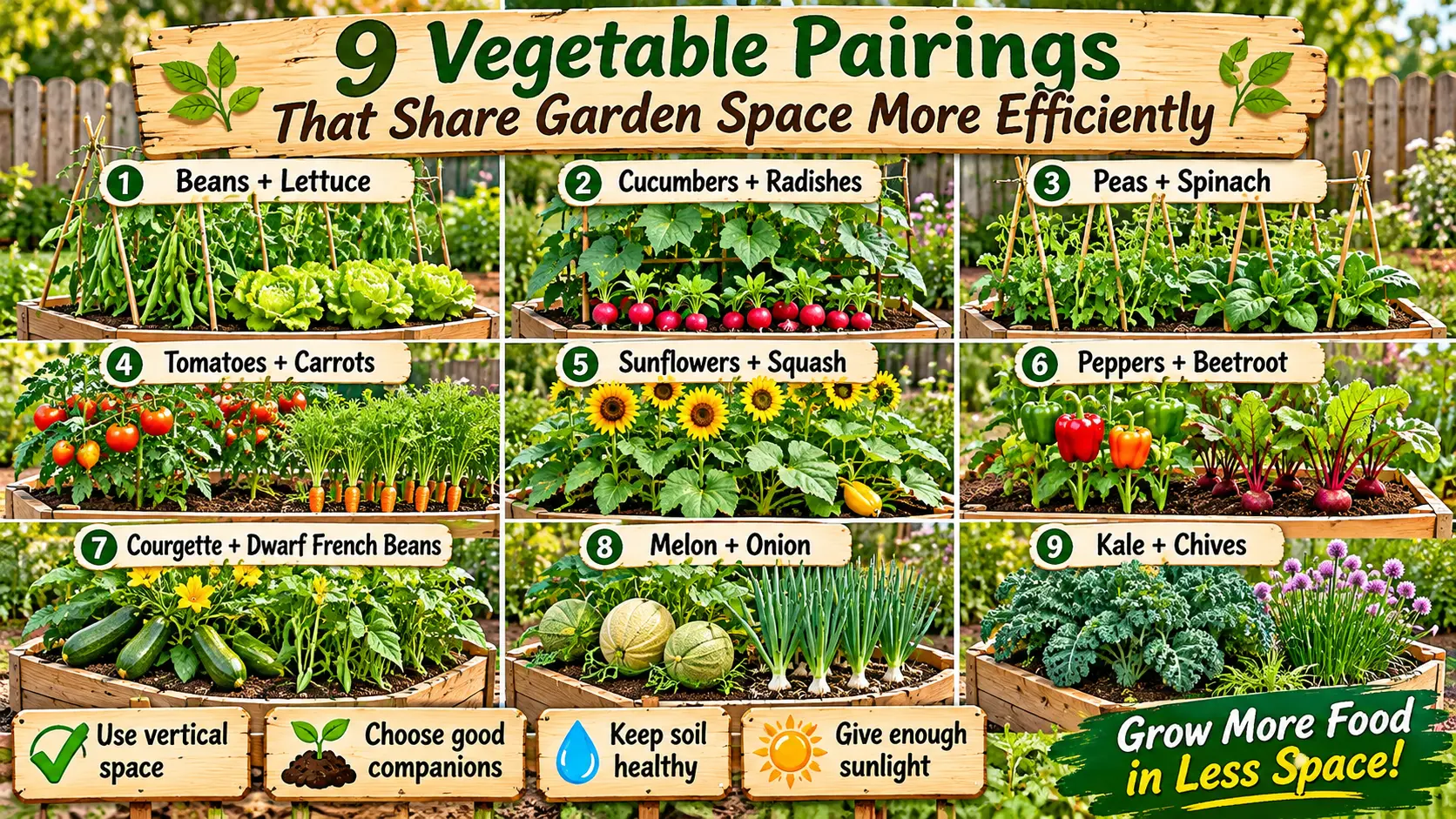
1. Climbing Beans + Lettuce
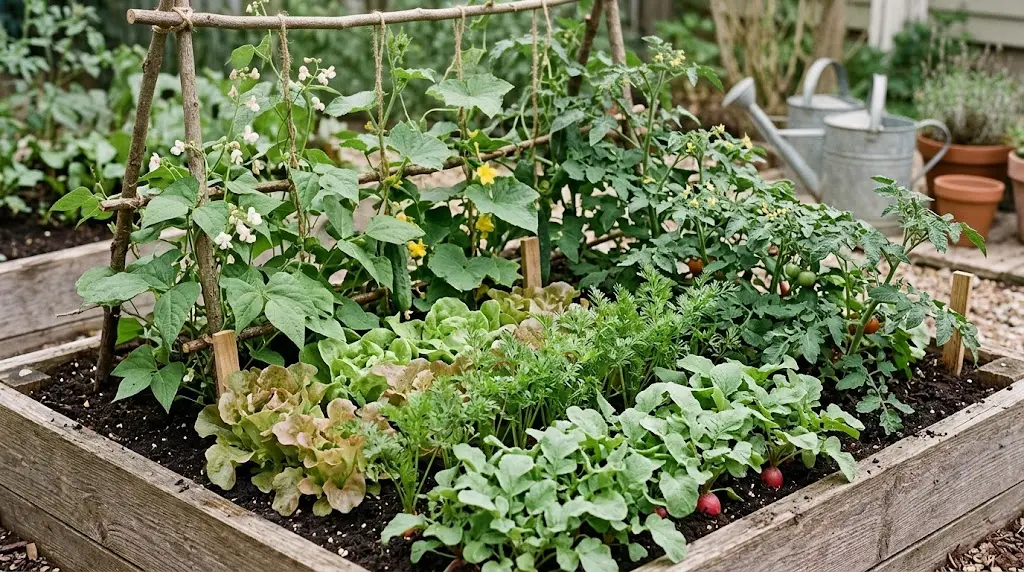
This is a good example of using vertical and horizontal space at the same time.
Pole beans climb a trellis while lettuce stays low beneath them.
The combination can work especially well when lettuce is planted early and harvested before the beans create a dense canopy.
Why it can work
- Beans use vertical space.
- Lettuce uses the lower bed area.
- Lettuce matures relatively quickly.
- Some shade can help lettuce during warmer weather.
Do not let the bean canopy completely shade lettuce during its early growth.
2. Cucumber + Radish
Cucumbers and radishes can share space mainly because they mature at very different speeds.
Radishes can be ready long before a cucumber vine reaches full size.
Plant radishes in open spaces around young cucumber plants, then harvest the radishes as the cucumber vines begin expanding.
Make it even better
Train cucumbers vertically on a trellis. Illinois Extension specifically recommends vertical supports for cucumbers as a way to save garden space.
3. Peas + Spinach
Peas and spinach are both cool-season crops, which makes them a practical spring combination in many climates.
Peas climb upward while spinach remains low.
The important limitation is timing: both crops prefer cooler conditions, so they may finish before summer heat arrives.
University of Minnesota lists peas and spinach among crops planted relatively early in the growing season. :chatgpt-content-reference{index=”2″}
4. Tomatoes + Carrots
This is one of the better-supported combinations from the viral graphic.
Oregon State University Extension lists tomatoes and carrots as a useful companion-cropping example because carrots occupy a different root zone and tomatoes can provide some shade as summer temperatures rise. :chatgpt-content-reference{index=”3″}
Best approach
Sow carrots before tomato plants become large. Harvest carrots as tomato roots and foliage begin filling more of the bed.
Useful distinction: The benefit here is mainly space and timing. Do not assume tomatoes and carrots magically protect each other from every pest.
5. Sunflowers + Squash
This combination can work, but it needs much more room than the small circular bed shown in many graphics.
Both sunflowers and squash can become large plants.
The idea works best when tall sunflowers are positioned where they will not shade the squash excessively and squash vines are allowed to trail outside the main bed.
Do not squeeze several full-size squash plants into a tiny raised bed simply because an illustration shows them together.
6. Peppers + Beets
This pairing works better as a timing strategy than as a classic companion pair.
Beets tolerate cool conditions and can be planted earlier, while peppers are warm-season plants that go into the garden later.
University of Minnesota lists beets as a cool-season crop and peppers as a later warm-season planting. :chatgpt-content-reference{index=”4″}
That means you can harvest early beets as pepper plants begin needing more root and canopy space.
7. Zucchini + Dwarf French Beans
This pairing needs caution.
A mature zucchini plant can become enormous and easily shade dwarf bush beans.
It works best in a larger bed where the zucchini is planted near an edge and allowed to spill outward, leaving the center or sunny side for beans.
This is not a good choice for a tiny 3-foot circular bed.
8. Melon + Onion
This is another pairing where the viral illustration is more convincing than the horticultural evidence.
Melons are warm-season, sprawling crops that need full sun and substantial space. Onions usually begin much earlier in the season.
The combination can work as succession or overlap planting if onions are harvested before melon vines completely cover the bed.
Oregon State lists melons as full-sun fruiting vegetables and onions among cool-season crops, so timing is more important than a claimed companion effect. :chatgpt-content-reference{index=”5″}
9. Kale + Chives
Kale and chives can share a bed reasonably well because chives take relatively little horizontal space.
Plant chives along an edge rather than directly around the crown of each kale plant.
Both are cool-season crops, so their basic seasonal preferences can overlap. :chatgpt-content-reference{index=”6″}
Which Pairings From the Viral Graphic Are Strongest?
| Pairing | FarmSolo Rating | Why |
|---|---|---|
| Beans + Lettuce | Good | Vertical + low-growing crop. |
| Cucumber + Radish | Good | Fast radish harvest before cucumbers fill space. |
| Peas + Spinach | Good | Both suit cool-season timing. |
| Tomatoes + Carrots | Very good | Supported by Extension examples. |
| Sunflower + Squash | Conditional | Both get large; needs space. |
| Peppers + Beets | Good as succession | Cool-season beets finish as peppers expand. |
| Zucchini + Bush Beans | Conditional | Zucchini can overwhelm beans. |
| Melon + Onion | Mostly succession | Different seasonal timing is the main advantage. |
| Kale + Chives | Good | Compact edge crop + larger leafy crop. |
Do Not Confuse Intercropping With Overcrowding
This is the biggest problem with many companion-planting graphics.
They draw mature vegetables very close together without showing the actual space each plant needs.
Plants still compete for:
- Light
- Water
- Nutrients
- Root space
- Airflow
Follow the mature spacing recommendations for your specific varieties and use intercropping mainly where one crop will be harvested before the other reaches full size.
Use Vertical Space Whenever You Can
Vertical growing is one of the most reliable ways to increase production in a small bed.
Illinois Extension recommends trellising crops such as:
- Pole beans
- Peas
- Cucumbers
- Some squash and gourds
Once those plants grow upward instead of across the soil, the lower space can support shorter crops.
Put Tall Crops on the Correct Side of the Bed
A trellis can save space and still ruin the bed if it blocks sunlight from everything else.
In the Northern Hemisphere, tall crops are often placed toward the north side of a bed when practical so they cast less shade across shorter vegetables.
Observe your own garden because buildings, fences, trees, and season can change the sun pattern.
Succession Planting May Save More Space Than Companion Planting
You do not have to keep two vegetables together for the entire season.
Sometimes the most efficient combination is one crop followed by another.
Oregon State and Illinois Extension both recommend succession planting as a way to keep garden space productive throughout the growing season. :chatgpt-content-reference{index=”7″}
Examples
- Spring spinach → summer beans
- Spring radishes → summer squash
- Early peas → tomatoes
- Spring lettuce → peppers
- Summer beans → fall spinach
Choose Plants With Compatible Seasons
Some combinations fail simply because one plant wants cool spring weather while another wants hot summer conditions.
Cool-season crops include:
- Lettuce
- Spinach
- Peas
- Radishes
- Carrots
- Beets
- Kale
- Onions
Warm-season crops include tomatoes, peppers, cucumbers, melons, beans, and summer squash. :chatgpt-content-reference{index=”8″}
The overlap between those groups can be useful—but only when timed correctly.
The “Companion Plant Repels Pests” Problem
Many companion-planting charts make strong claims that one vegetable automatically protects another from insects.
Be careful with those claims.
Oregon State Extension notes that many popular companion-planting pest claims still lack enough research support. :chatgpt-content-reference{index=”9″}
That does not mean diverse planting is useless. Penn State notes that diverse polycultures can make it harder for some pests to locate host plants and that certain herbs have research-supported roles. :chatgpt-content-reference{index=”10″}
But space-saving, timing, and crop diversity are much stronger reasons to intercrop than viral promises about magical plant friendships.
A Simple Raised-Bed Layout
For a sunny rectangular bed, one simple design could be:
- Back/north edge: pole beans or cucumbers on a trellis
- Middle: tomatoes or peppers
- Early-season gaps: radishes or carrots
- Front edge: lettuce, spinach, chives, or other compact crops
As fast crops are harvested, the larger warm-season plants gain the extra space they need.
6 Mistakes to Avoid
1. Copying a companion chart without checking mature size
A tiny seedling can become a four-foot-wide squash plant.
2. Planting everything at the same time
Succession and staggered planting often produce better use of space.
3. Letting tall crops shade fruiting vegetables
Tomatoes, peppers, melons, and squash generally need strong sun to produce well.
4. Ignoring airflow
Crowded foliage can stay wet longer and make harvesting difficult.
5. Forgetting water competition
More plants in one bed can mean faster soil moisture loss.
6. Treating every internet pairing as proven science
Use companion charts as ideas, then evaluate plant size, season, roots, sunlight, and actual research.
Vegetable Pairing FAQ
What vegetables grow well together in a raised bed?
Good combinations include crops that use different layers of space or mature at different times, such as tomatoes with carrots, climbing beans with lettuce, and cucumbers with early radishes.
Do companion plants really repel pests?
Some plant relationships have evidence behind them, but many common companion-planting pest claims are anecdotal or weakly supported. Focus first on diversity, spacing, timing, and healthy growing conditions.
Can tomatoes and carrots grow together?
Yes. Oregon State Extension includes tomatoes and carrots as a useful companion-cropping example.
Can cucumbers and radishes grow together?
They can share space well when radishes are planted and harvested early before cucumber vines expand.
Can peas and spinach grow together?
Yes, especially as a cool-season combination. Give peas a trellis and keep spinach where it still receives enough light.
Is companion planting the best way to grow more food?
It can help, but vertical growing, succession planting, proper spacing, good soil, and choosing productive varieties are just as important.
The Bottom Line
The best vegetable pairings are not necessarily plants with a mysterious ability to “like” each other.
They are plants that fit together physically and seasonally.
Use tall crops above short crops, fast crops beside slow crops, and early crops in spaces that later crops will eventually need.
That approach is more reliable than blindly following a companion-planting chart—and it can genuinely help you harvest more from a small backyard garden.
Related FarmSolo guide
If you are planning the bed itself first, read My Raised Garden Bed Experiment: What Worked, What Failed, and What I’d Do Differently.
Sources
- University of Minnesota Extension — Companion Planting in Home Gardens
- University of Illinois Extension — Pick Your Technique: Vertical Cropping, Succession Planting and Intercropping
- Oregon State University Extension — Companion Planting
- Oregon State University Extension — Succession Planting
- Penn State Extension — Herbs Make Good Plant Partners and Companions