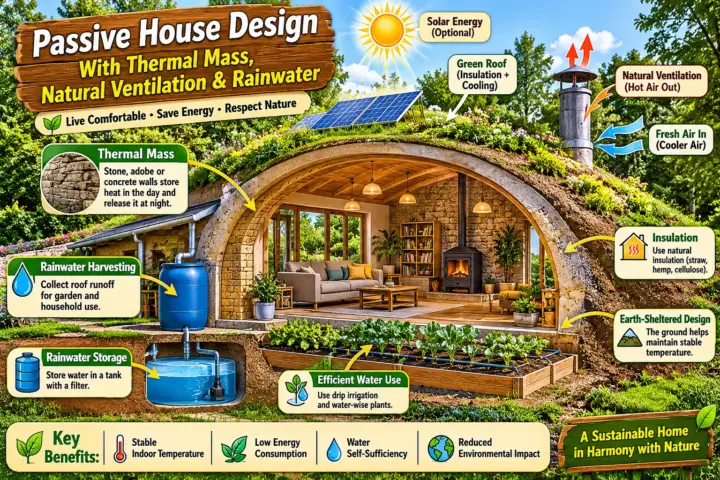
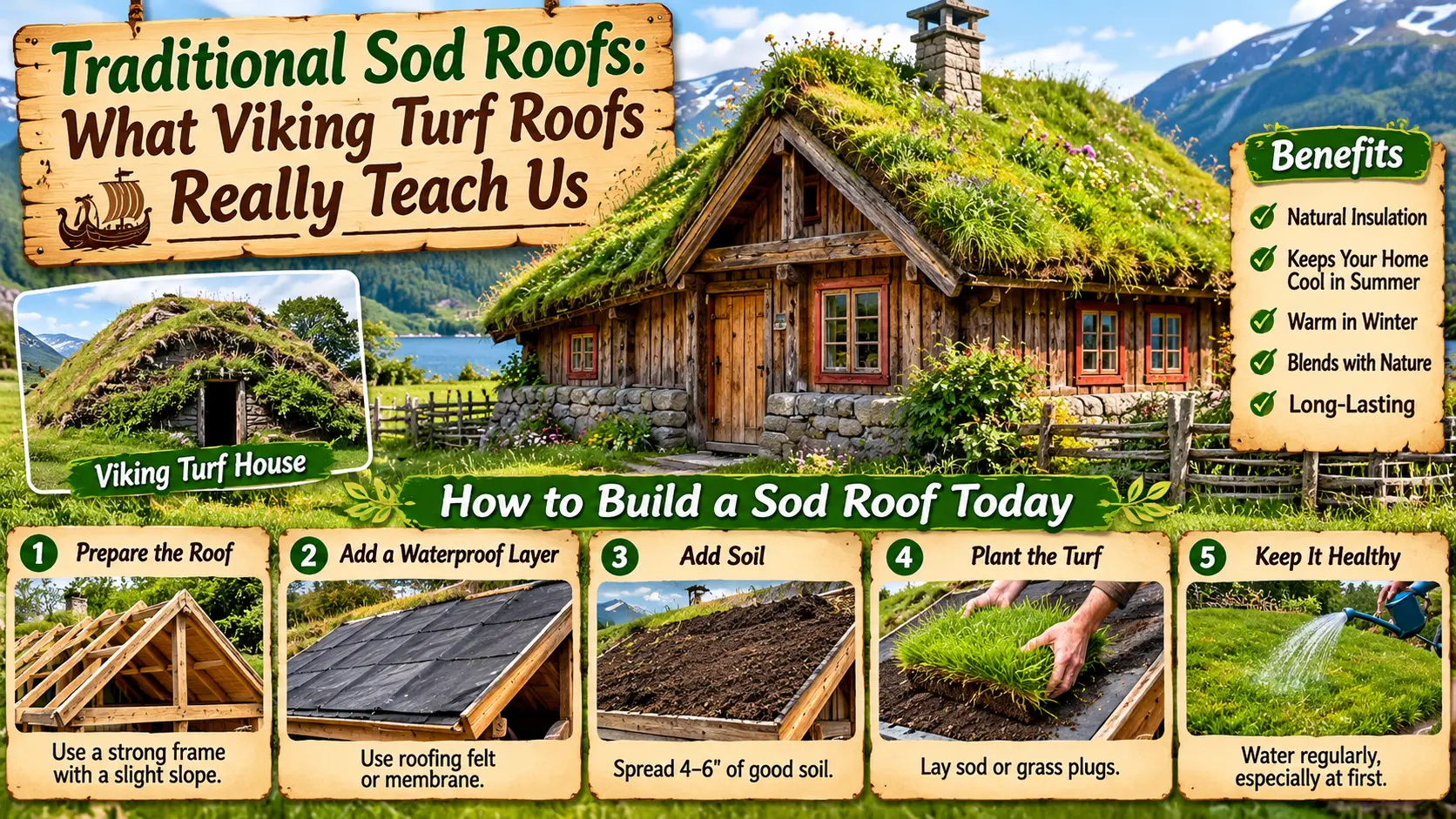
Traditional sod roofs are real, durable, and surprisingly sophisticated—but they were not magical roofs that repaired themselves forever. Historic Scandinavian builders combined vegetation, turf, wood, and waterproof layers in a roofing system that worked with local materials and climate.
Today, modern green roofs use the same broad idea—vegetation above a waterproof roof—but they rely on engineered membranes, root barriers, drainage layers, growing media, and carefully selected plants.
The Pinterest image gets the history partly right. Turf roofs can last a long time. What it gets wrong is the claim that they need no replacement or maintenance.
Quick answer
A traditional sod roof was not simply grass planted on wooden boards. Historically, layers such as birch bark provided water protection while turf above added weight, protection, and vegetation. A modern living roof needs a waterproof membrane, root protection, drainage, engineered growing media, vegetation, and enough structural capacity for the fully saturated roof.
What Is a Sod Roof?
A sod roof, also called a turf roof or grass roof, is a roof covered with layers of soil or turf and living vegetation.
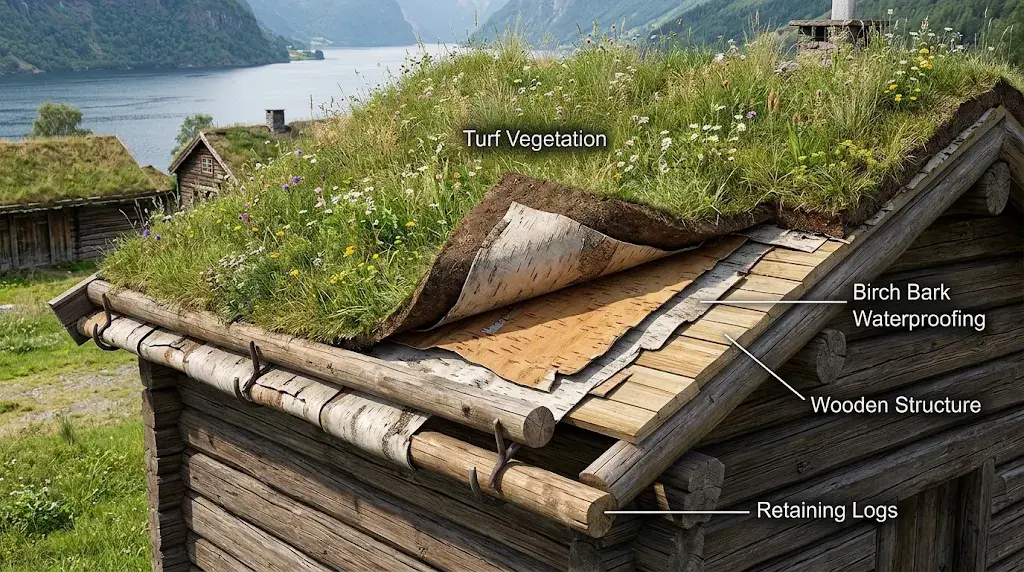
Traditional Norwegian turf roofs were commonly built over timber structures and used birch bark beneath the turf as an important water-resistant layer.
The vegetation was the visible part. The waterproofing underneath was the part that protected the building.
Were Turf Roofs Really Used for Centuries?
Yes. Sod roofing has a long history in Norway and other parts of Scandinavia.
Historic Norwegian farm buildings preserved today still show how widespread this roofing method once was.
But an old building surviving for centuries does not mean every original roof component survived untouched for centuries.
Historic longevity and zero maintenance are not the same thing. Traditional buildings were repaired, maintained, and sometimes re-roofed as materials aged.
1. The Grass Was Not the Waterproof Layer
This is one of the most important details missing from viral turf-roof graphics.
Grass and soil absorb water. They do not automatically make a wooden house waterproof.
Traditional Scandinavian construction often used overlapping birch bark underneath the turf.
The turf helped hold those layers in place while also protecting them from sunlight, wind, and mechanical damage.
2. Turf Adds a Huge Amount of Weight
Soil is heavy. Wet soil is much heavier.
A roof that supports vegetation needs to carry the weight of:
- The waterproofing system
- Drainage materials
- Growing media
- Mature plants
- Retained water
- Rain or snow where applicable
- People performing maintenance
That is why an ordinary roof should never be converted into a green roof simply by adding soil and plants.
3. Modern Green Roofs Use Multiple Layers
A modern green roof normally includes more than one protective layer.
| Layer | Main Job |
|---|---|
| Roof structure | Carries all loads |
| Waterproof membrane | Keeps water out of the building |
| Root-resistant layer | Protects the membrane from roots |
| Drainage layer | Moves excess water toward drains |
| Filter layer | Keeps growing media from clogging drainage |
| Growing medium | Supports plant roots |
| Vegetation | Provides the living roof surface |
4. A Green Roof Still Needs Drainage
A living roof is designed to retain some rainfall, but it should not become a permanent rooftop pond.
Excess water needs a clear path to roof drains, gutters, or another designed outlet.
Poor drainage can contribute to:
- Waterlogged plants
- Extra structural weight
- Membrane problems
- Blocked drains
- Leaks
5. Roots Need to Be Kept Away From the Waterproofing
Plant roots naturally follow moisture.
If roots reach weak seams or unsuitable waterproofing, they can damage the roof assembly over time.
Modern systems use root-resistant membranes or separate root barriers to reduce that risk.
6. Green Roofs Can Protect the Membrane
One real advantage behind the Pinterest claim is that vegetation and growing media can protect the waterproofing membrane underneath.
The layers above the membrane reduce direct exposure to:
- Ultraviolet sunlight
- Large surface-temperature swings
- Some mechanical damage
- Extreme weather exposure
That protection can extend roof-membrane service life when the system is designed and maintained correctly.
7. But “Zero Replacement” Is Not a Reliable Claim
No roofing system should be presented as maintenance-free forever.
Modern green roofs still need inspection and maintenance of:
- Drains
- Flashing
- Roof penetrations
- Vegetation
- Eroded growing media
- Membrane-access areas
- Edges and retaining systems
Plants can die, drainage can clog, flashing can fail, and membranes eventually age.
8. Does the Vegetation “Self-Repair”?
Living vegetation can spread into small bare areas under suitable conditions. In that limited sense, a healthy plant layer can regenerate.
But plants cannot repair:
- A torn waterproof membrane
- Rotten structural timber
- Failed flashing
- A blocked drain
- A leaking roof penetration
- Structural movement
Calling the entire roof “self-repairing” is therefore misleading.
9. Sloped Living Roofs Need Erosion Control
Traditional Nordic roofs were often steep enough that holding soil in place was a real design issue.
Modern sloped green roofs also need methods to prevent growing media from slowly moving downhill.
Depending on the system, this may involve:
- Retention battens
- Special drainage mats
- Erosion-control fabrics
- Edge restraints
- Plant roots that stabilize the media after establishment
10. Do Green Roofs Improve Insulation?
Vegetation and growing media can reduce heat reaching the roof surface and moderate temperature swings.
That can reduce cooling demand and improve indoor comfort in some climates.
But a green roof should not automatically be used as a substitute for code-required roof insulation.
Think of the green layer as part of the building system—not as a replacement for waterproofing, insulation, structure, or drainage.
11. Green Roofs Can Reduce Stormwater Runoff
One of the strongest modern reasons for installing a green roof is water management.
Growing media and vegetation capture part of a rainfall event and release some of that moisture later through evaporation and plant transpiration.
Excess water then moves through the drainage system rather than immediately running from a bare roof surface.
12. Plant Choice Should Match the Climate
A Norwegian-style grass roof is not the correct planting system everywhere.
Plant selection should reflect:
- Rainfall
- Summer heat
- Winter cold
- Wind
- Roof orientation
- Growing-medium depth
- Irrigation availability
- Fire conditions
In hot or dry regions, a traditional thick grass turf may require much more irrigation than a climate-adapted modern extensive green roof.
13. Green Roofs Still Need Maintenance
EPA guidance treats maintenance as part of the green-roof system from the beginning.
Typical tasks can include:
- Removing weeds
- Replacing dead plants
- Clearing drains
- Checking flashing
- Watching for erosion
- Removing debris
- Inspecting membrane-access areas
- Managing irrigation where needed
Living does not mean maintenance-free.
Traditional Sod Roof vs. Modern Green Roof
| Feature | Traditional Sod Roof | Modern Green Roof |
|---|---|---|
| Waterproofing | Historically birch bark or similar traditional layers | Engineered waterproof membrane |
| Root protection | Dependent on historic assembly | Dedicated root-resistant membrane or barrier |
| Drainage | Traditional roof geometry and materials | Engineered drainage layer and outlets |
| Growing layer | Natural turf and soil | Lightweight engineered growing medium |
| Maintenance | Required | Required |
What the Pinterest Graphic Gets Right
- Turf roofs are a real traditional Scandinavian roofing method.
- Vegetation can protect roof layers from direct sunlight.
- Green roofs can have long service lives when properly built.
- Traditional builders successfully used local natural materials.
- Modern construction can still learn from living-roof principles.
What the Graphic Gets Wrong
| Claim | More Accurate Explanation |
|---|---|
| “Self-repaired” | Plants can regrow, but they cannot repair structural or waterproofing failures. |
| “Over a century” | Historic buildings can survive for centuries while still receiving maintenance, repairs, and restoration. |
| “Zero replacement required” | No reliable roofing system should be presented as permanently maintenance-free. |
| Turf alone protects the house | Historic systems relied on waterproof layers beneath the vegetation. |
7 Mistakes to Avoid With a Modern Living Roof
1. Putting soil directly over ordinary shingles
A green roof requires a designed roof assembly, not a layer of dirt over an existing roof.
2. Ignoring saturated weight
Growing media becomes much heavier after rain.
3. Skipping the root barrier
Roots can seek moisture around vulnerable roof details.
4. Blocking roof drains
Drains must remain accessible for inspection and cleaning.
5. Choosing plants only for appearance
Roof plants face more wind, heat, shallow soil, and drought than ordinary garden plants.
6. Assuming a green roof replaces insulation
Green-roof layers can improve thermal performance but do not replace a properly designed building envelope.
7. Calling it maintenance-free
Inspect vegetation, drainage, edges, flashing, and penetrations throughout the life of the roof.
Sod Roof FAQ
Did Vikings really have grass roofs?
Turf roofing has a long Scandinavian history, including Norway. However, it is better to describe it as a traditional Nordic or Norwegian roofing method rather than assuming every turf-roof technique belongs specifically to the Viking Age.
What was underneath a traditional sod roof?
Traditional Norwegian turf roofs commonly used birch bark as an important water-resistant layer beneath the turf.
Do grass roofs repair themselves?
Vegetation can regrow into small bare areas, but the living layer cannot repair failed waterproofing, damaged flashing, blocked drainage, or structural decay.
How long does a modern green roof last?
Service life varies with the membrane, climate, installation, drainage, vegetation, and maintenance. Properly designed green roofs can protect the waterproofing and may outlast conventional exposed roofing systems, but no universal lifespan applies to every roof.
Can I turn my existing roof into a green roof?
Possibly, but the structure must first be evaluated for saturated green-roof loads. Waterproofing, drainage, roof slope, flashing, root protection, and local building requirements also need professional evaluation.
Does a green roof need watering?
That depends on climate, plant selection, substrate depth, rainfall, and establishment stage. Some systems require irrigation, especially during establishment or prolonged dry weather.
The Bottom Line
Traditional Scandinavian turf roofs deserve attention because they show that vegetation and buildings can work together successfully.
But the useful lesson is not that grass magically fixes a roof.
The real lesson is layered design: structure carries the load, waterproofing keeps the building dry, drainage manages excess water, and vegetation protects and moderates the roof surface.
Modern green roofs use newer materials, but the same basic principle remains: the living layer works because the hidden roof underneath it was designed correctly.
Sources
- Norsk Folkemuseum — Historic Norwegian Farm Buildings and Sod Roofing
- Visit Norway — Norwegian Wooden Architecture and Traditional Torvtak
- U.S. Environmental Protection Agency — Design Guidelines and Maintenance Manual for Green Roofs
- U.S. Environmental Protection Agency — Using Green Roofs to Reduce Heat Islands
- U.S. General Services Administration — Planted Roof Systems