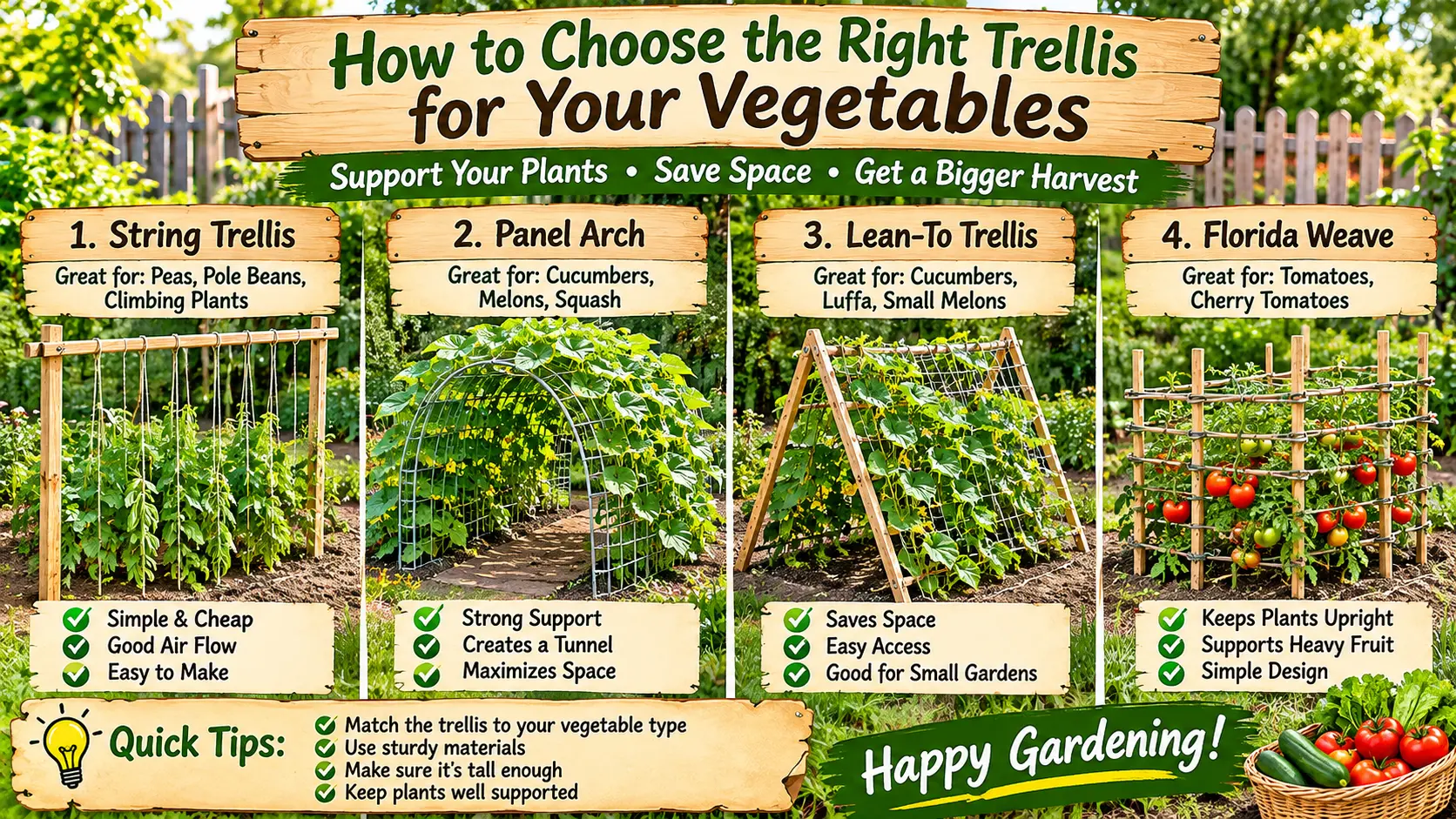
The best trellis depends less on what looks pretty and more on how the plant actually grows. Peas and pole beans climb differently from tomatoes. Cucumbers need a different type of support than heavy pumpkins. Melons may climb beautifully but often need slings for the fruit.
That is why one trellis style does not fit every vegetable.
A good support should match the crop’s weight, climbing habit, mature size, and harvest style while keeping enough airflow and making the fruit easy to reach.
Quick answer
Use light string or netting for peas and pole beans, a strong arch or panel for cucumbers and small-fruited vines, an angled trellis for cucumbers or smaller melons, and a Florida weave for rows of tomatoes. The heavier the crop, the stronger the trellis needs to be.
Why Trellis Vegetables at All?
Growing upward instead of outward saves garden space.
Illinois Extension recommends vertical growing for crops such as pole beans, peas, cucumbers, squash, and gourds because it can free up valuable ground area for other plants.
Trellising can also make vegetables easier to harvest and keep some fruit cleaner by lifting it away from wet soil.
The 4 Main Trellis Styles in the Viral Graphic
| Trellis Type | Best Crops | Strength Needed |
|---|---|---|
| String Trellis | Peas, pole beans, light climbing flowers | Light to medium |
| Cattle Panel Arch | Cucumbers, gourds, smaller squash, small melons | Heavy-duty |
| Lean-To Trellis | Cucumbers, luffa, small melons | Medium to heavy |
| Florida Weave | Tomatoes, especially rows of plants | Medium to heavy |
1. String Trellis: Best for Peas and Pole Beans
A string trellis is one of the simplest supports you can build.
It usually consists of a sturdy top support with vertical strings hanging toward the soil.
UMN Extension notes that peas and beans can grow on light netting or vertical twine systems, and natural-fiber twine such as sisal, cotton, or hemp can even be composted with spent vines at the end of the season.
Best crops
- Pole beans
- Tall peas
- Light ornamental vines
- Nasturtiums in some garden designs
Why it works
These crops do not produce extremely heavy fruit, so they usually do not need the strength required for melons or squash.
Peas and Beans Do Not Climb Exactly the Same Way
Peas use tendrils to grab onto nearby supports.
Pole beans twine their stems around supports as they grow.
Both can use a string system, but peas often perform especially well when they have multiple thin strands or mesh openings to grab.
How Tall Should a Bean Trellis Be?
Pole beans can become vigorous vines, so a short decorative trellis may quickly become overwhelmed.
Build the support tall enough for the variety you are growing and strong enough to handle wind after the foliage fills in.
Install it before the vines become tangled.
2. Cattle Panel Arch: Best for Strong Vines
A rigid arch made from welded livestock panel can support much more weight than light string or netting.
That makes this style useful for vigorous cucurbit vines.
Good choices include
- Cucumbers
- Gourds
- Small-fruited squash
- Smaller melons
Illinois Extension confirms that cucumbers, squash, melons, and gourds can all be trained vertically when the support is strong enough for the mature crop.
Do not assume every squash belongs on a trellis. University of Minnesota notes that large pumpkins and heavy squash are generally too heavy for typical trellising systems.
Why Gardeners Like Trellis Arches
An arch moves the vines overhead rather than simply up a flat wall.
That gives you several advantages:
- More ground space for other crops
- Easier harvesting beneath the arch
- Better visibility of hanging fruit
- A shaded walkway or planting area beneath
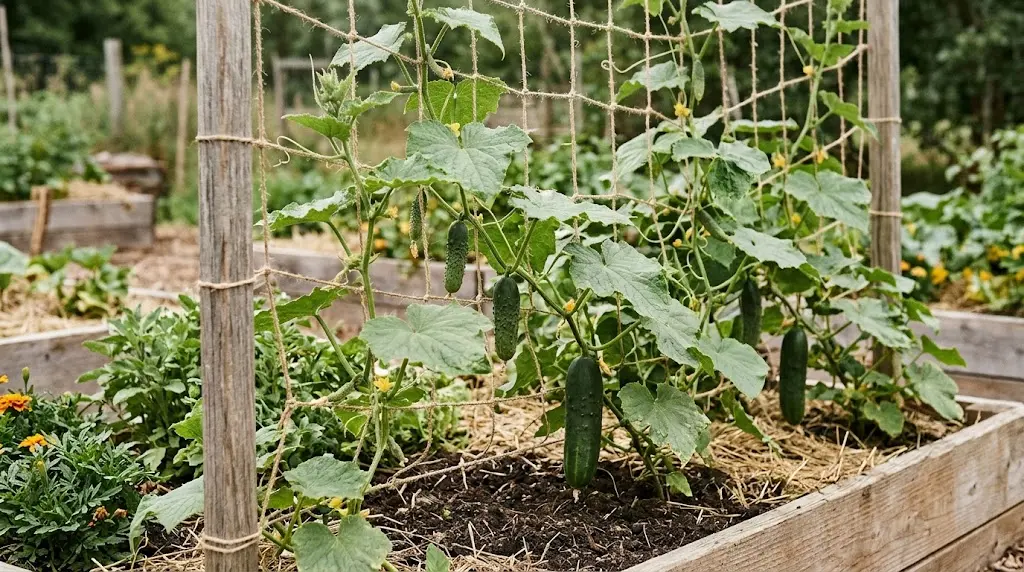
Melons Need Extra Support
A melon vine may climb the trellis successfully while the fruit itself becomes too heavy for the stem.
UMN recommends supporting trellised melons with cloth slings or hammocks tied to the trellis.
The sling should expand with the growing fruit rather than squeezing it.
3. Lean-To Trellis: Great for Cucumbers
A lean-to trellis is angled rather than vertical.
That angle can help fruit hang freely underneath the support and can make harvesting easier.
UMN specifically describes angled trellises as useful for vine crops and notes that they can be positioned to maximize sunlight while allowing fruit to hang below.
Best crops
- Cucumbers
- Luffa
- Smaller melons
- Light squash varieties
Cucumbers Are One of the Best Trellis Crops
Cucumber vines can take a surprising amount of horizontal garden space.
Training them upward helps control that sprawl.
UMN also notes that trellised cucumbers can produce straighter, cleaner fruit.
Guide young vines onto the support before they begin crawling in several directions.
4. Florida Weave: Best for Rows of Tomatoes
The Florida weave—also called basket weave—is different from a climbing trellis.
Tomatoes do not naturally twine around the strings.
Instead, stakes are placed along the row and horizontal layers of twine are woven around the plants to hold them upright.
Penn State calls the Florida weave a common field-tomato support system and recommends adding new levels of twine as plants grow.
Why it works
- Uses fewer stakes than staking every tomato individually
- Keeps a row upright
- Makes harvesting easier
- Improves airflow compared with unsupported sprawling plants
- Can reduce fruit contact with the soil
Is Florida Weave Good for Indeterminate Tomatoes?
It can be, but the stakes need to be tall and strong.
Penn State recommends stakes around 6–7 feet for indeterminate tomatoes, while shorter stakes may be sufficient for determinate varieties.
Very vigorous indeterminate plants may also work better on an overhead string system when you want more vertical control.
Already growing indeterminate tomatoes?
FarmSolo has a separate guide specifically for an overhead tomato string trellis, including frame strength, string spacing, clips, and training tall tomato stems.
What About Tomatillos?
The viral graphic places tomatillos in the Florida-weave group.
That can work because tomatillos often become wide and floppy, but it is not the only option.
Strong cages or stakes can also support them effectively.
What About Ground Cherries?
Ground cherries are not usually the first crop that needs an elaborate trellis.
Their growth habit can be sprawling, so light support or containment may help, but they are not as natural a match for a Florida weave as tomatoes.
Treat that pairing in the viral chart as an option rather than a rule.
Which Trellis Should You Choose?
| Crop | Best Starting Option |
|---|---|
| Peas | Netting or string trellis |
| Pole beans | String, poles, teepee, or tall trellis |
| Cucumbers | Lean-to, panel, or vertical mesh |
| Small melons | Strong panel or lean-to with fruit slings |
| Small squash | Heavy panel or strong mesh |
| Large pumpkins | Usually ground-grown rather than trellised |
| Tomatoes | Florida weave, cage, stake, or string system |
| Tomatillos | Cage, stakes, or weave system |
Match Trellis Strength to Fruit Weight
This is probably the most important rule in the whole guide.
A mature vine weighs much more than it did when you installed the trellis in spring.
Add:
- Fruit
- Rainwater on leaves
- Wind load
- Several vines pulling in different directions
Illinois Extension specifically recommends making the support strong enough for the mature plant and fruit load.
Install the Trellis Before Plants Get Large
Trying to drive stakes beside mature roots can damage plants.
It is also much harder to untangle established vines and force them onto a new support.
Install the structure when planting or shortly afterward.
Anchor the Posts Deep Enough
A tall trellis becomes a sail in strong wind once it is covered in leaves.
Illinois Extension recommends stakes driven at least about a foot into the soil for many garden trellis systems, with the exact depth and material depending on crop size and structure.
Heavy cattle-panel arches and tall tomato systems may need even stronger anchoring.
Think About Sun Before Choosing the Location
A tall wall of pole beans can shade half a small raised bed.
Place tall supports where they will not unnecessarily block sun from shorter sun-loving crops.
Observe the actual sun path in your garden rather than following a universal diagram blindly.
Use Openings Large Enough to Harvest Through
A trellis can support the plant perfectly and still be frustrating if you cannot reach the produce.
Choose mesh openings large enough to:
- Reach through with your hand
- Remove mature cucumbers
- Guide vines
- Inspect both sides of foliage
7 Trellis Mistakes to Avoid
1. Building for seedlings instead of mature plants
The support needs to carry the full vine and fruit load later in summer.
2. Trellising giant pumpkins
Large squash and pumpkins are usually too heavy for ordinary garden trellises.
3. Forgetting melon slings
Support developing fruit before it becomes heavy.
4. Installing the support too late
Add the trellis before roots and vines make installation difficult.
5. Using weak string for heavy plants
Match material strength to crop weight.
6. Blocking sunlight
Think about the shadow created by mature vines, not just the bare spring trellis.
7. Copying one trellis style for every crop
Plant growth habit and fruit weight should determine the support.
Vegetable Trellis FAQ
What is the best trellis for peas?
Light netting, mesh, or a string trellis generally works well because pea tendrils can grab thin supports easily.
What is the best trellis for pole beans?
Tall strings, poles, teepees, fences, or vertical trellises all work. Give pole varieties enough height for vigorous growth.
What is the best trellis for cucumbers?
A vertical mesh, cattle panel, or angled lean-to trellis works well. The structure should be strong and easy to harvest through.
Can you trellis melons?
Yes, especially smaller-fruited varieties. Use a strong support and add slings beneath developing melons.
Can squash grow on a trellis?
Smaller varieties can. Large pumpkins and heavy squash are usually better left on the ground.
Is Florida weave good for tomatoes?
Yes. It is a well-established support system for rows of tomatoes and is especially useful when growing several plants together.
Does trellising help prevent disease?
Keeping plants upright can improve airflow and keep foliage and fruit away from wet soil, which can help reduce conditions favorable to some diseases. Trellising is not a complete disease-prevention strategy on its own.
The Bottom Line
There is no single best trellis for every vegetable.
Light climbers such as peas and beans can use simple string or netting. Cucumbers and small-fruited vines benefit from stronger panels or angled structures. Melons need support for both the vine and fruit. Tomatoes can use stakes, cages, Florida weave, or vertical string systems.
Choose the trellis based on mature plant weight, climbing habit, fruit size, wind exposure, and how you plan to harvest.
That approach will save more garden space—and save you from rebuilding a collapsed trellis halfway through summer.
Sources
- University of Minnesota Extension — Trellises and Cages to Support Garden Vegetables
- University of Illinois Extension — Starting a Garden: Supporting Plants
- University of Illinois Extension — Pick Your Technique: Vertical Cropping
- Penn State Extension — Stake Your Tomatoes
- Oregon State University Extension — Grow Your Own Tomatoes and Tomatillos