FARMSOLO • BACKYARD LANDSCAPING
A living willow arbor starts as a bundle of bare sticks and slowly turns into a leafy garden room. That transformation is real—but only when the structure is made from living willow rods that are able to root and grow.
Choose the right willow, plant while the rods are dormant, keep the rooting zone consistently moist, and expect to train and prune the structure every year. This is a growing landscape feature, not a one-week DIY pergola.
Quick Answer
A living willow arbor is made by planting long, fresh willow rods directly into moist soil, bending and tying them into an arch, dome, tunnel or bower, and then training the new shoots as they grow.
The best time to start is generally winter to early spring while the willow is dormant. Use a suitable willow species, choose a sunny site with moisture-retentive soil, water carefully during establishment, and leave enough distance from buildings and drains for the vigorous root system.
The biggest Pinterest correction: Dry decorative branches will not turn into the green shelter shown in the “after” image. You need fresh, viable willow intended for living structures. Even then, expect gradual establishment and yearly training rather than an instant dense canopy.
What Is a Living Willow Arbor?
A living willow arbor is somewhere between a planted tree feature and a garden structure.
Instead of building an arbor from milled lumber, you plant long flexible willow rods into the soil. The rods are bent, crossed and tied together while they are still pliable.
When conditions are right, the buried ends develop roots and the exposed rods produce shoots. Those shoots can then be woven back into the frame.
Over time, the original framework becomes surrounded by fresh growth.
It is a living plant first. Think of the arbor as a group of closely trained willow plants rather than a wooden structure that happens to have leaves.
9 Things to Know Before Making a Living Willow Arbor
01 • USE LIVING MATERIAL
Start With Fresh Willow Rods, Not Dry Branches
This is the single most important part of the project.
Willow is famous for rooting readily from fresh hardwood material, which is why it is also used for techniques such as live staking.
But dried craft willow is different. Once willow has been harvested and fully dried for basketry or decoration, do not expect it to behave like living planting material.
02 • CHOOSE THE RIGHT WILLOW
Not Every Willow Grows the Same Way
Look for long, straight, flexible rods from willow types commonly used for living structures.
The Royal Horticultural Society lists options including Salix viminalis, Salix purpurea, Salix daphnoides and several forms of Salix alba.
Using suitable material from a specialist grower also makes it easier to get rods with the length, straightness and flexibility needed for an arbor or dome.
03 • PLANT AT THE RIGHT TIME
Winter to Early Spring Is the Main Planting Window
Living willow structures are normally created while the rods are dormant and before active leaf growth begins.
That usually means winter through early spring, although the exact timing depends on your climate and the willow source.
Keep freshly harvested rods from drying out before planting. If you buy living willow from a specialist supplier, follow its storage and planting directions closely.
04 • SITE SELECTION
Give Willow Moist Soil and Plenty of Light
Willow generally performs best where the soil stays reasonably moist and the plants receive good light.
A permanently dry lawn corner that receives no irrigation is not an ideal location for a new living willow dome.
Prepare a planting ring or planting lines around the structure rather than pushing rods through dense turf and hoping they can compete with established grass.
Keep vigorous willow roots away from drains and buildings. RHS guidance for living willow recommends choosing a moist sunny location and keeping the planting at least about 10 m (33 ft) from drains and buildings. Site conditions and willow vigor vary, so treat that as a conservative planning reminder rather than planting willow beside utility lines.
05 • SHAPE BEFORE PLANTING
Mark the Dome or Arbor Footprint First
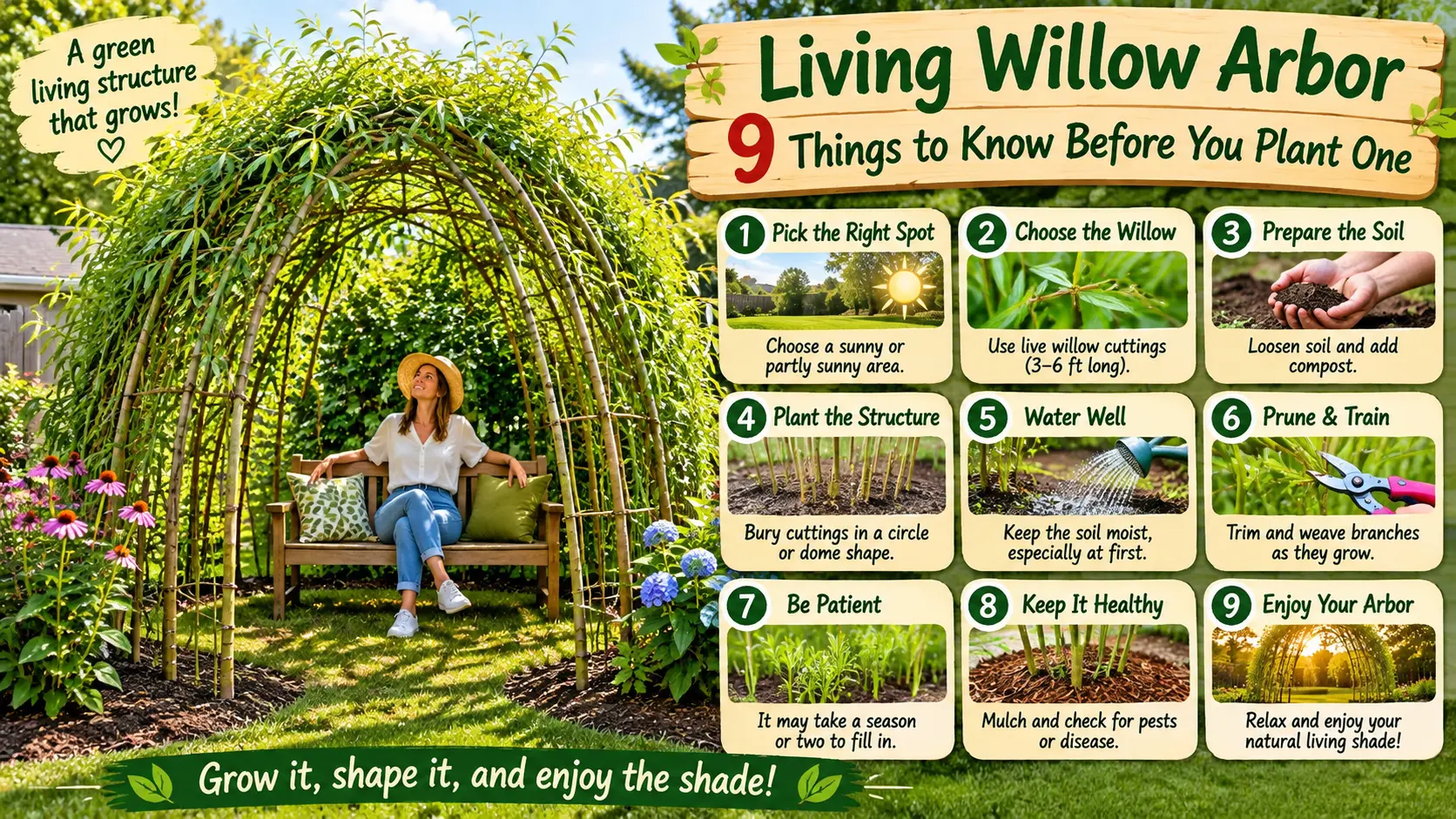
The structure in the Pin uses a circular footprint with an open entrance and willow rods bending toward the center.
That can work, but draw the footprint on the ground before planting anything.
Think about the mature size, the width of the entrance, how a bench will fit, how you will mow or mulch around the structure, and whether you can reach the inside for pruning.
06 • BUILD GENTLY
Bend the Rods—Do Not Force Them Until They Crack
Fresh willow is flexible, which makes arches and domes possible.
Still, every rod has a limit. Bend gradually and use several rods to create the shape rather than forcing one thick stem into a sharp curve.
Crossing rods can be secured temporarily with soft garden twine or similar ties. Inspect those ties as the stems thicken so they do not become tight around growing wood.
07 • WATERING
Do Not Let New Rods Dry Out While They Establish
Fresh willow rods do not arrive with a developed root system.
They need reliable soil moisture while roots begin developing. Penn State’s live-staking guidance emphasizes that willow cuttings root well in wet conditions and should be kept from drying before and after planting.
Mulching the planting area can help conserve moisture and reduce competition from lawn grass, but keep mulch from being packed tightly against the stems.
08 • TRAIN NEW GROWTH
Weave New Shoots Into the Structure
The bare framework is only the beginning.
New willow shoots can be trained through gaps in the dome, along the roofline, or around neighboring stems.
Winter is particularly useful for training because the young shoots are easier to see and handle after the leaves have dropped.
09 • EXPECT PRUNING
A Living Willow Dome Will Not Stay Neat by Itself
Willow can grow quickly once established.
RHS notes that living willow can produce substantial yearly growth, sometimes up to about 2 m (6½ ft), which means a small dome can become shaggy surprisingly fast.
Plan to prune, weave and redirect shoots regularly. That maintenance is what turns a loose group of willow plants into the dense, controlled garden structure shown in finished photos.
Will a Willow Dome Look Like the “After” Photo in One Summer?
Possibly greener, yes. Fully dense and mature, probably not.
A healthy planted rod can produce leaves and shoots after rooting begins, but the finished canopy depends on climate, variety, soil moisture, planting material and how well the rods establish.
The most attractive living structures usually improve over several growing seasons as fresh shoots are trained back into the framework.
A realistic timeline
| Planting time | Bare flexible framework with very little foliage. |
| First growing season | Successful rods leaf out and produce new shoots. |
| Following seasons | New growth can be woven and pruned to fill gaps and improve the shape. |
| Long term | The structure becomes thicker and requires regular pruning to stay controlled. |
Should You Put a Bench Inside?
Yes—this is one of the nicest uses for a willow dome.
Just make the bench an independent piece of furniture. Do not hang a heavy bench, swing or hammock from young willow rods.
A living willow arbor is a planted landscape feature. It should not be treated as an engineered load-bearing pergola.
Leave enough clearance around the bench so new shoots can be pruned without moving furniture every time.
Design idea: A simple freestanding garden bench, gravel or mulch floor, and a wide entrance can make the willow dome feel like a small outdoor room without asking the living structure to carry furniture loads.
Can You Build a Willow Arch Instead of a Dome?
Absolutely.
A living arch is a smaller version of the same basic idea. Willow rods are planted on opposite sides of a path and bent toward each other overhead.
It can create a garden entrance without using as many rods or as much ground space as a full dome.
Other possibilities include:
- Living willow tunnels
- Willow garden screens
- Willow bowers
- Living fences or “fedges”
- Children’s garden dens
- Small shaded seating areas
Want a conventional support instead? See FarmSolo’s Fruit Trellis Ideas for arches and trellises designed to support vines and fruit plants rather than becoming the living structure themselves.
Living Willow Arbor vs. Regular Garden Arbor
| Feature | Living Willow Arbor | Wood or Metal Arbor |
|---|---|---|
| Material | Living willow rods | Finished lumber or metal |
| Appearance | Changes with the seasons | Mostly fixed |
| Shade | Increases as foliage develops | Depends on roof or climbing plants |
| Water | Needs regular soil moisture | Structure itself needs none |
| Maintenance | Pruning and training every year | Painting, sealing or hardware maintenance |
| Load-bearing use | Not an engineered shelter or furniture support | Can be structurally designed for specific uses |
Common Living Willow Mistakes
- Using dead or dried willow. A decorative branch structure will not automatically root.
- Planting in a very dry lawn without irrigation. New willow rods need dependable moisture while establishing.
- Planting close to drains or foundations. Willow can develop vigorous water-seeking roots.
- Using weak or unsuitable rods. Long, straight, flexible live material is easier to train.
- Bending stems too sharply. Cracked rods may fail or develop weak points.
- Using permanent tight wire ties. Growing stems can be damaged as they thicken.
- Expecting an instant dense dome. The green canopy develops through new growth and repeated training.
- Ignoring pruning. Willow grows quickly and can lose the intended shape.
- Hanging heavy furniture from the frame. Treat it as a living garden feature rather than a load-bearing structure.
- Ignoring rabbits or deer. Both can browse young willow and may need to be excluded during establishment.
How Much Maintenance Does a Willow Dome Need?
More than a normal garden arch, but the work is fairly simple when done regularly.
| Spring | Check which rods survived and watch for new shoots. |
| Summer | Water during dry periods and trim unwanted growth as needed. |
| Fall | Inspect ties, mulch and the overall shape. |
| Winter | Train flexible dormant shoots and weave useful growth into gaps. |
Does Willow Attract Wildlife?
A leafy living structure adds more habitat value than a bare metal or lumber arbor, but not every visitor will be welcome.
Willow foliage and early flowers can contribute to garden habitat, while the dense growth can provide cover for small wildlife.
On the other hand, rabbits and deer may browse willow, especially when the structure is young.
If browsing pressure is high, protect the newly planted rods until the structure is well established.
Living Willow Arbor FAQ
Will cut willow branches actually grow?
Fresh viable willow cuttings can root readily when planted under suitable conditions. Dried decorative willow should not be expected to grow.
When should I plant a living willow arbor?
Winter to early spring while the willow is dormant is generally the best period for creating a living willow structure.
Does a willow dome need full sun?
Willow generally grows most vigorously with good sunlight and moist soil. Exact performance varies by species and climate.
How far should willow be from a house or drain?
Willow has vigorous moisture-seeking roots. RHS living-willow guidance recommends keeping structures about 10 m (33 ft) from buildings and drains, so choose the site carefully.
How fast does a living willow arbor grow?
Willow can be vigorous once established. RHS notes that living willow may put on up to around 2 m of growth in a year in favorable conditions, which is why regular pruning and training are important.
Can I hang a swing inside a willow dome?
I would not use a living willow dome as the structural support for a swing or hammock. Use a freestanding bench or a separately engineered support instead.
Sources Used for This Guide
- Royal Horticultural Society — Living Willow
- Royal Horticultural Society — Living Structures: Creating and Maintaining
- Royal Horticultural Society — Willow Growing and Propagation Guidance
- Penn State Extension — Live Staking and Willow Establishment
- Oregon State University Extension — Woody Cuttings and Willow Establishment
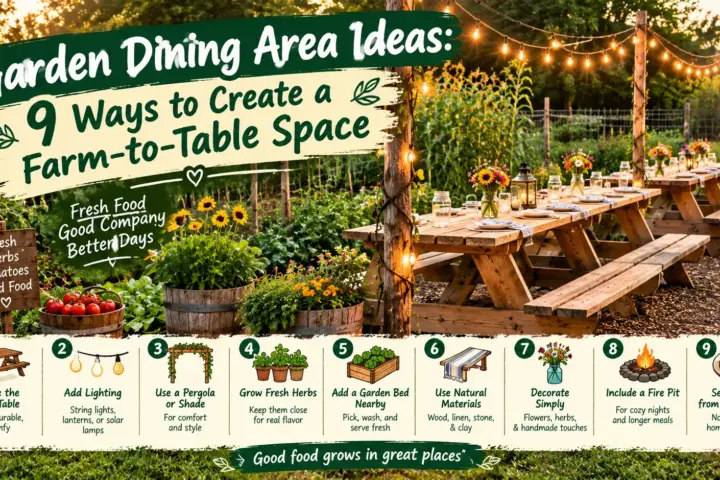
Creating a seating space around it? FarmSolo’s Garden Dining Area Ideas covers paths, shade, seating and practical outdoor-space planning.
THE FARMSOLO TAKEAWAY
Plant the Arbor—Do Not Just Build It
The appeal of a living willow arbor is that the project never really stops growing.
You start with bare flexible rods. Roots establish below the soil. Shoots appear above it. Then each year you weave, prune and shape the new growth until the frame becomes a leafy garden room.
Use living willow, give it moisture and room for its roots, keep it away from buildings and drains, and plan for annual pruning. That is the difference between a pile of branches and a living structure that improves with age.