

A chamomile lawn can replace grass in the right small, lightly used part of a yard, but it is not a zero-water, heavy-traffic lawn. Roman chamomile can form a soft aromatic groundcover, and the dwarf cultivar ‘Treneague’ needs little or no mowing. The tradeoff is that chamomile needs good drainage, careful establishment, weed control, and much lighter foot traffic than ordinary turf.
Quick reality check
- “Uses 90% less water than grass” — not a reliable universal claim.
- “Only mow once a year” — depends on the type of chamomile you grow.
- “Smells like apples when walked on” — yes, the aromatic foliage can release an apple-like scent.
- “Makes free tea” — flowering chamomile can be harvested for tea, but the best lawn cultivar does not flower.
- “Used as lawns since the 1500s” — chamomile lawns were popular in Elizabethan England.
- “Makes medicine” — chamomile has traditional herbal uses, but that is not the same as proving medical treatment benefits.

What Is a Chamomile Lawn?
A chamomile lawn is a low-growing carpet of Roman chamomile, Chamaemelum nobile, used instead of conventional turfgrass in a small garden area.
Roman chamomile is a creeping perennial with finely divided aromatic leaves. When the foliage is brushed or lightly stepped on, it releases the scent that gave chamomile its old “ground apple” or “earth apple” associations.
But there is an important detail that many social media posts leave out:
The best chamomile for a lawn is not necessarily the same chamomile you would choose for flowers or tea.
The Royal Horticultural Society recommends Chamaemelum nobile ‘Treneague’ for traditional low chamomile lawns. It grows only a few inches tall, spreads into a mat, and does not flower.
1. Does a Chamomile Lawn Really Use 90% Less Water?
I would not use that number.
Water use depends on climate, rainfall, soil, sun, plant establishment, and what type of turfgrass you are comparing it with.
Chamomile can tolerate some dry conditions once established, but it is not a plant that should be installed and then forgotten during every drought.
RHS guidance says chamomile lawns may need watering during prolonged dry spells. Very free-draining soils and low-rainfall locations can be difficult enough that another groundcover, such as thyme, may be a better choice.
Newly planted chamomile also needs regular moisture while the roots establish and the individual plants begin growing together.
Better claim: An established chamomile lawn may require less mowing and can tolerate some dry conditions, but there is no good reason to promise every homeowner a 90% reduction in water use.
2. Does a Chamomile Lawn Need Mowing?
This depends heavily on which chamomile you plant.
The dwarf non-flowering cultivar ‘Treneague’ is the easiest choice when your goal is a very low lawn. RHS says it generally does not need mowing, although a light trim in late summer can tidy any straggly growth.
That is different from saying every chamomile lawn should be mowed exactly once a year.
The ordinary flowering species grows taller. If you use flowering Roman chamomile as a lawn, it may need more trimming or mowing, and removing flowers can help keep the groundcover from becoming patchy.
So the viral “mow once a year” rule is too simple.
3. Does Chamomile Really Smell Like Apples?
Yes. This is one of the strongest claims in the Pinterest post.
Roman chamomile has aromatic foliage, and horticultural references describe its fragrance as apple-like.
The RHS notes that even the word chamomile traces back to a Greek term meaning “earth apple.” Kew Gardens also describes the apple-like scent as one reason chamomile became popular in old scented lawns and garden seats.
Lightly brushing against established plants can release that aroma.
But do not take that as permission to use chamomile where children, pets, or guests run back and forth all day. The lawn still has limited traffic tolerance.
4. Can You Walk on a Chamomile Lawn?
Yes, but only lightly.
This is probably the biggest limitation if you are comparing chamomile with a normal backyard lawn.
RHS recommends keeping foot traffic light even after the lawn is established. A new lawn should not be walked on for at least about 12 weeks, and traffic should remain minimal during the first year.
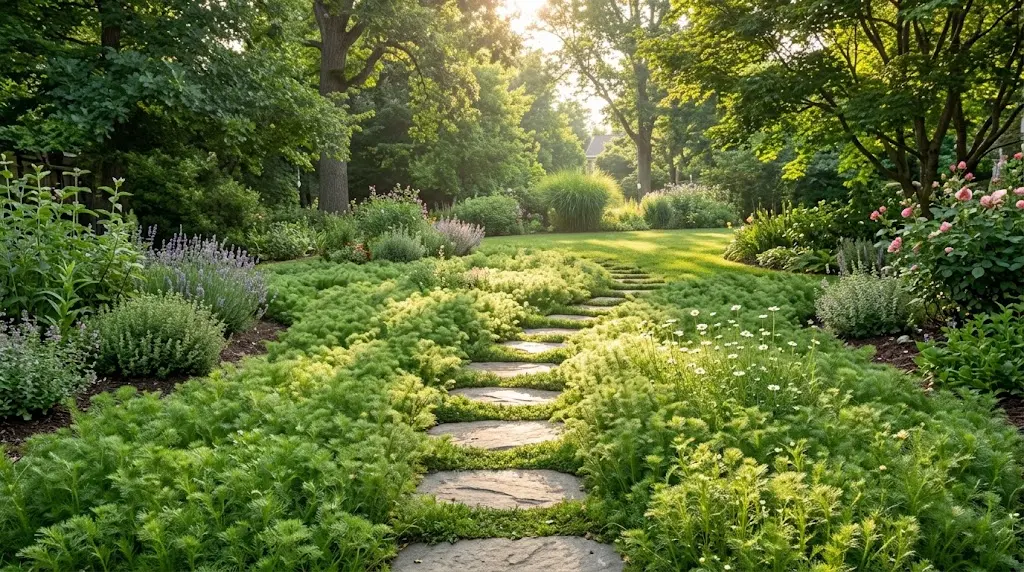
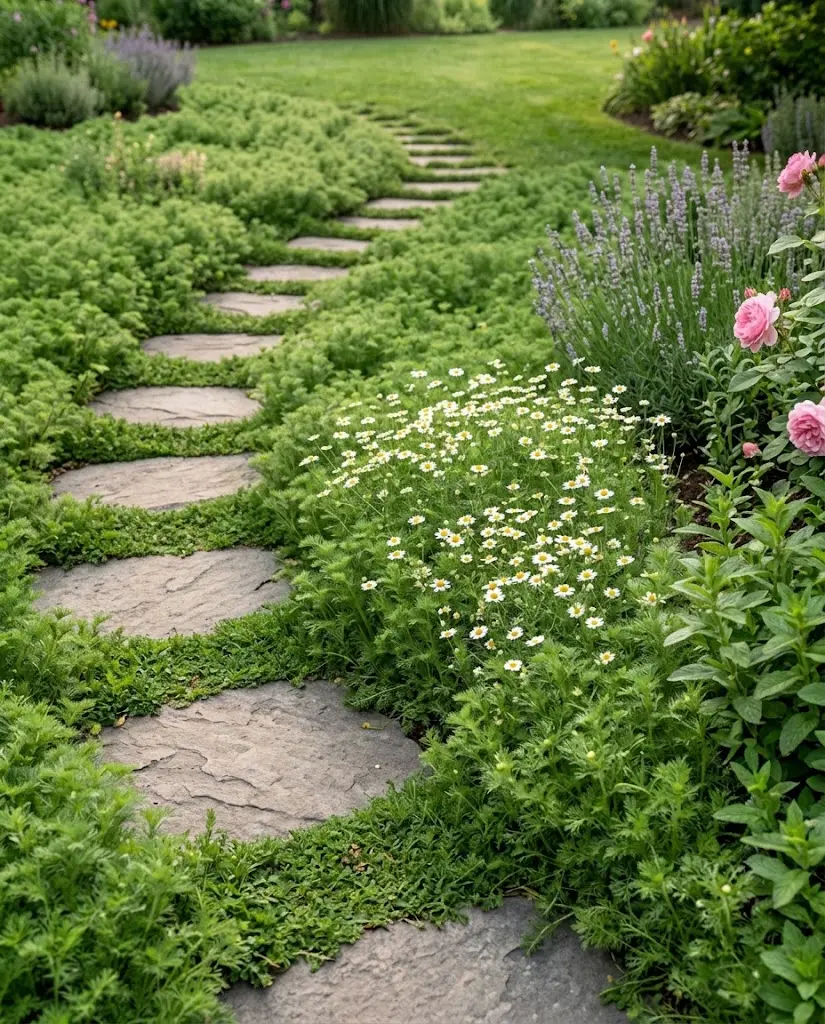
For areas you cross frequently, stepping stones are a better solution.
Chamomile is therefore much better for a quiet side garden, a path edge, a small front-yard feature, or an ornamental sitting area than for a lawn used for soccer, dogs, children’s play, or constant entertaining.
Good place for chamomile: a small sunny garden feature with occasional walking.
Bad place for chamomile: the main family play lawn or the route everyone uses to reach the backyard.
5. Can a Chamomile Lawn Give You Tea?
Sometimes, but this claim needs an important distinction.
The traditional low lawn cultivar ‘Treneague’ does not produce flowers. That is actually one reason it makes such a neat low lawn.
Flowering Roman chamomile can produce flowers that are used for tea, but Roman chamomile tends to be more bitter than German chamomile.
University of Vermont Extension recommends German chamomile, Matricaria chamomilla, when growing chamomile specifically for tea because it is less bitter.
So if tea is your priority, a dedicated herb patch may make more sense than expecting your low lawn to do both jobs perfectly.
Only harvest correctly identified chamomile that has not been treated with inappropriate pesticides, contaminated by pets, or grown where you would not normally harvest food plants.
6. Have Chamomile Lawns Really Been Used Since the 1500s?
The historical part of the Pinterest claim is broadly believable.
Kew Gardens describes chamomile as a popular plant for lawns and garden seats in Elizabethan England because of its soft feel and apple-like fragrance.
That places documented chamomile-lawn culture in the 1500s.
So chamomile as a lawn alternative is not a new social-media gardening trend. Gardeners have been interested in scented, low-growing chamomile surfaces for centuries.
What has changed is the availability of dwarf cultivars such as ‘Treneague’, which make modern low-maintenance chamomile lawns easier to create.
7. Does a Chamomile Lawn Flower for Four Months?
It can flower for a long summer season, but this is not a universal four-month guarantee.
Flowering Roman chamomile can produce white daisy-like blooms through summer and sometimes into fall, depending on climate and growing conditions.
UConn Extension lists a typical June-to-September bloom period for chamomile in New England landscapes.
But again, the classic lawn cultivar ‘Treneague’ is non-flowering.
That means you have a design decision to make:
- Want the lowest-maintenance carpet? Choose a dwarf non-flowering lawn cultivar.
- Want flowers and pollinator activity? Use a flowering form, but expect more height and maintenance.
8. Does a Chamomile Lawn “Make Medicine”?
I would not describe it that way.
Chamomile has a long history of traditional herbal use and is widely consumed as herbal tea.
But traditional use does not mean a backyard chamomile lawn should be promoted as medical treatment.
The National Center for Complementary and Integrative Health says research has not produced enough reliable evidence to rate chamomile’s effectiveness for many of the health conditions for which it is promoted.
Chamomile can also cause allergic reactions, particularly in people who react to related plants such as ragweed, chrysanthemums, marigolds, or daisies. Interactions with some medications, including warfarin, have also been reported.
Enjoy chamomile as a garden plant and, when appropriate, an herbal tea ingredient. Do not treat your lawn as a pharmacy.
9. Chamomile Is Not a Drop-In Replacement for Every Grass Lawn
This is the biggest lesson to take away from the viral image.
A traditional grass lawn and a chamomile lawn are designed for different types of use.
| Feature | Chamomile lawn | Traditional turfgrass |
|---|---|---|
| Foot traffic | Light, occasional traffic | Many turf types tolerate much heavier use |
| Mowing | Very little with dwarf ‘Treneague’ | Regular mowing during active growth |
| Fragrance | Aromatic, apple-like foliage | Fresh-cut grass scent |
| Flowers | Depends on cultivar | Usually managed to prevent flowering |
| Establishment | Needs weed control and careful establishment | Can be seeded or sodded depending on grass type |
| Best use | Small ornamental, low-traffic areas | General-use lawns and play spaces |
If your yard really needs a durable conventional lawn, FarmSolo’s grass seed guide explains how to establish grass instead.
Best Conditions for a Chamomile Lawn
Chamomile performs best when the site matches what the plant actually wants.
- Light: full sun is ideal; light dappled shade can work.
- Soil: light, well-drained soil is preferable.
- Moisture: enough moisture to establish and survive dry periods without constant saturation.
- Traffic: light and occasional.
- Drainage: avoid sites that stay wet for long periods.
Heavy clay can be particularly difficult because it may stay too wet in winter and become hard and dry during summer.
Deep shade is another poor fit. The plants can become thin and patchy instead of forming the dense carpet you see in ideal photos.
How to Start a Chamomile Lawn
1. Start With a Small Area
A chamomile lawn is much easier to manage as a small garden feature than as a huge replacement for every square foot of turf.
Try a side yard, a garden sitting area, a section between beds, or a low-traffic front-yard patch first.
2. Remove Existing Weeds Thoroughly
This step matters more than many people expect.
Chamomile does not magically suppress every weed from day one.
Remove perennial weeds and existing turf before planting. It is often worth waiting briefly after the first soil preparation so newly germinating weeds can be removed before the chamomile goes in.
3. Improve the Soil Only if It Needs It
The goal is a free-draining but not bone-dry growing area.
Do not automatically add large amounts of compost to a site that already has suitable soil. First look at drainage, texture, and existing conditions.
4. Choose the Right Chamomile
For a traditional low green carpet, use the cultivar Chamaemelum nobile ‘Treneague’.
It is propagated vegetatively rather than from ordinary seed because it is a named clone.
If you sow generic chamomile seed expecting an identical no-mow lawn, you may end up with taller flowering plants instead.
5. Space the Plants Closely Enough to Fill In
RHS recommends spacing lawn chamomile plants about 4 to 8 inches apart, depending on plant size and how quickly you want the area to fill.
Closer spacing costs more at the beginning but produces a continuous carpet sooner.
6. Water Until Established
Do not treat newly installed plants as drought-proof groundcover.
Water well after planting and keep the root zone from drying excessively while the plants establish and begin rooting into surrounding soil.
7. Stay Off the New Lawn
Give the plants time to spread before treating the space like an established lawn.
Avoid walking on it for at least the first several weeks. Where permanent access is needed, install stepping stones instead of creating a worn path through the plants.
Can You Grow a Chamomile Lawn From Seed?
You can grow the straight species of Roman chamomile from seed, but that does not give you the same result as a lawn of ‘Treneague’.
‘Treneague’ is a non-flowering named cultivar and must be propagated from existing plants, such as rooted pieces or divisions.
For that reason, a true low ‘Treneague’ lawn generally costs more to establish than simply broadcasting a bag of grass seed.
This is one reason chamomile lawns are most realistic as smaller specialty areas rather than acres of lawn replacement.
Is Chamomile Better Than Clover or Thyme?
There is no single best grass alternative.
| Groundcover | Useful feature | Main limitation |
|---|---|---|
| Chamomile | Soft, aromatic, very low mowing with the right cultivar | Light traffic only and can struggle in unsuitable soil |
| Creeping thyme | Fragrant and suited to sunny, free-draining sites | Not ideal for every climate or wet soil |
| White clover | Tougher groundcover with pollinator-friendly flowers | Different appearance from a fine traditional lawn |
| Turfgrass | Better choice for frequent walking and play | Usually requires regular mowing and other lawn care |
The best option depends on what the space is actually for.
If your main goal is supporting local wildlife rather than creating a formal lawn, FarmSolo’s native plants guide can help you choose plants better matched to your region and site.
Common Chamomile Lawn Mistakes
- Believing the 90% water claim. Water use depends on climate, soil, cultivar, and establishment.
- Buying any packet labeled chamomile. Lawn chamomile and tall tea chamomile are not interchangeable.
- Expecting flowers from ‘Treneague’. Its lack of flowers is one reason it stays so low.
- Expecting tea and a no-mow flowering lawn from the same plant. Those goals often point to different chamomile choices.
- Installing it in heavy traffic. Repeated walking can create bare patches.
- Planting in waterlogged soil. Chamomile prefers good drainage.
- Planting in deep shade. Cover may become sparse and uneven.
- Ignoring weeds during establishment. Gaps give weeds room to move in.
- Making medical claims about the lawn. Traditional herbal use is not proof that chamomile treats a health condition.
Chamomile Lawn FAQ
Can chamomile completely replace grass?
It can replace grass in a sunny, lightly used area with suitable soil. It is usually a poor replacement for a heavily used family lawn, sports area, or dog run.
Does a chamomile lawn need mowing?
The dwarf non-flowering cultivar ‘Treneague’ generally does not need normal mowing, although occasional light trimming can keep it neat. Flowering Roman chamomile may require more cutting.
Does chamomile need watering?
Yes, especially during establishment and extended dry weather. It should not be marketed as a plant that never needs irrigation.
Can dogs walk on a chamomile lawn?
A chamomile lawn is suited to light foot traffic, not repeated running or concentrated pet traffic. North Carolina Extension also notes that Roman chamomile can be problematic for dogs, cats, and horses if ingested, so consider household pets when deciding whether it belongs in your yard.
Can you make tea from lawn chamomile?
Flowers from correctly identified flowering Roman chamomile can be used for herbal tea, but the common low lawn cultivar ‘Treneague’ does not flower. German chamomile is often preferred when tea production is the main goal.
Does chamomile smell when you walk on it?
Yes. Crushing or brushing the aromatic foliage releases a distinctive scent commonly described as apple-like.
Does chamomile flower all summer?
Flowering Roman chamomile can bloom through much of summer and sometimes into fall, but timing depends on climate and cultivar. ‘Treneague’ produces no flowers at all.
Is a chamomile lawn medicinal?
Chamomile has a history of traditional herbal use, but a lawn should not be presented as medical treatment. Evidence for many promoted health uses remains limited, and chamomile can cause allergic reactions or interact with medications in some people.
Is a Chamomile Lawn Worth It?
A chamomile lawn can be beautiful when you use it for the job it actually does well.
Use it for a small aromatic groundcover, a quiet garden corner, a lightly used path with stepping stones, or a low-maintenance ornamental lawn where regular mowing is inconvenient.
Do not choose it because a social media graphic promises 90% less water, four months of flowers, free tea, no mowing, and medicinal benefits all from the same patch.
The real plant is more interesting than that.
Choose the right cultivar, give it sun and good drainage, protect it while it establishes, keep traffic light, and decide whether your goal is a neat aromatic lawn or a flowering herb patch.
When those expectations match your yard, chamomile can be a genuinely useful alternative to a small area of conventional grass.