How to Build a Tiered Raised Bed Garden for Small Spaces
A tiered raised bed garden can help you grow more vegetables, herbs, and flowers in a small backyard by using height instead of spreading every bed across the ground. The best designs keep every planting tier reachable, allow water to drain freely, and avoid stacking so high that upper levels shade the lower crops.
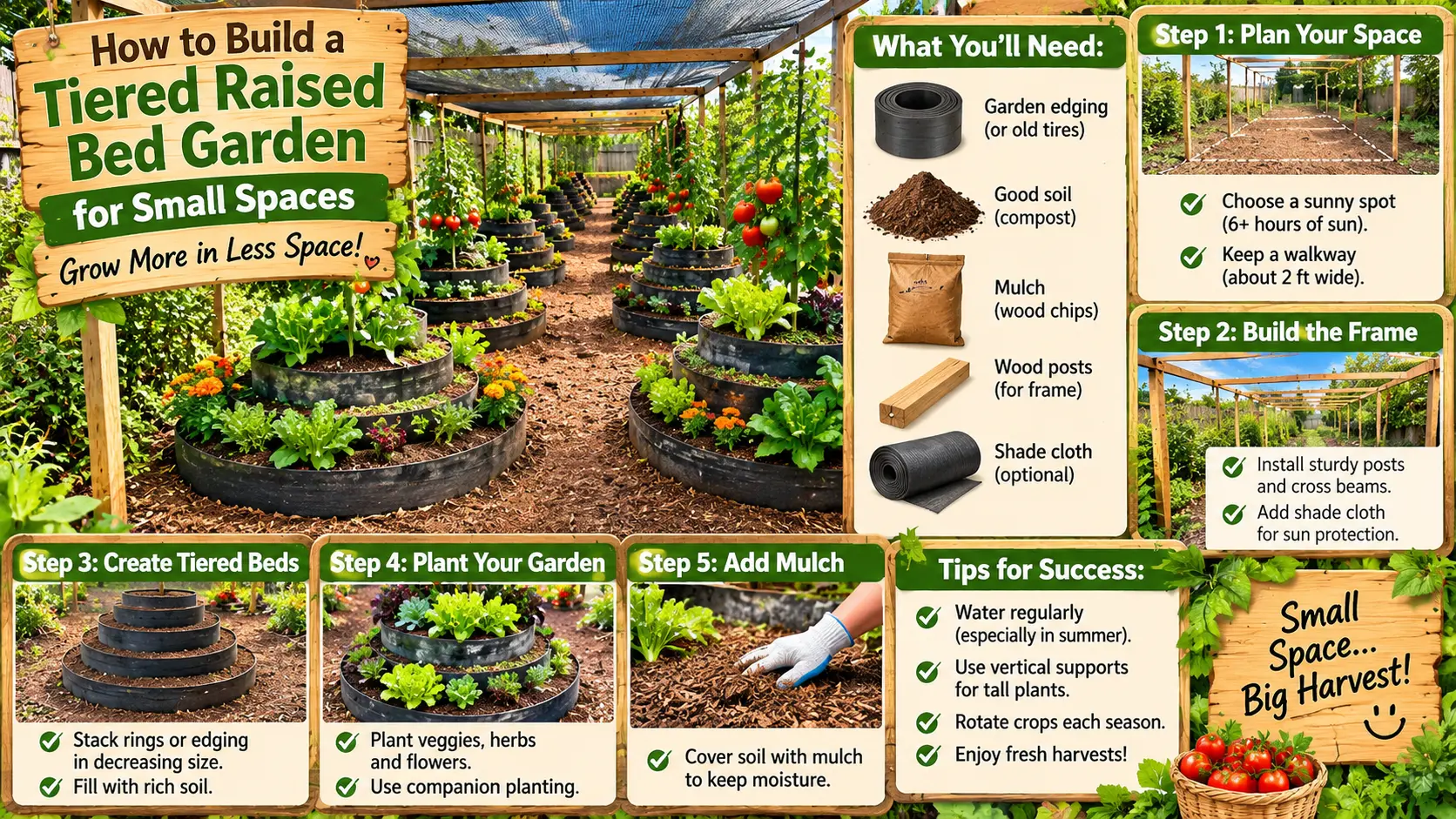
The inspiration image shows a long protected growing area filled with cone-shaped tiered beds. Each bed gets narrower toward the top, creating several planting rings in roughly the footprint of one ordinary bed.
Best use: treat a tiered bed as a space-saving raised garden, not simply as a tall pile of soil. Every level needs adequate root depth, drainage, sunlight, irrigation, and safe access.
Why Tiered Raised Beds Work in Small Gardens
Raised beds already use garden space efficiently, and adding multiple planting levels can increase usable surface area without increasing the footprint by the same amount.
Utah State Extension notes that raised beds are especially useful where growing space is limited and that vertical growing structures can make even better use of a small garden.
A tiered bed can also make it easier to separate crops with different root depths or growth habits.
1. Keep Every Tier Within Reach
A space-saving bed is not useful if you have to step into it to weed or harvest.
University of Minnesota recommends sizing raised beds so you can comfortably reach the center without walking on the soil. If you can reach from both sides, beds can be wider; if access is only from one side, they should be narrower.
For a circular tiered design, make sure the outer diameter and total height still allow you to reach the top and inner planting areas safely.
2. Do Not Make the Bed Too Wide
OSU and USU both use about 4 feet as a practical maximum width for many adult-access raised beds.
A circular bed can technically be larger if you can walk around the whole perimeter, but the upper tiers should remain narrow enough to reach comfortably.
3. Give Each Level Real Root Depth
Do not build several very shallow rings only for appearance.
Leafy greens and many herbs can manage with relatively modest root depth, while tomatoes, peppers, carrots, and larger crops benefit from deeper soil.
USU commonly describes raised beds in the 12–18 inch depth range for general gardening, although exact crop needs vary.
4. Put Deep-Rooted Crops in the Lower or Larger Tiers
The widest lower ring usually holds the most soil volume.
Good candidates can include:
- Tomatoes
- Peppers
- Eggplant
- Chard
- Carrots
- Beets
5. Use Upper Tiers for Smaller Crops
The smaller upper planting rings work well for crops that do not need a huge root zone.
- Lettuce
- Spinach
- Parsley
- Basil
- Chives
- Radishes
- Small flowers
6. Watch for Shade From the Upper Levels
Tiered beds create their own microclimates.
Tall crops planted at the top can shade lower rings for much of the day, especially when the bed is narrow or the sun angle is low.
USU specifically cautions that close small-space plantings can shade neighboring plants, so crop placement should account for sun direction and plant height.
7. Put Taller Crops Where They Will Not Shade Everything Else
In the Northern Hemisphere, placing taller crops toward the north side of a bed often helps reduce shading on shorter crops.
For circular beds, think about where the strongest sunlight arrives and position tall plants accordingly.
8. Drainage Is Critical in a Stacked Design
Water from upper tiers naturally moves downward.
If the lower tiers do not drain well, they can stay waterlogged while the upper rings dry out.
USU recommends ensuring that raised-bed irrigation water drains freely away from the root zone.
9. Do Not Build a Sealed Bottom Unless the Design Requires One
Typical raised beds are open to the soil below rather than built as giant closed containers.
USU notes that traditional raised beds have no bottom, allowing roots to extend into the native soil beneath.
If you are building over concrete or another hard surface, the design becomes more like container gardening and needs drainage openings and greater attention to watering.
10. Use Good Soil, Not Pure Compost
A giant tiered bed can require a surprising volume of growing medium.
Do not fill the entire structure with pure compost.
OSU recommends mixing compost with soil rather than relying on compost alone; one raised-bed recommendation is up to about 25% compost by volume in the fill.
11. Avoid Random “Layer-Filling” Tricks
Very tall raised beds are sometimes filled with large quantities of logs, branches, cardboard, or undecomposed organic matter simply to save soil.
Those materials settle as they decompose, which can cause the soil surface to drop unevenly.
For a long-lasting tiered bed, use stable fill and reserve high-quality growing soil for the rooting zones.
12. Expect the Upper Tiers to Dry Faster
Raised beds lose moisture faster than surrounding ground soil, and taller beds generally need more frequent watering. University of Minnesota specifically notes that taller raised beds dry faster.
In a pyramid design, the smallest top ring may dry noticeably faster than the broad lower tier.
13. Drip Irrigation Works Well
Running a drip or soaker line around each level makes watering much easier than trying to spray a tall stacked bed evenly.
USU recommends drip or trickle irrigation as an efficient option for raised-bed gardens.
14. Water Each Tier Based on Its Needs
Do not assume water applied to the top will automatically hydrate the lower plants correctly.
Separate drip loops or adjustable emitters give you much more control.
15. Mulch Exposed Soil
A light organic mulch helps reduce evaporation and soil splash.
This is particularly useful in raised beds because they tend to dry more quickly than in-ground garden soil.
16. Keep the Path Wide Enough to Work
The inspiration image packs many beds into a narrow protected tunnel.
That can maximize production, but you still need room to carry compost, hoses, harvest baskets, and tools.
USU recommends leaving practical walkways between raised beds, and one of its recent guides suggests at least about 2 feet between beds as a useful minimum.
17. Wheelbarrow Access Matters
If your path is only wide enough for your feet, filling the beds and moving compost later becomes frustrating.
Design the aisle around the tool you actually use.
18. Crop Rotation Still Matters
Tiered beds are compact, but they are still soil-based growing spaces where diseases and pests can build up.
University of Minnesota notes that multiple smaller raised beds can make crop rotation easier and recommends avoiding repeated planting of the same crop family in the same bed for several years where practical.
19. Use Different Beds for Different Crop Families
If you build several tiered units, rotate tomatoes, peppers, and eggplant away from the same structure the following season when possible.
Use another bed for beans, greens, roots, or other unrelated crops.
20. Add Vertical Trellises for Even More Production
A tiered bed already uses height, but crops like pole beans, peas, and some cucumbers can use trellises to extend production vertically again.
USU specifically recommends vertical supports for vining crops when maximizing small-space production.
21. Do Not Overcrowd Just Because You Have More Planting Surface
More planting area does not mean every square inch should be packed with plants.
Overcrowding can cause:
- Poor airflow
- More disease pressure
- Competition for water
- Competition for nutrients
- Excessive shade
- Difficult harvesting
22. Use the Top Tier for Pollinator Flowers Too
Not every level needs to grow food.
Compact flowering plants near the top can add color and attract pollinating insects while leaving larger lower areas for vegetables.
23. Covering the Whole Garden Can Reduce Pest Pressure
The image appears to show netting or protective mesh over the entire growing space.
Raised beds make it relatively easy to add hoops, row cover, or pest barriers. University of Minnesota highlights this as one advantage of raised-bed gardening.
24. Remember Pollination When Using Netting
Permanent insect netting can also exclude bees and other pollinators.
If you grow cucumbers, squash, melons, or other crops that depend on pollinating insects, the cover must be managed appropriately during flowering unless you are hand-pollinating.
25. Strong Tier Walls Matter
Wet soil is heavy.
Each tier acts like a small retaining wall, so weak flexible edging can bow outward or collapse after repeated watering.
Use durable material and secure each level before filling it.
26. Choose Safe Materials Around Edible Crops
OSU recommends choosing raised-bed framing materials that will not introduce unwanted chemicals into food-growing soil and specifically advises avoiding materials such as creosote-treated railroad ties.
Know what recycled materials were previously used for before placing them around vegetables.
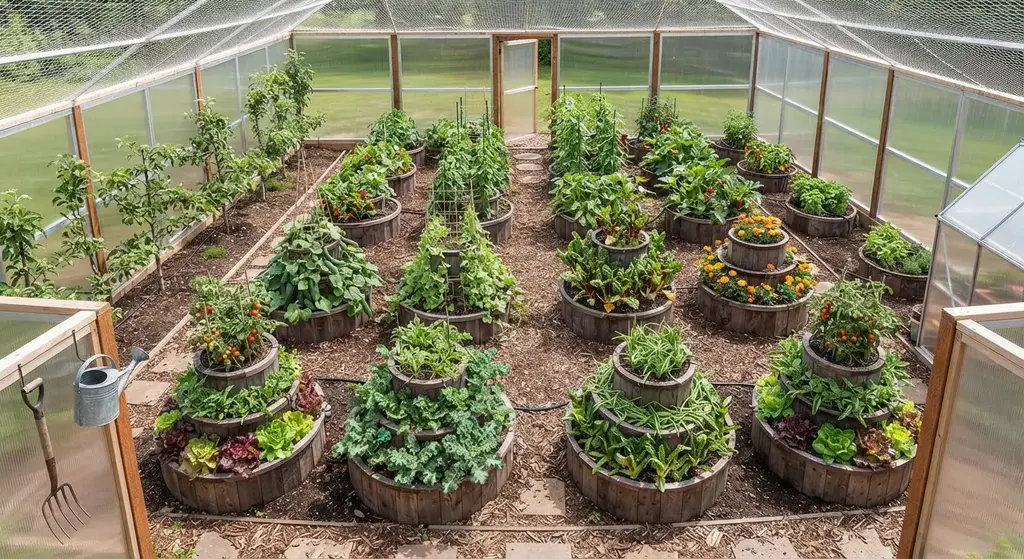
Best Crop Placement in a Tiered Bed
| Tier | Good Crops | Why |
|---|---|---|
| Top | Herbs, lettuce, radishes, small flowers | Small root zones and easy access |
| Middle | Greens, beets, onions, compact peppers | Moderate soil volume |
| Lower | Tomatoes, chard, carrots, eggplant | More soil and root space |
| Outer edges | Strawberries, thyme, trailing herbs | Can spill over without shading the center |
What This Pinterest Design Gets Right
- Uses vertical space instead of only ground area.
- Creates multiple planting zones in a small footprint.
- Leaves a central working path.
- Appears to use overhead pest protection.
- Makes individual beds easy to organize.
- Can support succession planting and crop rotation.
What I Would Change
- Widen the aisle if a wheelbarrow cannot pass comfortably.
- Limit bed height so the upper tier remains reachable.
- Add separate drip irrigation to each level.
- Make sure lower tiers drain instead of collecting water from above.
- Do not overcrowd every ring.
- Use deeper lower tiers for root-heavy crops.
- Plan tall crops so they do not shade the whole bed.
- Use durable, food-garden-appropriate framing materials.
Tiered Raised Bed FAQ
Do tiered raised beds really save space?
Yes. They create several planting surfaces within one footprint, which can be useful in small backyards when each level remains accessible and receives enough light.
How wide should a raised bed be?
A common guideline is no more than about 4 feet when gardeners can access both sides. Narrower beds are better when access is only from one side.
What should I plant on top?
Herbs, greens, radishes, strawberries, and compact flowers are useful options because the top tier usually has less soil volume and dries faster.
Can tomatoes grow in a tiered bed?
Yes, but place them where there is adequate soil depth and where the mature plants will not shade everything below them.
Do tiered raised beds need drip irrigation?
They do not require it, but drip irrigation makes it easier to water individual levels evenly and efficiently.
Can I fill the whole bed with compost?
No. Use a balanced soil mix. OSU recommends incorporating compost into soil rather than filling raised beds entirely with compost.
Do tall raised beds dry out faster?
Yes. Raised beds generally dry faster than surrounding soil, and taller beds may need more frequent irrigation.
The Bottom Line
The garden in the inspiration image is a clever example of using height to increase planting area in a restricted footprint.
A good tiered bed should save space without sacrificing access, soil depth, drainage, sunlight, or irrigation. Keep the structure reachable, use deeper lower tiers for larger crops, reserve smaller upper levels for herbs and greens, and leave enough pathway space to actually work in the garden.
Sources
- University of Minnesota Extension — Raised Bed Gardens
- Utah State University Extension — Raised Bed Gardening
- Oregon State University Extension — Raised Bed Gardening
- Oregon State University Extension — How to Use Compost in Gardens and Landscapes