
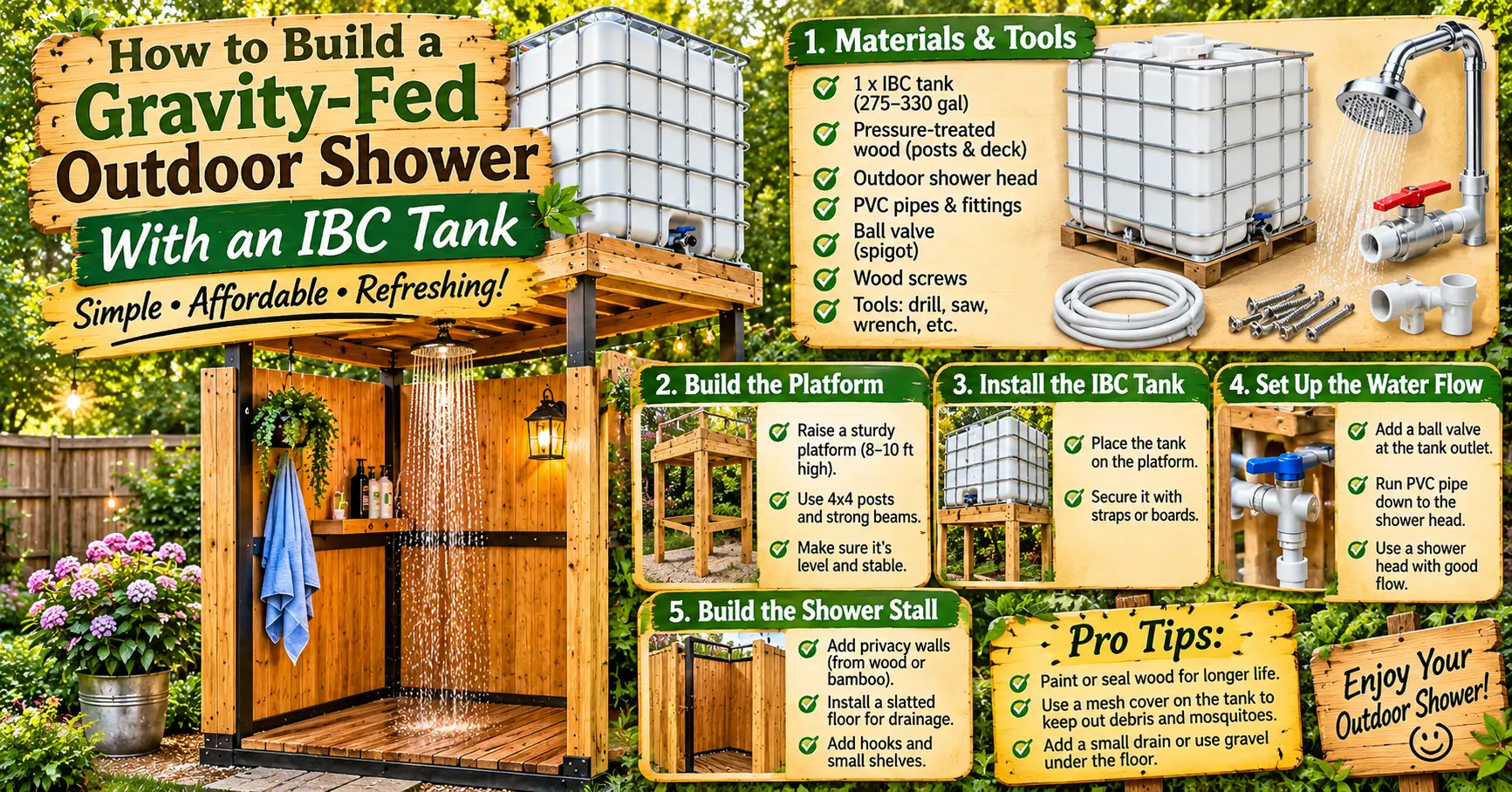
A gravity-fed outdoor shower can work without a pressure pump by placing a water tank above the shower head, but the elevated tank is the part that requires the most careful planning. Hundreds of gallons of water can weigh more than a ton, so the support structure needs to be designed around the full tank load—not treated like a decorative pergola or ordinary shower roof.
The Pinterest image combines an elevated IBC tote, outdoor shower, privacy walls, wooden platform, small sink, and simple gravity plumbing. The concept is practical for an off-grid homestead, garden washing station, cabin, or seasonal outdoor shower, but several details need to be corrected before copying the design.
Critical safety point: do not place a full IBC tank on top of a lightly framed shower enclosure. A typical full IBC can place thousands of pounds on a very small footprint. Use a purpose-designed independent platform or engineered structure with a stable foundation.
How a Gravity-Fed Outdoor Shower Works
The basic system is simple:
Water source → storage tank → elevated outlet → shutoff valve → pipe or hose → shower head → drainage area
Gravity creates pressure because the water surface in the tank is higher than the shower head.
The greater the vertical difference, or head height, the more pressure is available.
1. Decide What Water Source You Will Use
An outdoor shower tank can potentially be filled from:
- A potable household water supply
- A private well
- Delivered potable water
- Harvested rainwater that has been appropriately collected and treated for the intended use
Do not assume roof-collected rainwater is clean simply because it looks clear.
2. Rainwater Used for Bathing Needs More Care Than Garden Water
Rainwater can pick up dust, bird droppings, roofing residues, metals, microorganisms, and other contamination as it moves across a roof and through gutters.
Water used only for ornamental plants does not need the same quality as water that will contact your face, skin, eyes, or mouth.
If rainwater is intended for bathing, follow local health guidance for testing, filtration, disinfection, storage, and maintenance.
3. Do Not Use an IBC Tote With an Unknown History
Used IBC containers are inexpensive, but their previous contents matter.
Avoid tanks that previously contained:
- Pesticides
- Herbicides
- Fuel
- Industrial solvents
- Unknown chemicals
- Products with an unknown contamination history
For water that will contact people, use a tank with a known appropriate history and materials suitable for the intended water use.
4. Understand How Heavy the Tank Becomes
This is the biggest weakness in many viral outdoor-shower designs.
Water weighs about 8.34 pounds per U.S. gallon.
| Tank Capacity | Approx. Water Weight Alone |
|---|---|
| 100 gallons | 834 lb |
| 250 gallons | 2,085 lb |
| 275 gallons | About 2,294 lb |
| 330 gallons | About 2,752 lb |
Then add the weight of the IBC cage, plumbing, platform, wet timber, roofing, hardware, wind forces, and people using or maintaining the structure.
5. A Separate Tank Tower Is Often Safer
Instead of making the shower enclosure carry the tank, consider separating the two structures.
A dedicated tank stand can:
- Carry the heavy load directly into its own foundation
- Make structural inspection easier
- Reduce risk above the person showering
- Allow the shower enclosure to remain lightweight
- Make future tank replacement easier
Better layout: place the IBC on a properly engineered tower beside the shower, then run a short pipe downhill to the shower head.
6. Build the Foundation for the Full Load
A tank platform should not sit on loose pavers, soft garden soil, or a few decorative concrete blocks.
A full tank can cause inadequate footings to:
- Settle unevenly
- Lean
- Twist the frame
- Crack
- Overturn
Foundation design depends on soil, frost depth, wind, tank size, platform height, and local building requirements.
7. Brace the Tank Platform in Both Directions
Tall posts without diagonal bracing can rack sideways under wind or when the tank moves slightly during filling.
A tank stand needs resistance to:
- Vertical load
- Side load
- Wind
- Racking
- Uneven settlement
- Dynamic movement of water
8. Keep the Tank Fully Supported
An IBC tote should sit on a flat structural surface that supports the base as intended.
Do not rest only the corners or cage rails on narrow beams unless the tank manufacturer and structural design specifically allow it.
9. Secure the Empty Tank Against Wind
A full IBC is extremely heavy, but an empty plastic tank and metal cage can be much easier for strong wind to move.
The tank and platform should remain stable whether the tank is full, half-full, or empty.
10. Gravity Pressure Depends on Height
One foot of water head produces only about 0.43 psi.
If the surface of the water is only 8 feet above the shower head, the static pressure is roughly 3.5 psi before losses through pipes, valves, elbows, and the shower head.
That is much lower than normal household plumbing pressure.
11. Choose a Low-Pressure Shower Head
A conventional shower head designed for household pressure may give a disappointing trickle on a low-head gravity system.
Look for a fixture designed to work at low pressure, or use a simple open-flow shower rose.
12. Keep the Plumbing Large Enough
Long runs of narrow pipe create additional friction loss.
With a gravity system, keeping the plumbing reasonably short and avoiding unnecessary restrictive fittings helps preserve the limited available pressure.
13. Install an Accessible Shutoff Valve
Place a valve near the tank outlet so the downstream plumbing can be repaired without emptying the entire tank.
Another convenient valve or shower control should be reachable from the shower itself.
14. Add a Drain or Clean-Out Point
Sediment can collect at the bottom of a storage tank.
Keep the main tank valve and cleaning access reachable instead of permanently enclosing the tank inside a decorative roof structure.
15. Screen Tank Openings
Open storage water can become mosquito habitat.
Screen vents, overflow openings, and rainwater inlets while still allowing the tank to breathe as water enters and leaves.
16. A First-Flush Diverter Helps With Roof-Collected Water
If the tank receives roof runoff, install leaf screening and consider a first-flush diverter.
The first runoff after a dry period tends to carry more roof debris, dust, and contamination than later water.
17. Do Not Connect Untreated Rainwater Into Potable Plumbing
If the property also has a normal household water supply, keep the rainwater system separated unless an approved system provides the required cross-connection and backflow protection.
Rainwater entering potable pipes can contaminate otherwise safe drinking water.
18. Sun-Warmed Water Can Become Very Hot
An exposed plastic tank can heat significantly in direct sun, especially during hot weather.
Do not assume solar-heated tank water will always reach a comfortable shower temperature.
Test the water temperature before stepping under the shower.
19. Warm Stored Water Also Needs Hygiene Management
Warm stagnant water can support microbial growth.
Do not fill a tank, leave it warm and stagnant for long periods, and assume the water remains suitable for bathing indefinitely.
Keep the system clean, follow local guidance for water treatment, and rotate or drain stored water as appropriate.
20. The Outdoor Shower Needs Drainage Too
The Pinterest image shows a slatted wooden floor, but the water still has to go somewhere underneath.
Plan drainage before building the platform.
Possible approaches, where local rules allow, may include an approved infiltration area or properly designed greywater system.
21. Do Not Let Shower Water Pool Around Posts
Repeatedly wetting structural posts can accelerate decay and undermine soil around foundations.
Slope the surrounding area so water drains away from the structure.
22. Soap Changes the Drainage Question
Water from rinsing garden dirt off boots is different from greywater containing soap, shampoo, hair products, or other personal-care products.
Do not simply route shower greywater into a vegetable bed or surface drain without checking local greywater and wastewater rules.
23. Make the Floor Slip Resistant
Wet wood can become slippery and can grow algae or biofilm where it stays damp.
Provide:
- Drainage gaps
- A stable walking surface
- No exposed fasteners
- No sharp edges
- Regular cleaning
24. Use Exterior-Rated Materials
The enclosure will experience repeated wetting, humidity, sun, and temperature changes.
Use exterior-rated lumber, corrosion-resistant fasteners, and plumbing materials suitable for outdoor exposure.
25. Keep Electrical Lighting Away From DIY Improvisation
The Pinterest image includes decorative lights beside the shower.
Water and electricity require appropriate outdoor and wet-location equipment, grounding, protection, clearances, and local electrical-code compliance.
Solar lights located safely away from the wet area may simplify a basic off-grid installation.
26. Add Privacy Without Blocking Ventilation
Solid walls around an outdoor shower provide privacy but can trap humidity.
Leave controlled openings high and low so wood can dry between uses.
27. The Sink Can Share the Tank—but Pressure Will Still Be Low
A nearby utility sink can be supplied from the same elevated tank.
Keep expectations realistic: gravity pressure at a sink may also be much lower than household faucet pressure.
28. A Smaller Header Tank May Be Smarter Than Lifting the Whole IBC
One safer alternative is to keep the large IBC at ground level and move only a smaller quantity of water to an elevated header tank.
For example, the main IBC can store water near the ground while a much smaller tank above the shower provides gravity pressure.
This can dramatically reduce the structural load overhead.
Safer concept: large storage tank at ground level → small transfer pump or manual filling → smaller elevated header tank → gravity-fed shower.
A Practical Layout for FarmSolo
- Place the main IBC on a stable ground-level base.
- Screen the water inlet and keep the tank covered.
- Add a first-flush diverter if collecting roof rainwater.
- Filter and treat water appropriately for its intended use.
- Use a smaller elevated header tank if gravity pressure is needed.
- Keep the elevated structure independent and strongly braced.
- Install a low-pressure shower head.
- Add an accessible shutoff valve.
- Build a draining, slip-resistant shower floor.
- Route greywater according to local rules.
- Vent the privacy enclosure.
- Keep electrical equipment out of the wet zone unless properly designed for it.
What This Pinterest Outdoor Shower Gets Right
- Uses elevation to create gravity-fed water pressure.
- Combines shower and utility sink in one compact station.
- Provides privacy walls.
- Uses a slatted floor for drainage.
- Requires little or no electricity for water delivery.
- Could fit an off-grid cabin or small homestead.
What I Would Change Before Building It
- I would not place a full large IBC directly over the shower on a lightly framed timber roof.
- I would use a separate structural tank tower or a much smaller elevated header tank.
- I would verify the previous contents of any reused IBC.
- I would treat rainwater according to its intended bathing use.
- I would add insect-proof screens to tank openings.
- I would include safe overflow and tank-cleaning access.
- I would build a dedicated greywater drainage system rather than letting water collect under the floor.
- I would keep electrical lighting away from improvised wet-area wiring.
IBC Outdoor Shower FAQ
Can an IBC tank run a shower without a pump?
Yes, if the water level is high enough above the shower head and the plumbing and shower head are suitable for low pressure. The flow will usually be much gentler than a normal household shower.
How high should a gravity shower tank be?
There is no universal height. Every foot of vertical water head adds only about 0.43 psi, so usable pressure depends on tank water level, shower height, pipe size, fittings, and shower-head restriction.
Can I put a 275-gallon IBC on a wooden platform?
A full 275-gallon tank contains roughly 2,300 pounds of water before the tank and platform are counted. A platform carrying that load should be specifically designed for it with appropriate foundations, posts, beams, connections, and lateral bracing.
Can I shower in collected rainwater?
Rainwater is not automatically safe for bathing. Its quality depends on the catchment surface, storage tank, local contamination, treatment, and maintenance. Follow local public-health guidance and test and treat the water as needed for bathing use.
Will an IBC tank heat water in the sun?
Yes, exposed tanks can warm substantially in sunshine, but temperatures are unpredictable. Water may remain too cold on some days and become uncomfortably hot on others.
Can I use the shower water to irrigate the garden?
That depends on what is in the greywater and local regulations. Soap, shampoo, salts, personal-care products, soil conditions, and crop type all matter. Do not automatically discharge shower water onto edible crops.
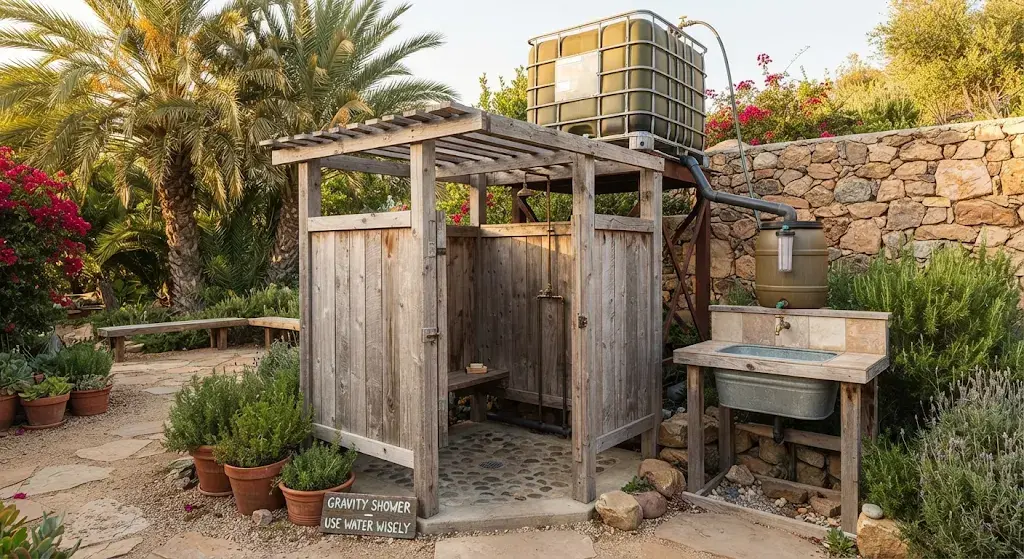
Is a black IBC better for a solar shower?
A dark tank can absorb more solar energy and also block light that encourages algae, but uncontrolled heating is not a substitute for a proper water-heating and temperature-control system.
The Bottom Line
The Pinterest outdoor shower is an appealing off-grid concept because a raised tank can deliver water without an electric pressure pump.
But the safest version should separate the lightweight shower enclosure from the heavy water-storage structure. Keep the main IBC near ground level or build a properly engineered tank tower, use a smaller elevated header tank when possible, manage rainwater quality carefully, and design drainage before the first shower is used.
Sources
- CDC — Collecting Rainwater and Your Health
- CDC — Personal Hygiene and Safe Bathing Water
- U.S. EPA — Onsite Alternative Water Sources and Water Reuse
- FarmSolo — DIY Rainwater Harvesting: Rain Barrels, Multi-Barrel & IBC Systems