How to Ripen Green Tomatoes Indoors Before Frost
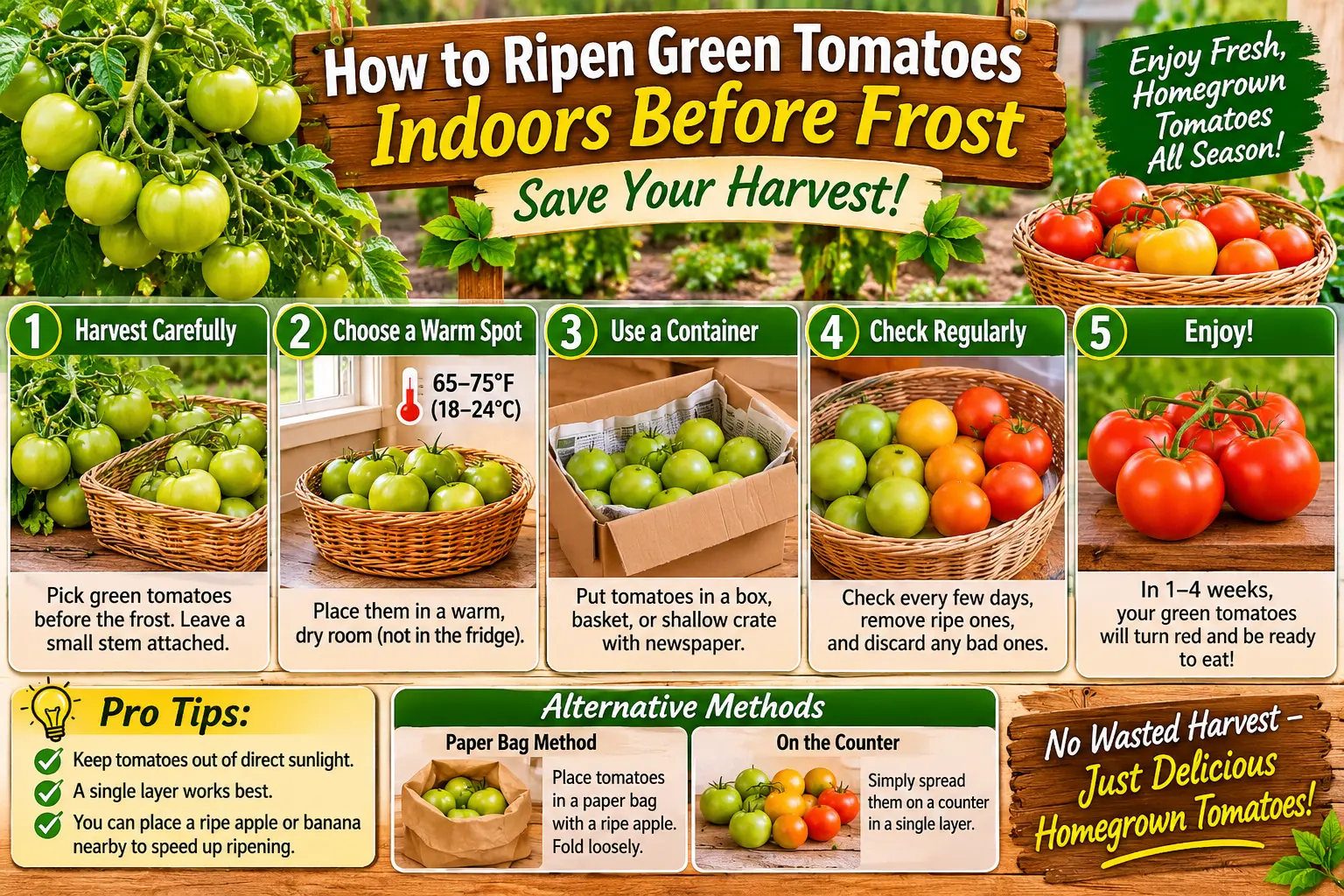
When the first hard frost is approaching, you do not have to abandon every green tomato still hanging on the vines. Mature green tomatoes can often finish ripening indoors if you harvest them before frost damage and store them at the right temperature.
The Pinterest idea of pulling up entire tomato plants and hanging them upside down is a traditional method some gardeners use, but it is not necessary for most home gardens. A simpler method is to pick the mature fruit, sort it carefully, and let it ripen indoors at room temperature.
Quick answer: Before frost, harvest full-sized green tomatoes that have begun to lighten in color. Keep them indoors around normal room temperature, preferably in a single layer, and check them often. They do not need sunlight to turn red.
Which Green Tomatoes Will Actually Ripen?
Not every green tomato is mature enough to finish ripening after harvest.
University of Minnesota Extension explains that tomatoes harvested at the mature-green stage—fully developed in size but not yet colored—will often ripen satisfactorily indoors. Tomatoes that are still very immature and uniformly deep green are less likely to develop good flavor.
Good candidates usually have:
- Reached close to their expected full size
- A firm surface
- A lighter green or whitish-green color
- No frost damage
- No rot, cracks, or disease lesions
Harvest Before the First Frost
Do not wait until the plants are frost-killed.
UMN recommends picking all tomato fruit and bringing it indoors when frost threatens.
This is especially important if you plan to preserve any of the fruit later, because tomatoes from frost-killed vines are not recommended for home canning.
How to Harvest Green Tomatoes
- Watch the forecast closely as nighttime temperatures fall.
- Pick mature fruit before frost arrives.
- Handle tomatoes gently to avoid bruising.
- Discard badly damaged or diseased fruit.
- Separate nearly ripe tomatoes from very green ones.
- Bring the sound fruit indoors immediately.
Do Green Tomatoes Need Sunlight to Ripen?
No. Light is not required for tomato fruit to ripen after harvest.
UMN specifically notes that warmth is more important than light. Tomatoes can ripen perfectly well in a pantry, basement room, spare room, or other suitable indoor location.
Best Temperature for Ripening Tomatoes Indoors
Temperature has a major effect on ripening speed and quality.
Penn State reports an optimum ripening range of roughly 63°F to 70°F for mature green tomatoes. Temperatures above about 80°F or below about 55°F can interfere with normal ripening.
UMN also notes that tomato maturation performs well around the upper 60s to 70s Fahrenheit, while very high temperatures can interfere with red pigment formation.
Method 1: Ripen Tomatoes in a Single Layer
This is the simplest and most reliable method for most gardeners.
- Choose sound mature-green tomatoes.
- Arrange them in a single layer.
- Leave a little space between fruits.
- Keep them at room temperature.
- Check every few days.
- Remove ripe tomatoes promptly.
- Discard any fruit that develops rot.
UMN recommends storing unripe tomatoes one layer deep and spaced so they are not touching.
Method 2: Use a Cardboard Box
A shallow box works well when you have a larger harvest.
Line the box with clean paper, arrange tomatoes in one layer, and keep the box somewhere cool-to-moderate and dry.
Do not completely forget about the box. One rotting tomato can affect nearby fruit if it goes unnoticed.
Method 3: Use a Paper Bag for Faster Ripening
If you want a few tomatoes to ripen faster, a loosely closed paper bag can trap some of the natural ethylene gas produced by ripening fruit.
You can add a ripe apple or banana, which also releases ethylene, but check the tomatoes frequently so excess moisture or rot does not develop.
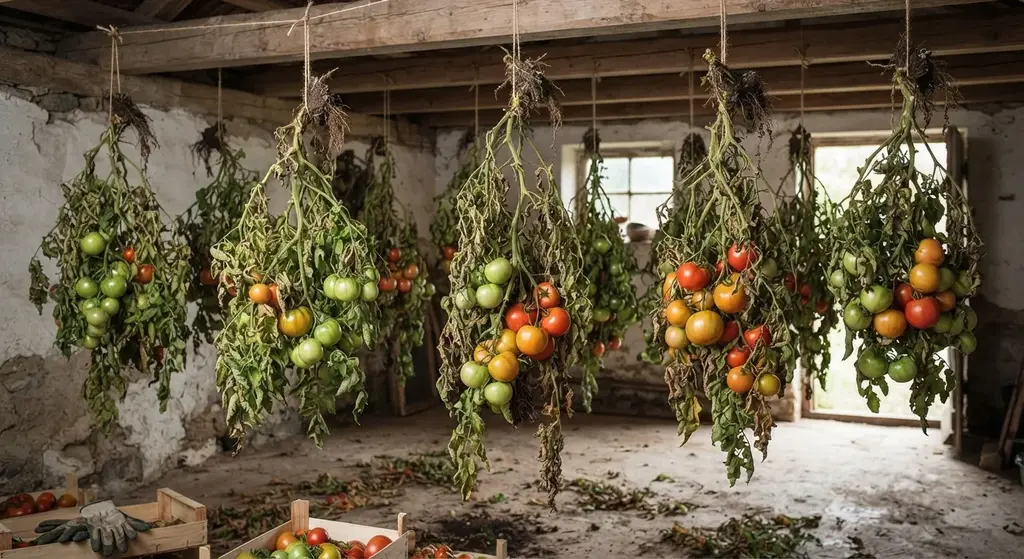
Method 4: Hang the Entire Tomato Plant Upside Down
The Pinterest image shows entire tomato plants pulled from the soil and hung upside down in a garage or shed.
This method can work as a traditional end-of-season technique, especially when many tomatoes remain attached to one healthy plant, but it is not necessary for the fruit to ripen.
If you try it:
- Choose only healthy plants.
- Pull them before frost damage.
- Shake off excess soil.
- Hang them in a dry, protected location.
- Keep the fruit off the floor.
- Check frequently for rot and disease.
Important correction to the Pinterest claim: the tomatoes do not need the uprooted plant’s remaining “reserves” in order to ripen. Mature-green tomatoes can ripen after they are individually harvested. The whole-plant method is better treated as an optional storage technique, not a requirement.
Should You Wash Tomatoes Before Indoor Ripening?
If the fruit is visibly dirty, gently clean it and dry it completely before storage.
The important part is that tomatoes do not remain wet in storage, because persistent moisture encourages decay.
How Long Does It Take?
Ripening time depends on how mature the tomato was when picked and the temperature of the room.
Fruit already showing a pink or orange blush may ripen relatively quickly. Fully green but mature tomatoes can take several weeks.
UMN notes that mature green fruit can continue ripening over the following weeks when stored appropriately.
Do Tomatoes Taste as Good as Vine-Ripened Fruit?
Tomatoes harvested at a properly mature stage can develop good color and acceptable flavor indoors.
But truly immature fruit generally does not develop the same flavor quality, even if it eventually softens or changes color.
Do Not Refrigerate Green Tomatoes to Ripen Them
Very cool temperatures slow normal ripening.
Penn State notes that mature-green tomatoes do not ripen normally below about 55°F.
Use room temperature for ripening rather than putting green tomatoes directly into the refrigerator.
Check for Late Blight and Other Disease
Tomatoes harvested from a plant showing disease need extra attention.
Penn State warns that green tomatoes picked from plants affected by late blight may develop visible lesions after harvest. Check them frequently and discard fruit that develops disease symptoms.
Do Not Can Tomatoes From Frost-Killed Vines
This distinction is important for FarmSolo readers who preserve their garden harvest.
UMN advises against canning damaged tomatoes or tomatoes from dead or frost-killed vines because deterioration can affect safety.
If you intend to can the crop, harvest sound fruit before the plant is killed by frost and follow a tested tomato-canning recipe.
What to Do With Tomatoes That Will Not Ripen
Not every green tomato needs to become a red tomato.
Sound green tomatoes can also be used in recipes designed specifically for green tomatoes, such as:
- Green tomato relish
- Tested green tomato pickle recipes
- Fried green tomatoes
- Chutney recipes
- Other tested preservation recipes
If preserving them, always use a tested recipe rather than improvising acid levels or processing times.
Best Indoor-Ripening Methods Compared
| Method | Best For | Main Advantage |
|---|---|---|
| Single layer | Most home gardeners | Easy to inspect |
| Cardboard box | Larger harvests | Compact storage |
| Paper bag | A few tomatoes | Can speed ripening |
| Whole plant hanging | Large healthy plants before frost | Keeps fruit attached |
Common Mistakes
Waiting Until After Frost
Harvest before the plant and fruit are damaged.
Trying to Ripen Very Immature Fruit
Small deep-green tomatoes may never develop satisfying flavor.
Stacking Tomatoes Deeply
Pressure and poor airflow make bruising and hidden rot harder to detect.
Keeping Them Too Cold
Cold storage can slow or prevent normal ripening.
Leaving Diseased Fruit With Healthy Tomatoes
One diseased fruit can deteriorate quickly and should be removed immediately.
Green Tomato Ripening FAQ
Will green tomatoes ripen after picking?
Yes, if they have reached the mature-green stage. Very immature tomatoes are much less likely to develop good flavor.
Should I put green tomatoes in a sunny window?
No sunlight is required. A suitable room temperature is more important than direct light.
Can I hang the whole plant upside down?
Yes, some gardeners use this method, but individual mature-green fruit can also ripen successfully after picking. Hanging the plant is optional.
What temperature is best?
Around the mid-60s to low-70s Fahrenheit is a useful target. Penn State gives about 63–70°F as an optimum range for mature-green tomatoes.
How long can green tomatoes take to ripen?
Depending on maturity and temperature, they may need anywhere from several days to several weeks.
Can I can tomatoes after they ripen indoors?
Sound tomatoes harvested before frost can be used with tested canning recipes. Do not can tomatoes from dead or frost-killed vines, and follow current acidification and processing guidance.
The Bottom Line
You can extend your tomato harvest beyond the first cold nights without leaving every fruit on the vine until frost destroys it.
Harvest mature-green tomatoes before frost, keep them at a moderate room temperature, arrange them so you can inspect them easily, and remove ripe or damaged fruit as you go. Hanging the whole tomato plant upside down can be tried, but it is not necessary—the maturity of the fruit and the storage conditions matter more.
Sources
- University of Minnesota Extension — Growing Tomatoes in Home Gardens
- University of Minnesota Extension — Canning at Home: Tomatoes
- Penn State Extension — Tomato Production
- Penn State Extension — Tomatoes and Potatoes Infected With Late Blight