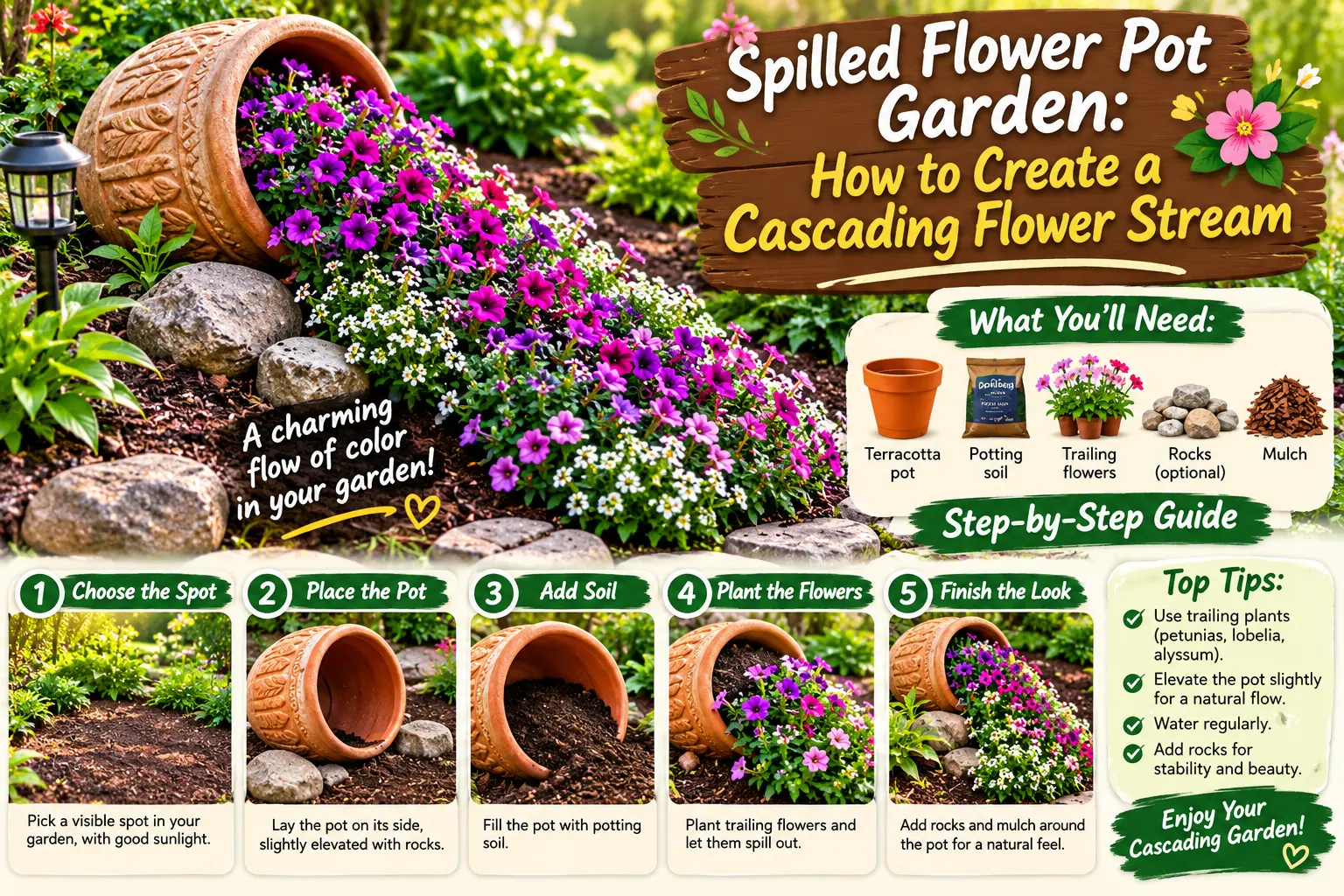
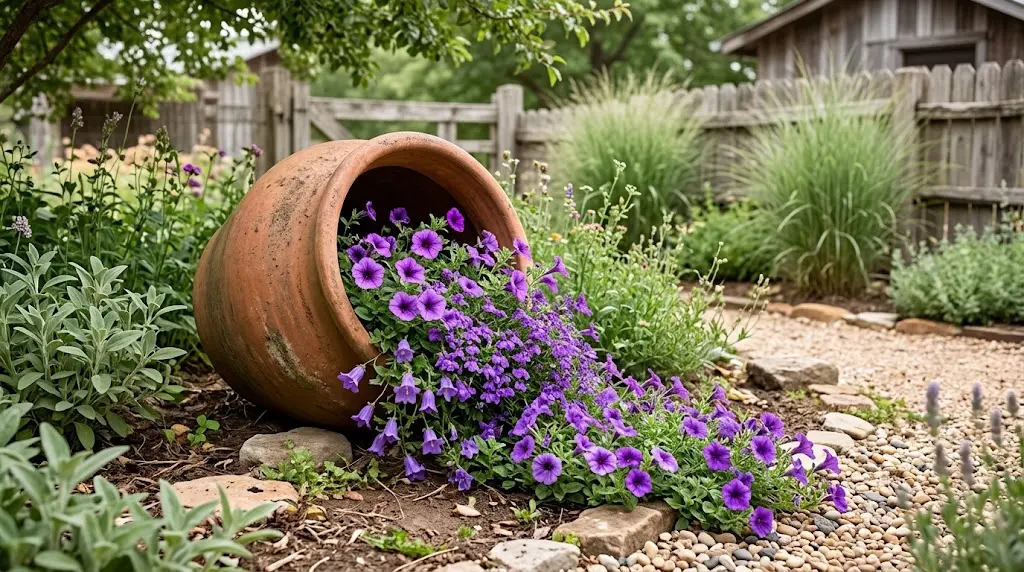
A spilled flower pot garden turns one ordinary planter into a garden feature that looks like flowers are pouring across the ground. The effect can be surprisingly convincing when the pot is positioned at the right angle and low-growing or trailing flowers form a narrow stream from its opening.
You may have seen versions made with petunias, lobelia, calibrachoa, alyssum, or other cascading flowers. Some designs simply plant directly into a shaped garden bed. Others use chicken wire and a liner to create a raised, three-dimensional spill like the one shown in many viral garden photos.
Both approaches can work, but the simpler version is usually easier to water, maintain, and redesign later.
Quick answer
Lay a large planter on its side, partially secure it in the soil, build a gently widening strip of good planting mix from the opening, and fill that strip with low-growing or trailing flowers. Choose plants with similar light and moisture needs and make sure the pot can drain freely.
What Is a Spilled Flower Pot Garden?
A spilled flower pot garden is a landscaping illusion.
Instead of standing upright, a large pot, urn, barrel, bucket, or other planter is laid partly on its side.
Flowers begin inside the container and continue outward across the garden bed so they look as though they are flowing from the opening like colorful water.
The idea works especially well beside:
- Garden paths
- Rock gardens
- Mulched borders
- Patios
- Entry gardens
- Retaining walls
- Raised landscape beds
You Do Not Need Chicken Wire for the Basic Version
Some inspiration photos make this project look more complicated than it needs to be.
The easiest method is simply to shape a low mound of planting soil that begins inside the tipped container and extends outward across the garden bed.
Plant the flowers closely enough that foliage eventually hides most of the soil.
This method gives roots direct access to the garden soil, is easier to water, and avoids exposed wire edges.
What Is the Wire-and-Burlap Method?
The viral design in the inspiration image appears to use a curved sleeve made from wire mesh with a fabric or burlap-style liner inside.
That sleeve creates a raised planting channel extending from the mouth of the pot.
The basic layers are:
- A curved wire form.
- A liner that keeps potting mix from falling through.
- Growing medium inside the form.
- Trailing plants inserted along the top and sides.
Once the plants fill in, the support can become nearly invisible.
Safety note: Cut wire can leave very sharp ends. Fold, crimp, cap, or otherwise secure every exposed edge and place the structure where children and pets cannot brush against unfinished wire.
Which Method Is Better?
| Method | Best For | Main Drawback |
|---|---|---|
| Ground-planted spill | Easy, natural-looking garden beds | Takes time for plants to fill the shape |
| Wire-and-liner spill | Raised waterfall effect and dramatic photos | Dries faster and requires more maintenance |
| Container-only cascade | Patios and small spaces | Less convincing as a long flower stream |
Choose the Right Pot First
The planter is the focal point even after the flowers fill in.
Good options include:
- Large terracotta pots
- Weathered clay urns
- Old ceramic planters
- Wooden barrels
- Galvanized containers suitable for planting
- Large concrete or stone-look planters
The opening should be large enough for flowers to visually flow from the container instead of looking squeezed through a narrow hole.
Make Sure the Pot Has Drainage
Even though the pot lies on its side, drainage still matters.
University of Illinois Extension notes that drainage openings are important because roots need air and few plants tolerate constantly waterlogged growing media.
If rainwater can collect in the lowest part of the tipped pot, roots may stay wet for too long.
Before planting, check that excess water has an easy path out.
Do Not Put Gravel in the Bottom to “Improve Drainage”
This is a common container-gardening myth.
Adding a thick layer of gravel beneath potting mix does not improve drainage in the way many gardeners expect.
Instead, use a well-draining potting mix and make sure the container itself has a functioning drainage opening.
What Soil Should You Use?
Inside the container and any raised wire sleeve, use a quality container growing medium rather than dense garden soil by itself.
Container soil should hold enough moisture for roots while still allowing air and excess water to move through it.
Oregon State University Extension recommends a general potting mix containing materials such as perlite or vermiculite to improve drainage and aeration.
For the section planted directly in the garden bed, improve poor soil as needed rather than filling the whole stream with container mix.
The Best Plants for a Spilled Flower Pot
Trailing and spreading plants usually create the strongest illusion because they soften the edge of the pot and hide bare soil.
1. Trailing Petunias
Petunias are one of the easiest choices for a dramatic sunny flower stream.
Trailing types spread quickly and are available in purple, pink, white, red, yellow, and mixed colors.
2. Calibrachoa
Calibrachoa looks like a miniature petunia and naturally works well in baskets and spilling container designs.
It performs best with plenty of sun, moist but well-drained soil, and regular nutrition.
3. Lobelia
Blue or purple lobelia can create one of the most convincing “waterfall” effects.
It prefers moist, well-drained conditions and often performs better in cooler weather than extreme summer heat.
4. Sweet Alyssum
Low mounds of small white, lavender, or pink flowers can create a soft edge along the stream.
5. Bacopa
Bacopa produces small flowers on trailing stems and works particularly well near the opening of the tipped pot.
6. Verbena
Trailing verbena can spread across the soil and provide long-lasting color in sunny areas.
7. Creeping Jenny
For a foliage-focused spill, creeping Jenny provides bright trailing stems that can soften the container edge.
Check whether a spreading plant is suitable for your region before putting it directly into the ground, because some vigorous plants can spread beyond the intended design.
Match Plants to the Sun You Actually Have
Do not choose plants based only on the color in a Pinterest photo.
Watch the site for a full day and determine whether it receives:
- Full sun
- Morning sun
- Afternoon sun
- Partial shade
- Mostly shade
For example, Illinois Extension lists petunias and calibrachoa primarily as full-sun plants, while lobelia can tolerate sun to partial shade.
Choose Plants With Similar Water Needs
The entire flower stream is easiest to maintain when the plants want roughly the same conditions.
Mixing a plant that wants consistently moist soil with another that prefers to dry substantially between watering can make maintenance frustrating.
Illinois Extension recommends combining container plants with compatible light and moisture requirements.
How to Position the Pot
The pot should look casually tipped over without actually being unstable.
One reliable approach is to slightly bury part of the lower side of the container into the soil.
That helps:
- Prevent rolling
- Make the pot look naturally settled
- Hide the transition between pot and garden bed
- Keep wind from shifting a lightweight container
Large terracotta containers become very heavy when wet, so choose the position before completely filling them.
How to Shape the Flower Stream
A perfectly straight rectangle rarely looks like a natural spill.
Start narrow at the mouth of the container and gradually widen the bed as it moves outward.
A gentle curve often looks more natural than a straight line.
Design trick: Lay a garden hose or rope on the ground first. Adjust the shape until the flower stream looks natural, then mark the edges before digging.
Simple Ground-Planted Method
- Choose the location. Match the site to the plants’ light requirements.
- Position the pot. Lay it on its side and stabilize it.
- Mark the stream. Make it narrow near the pot and wider toward the end.
- Remove weeds or turf.
- Prepare the soil. Improve compacted or poorly draining soil where needed.
- Add quality growing medium inside the pot.
- Plant the pot opening first. Use trailing plants to hide the transition.
- Continue planting outward.
- Water thoroughly.
- Add a light mulch around—not on top of—the plant crowns.
How to Make the Raised Wire Version
If you specifically want the elevated waterfall shape seen in the inspiration image, a wire form can create more height.
Materials may include:
- Large stable planter
- Wire mesh
- Wire cutters
- Protective gloves
- Burlap, coir, or another suitable planter liner
- Quality container mix
- Trailing plants
- Landscape pins or other suitable anchors
Step 1: Form the wire
Shape the mesh into a low half-cylinder or trough that fits partly inside the mouth of the pot and extends outward.
Step 2: Secure every cut edge
Do not leave clipped wire pointing outward. Fold it inward or protect it so routine gardening does not result in cuts.
Step 3: Add the liner
Line the wire form so potting mix stays inside while excess water can still escape.
Step 4: Fill gradually
Add moist potting mix in stages rather than filling the entire sleeve at once.
Step 5: Plant from the outside inward
Place trailing plants near the edges and opening so they quickly cover visible structure.
The Wire Version Will Dry Out Faster
This is the biggest maintenance disadvantage.
A thin raised sleeve exposes much more growing medium to warm air and wind than an ordinary garden bed.
Wire baskets and porous liners can also lose moisture more quickly than solid containers.
During hot, windy weather, check the raised portion frequently rather than assuming the garden-bed soil and wire sleeve will dry at the same rate.
How Often Should You Water?
There is no universal schedule.
Check the growing medium with your finger. Container-grown plants often need watering more frequently than the same plants growing directly in the ground.
Illinois Extension suggests checking container media when the upper inch or so becomes dry and watering thoroughly enough that excess moisture can drain away.
How Many Plants Do You Need?
Do not try to make the display look completely mature on planting day by packing plants together without considering their mature size.
Use the recommended spacing for the cultivars you buy.
A little visible soil in the beginning is normal. Healthy trailing annuals can fill gaps quickly during active growth.
One Color or a Mixture?
Both can work, but they create different effects.
Single-color spill
Using one dominant color makes the design look more like a continuous stream.
Blue, purple, white, and pink are especially effective.
Mixed-color spill
Mixing several complementary colors creates a more informal cottage-garden appearance.
Try to repeat colors rather than planting every available shade randomly.
Use Rocks to Make the Illusion Stronger
A few rocks placed along the edges can make the flower spill resemble a tiny stream.
Use them sparingly.
Too many rocks can turn a simple flower feature into a heavy-looking rock bed and compete visually with the blooms.
7 Mistakes to Avoid
1. Using a pot with trapped water
Make sure excess water can escape from the tipped container.
2. Filling the bottom with gravel
Good drainage comes from drainage openings and an appropriate growing medium, not a decorative gravel layer beneath the soil.
3. Leaving sharp chicken-wire edges exposed
Finish every cut edge safely before planting.
4. Mixing plants with opposite needs
Keep light and moisture preferences compatible.
5. Choosing flowers only by color
A beautiful shade-loving plant will struggle in an exposed full-sun bed no matter how well it matches the pot.
6. Forgetting how quickly the raised portion dries
Wire-and-liner designs may need closer moisture monitoring than plants rooted directly in garden soil.
7. Making the stream perfectly straight
A slight curve and gradual widening generally creates a more natural flowing effect.
Spilled Flower Pot Garden FAQ
What are the best flowers for a spilled pot?
Trailing petunias, calibrachoa, lobelia, bacopa, verbena, and other low-growing trailing plants are good possibilities. Choose varieties suited to your light, climate, and moisture conditions.
Do I need chicken wire?
No. You can create a convincing spilled flower pot simply by planting a shaped strip of flowers directly in the garden bed. Wire is mainly useful when you want a raised three-dimensional cascade.
Can I use burlap as a liner?
A porous natural-fiber liner can help hold growing medium inside a wire form, but it can also dry quickly and eventually decompose outdoors. Monitor moisture and expect to replace biodegradable materials over time.
Can I use a broken pot?
A cracked or broken container can create a rustic look if it remains stable, but avoid sharp edges in places where people, pets, or garden tools can contact them.
Can I make the design with perennials?
Yes. Low-growing perennial groundcovers can work if they are suited to your climate and site. Check their mature spread before planting so they do not overwhelm nearby beds.
Can I make one in shade?
Yes, but choose shade-tolerant plants rather than copying the sun-loving flowers from an inspiration photo.
Why are my spilled-pot flowers wilting?
Check moisture first, especially in a wire or terracotta setup. Also consider excessive sun, root problems, inadequate soil volume, transplant stress, or inappropriate plant selection.
The Bottom Line
A spilled flower pot garden is one of those landscaping ideas that looks complicated but can be surprisingly simple.
You do not need to reproduce every hidden support shown in a viral photo.
For most gardens, a stable tipped planter, good drainage, a gently shaped bed, and healthy trailing flowers are enough to create the effect.
Use the wire-and-liner version only when you specifically want more height and are comfortable giving it the extra watering and maintenance it needs.
Choose plants for the conditions you actually have, let them grow into the design naturally, and the finished flower stream will usually look better than one that was forced to appear full on the first day.
Sources
- University of Illinois Extension — Container Drainage Options
- University of Illinois Extension — Hanging Baskets and Trailing Plants
- University of Illinois Extension — Petunia
- University of Illinois Extension — Calibrachoa
- University of Illinois Extension — Lobelia
- Oregon State University Extension — Container Gardening Basics
- Penn State Extension — The Art of Container Gardening