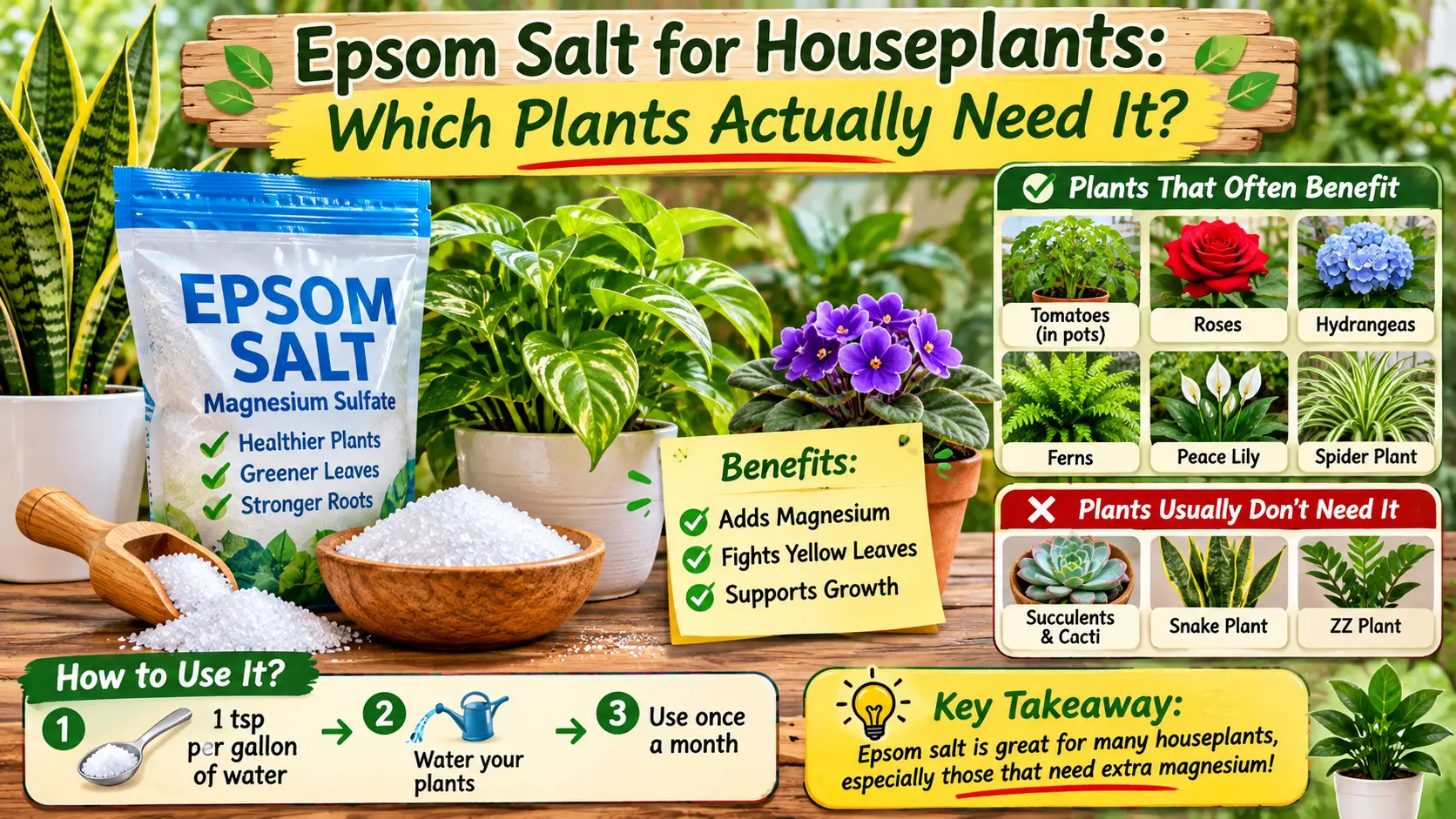
Epsom salt is often promoted as a simple trick for greener leaves, stronger roots, and more flowers on houseplants. Viral gardening graphics recommend it for everything from Monstera and pothos to snake plants, peace lilies, and African violets.
There is one problem: most healthy houseplants do not automatically need extra Epsom salt.
Epsom salt is magnesium sulfate. Magnesium and sulfur are essential plant nutrients, so the idea sounds reasonable. But adding more of a nutrient only helps when the plant actually needs more of it.
Quick answer
Epsom salt can supply magnesium to a plant that is deficient in magnesium. It is not a universal houseplant booster. Adding it routinely to healthy plants may accomplish nothing and can contribute to nutrient imbalance or salt buildup in containers.
What Is Epsom Salt?
Despite its name, Epsom salt is not the same substance as table salt.
It is magnesium sulfate, a soluble compound that provides two nutrients plants use:
- Magnesium
- Sulfur
Magnesium plays an important role in chlorophyll and photosynthesis. Sulfur is also involved in normal plant growth and the formation of important plant compounds.
That means plants need these nutrients. It does not mean that every plant needs additional magnesium sulfate added to its pot.
Does Epsom Salt Make Houseplants Grow Better?
Only under the right conditions.
If a plant has a genuine magnesium deficiency, adding an appropriate source of magnesium can help correct the deficiency.
If the plant already has enough magnesium, adding more does not automatically produce larger leaves, stronger roots, faster growth, or additional flowers.
Michigan State University Extension specifically advises against adding Epsom salt unless the soil or growing medium is low in magnesium.
Important: Epsom salt is not a complete fertilizer. It does not provide nitrogen, phosphorus, potassium, or the full range of nutrients a houseplant may require.
The Biggest Problem With the Viral Houseplant Claim
The viral graphic lists Monstera, snake plant, pothos, peace lily, ZZ plant, spider plant, philodendron, African violet, rubber plant, and Calathea as plants that supposedly “thrive” with Epsom salt.
That wording makes it sound as though magnesium sulfate is a special growth treatment for those species.
There is no good reason to assume that simply belonging to one of those plant groups means the plant needs additional magnesium.
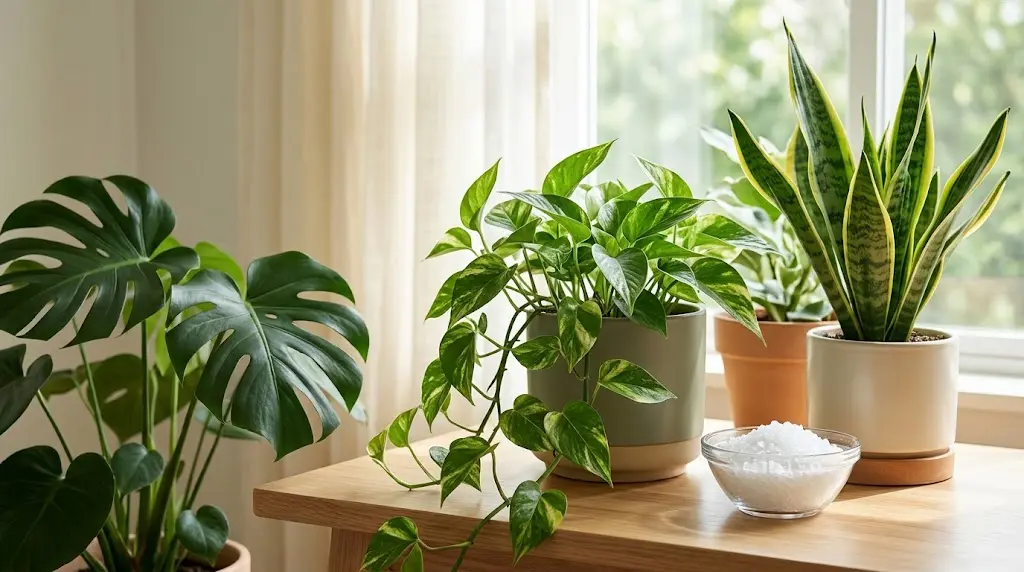
A Monstera with adequate nutrition does not need Epsom salt simply because it is a Monstera. The same is true for pothos, snake plants, ZZ plants, peace lilies, and other common houseplants.
What Magnesium Deficiency Looks Like
Magnesium is mobile inside plants. When a plant becomes deficient, it can move magnesium from older tissue toward new growth.
For that reason, magnesium deficiency often appears first on older or lower leaves.
Possible signs include:
- Yellowing between the leaf veins
- Veins remaining greener than the surrounding tissue
- Symptoms beginning on older leaves
- Reduced growth in more serious cases
- Brown or dead areas as deficiency becomes severe
Do not diagnose from yellow leaves alone. Overwatering, root problems, incorrect pH, low nitrogen, pests, poor drainage, too much fertilizer, and several other issues can also cause yellowing.
Can Epsom Salt Make Leaves Greener?
This claim has a small piece of truth behind it.
Magnesium is part of the chlorophyll molecule. A magnesium-deficient plant may therefore lose normal green coloration.
Correcting that deficiency can improve the plant’s appearance.
But if a plant is yellow because its roots are sitting in wet soil, adding Epsom salt will not fix the drainage problem.
If it is yellow because of nitrogen deficiency, magnesium sulfate does not supply the missing nitrogen.
Does It Create Stronger Roots?
There is no reason to treat Epsom salt as a general-purpose root stimulant.
Healthy root growth depends on many things, including:
- Enough oxygen around the roots
- Appropriate watering
- Suitable potting mix
- Correct container size
- Balanced nutrition
- Suitable temperature
- Healthy root tissue
Adding one nutrient cannot compensate for poor root conditions.
Does Epsom Salt Help Plants Absorb Other Nutrients?
Magnesium participates in normal plant metabolism, so an actual magnesium deficiency can interfere with healthy growth.
But the idea that extra magnesium always helps a plant absorb more nutrients is misleading.
Plant nutrients interact with one another. Too much of one nutrient can interfere with the uptake of another.
Michigan State Extension warns that excessive magnesium can interfere with calcium uptake.
Does Epsom Salt Produce More Flowers?
Do not expect Epsom salt to turn every flowering houseplant into a heavy bloomer.
Flower production depends on species, plant maturity, light, temperature, nutrition, pruning, watering, and seasonal conditions.
Correcting a real nutrient deficiency may help a stressed plant return to normal growth. That is very different from saying Epsom salt directly causes more flowers in healthy houseplants.
10 Houseplants From the Viral Graphic: Do They Need Epsom Salt?
| Houseplant | Should You Add Epsom Salt Routinely? |
|---|---|
| Monstera | No. Use balanced nutrition unless a magnesium deficiency is suspected or confirmed. |
| Snake Plant | No. Its biggest problems are more often related to excess water and poor drainage than lack of Epsom salt. |
| Pothos | No routine need. Diagnose yellow leaves before adding nutrients. |
| Peace Lily | No general requirement. Water, light, and balanced nutrition matter more. |
| ZZ Plant | No routine need. This plant generally does not require heavy feeding. |
| Spider Plant | No automatic need. Brown tips can have several causes and do not prove magnesium deficiency. |
| Philodendron | No. Use Epsom salt only when there is a reason to correct low magnesium. |
| African Violet | No general recommendation. A fertilizer formulated for the plant is more predictable. |
| Rubber Plant | No routine need. Check light, watering, and normal fertilizer first. |
| Calathea | No. Calatheas can be sensitive to water quality and excess dissolved salts, so unnecessary additions are especially unhelpful. |
What About the “1 Tablespoon Per Gallon” Recipe?
You will find many different Epsom salt recipes online.
Some recommend one tablespoon per gallon. Others recommend two tablespoons. Some tell gardeners to use the solution monthly or every few weeks.
That is exactly why a universal recipe is a poor approach.
Oregon State University Extension notes that magnesium deficiency can occur in foliage plants and gives a conservative example of approximately 1 teaspoon per gallon of water used twice per year when supplemental magnesium is appropriate.
That is far less aggressive than many viral recommendations suggesting tablespoons every two to four weeks.
FarmSolo rule of thumb
Do not start an Epsom salt schedule just because a Pinterest graphic gives you one. First decide whether the plant actually needs additional magnesium.
Why Epsom Salt Can Be Riskier in Pots
Container plants live in a limited volume of potting mix.
Unlike a garden bed exposed to substantial rainfall and a large volume of soil, a houseplant pot has fewer places for excess dissolved minerals to go.
Repeated applications of soluble nutrients can contribute to salt accumulation, especially when pots are watered lightly and excess water rarely drains through the bottom.
High soluble salt levels can stress roots and cause symptoms such as poor growth and damaged leaf margins.
Epsom Salt Is Not a Replacement for Fertilizer
This distinction is important.
Houseplants need several essential nutrients. Epsom salt primarily contributes magnesium and sulfur.
It does not provide the major fertilizer nutrients:
- Nitrogen
- Phosphorus
- Potassium
It also does not provide a complete package of micronutrients.
For routine feeding, a balanced fertilizer suited to the plant is generally much more useful than repeatedly adding one mineral.
Before Adding Epsom Salt, Check These 6 Things
- Watering: Is the plant staying wet for too long?
- Drainage: Can excess water escape from the pot?
- Light: Is the plant receiving the amount of light its species needs?
- Roots: Are there signs of root rot or a severely root-bound plant?
- Fertilizer: Has the plant already received a complete fertilizer?
- Leaf pattern: Does the yellowing genuinely resemble magnesium deficiency?
These questions solve far more houseplant problems than blindly adding another supplement.
When Epsom Salt May Actually Make Sense
Epsom salt can be useful when there is good reason to believe the plant or growing medium is deficient in magnesium and additional magnesium is appropriate.
Situations that deserve closer investigation include:
- Characteristic interveinal yellowing on older leaves
- A nutrient analysis confirming low magnesium
- A potting medium known to contain little magnesium
- A professional recommendation based on the growing conditions
Even then, the goal is to correct the deficiency—not to keep adding magnesium forever.
When You Should Skip It
Avoid adding Epsom salt simply because:
- A leaf turned yellow
- A plant is growing slowly during winter
- You want bigger leaves
- You want a plant to flower
- A viral graphic says the species loves it
- You already use a complete fertilizer containing magnesium
More fertilizer is not always better fertilizer.
Viral Epsom Salt Claims: Fact-Checked
| Claim | Reality |
|---|---|
| “It makes all houseplants greener.” | It may help if lack of magnesium is causing the loss of green color. It will not correct every cause of yellow leaves. |
| “It creates stronger roots.” | There is no reason to use it as a universal root stimulant. |
| “It improves nutrient absorption.” | Balanced mineral nutrition matters. Excess magnesium can interfere with other nutrients. |
| “It produces more flowers.” | Not reliably in healthy plants that already have enough magnesium. |
| “Use it every 2–4 weeks.” | Routine application is unnecessary unless there is an identified need. |
| “All 10 plants in the graphic thrive on it.” | The species name alone does not tell you whether a plant needs additional magnesium. |
Frequently Asked Questions
Is Epsom salt good for Monstera?
It can provide magnesium if a Monstera is genuinely deficient, but there is no need to add Epsom salt routinely to a healthy Monstera receiving appropriate nutrition.
Can I use Epsom salt on pothos?
Do not use it automatically. If your pothos has yellow leaves, first check watering, roots, light, and normal fertilization.
Does a snake plant need Epsom salt?
Not as part of normal care. Snake plants are relatively light feeders, and overwatering is a much more common problem than needing an Epsom salt supplement.
Can Epsom salt fix yellow leaves?
Only when the yellowing is connected to magnesium deficiency. Yellow leaves have many other possible causes.
Is Epsom salt fertilizer?
It is a source of magnesium and sulfur, but it is not a complete fertilizer because it does not supply the full nutrient profile plants need.
Can too much Epsom salt hurt plants?
Yes. Unnecessary magnesium can disrupt nutrient balance, and repeated use of soluble mineral products can contribute to salt problems in container media.
The Bottom Line
Epsom salt is not useless, but it is also not the universal houseplant hack social media often makes it appear to be.
Magnesium and sulfur are essential plant nutrients. When a plant is genuinely deficient in magnesium, magnesium sulfate can be a useful way to supply it.
Healthy houseplants that already receive enough magnesium do not need a regular Epsom salt treatment.
Instead of adding Epsom salt every few weeks, focus on the basics: the right light, proper watering, good drainage, healthy roots, and balanced nutrition.
Those habits will do far more for a Monstera, pothos, snake plant, peace lily, or Calathea than any viral one-ingredient gardening trick.
Sources
- Oregon State University Extension Service — Environmental Factors Affecting Plant Growth
- Oregon State University Extension Service — Gardening Myths and Epsom Salts
- Michigan State University Extension / Ask Extension — Epsom Salt for Houseplants
- Penn State Extension — Soluble Salts and Plant Growth