
FARMSOLO • PERMACULTURE DESIGN
A chicken moat garden is a simple way to keep chickens close to your vegetable beds without letting them scratch through the crops. Instead of opening the garden to the flock, you create a fenced chicken run around all or part of the growing area. The hens get a place to walk, scratch and forage while the vegetables stay on the protected side of the fence.
Best for: backyard chickens • vegetable gardens • permaculture layouts • controlled foraging • small homesteads
The Basic Idea
Vegetables stay inside the protected garden. Chickens move through a separate fenced corridor around the outside.
What It Is Not
Despite the name, a chicken moat is normally a dry fenced run—not a trench filled with water.
Quick Answer
A chicken moat garden uses two boundaries: one protects the vegetable beds and the other keeps the chickens inside a dedicated run. The run can wrap around the full garden or only the sides where it is most useful. Build it wide enough for your flock to move comfortably, include easy human access, provide shade and water, manage manure, and use predator-resistant construction when the birds will spend unsupervised time there.
What Is a Chicken Moat Garden?
A chicken moat is essentially a long chicken run arranged around a garden instead of beside it.
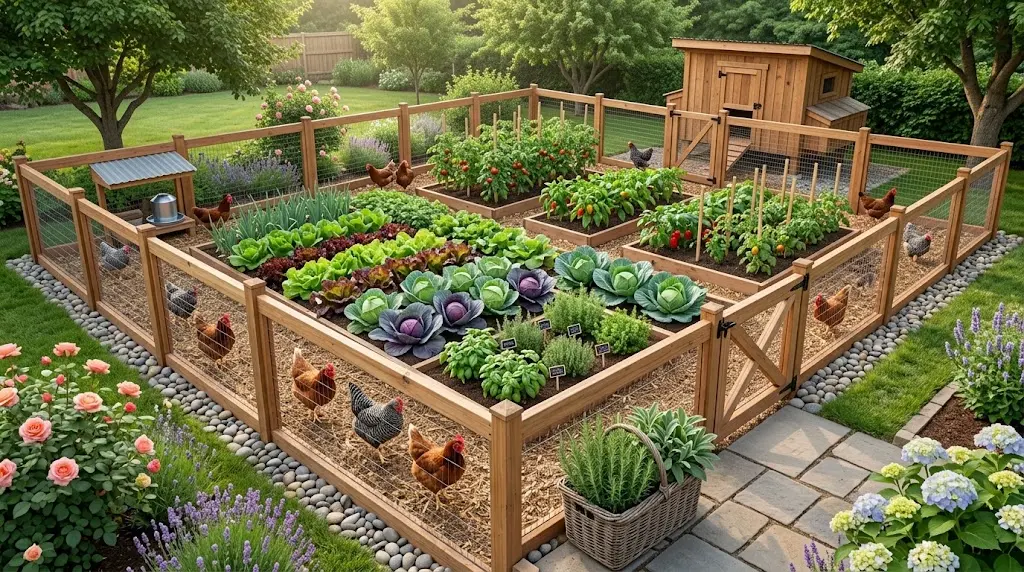
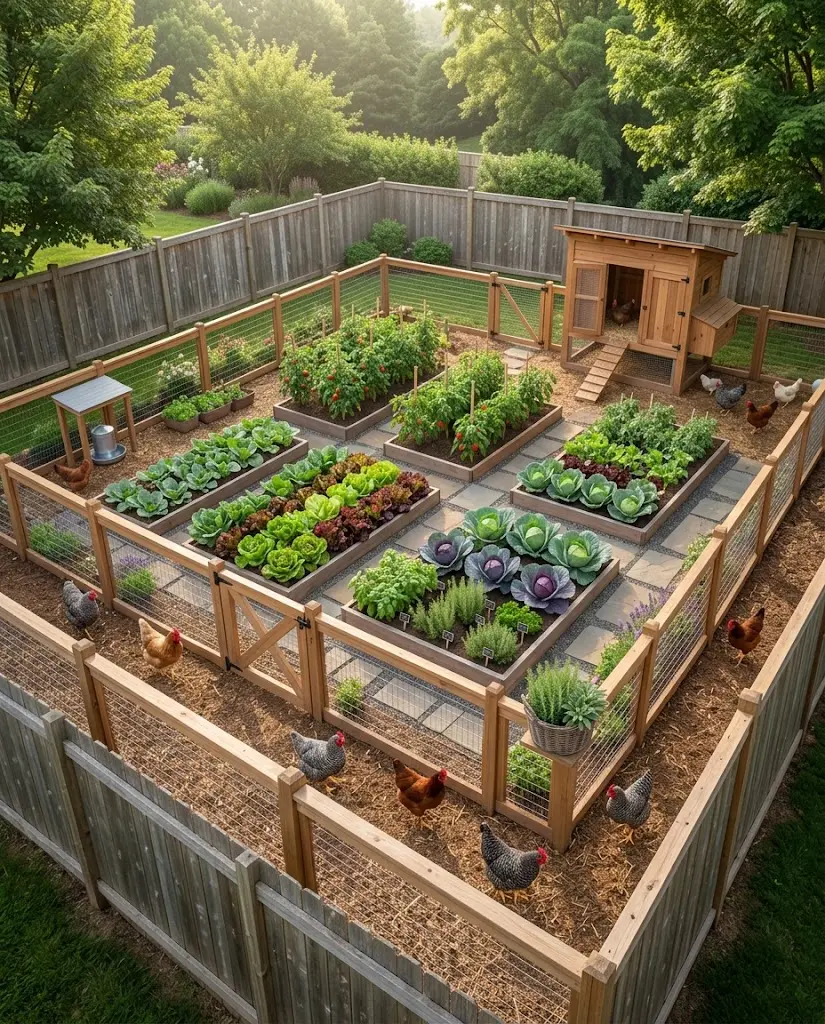
Imagine your vegetable garden surrounded by a fence. Now add a second fence several feet farther out. The strip of ground between those two fences becomes the chicken run.
The vegetables stay on one side. The chickens stay in the corridor. You can still work in the garden without hens digging up seedlings, throwing mulch onto paths, or helping themselves to every lettuce plant they can reach.
The moat can connect directly to the coop so the flock moves between shelter and the perimeter run without having to be carried or herded across the yard.
FarmSolo Reality Check: Chickens can eat insects and weed seeds, but do not expect them to politely patrol a vegetable bed without damaging plants. Their normal behavior includes scratching, pecking and digging. The fence is what makes this system useful.
9 Things to Plan Before Building a Chicken Moat Garden
01 • THE LAYOUT
You Do Not Need a Perfect Circle
The inspiration image uses a beautiful curved garden, but a chicken moat does not need to be round.
A rectangular garden is often easier and less expensive to fence. An L-shaped or three-sided run can also work if a shed, wall, or another secure boundary already forms part of the layout.
Design around the real property, not the Pinterest shape. Think about sunlight, existing trees, garden beds, the coop, gates, water and the routes you walk every day.
02 • RUN WIDTH
Make the Corridor Comfortable, Not Just Technically Passable
There is no universal chicken-moat width that fits every flock and yard.
The corridor should give birds enough room to turn around, pass each other, scratch, dust and move away from a more dominant hen. You also need enough room to enter for cleaning, repairs or catching a bird.
A very narrow run may look space-efficient on paper but become frustrating when you have to carry a rake through it or reach a chicken at the far end.
03 • GARDEN FENCE
Keep Crops Beyond Pecking Distance
A fence stops the chicken’s body. It does not necessarily stop her head.
If lettuce, kale, tomato leaves or young seedlings grow directly against open wire, hens may reach through and eat whatever they can grab.
Leave a buffer between valuable crops and the fence, use smaller openings near vulnerable plants, or reserve the edge for sturdy plants you do not mind the hens investigating.
04 • PREDATOR PROTECTION
Chicken Wire Keeps Chickens In—Not Every Predator Out
This is one of the biggest details missing from many beautiful garden-run photos.
Light poultry wire can be useful as an interior garden barrier, but it should not automatically be treated as predator-proof fencing.
If the birds will use the moat without supervision, design the outer boundary around the predators in your area. Strong hardware cloth, secure gates, protected lower edges, an apron or buried barrier, and overhead protection may all be appropriate depending on the site.
05 • GATES
Plan Human Access Before Closing the Loop
A full perimeter run can accidentally make the vegetable garden harder for you to reach.
Decide how you will carry compost, tools, harvest baskets, soil and wheelbarrows into the growing area.
Use gates wide enough for the equipment you actually use. A small chicken gate and a separate full-size garden gate can make daily chores much easier.
06 • SHADE & WATER
The Moat Is Still a Chicken Run
Do not become so focused on protecting the garden that you forget what the birds need.
Chickens need continuous access to clean drinking water. In hot weather, shade becomes especially important because birds rely partly on panting to cool themselves.
A long run should not force the flock to walk all the way back to the coop every time they need water. Depending on the size of the system, a shaded water station along the route may make daily use easier.
07 • GROUND CONDITIONS
Expect Chickens to Change the Ground
Chickens scratch. That is one of the reasons the system exists.
But concentrated scratching can also turn a narrow run into bare soil. In wet weather, bare soil can become mud. Around feeders and waterers, manure and moisture can build up quickly.
Plan drainage before the birds arrive. Wood chips or another appropriate run surface may help in some locations, but the run still needs regular inspection and cleaning.
08 • FOOD SAFETY
Keep Poultry Droppings Out of Active Vegetable Beds
One of the strongest reasons to use a chicken moat instead of letting hens roam through an active vegetable garden is food safety.
Healthy-looking chickens can carry microorganisms such as Salmonella and Campylobacter. Their droppings can contaminate soil, tools, irrigation equipment and produce.
Keep manure in the chicken area and compost poultry litter properly before treating it as a garden soil amendment. Do not shovel fresh manure directly around vegetables because it happens to be conveniently close.
09 • ROTATION
Consider Dividing the Moat Into Sections
A chicken moat does not have to operate as one giant continuous run every day.
Internal gates can let you rest one section while the flock uses another. This can help reduce constant pressure on the same soil and make maintenance easier.
Section gates can also help when you need to catch a bird. Herding one hen through a complete loop around a large garden is much less fun than the Pinterest photo suggests.
Chicken Moat vs. Chickens Inside the Vegetable Garden
| Chicken moat | Chickens loose in active beds |
|---|---|
| Crops remain separated from poultry | Hens can directly scratch and peck plants |
| Droppings stay mostly outside production beds | Droppings can land around edible crops |
| Chickens can patrol a controlled route | Birds decide where they want to go |
| Mulch and seedlings remain protected | Loose mulch and young plants are easy targets |
| Access can be rotated with gates | Management depends on catching or herding birds out |
| Requires more fencing | Requires less infrastructure initially |
Simple Chicken Moat Layout
Coop → secure chicken gate → perimeter run → shade/water point → section gate → perimeter run → return toward coop.
Inside that loop, keep the vegetable beds, human pathways and harvest area separated by the inner garden fence.
Can a Chicken Moat Reduce Garden Pests?
Chickens naturally forage for insects, seeds and other small foods they find on the ground, so a perimeter run can put that behavior to work around the garden.
That does not make the moat a guaranteed pest-control system.
Many insects fly directly into gardens. Others already live in the soil or reproduce on the plants. Chickens can eat some insects they encounter, but they cannot replace crop inspection, healthy soil, crop rotation or appropriate pest management.
I would treat pest reduction as a possible bonus rather than the main reason to build the system.
What About Plants Along the Inner Fence?
The fence itself can become useful garden space.
Climbing beans, peas and other trellised crops may use a separate garden-side trellis, but keep edible growth far enough away that chickens cannot reach through and strip it.
You can also intentionally grow some chicken-safe forage where birds can reach selected leaves through the fence. Just remember that treats and garden scraps should complement rather than replace a balanced poultry ration.
Should the Chicken Moat Have a Roof?
That depends largely on predator pressure and how the run will be used.
If the chickens only enter while you are nearby during the day, your design may be different from a run intended for long periods of unattended use.
Where hawks, climbing predators or other threats are common, overhead protection may become an important part of the design. A fully enclosed run offers much more protection than an open fence alone.
Can Chickens Enter the Garden After Harvest?
One useful feature is an optional gate between the moat and the vegetable area.
When a bed is finished for the season and you intentionally want the birds there, you can give controlled access instead of permanently opening the entire garden.
They may scratch through crop residue and look for insects, but remember that manure management still matters. Do not assume fresh poultry droppings automatically improve a bed that will soon produce ready-to-eat vegetables.
Common Chicken Moat Mistakes
- Calling a normal fenced garden a chicken moat. The key idea is a dedicated chicken corridor separated from the crop area.
- Building the run too narrow to maintain. You need to reach every part of it.
- Planting vegetables directly against open mesh. Chickens can reach farther through fencing than you may expect.
- Assuming chicken wire is predator-proof. Use protection appropriate to the predators in your area.
- Forgetting shade and water. It is still a living space for chickens.
- Ignoring drainage. Concentrated scratching and manure can create muddy areas quickly.
- Building too few gates. A beautiful continuous loop becomes irritating when repairs or cleaning are difficult.
- Letting manure enter active vegetable beds. Keep fresh poultry waste away from growing produce and compost manure properly.
- Expecting chickens to eliminate every pest. Think of foraging as one part of the system, not a complete pest-control plan.
More FarmSolo ideas: If you want a simpler setup before committing to a full perimeter run, see Chicken Run Garden Ideas. For planning the coop and garden as one system, see Backyard Chicken Coop Garden Ideas. You can also use the broader Permaculture Homestead Layout guide when deciding where animals, paths, water and growing areas belong.
Chicken Moat Garden FAQ
What is a chicken moat?
A chicken moat is a dry fenced chicken run that surrounds all or part of a garden. Chickens move through the outer corridor while the vegetables remain protected behind an inner fence.
Does a chicken moat contain water?
No. In this gardening context, “moat” normally describes the enclosed strip of dry land around the garden rather than a water-filled trench.
Will chickens destroy a vegetable garden?
They can quickly damage young plants, mulch and loose soil through normal scratching and pecking. Controlled access or fencing is much more predictable than relying on hens to avoid valuable plants.
Does a chicken moat stop garden insects?
Chickens may eat insects they encounter while foraging, but a moat will not stop every garden pest. Flying insects and pests already living in the soil or on crops still need normal garden management.
Can I use chicken wire for a chicken moat?
Chicken wire can help contain chickens, but it should not automatically be treated as predator protection. Where predators are a concern, use stronger construction such as appropriate hardware cloth and secure the lower and upper parts of the run as needed.
Can chicken manure go directly into vegetable beds?
Fresh poultry manure should not simply be spread around active vegetable crops. Compost poultry manure properly and follow safe manure-handling practices before using it as a garden amendment.
Is a circular chicken moat better than a rectangular one?
No. The best shape is the one that fits your property, existing garden, coop, paths and fencing budget. Rectangular layouts are often simpler to build, while curved layouts can work well when they match an existing garden design.
Keep the Chickens Close—Just Not in the Lettuce
The best lesson from a chicken moat garden is separation without isolation.
The flock can stay close to the garden, forage around its perimeter, provide manure for the compost system and remain part of the daily homestead routine without having unrestricted access to growing vegetables.
Build around the birds, the crops, food safety and the real predator pressure on your property—not around a perfect Pinterest shape.